
ADHD (Attention-Deficit/Hyperactivity Disorder) is the current medical term used by doctors. ADD (Attention Deficit Disorder) is an older term that is no longer used as an official diagnosis, though many people still use it informally.
A few years ago, a parent asked me a question that I hear all the time:
“Does my child have ADD or ADHD?”
At first, it sounded like a simple question. Yet many people are surprised to learn that doctors no longer diagnose ADD. The term ADHD is now used for all forms of the condition.
The confusion is easy to understand. For years, books, articles, teachers, and even family members used ADD to describe people who struggled with attention but were not very hyperactive. As medical research improved, experts updated the way they classified the condition.
If you have searched for ADHD or ADD, you probably want to know which term is correct, what the difference is, and whether they mean the same thing.
The good news is that the answer is simpler than most people think.
Let’s clear up the confusion once and for all.
ADHD or ADD: Quick Answer
ADHD is the official medical term used today.
ADD was once used to describe people who had attention problems without obvious hyperactivity. Today, those individuals are usually diagnosed with a type of ADHD called Predominantly Inattentive Presentation.
Simple Examples
- A child who struggles to focus in class may receive an ADHD diagnosis.
- An adult who frequently forgets appointments may also be diagnosed with ADHD, even if they are not hyperactive.
In modern medicine, ADHD covers both situations.
The Origin / Background of ADHD or ADD
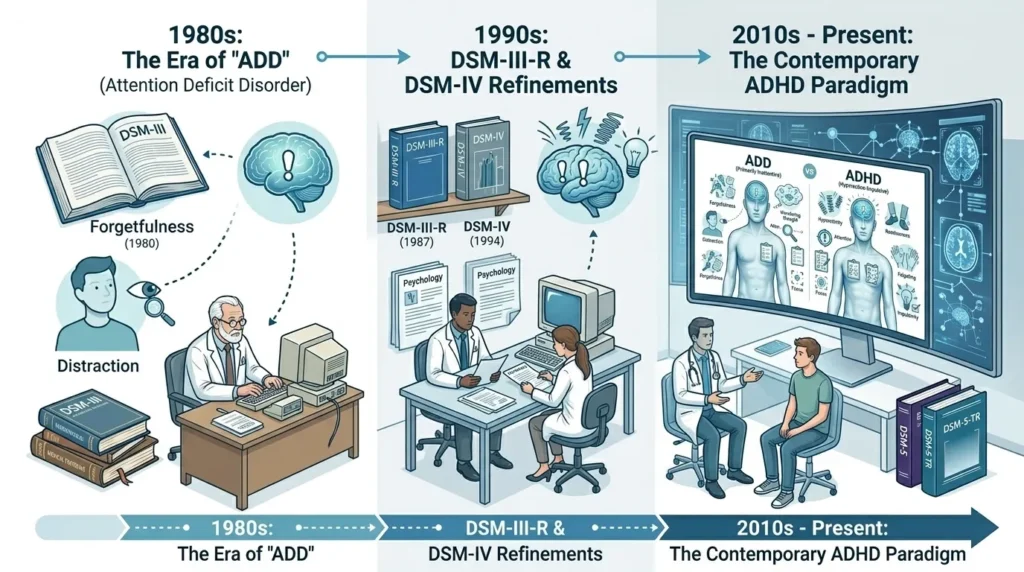
The history of these terms explains why people still get confused.
In 1980, mental health professionals used the term Attention Deficit Disorder (ADD). It described people who had difficulty paying attention, with or without hyperactivity.
Later, researchers discovered that attention problems and hyperactivity were closely related. Because of this, the medical community updated the diagnosis.
In 1987, the term ADHD (Attention-Deficit/Hyperactivity Disorder) became the official name.
Since then, ADHD has remained the accepted medical term in diagnostic manuals used by doctors and psychologists.
Why the Confusion Still Exists
Several reasons keep ADD alive in everyday conversations:
- Many adults were diagnosed when ADD was still used.
- Older books and websites mention ADD.
- People often use ADD to describe inattentive symptoms.
- The term feels familiar to many families.
Even today, someone might say they have ADD when their official diagnosis would be ADHD.
ADHD or ADD Explained: Key Differences
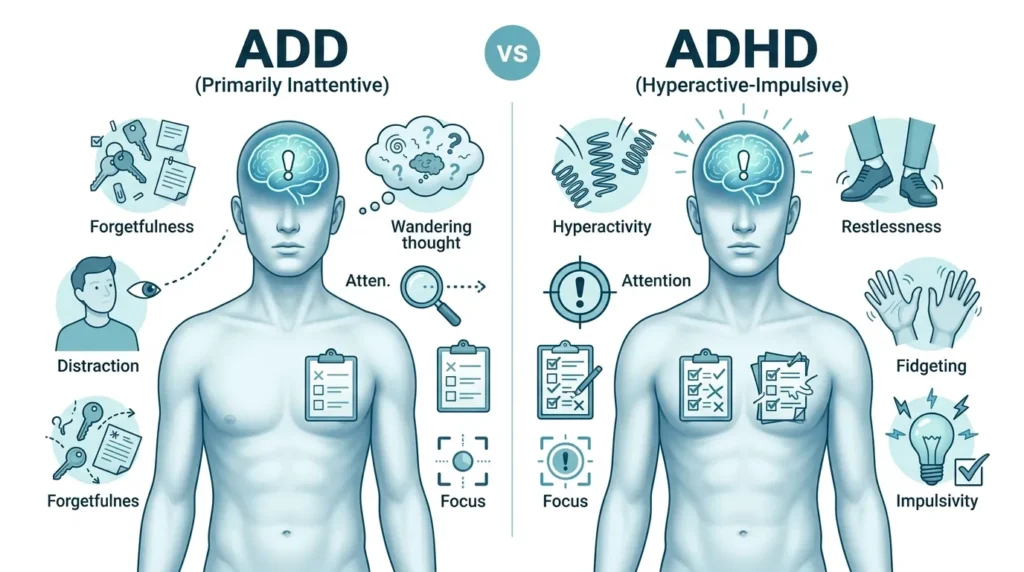
Although people often use the terms interchangeably, there is an important distinction.
| Term | Meaning | When to Use | Region/Context |
|---|---|---|---|
| ADD | Older term for attention difficulties | Informal conversations or historical references | Older terminology |
| ADHD | Official medical diagnosis | Medical, educational, and professional settings | Worldwide clinical use |
| ADHD Predominantly Inattentive Presentation | ADHD without significant hyperactivity | Modern diagnosis replacing ADD | Clinical settings |
What ADD Usually Described
People who were called ADD often showed:
- Forgetfulness
- Trouble focusing
- Easy distraction
- Difficulty finishing tasks
They were not necessarily hyperactive.
What ADHD Includes
ADHD may involve:
- Inattention
- Hyperactivity
- Impulsivity
- Or a combination of all three
This broader definition helps doctors provide more accurate diagnoses.
Which Version Should You Use?
The best choice depends on your situation.
For Students
Use ADHD.
Schools, teachers, and educational specialists use ADHD because it reflects current medical standards.
For Parents
Use ADHD when discussing evaluations, treatment, or school support plans.
For Healthcare Professionals
Always use ADHD because it is the official diagnosis.
For Everyday Conversations
You may still hear people say ADD. Most listeners will understand what they mean.
For Global and Neutral Use
Choose ADHD.
It is the accepted term worldwide and avoids confusion.
Common Mistakes with ADHD or ADD
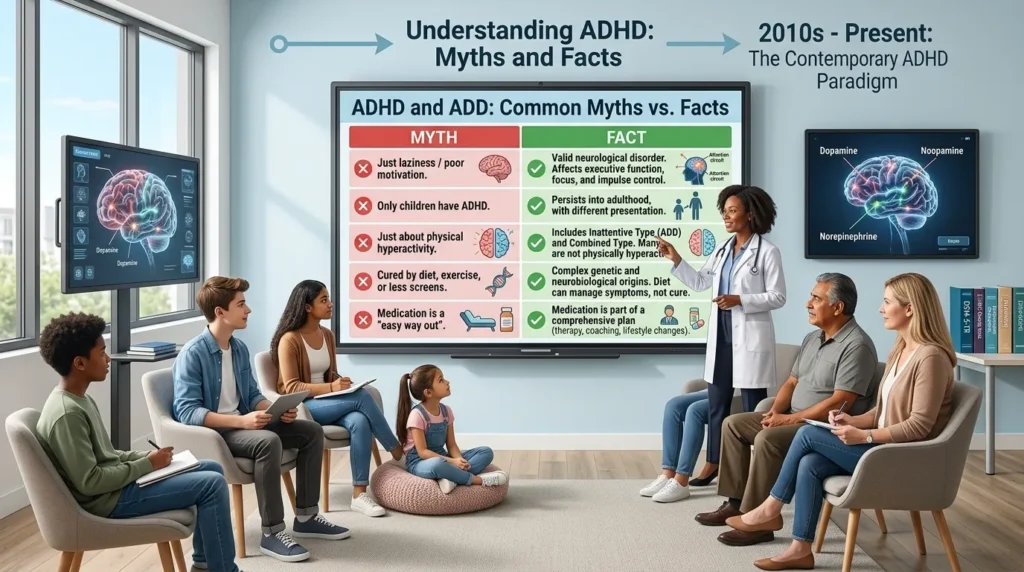
Many people misunderstand these terms.
| Mistake | Correction |
|---|---|
| ADD and ADHD are different disorders. | ADD is now considered part of ADHD. |
| Only hyperactive people have ADHD. | ADHD can exist without obvious hyperactivity. |
| Adults cannot have ADHD. | ADHD can continue into adulthood. |
| ADHD always causes poor intelligence. | ADHD has no connection to intelligence level. |
| ADD is the official diagnosis today. | ADHD is the official diagnosis. |
Why These Mistakes Happen
Most confusion comes from outdated information, old terminology, and misconceptions seen online.
Understanding the modern definition helps avoid these errors.
ADHD or ADD in Real World Examples

Professional Email
“After the evaluation, the specialist confirmed that the student meets the criteria for ADHD.”
News Headline
“Researchers Explore New Strategies for Managing ADHD Symptoms in Adults.”
Social Media Post
“I spent years thinking I had ADD. My doctor explained that the current diagnosis is actually ADHD.”
Formal Report
“The patient was diagnosed with ADHD Predominantly Inattentive Presentation following a comprehensive assessment.”
These examples show how ADHD is used in modern communication.
ADHD or ADD: Data, Trends & Usage
Interest in ADHD has grown significantly over the past decade.
Where Is It Most Searched?
Common audiences include:
- Parents
- Teachers
- Students
- Adults seeking diagnosis
- Healthcare professionals
Why People Search ADHD or ADD
Most searches fall into the informational category.
People want to know:
- The difference between ADHD and ADD
- Symptoms
- Diagnosis criteria
- Treatment options
- Adult ADHD information
Why This Matters Now
Awareness of attention disorders has increased dramatically. More adults are being evaluated than ever before. As a result, many people encounter both terms and want to know which one is correct.
ADHD vs ADD Comparison Table
| Term/Variant | Meaning | Region/Context | Best Used When |
|---|---|---|---|
| ADD | Former diagnosis for attention difficulties | Historical and informal use | Referring to older terminology |
| ADHD | Official diagnosis | Medical and educational settings | Modern communication |
| ADHD Inattentive Presentation | ADHD with mainly attention-related symptoms | Clinical diagnosis | Replacing traditional ADD |
| ADHD Hyperactive-Impulsive Presentation | ADHD with primarily hyperactive behaviors | Clinical diagnosis | Describing specific symptom patterns |
| ADHD Combined Presentation | Mix of inattentive and hyperactive symptoms | Clinical diagnosis | Most comprehensive description |
Frequently Asked Questions
Q: What does ADHD mean?
A: ADHD stands for Attention-Deficit/Hyperactivity Disorder. It is a neurodevelopmental condition that affects attention, self-control, and activity levels.
Q: What does ADD mean?
A: ADD stands for Attention Deficit Disorder. It was an older diagnostic term that is no longer officially used.
Q: Is ADHD the same as ADD?
A: In modern medicine, yes. People who would once have been diagnosed with ADD are now diagnosed with a form of ADHD.
Q: Which term is correct: ADHD or ADD?
A: ADHD is the correct and current medical term. ADD is considered outdated but is still commonly used in casual conversations.
Q: Can someone have ADHD without being hyperactive?
A: Yes. Many people have ADHD with mainly inattentive symptoms and little visible hyperactivity.
Q: Is ADHD acceptable in formal writing?
A: Yes. ADHD is the preferred term in schools, healthcare settings, research papers, and professional communication.
Q: Where did the term ADD come from?
A: ADD became an official diagnosis in 1980. It was later replaced by ADHD after researchers gained a better understanding of the condition.
Conclusion
The confusion between ADHD or ADD comes from changes in medical terminology over time. Years ago, ADD was a recognized diagnosis. Today, healthcare professionals use ADHD as the official term for all presentations of the condition.
The most important thing to remember is that ADHD includes people with attention difficulties, whether they are hyperactive or not. That means many individuals who once identified with ADD would now receive an ADHD diagnosis.
When speaking with doctors, teachers, employers, or specialists, use ADHD. It is the current and widely accepted term. Understanding this difference can help you communicate more clearly and avoid outdated information.
If you ever see ADD and ADHD used together, remember that ADHD is the modern diagnosis and ADD is largely a historical label.
Bookmark this guide so you never second-guess ADHD or ADD again, and share it with someone who may still be confused about the difference.
Read more: Yacht or Nyacht: The Easy Guide to the Correct Spelling

I am an English language writer dedicated to creating clear, accurate, and easy-to-understand content. My goal is to help readers build confidence in their language and communication skills.