Quick Answer: Dissatisfied means unhappy, disappointed, or displeased with something, while unsatisfied means a need, desire, requirement, or condition ha
s not been fulfilled or met. Use dissatisfied for feelings and unsatisfied for unmet expectations or requirements.
A few years ago, I was reviewing a client’s business report when I came across the sentence, “Several customers were unsatisfied with our service.” The meaning was clear, but the wording felt slightly off. In that context, dissatisfied was the better choice because it described how the customers felt.
Many writers, students, and English learners struggle with dissatisfied and unsatisfied because the words look similar and both relate to satisfaction. At first glance, they seem interchangeable. However, native speakers often use them in different situations.
Choosing the wrong word won’t always make your sentence incorrect, but it can make your writing sound less natural. Understanding the distinction helps you communicate more clearly and professionally.
If you’ve ever wondered which word to use in an email, essay, report, or conversation, you’re in the right place. This guide explains the difference in simple terms, provides real-world examples, and shows exactly when to use each word with confidence.
## Dissatisfied or Unsatisfied – Quick Answer
Both words relate to a lack of satisfaction, but they focus on different things.
- Dissatisfied = unhappy or disappointed.
- Unsatisfied = not fulfilled, not completed, or not met.
Examples
✅ The customer was dissatisfied with the service.
✅ The contract requirements remain unsatisfied.
A simple rule:
People are usually dissatisfied. Needs and requirements are usually unsatisfied.
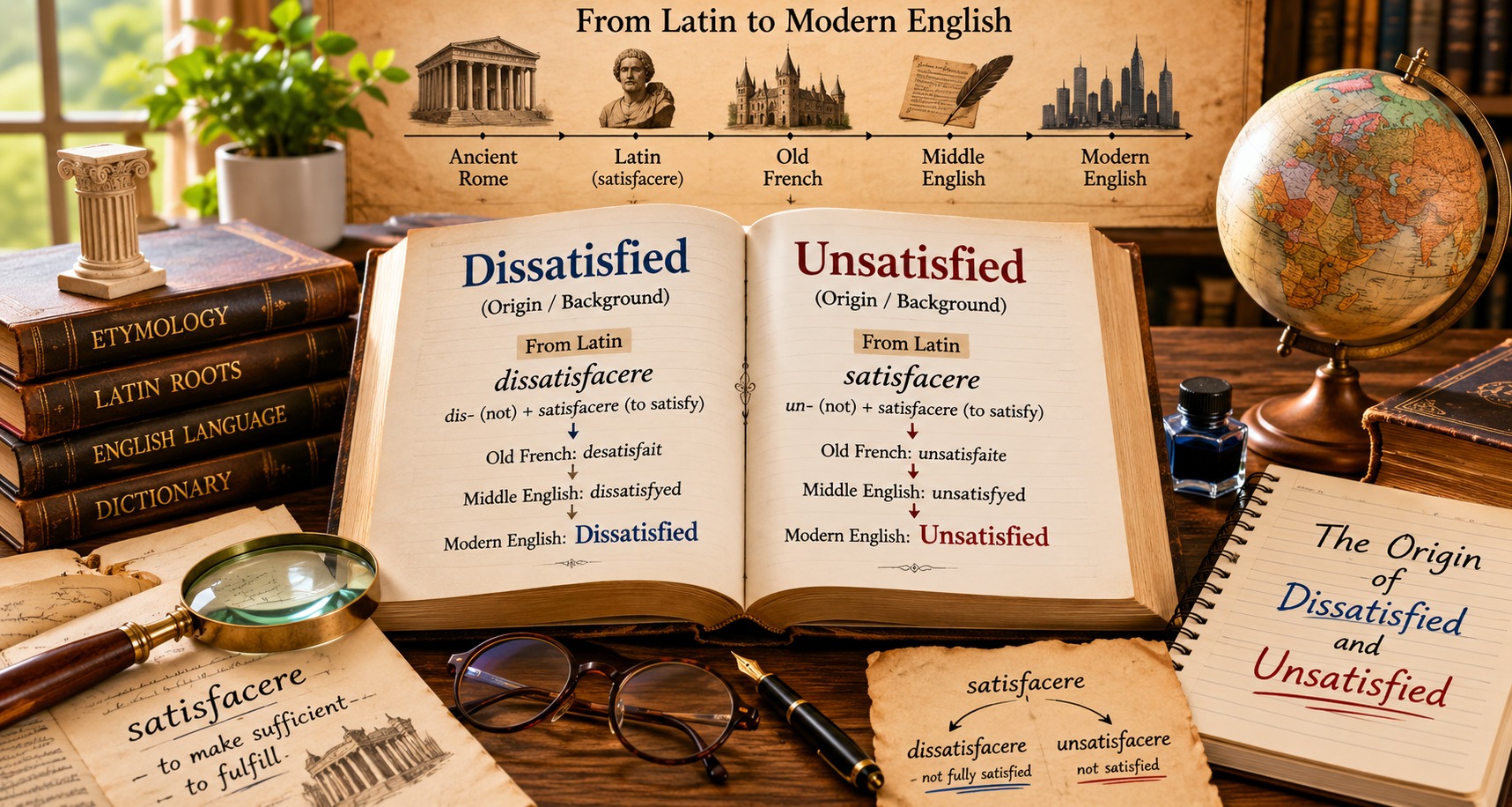
## The Origin / Background of Dissatisfied and Unsatisfied


Both words come from the verb satisfy, which means to meet a need, expectation, or desire.
The difference comes from their prefixes:
- Dis- often suggests opposition, disappointment, or negativity.
- Un- usually means “not” or “lacking.”
Over time, English speakers developed slightly different uses for these words.
Dissatisfied became associated with negative feelings and disappointment.
Unsatisfied became associated with needs, conditions, desires, and requirements that have not been fulfilled.
This distinction remains common in modern English writing and speech.
## Dissatisfied or Unsatisfied Explained — Key Differences
The biggest difference is what each word describes.
Comparison Table
| Term | Meaning | When to Use | Region/Context |
|---|---|---|---|
| Dissatisfied | Unhappy or disappointed | Feelings, opinions, reactions | Everyday English |
| Unsatisfied | Not fulfilled or unmet | Needs, desires, requirements | Formal, academic, legal, technical |
Examples of Dissatisfied
- She was dissatisfied with the hotel room.
- Customers became dissatisfied after the delay.
- The manager seemed dissatisfied with the results.
Examples of Unsatisfied
- His curiosity remained unsatisfied.
- Several legal conditions remain unsatisfied.
- The project’s requirements are still unsatisfied.
Key Difference
Think of it this way:
- Dissatisfied = emotional response
- Unsatisfied = unmet condition
## Which Version Should You Use?
For Students
Use dissatisfied when describing how someone feels.
Example:
- The student was dissatisfied with her grade.
For Business Writing
Use dissatisfied when discussing customer opinions or complaints.
Example:
- We received feedback from several dissatisfied customers.
For Academic Writing
Use whichever word matches the meaning.
- Dissatisfied for feelings.
- Unsatisfied for unmet criteria.
For Legal and Technical Documents
Use unsatisfied when discussing obligations, requirements, or conditions.
Example:
- The contractual obligations remain unsatisfied.
For General Use
A safe rule is:
- Person unhappy → dissatisfied
- Need not met → unsatisfied
## Common Mistakes with Dissatisfied and Unsatisfied
Mistake 1
| Mistake | Correction |
|---|---|
| The customer was unsatisfied with the service. | The customer was dissatisfied with the service. |
Why? The sentence describes a person’s feelings.
Mistake 2
| Mistake | Correction |
|---|---|
| The requirements were dissatisfied. | The requirements were unsatisfied. |
Why? Requirements cannot feel emotions.
Mistake 3
| Mistake | Correction |
|---|---|
| Her curiosity was dissatisfied. | Her curiosity was unsatisfied. |
Why? Curiosity is a desire, not a person.
Mistake 4
| Mistake | Correction |
|---|---|
| The conditions were dissatisfied. | The conditions were unsatisfied. |
Why? Conditions can be met or unmet.
Mistake 5
| Mistake | Correction |
|---|---|
| He remained unsatisfied with the restaurant. | He remained dissatisfied with the restaurant. |
Why? The sentence focuses on personal disappointment.
## Dissatisfied or Unsatisfied in Real-World Examples
Professional Email
We received several complaints from dissatisfied customers regarding delayed shipments.
News Headline
Residents Remain Dissatisfied with Local Government Services
Social Media Post
I’m really dissatisfied with this update. It created more problems than it solved.
Formal Report
Several compliance requirements remain unsatisfied at this time.
## Dissatisfied or Unsatisfied — Data, Trends & Usage
Search Intent
The keyword dissatisfied or unsatisfied has a strong informational search intent.
Most users want to know:
- Which word is correct
- Whether the words are interchangeable
- How to use them in writing
- Which sounds more natural
Who Searches for This Topic?
Common audiences include:
- Students
- English learners
- Content writers
- Business professionals
- Job seekers
Why This Matters
Using the correct word improves clarity and professionalism. Small vocabulary choices can have a big impact on how your writing is perceived.
## Standalone Comparison Table
| Term/Variant | Meaning | Region/Context | Best Used When |
|---|---|---|---|
| Dissatisfied | Unhappy or disappointed | Everyday English | Describing feelings or opinions |
| Unsatisfied | Unfulfilled or unmet | Formal and technical English | Describing requirements or needs |
| Very Dissatisfied | Extremely unhappy | Reviews and surveys | Showing strong disappointment |
| Unsatisfied Requirement | Requirement not fulfilled | Legal and technical writing | Discussing obligations |
## Frequently Asked Questions
Q: What does dissatisfied mean?
A: Dissatisfied means unhappy, disappointed, or displeased with a situation, service, product, or result.
Q: What does unsatisfied mean?
A: Unsatisfied means something has not been fulfilled, completed, or adequately met.
Q: Dissatisfied vs unsatisfied what’s the difference?
A: Dissatisfied describes feelings of disappointment, while unsatisfied describes unmet needs, desires, or requirements.
Q: Is dissatisfied acceptable in formal writing?
A: Yes. It is commonly used in business reports, surveys, reviews, and professional communication.
Q: Which version is correct dissatisfied or unsatisfied?
A: Both are correct. The right choice depends on the meaning you want to express.
Q: Can unsatisfied describe a person?
A: Yes, but it is less common. Native speakers usually prefer dissatisfied when discussing someone’s feelings or opinions.
Q: Can unsatisfied be used in legal writing?
A: Absolutely. Legal and technical documents frequently use unsatisfied to describe unmet conditions or obligations.
## Conclusion
Understanding the difference between dissatisfied and unsatisfied can make your writing clearer and more natural.
Remember these key points:
- Dissatisfied means unhappy or disappointed.
- Unsatisfied means unmet or unfulfilled.
- Use dissatisfied for people and emotions.
- Use unsatisfied for needs, requirements, and conditions.
In everyday conversation, business communication, and customer feedback, dissatisfied is often the better choice. In legal, academic, and technical contexts, unsatisfied is frequently used to describe unmet obligations or requirements.
Once you understand this simple distinction, choosing the right word becomes much easier. Now you know exactly when to use dissatisfied and unsatisfied so use them confidently in your next email, essay, report, or conversation.
Dissatisfied or Unsatisfied: The Complete Guide to Using the Right Word

I am an English language enthusiast who enjoys exploring word differences and spelling variations.
My work focuses on making confusing English terms easier to understand for everyday readers.
I believe clear language helps people communicate with confidence.