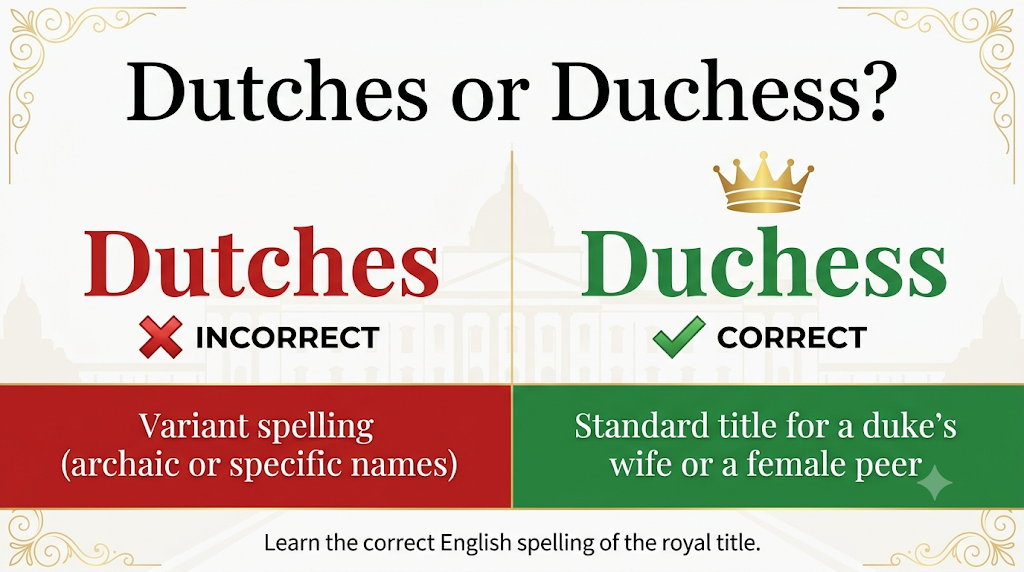
Duchess is the correct English word for a female duke or the wife of a duke. Dutches is usually a spelling mistake and is not the standard form used in modern English.
A few years ago, while editing an article about European royalty, I noticed the same mistake appearing again and again. Writers kept using “dutches” when they meant “duchess.” At first glance, the two words look very similar. That is exactly why so many people search for this topic.
If you have ever typed “dutches or duchess” into Google, you are not alone. Thousands of people wonder which spelling is correct. Some see one version online. Others hear the word spoken and are unsure how it should be written.
The confusion becomes even greater when reading about famous royal figures such as Catherine, Princess of Wales, who was previously known as the Duchess of Cambridge, or Meghan, Duchess of Sussex.
This guide clears up the confusion once and for all. You will learn the correct spelling, where the word comes from, common mistakes to avoid, and how to use it properly in real-life situations.
Let’s settle the question.
Dutches or Duchess Quick Answer
The correct word is duchess.
A duchess is:
- A woman who holds the rank of duke in her own right.
- The wife or widow of a duke.
The spelling dutches is generally considered incorrect in standard English.
Simple Examples
✅ The duchess attended the royal ceremony.
✅ The young duchess spoke to reporters.
❌ The dutches attended the royal ceremony.
In almost every writing situation, duchess is the word you want.
The Origin / Background of Dutches or Duchess
The word duchess has a long history.
It comes from the Old French word duchesse. That word referred to the female equivalent of a duke. French itself borrowed the idea from Latin roots connected to leadership and nobility.
Over time, English adopted the spelling duchess and kept it as the standard form.
Why Does Confusion Exist?
Several factors cause confusion:
- The ending sounds like “ches.”
- English contains many words ending in “es.”
- Autocorrect sometimes fails to catch the mistake.
- People often write words the way they hear them.
Because the pronunciation can sound similar, many writers accidentally type dutches instead of duchess.
Dutches or Duchess Explained — Key Differences or Variations
The biggest difference is simple.
| Term | Meaning | When to Use | Region/Context |
| Duchess | Female duke or wife of a duke | Standard English | Worldwide |
| Dutches | Common misspelling | Avoid in formal writing | Informal errors |
Duchess
This is the correct spelling.
Examples:
- The duchess hosted a charity event.
- The duchess visited local schools.
Dutches
This is normally an error.
Examples:
- Incorrect: The dutches attended the banquet.
- Correct: The duchess attended the banquet.
When writing professionally, academically, or formally, always choose duchess.
Which Version or Approach Should You Use?
The answer depends on your goal, but the recommendation is straightforward.
For Students
Use duchess.
Teachers, exams, and academic papers expect the correct spelling.
For Content Writers
Use duchess.
Search engines recognize it as the standard word.
For Business Professionals
Use duchess.
Formal communication requires correct spelling.
For Global Audiences
Use duchess.
It is accepted across British English, American English, Canadian English, Australian English, and other major English varieties.
Direct Recommendation
Choose “duchess” every time unless you are intentionally discussing a spelling mistake.
Common Mistakes with Dutches or Duchess
Many errors happen because the words sound similar.
Mistake #1
| Wrong | Correct |
| dutches | duchess |
Why it happens: People spell the word phonetically.
Mistake #2
| Wrong | Correct |
| The dutches visited London. | The duchess visited London. |
Why it happens: The writer assumes the word ends with “-es.”
Mistake #3
| Wrong | Correct |
| Dutchess | Duchess |
Why it happens: Some writers add an extra “t.”
Mistake #4
| Wrong | Correct |
| Duchesses is singular | Duchess is singular |
Why it happens: Confusion between singular and plural forms.
Mistake #5
| Wrong | Correct |
| Duchess’ attended | The duchess attended |
Why it happens: Incorrect punctuation usage.
Dutches or Duchess in Real-World Examples
Here are examples showing the correct use of duchess.
Professional Email
Dear Team,
The Duchess will attend the fundraising event on Friday. Please finalize all preparations before noon.
Best regards,
Event Coordinator
News Headline
Duchess Opens New Children’s Hospital Wing
Social Media Post
Excited to see the Duchess supporting local charities today! #RoyalVisit
Formal Report
The Duchess participated in three public engagements during the official visit.
Website Content
The Duchess met community leaders and discussed educational initiatives.
Dutches or Duchess — Data, Trends & Usage
Search interest in dutches or duchess is largely informational.
People usually want to know:
- Which spelling is correct.
- How the word is used.
- Whether “dutches” is acceptable.
- The meaning of “duchess.”
Search Intent
Primary Intent: Informational
Users want a quick language answer.
Who Searches Most?
Common audiences include:
- Students
- Writers
- Bloggers
- Editors
- English learners
- Royal family followers
Regions With High Interest
Interest often comes from:
- United States
- United Kingdom
- Canada
- Australia
- India
Why This Matters Today
Interest in royal titles remains strong because of continued media coverage of modern royal families. As a result, people frequently encounter the word duchess and want to ensure they are spelling it correctly.
Comparison Table
| Term/Variant | Meaning | Region/Context | Best Used When |
| Duchess | Female duke or wife of a duke | Standard English worldwide | Always when referring to a royal title |
| Dutches | Misspelling of duchess | Informal mistake | Avoid |
| Duke | Male noble rank | Worldwide | Referring to a male noble |
| Duchesses | Plural of duchess | Formal writing | Referring to multiple duchesses |
| Royal Consort | Spouse of a royal figure | Formal royal context | Specific ceremonial discussions |
Frequently Asked Questions
Q: What does duchess mean?
A: A duchess is a woman holding the rank of duke or the wife of a duke. It is a noble title used in many monarchies.
Q: How do you use duchess correctly?
A: Use duchess whenever referring to a female holder of a duchy or the wife of a duke. Example: “The duchess attended the ceremony.”
Q: Duchess vs duke — what’s the difference?
A: A duke is typically a male noble. A duchess is the female equivalent or the wife of a duke.
Q: Is duchess acceptable in formal writing?
A: Yes. Duchess is the correct and accepted spelling in formal, academic, journalistic, and professional writing.
Q: Which version is correct — dutches or duchess?
A: Duchess is correct. Dutches is generally considered a spelling error.
Q: Where does the word duchess come from?
A: It comes from the Old French word duchesse, which later entered English and became the standard spelling.
Q: Can duchess be used outside royal contexts?
A: Sometimes. People occasionally use it humorously or metaphorically, but its primary meaning relates to nobility and royal titles.
Conclusion
The debate between dutches or duchess is actually very simple once you know the rule. Duchess is the correct spelling. It refers to a female duke or the wife of a duke. The spelling dutches is usually a mistake and should be avoided in professional, academic, and everyday writing.
Remember these key points:
- Duchess is the standard English word.
- Dutches is generally incorrect.
- The word comes from Old French origins.
- Correct spelling improves credibility and clarity.
Whether you are writing an article, completing schoolwork, posting online, or discussing royal titles, using duchess ensures your writing looks polished and accurate.
Now you know exactly how to use duchess correctly. Bookmark this guide so you never second-guess the spelling again, and share it with someone who has been confused by dutches or duchess.

I am passionate about helping readers understand subtle differences between English words.
My articles focus on practical language usage and modern writing trends.
I enjoy turning complex grammar topics into easy-to-read guides.