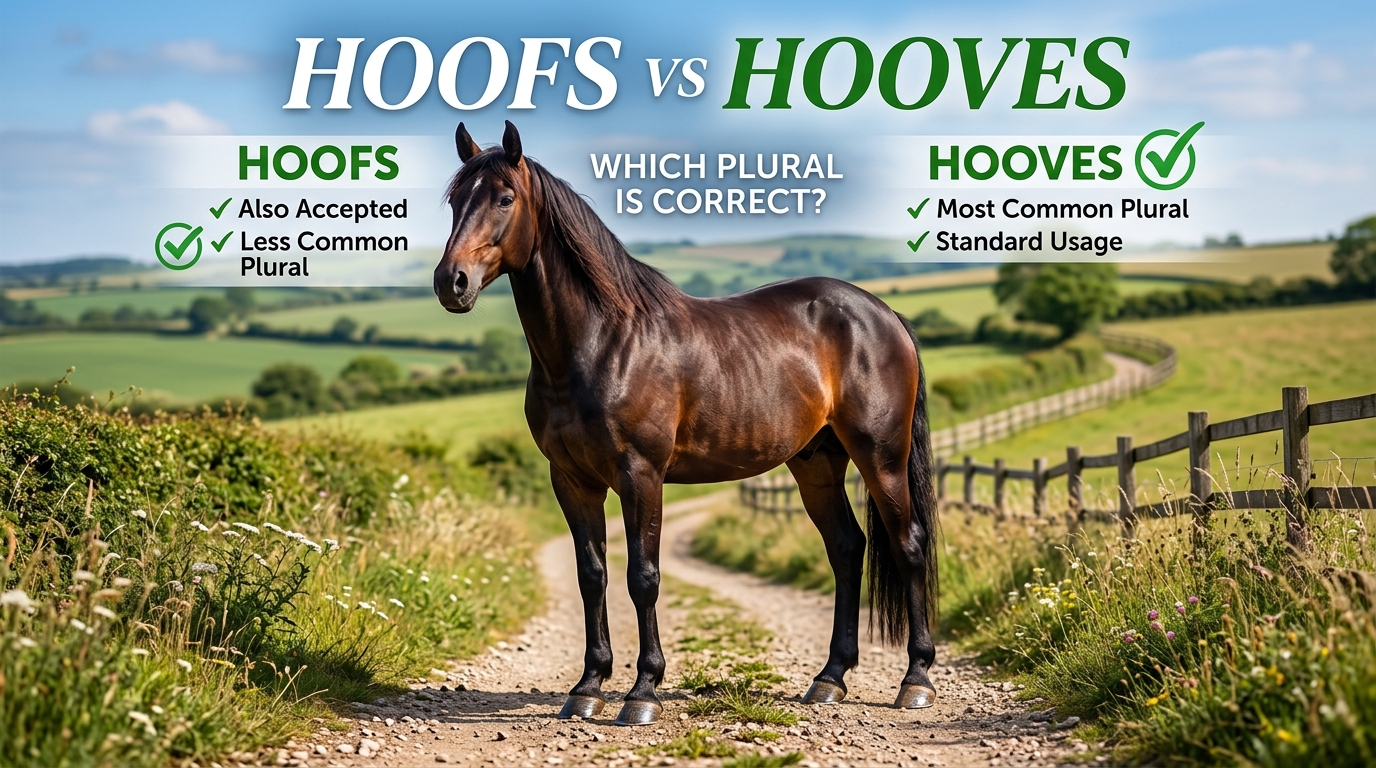
Hoofs and hooves are both accepted plural forms of hoof. However, hooves is more common in modern English.
A few years ago, I was editing an article about horses when I stopped at a simple sentence: “The horse lifted its hoofs.” Something felt off. I had always heard people say “hooves,” not “hoofs.”
Curious, I checked several dictionaries. To my surprise, both forms were correct.
That discovery reminded me how tricky English can be. Sometimes there is one right answer. Other times, there are two accepted versions, and that’s where confusion begins.
If you’ve searched for hoofs or hooves, you’re probably wondering which plural form sounds natural, which one dictionaries prefer, and whether one is considered wrong.
The good news is that the answer is easier than it looks. Once you understand the history and modern usage of these words, you’ll know exactly which form to use in school assignments, professional writing, and everyday conversation.
Let’s clear up the confusion once and for all.
Hoofs or Hooves : Quick Answer
Both hoofs and hooves are correct plurals of hoof.
However, hooves is the more common choice in modern English.
Examples
✅ The horse’s hooves were covered in mud.
✅ The deer stood quietly on its hoofs.
Although both are accepted, most readers expect to see hooves.
The Origin ; Background of Hoofs or Hooves

The word hoof comes from Old English. Like many old English words, its plural form changed over time.
English has a group of nouns that sometimes change f into v before adding -es.
Examples include:
- Leaf → Leaves
- Wolf → Wolves
- Calf → Calves
Because of this pattern, many people naturally formed the plural hooves.
Yet English does not always follow one rule. Over time, speakers also began using the regular plural form hoofs, simply by adding -s.
As a result, both forms survived.
Today, dictionaries generally accept both spellings, though hooves appears more often in books, articles, and everyday writing.
Hoofs or Hooves Explained : Key Differences or Variations
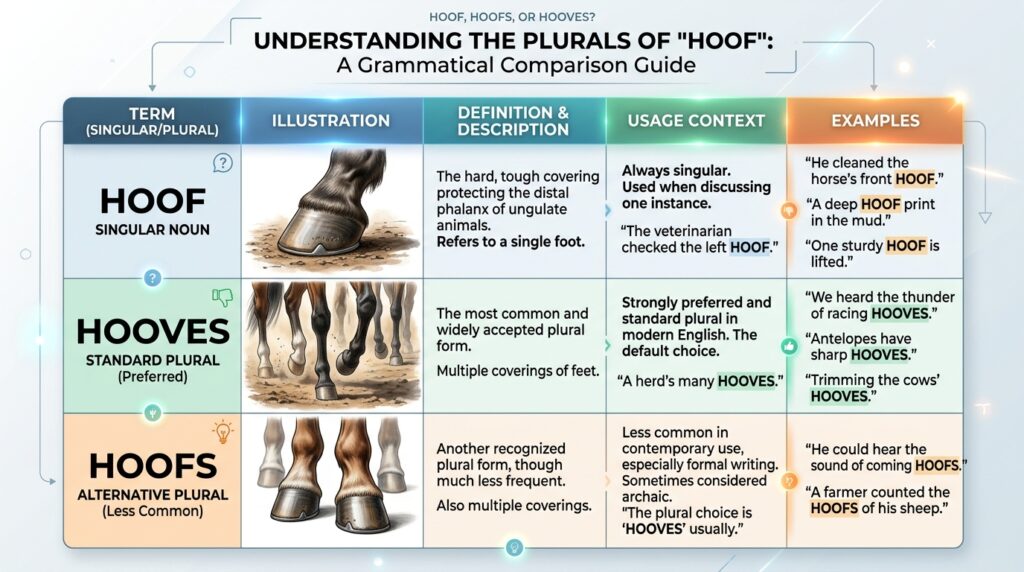
The meaning is identical.
Both words refer to more than one hoof.
The difference is mainly one of style and frequency.
| Term | Meaning | When to Use | Region/Context |
| Hoofs | Plural of hoof | Accepted but less common | Traditional or occasional usage |
| Hooves | Plural of hoof | Most common modern choice | General English worldwide |
Example Sentences
Hoofs
- The pony’s hoofs needed trimming.
- Mud clung to the animal’s hoofs.
Hooves
- The horse’s hooves struck the ground loudly.
- The veterinarian examined the cow’s hooves.
Most editors and teachers will naturally prefer hooves because it is more familiar.
Which Version Should You Use?
The best choice depends on your audience.
For Students
Use hooves.
Teachers and readers are more likely to recognize it immediately.
For Bloggers and Content Writers
Choose hooves.
It aligns with modern usage and reader expectations.
For Professional Writing
Use hooves unless a style guide says otherwise.
It feels natural to most audiences.
For Creative Writers
Either form works.
You may choose based on tone, character voice, or historical setting.
For Global Audiences
Use hooves.
It is the safest and most widely recognized option.
Final Recommendation
If you’re unsure, choose hooves. You will rarely go wrong with that choice.
Common Mistakes with Hoofs or Hooves

Many writers struggle because English plural rules are not always predictable.
| Mistake | Correct Form |
| hoofes | hooves |
| hoofses | hoofs |
| hoof’s (plural) | hoofs or hooves |
| hoove | hoof |
| Mixing forms in one article | Use one consistently |
Why These Mistakes Happen
Mistake 1: Applying the wrong plural rule
Some people add -es where it does not belong.
Mistake 2: Confusing plurals with possessives
An apostrophe changes the meaning.
Mistake 3: Mixing styles
Writers sometimes switch between hoofs and hooves in the same piece.
Mistake 4: Assuming only one form is correct
Many people think one version must be wrong, but dictionaries accept both.
Half’s or Halves: Easy Guide to Difference
Hoofs or Hooves in Real-World Examples
Professional Email
“The veterinarian inspected the horse’s hooves and found no signs of injury.”
News Headline
“Wild Horses Receive Free Care for Damaged Hooves“
Social Media Post
“Just watched a horse gallop by. The sound of those hooves was amazing!”
Formal Report
“The condition of the animals’ hooves was assessed during the annual health inspection.”
Historical Writing
“The farmer cleaned the mud from the horses’ hoofs before sunrise.”
Both forms appear in real writing, but hooves remains more common.
Hoofs or Hooves : Data, Trends & Usage
Search interest in this topic remains steady because many people encounter the word while reading about horses, livestock, wildlife, or veterinary care.
Who Searches Most?
- Students
- Animal lovers
- Horse owners
- Writers
- Editors
- English learners
Search Intent
The main search intent is informational.
People want to know:
- Which plural is correct
- Whether both forms are accepted
- Which version sounds natural
- Which form dictionaries prefer
Usage Trends
Modern books, articles, and websites generally use hooves more often than hoofs.
That trend has grown stronger over time.
Why This Matters Today
Readers notice unusual spellings. Choosing the expected form can make your writing feel smoother and easier to read.
Hoofs or Hooves Comparison Table
| Term/Variant | Meaning | Region/Context | Best Used When |
| Hoof | One foot of certain animals | Standard English | Singular form |
| Hoofs | More than one hoof | Accepted but less common | Alternative plural |
| Hooves | More than one hoof | Modern standard usage | Most writing situations |
| Horse Hooves | Hooves belonging to horses | General English | Animal-related content |
Frequently Asked Questions

Q: What does hoofs or hooves mean?
A: Both words are plural forms of hoof, the hard foot found on animals such as horses, deer, cattle, and goats.
Q: How do you use hoofs or hooves correctly?
A: Both are correct. However, hooves is the version most people use today.
Q: Hoofs vs hooves — what’s the difference?
A: There is no difference in meaning. The only difference is spelling and frequency of use.
Q: Is hooves acceptable in formal writing?
A: Yes. In fact, it is usually the preferred choice in formal and professional writing.
Q: Which version is correct — hoofs or hooves?
A: Both are correct according to major dictionaries. Modern English generally favors hooves.
Q: Where does the word hoof come from?
A: It comes from Old English and has been part of the language for centuries. Its unusual plural forms developed over time.
Q: Can hoofs be used in books and articles?
A: Yes. Although less common, hoofs remains a valid plural form and may appear in literature and historical writing.
Conclusion
The debate over hoofs or hooves is one of those rare English questions where both answers are correct.
Remember these key points:
- Hoofs and hooves are both accepted plurals of hoof.
- They have exactly the same meaning.
- Hooves is the more common choice in modern English.
- Most readers, teachers, and editors expect to see hooves.
- Consistency matters more than the choice itself.
If you want the safest option, use hooves. It is familiar, widely accepted, and fits almost every writing situation.
Now you know exactly how to use hoofs or hooves with confidence. Bookmark this guide so you never second-guess the plural again, and share it with someone who loves language as much as you do.
Hoofs or hooves explained meaning plural forms usage examples and grammar Learn which version to use correctly today
Teached or Taught: The Easy Guide to the Correct Word

As an English language enthusiast, I love diving into the tricky details of word differences and spelling variations. My mission is to explain confusing terms and make them accessible to everyone, helping readers to communicate with clarity and confidence.