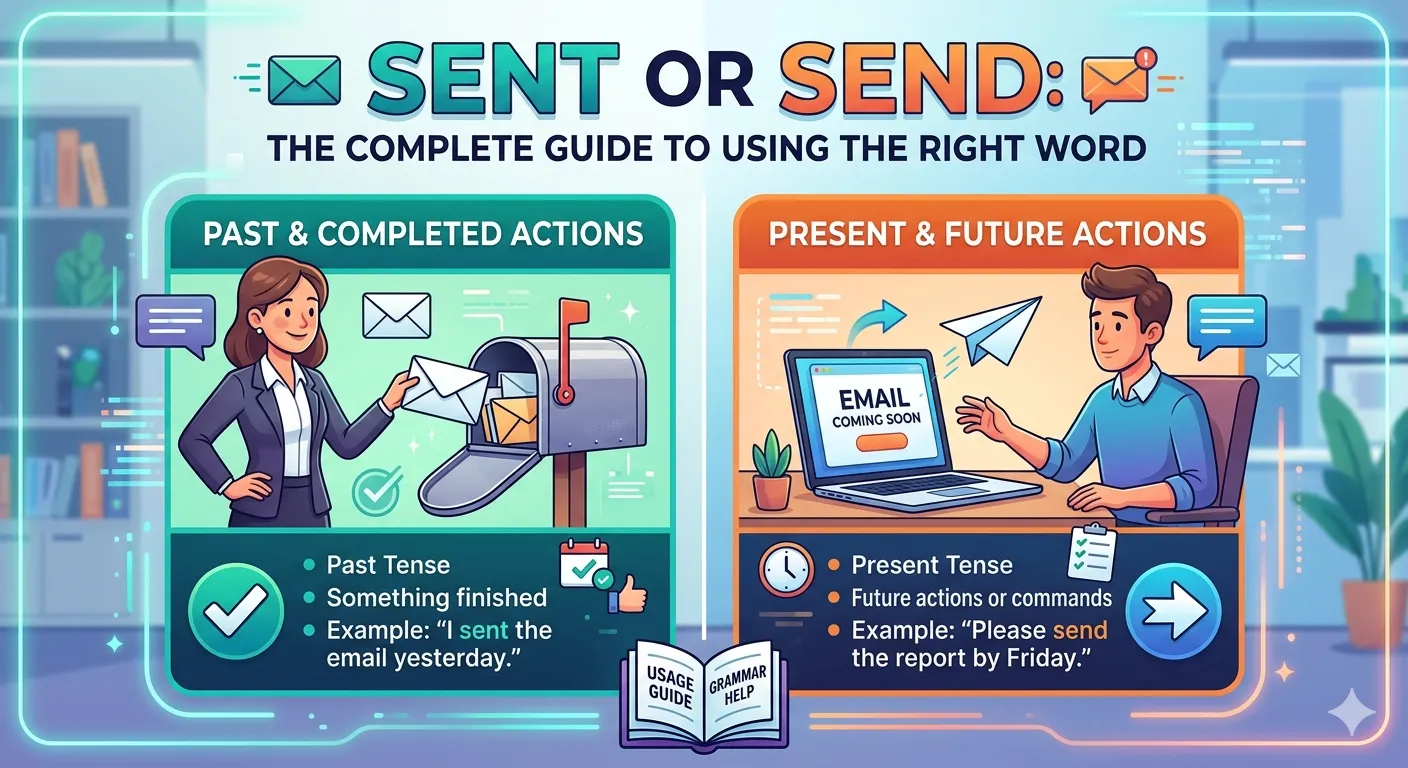
Send is the present-tense form of the verb, while sent is the past tense. Use send for actions happening now or in the future and sent for actions that already happened.
A few years ago, I was reviewing emails from students when I noticed the same mistake again and again: “I have send the document” or “Yesterday, I send the report.” The message was clear, but the grammar was not.
If you’ve ever paused before writing sent or send, you’re not alone. These two words are among the most commonly confused verbs in English. They look similar, come from the same root word, and often appear in emails, messages, and everyday conversations.
The confusion usually comes from verb tenses. Many people know what the words mean but aren’t sure which form fits the sentence. A small mistake can make writing sound awkward or less professional.
The good news is that the difference is easy to learn. Once you understand when to use each word, you’ll be able to write and speak with more confidence.
In this guide, you’ll learn the meanings of sent and send, their origins, key differences, common mistakes, practical examples, and simple memory tricks that make choosing the correct word easy every time.
Sent or Send: Quick Answer
The difference is all about time.
- Send = present or future action
- Sent = past action
Examples
- I will send the email tomorrow.
- Please send me the file.
- I sent the email yesterday.
- She sent the package last week.
A simple rule is:
If the action already happened, use “sent.” If it is happening now or later, use “send.”
The Origin / Background of Sent or Send

Both words come from the same English verb.
Origin of Send
The word send comes from Old English sendan, which meant “to dispatch,” “to cause to go,” or “to deliver.”
For centuries, English speakers have used it when talking about moving messages, people, or objects from one place to another.
Origin of Sent
Sent developed as the past-tense form of send.
Like many common English verbs, its past tense changed over time rather than simply adding “-ed.”
Why the Confusion Exists
Several factors create confusion:
- Both words have the same basic meaning.
- They differ only by tense.
- English learners often mix present and past forms.
- Perfect tenses can make sentence structure harder.
Fortunately, once you focus on the time of the action, the choice becomes simple.
Sent or Send Explained: Key Differences
The core difference is tense.
| Term | Meaning | When to Use | Region/Context |
| Send | Present or future action | Current requests, future actions | All English varieties |
| Sent | Past action | Completed actions | All English varieties |
Examples of Send
- Please send the report today.
- I will send the invoice tomorrow.
- Can you send me the details?
- We send newsletters every month.
Examples of Sent
- I sent the report yesterday.
- She sent the invitation last week.
- They sent the package by courier.
- We sent the payment this morning.
Quick Memory Trick
Think:
- Send = Now or Later
- Sent = Already Done
This simple rule solves most mistakes instantly.
Which Version Should You Use?
The correct choice depends on when the action happened.
For Students
If the action is happening now:
Use send.
Example:
- Please send your homework by Friday.
If the action already happened:
Use sent.
Example:
- I sent my homework yesterday.
For Professionals
Business emails often require the correct tense.
Use send:
- I will send the proposal tomorrow.
Use sent:
- I sent the proposal yesterday.
For Everyday Communication
Text messages, chats, and social media follow the same rule.
- I’ll send it tonight.
- I sent it this morning.
Best Recommendation
Ask yourself one question:
Has the action already happened?
- Yes → Sent
- No → Send
Common Mistakes with Sent or Send
These errors appear frequently in writing.
| Mistake | Correct Version |
| Yesterday I send the email. | Yesterday I sent the email. |
| I have send the report. | I have sent the report. |
| She send the package last week. | She sent the package last week. |
| I sent you the file tomorrow. | I will send you the file tomorrow. |
| They has sent it. | They have sent it. |
Why These Errors Happen
1. Mixing Present and Past Tense
Writers often use present-tense verbs when discussing past actions.
2. Confusion with Perfect Tenses
Phrases like “have sent” can feel unfamiliar to learners.
3. Fast Typing
People sometimes choose the wrong form without noticing.
4. Similar Meanings
Because both words describe the same action, tense becomes easy to overlook.
Sent or Send in Real-World Examples
Professional Email
“I will send the updated contract by the end of the day.”
News Headline
“Officials Sent Emergency Supplies to Flood Victims.”
Social Media Post
“I just sent my job application. Wish me luck!”
Formal Report
“The department sent notifications to all affected customers.”
Workplace Conversation
Manager: “Can you send the presentation today?”
Employee: “I already sent it this morning.”
Sent or Send: Data, Trends & Usage
The phrase sent or send is one of the most searched grammar topics online.
Search Intent
Primary intent:
- Informational
Users want to know:
- Which word is correct
- How verb tenses work
- How to avoid grammar mistakes
Audiences Most Interested
- Students
- English learners
- Teachers
- Business professionals
- Bloggers
- Content writers
Regions With Strong Search Interest
- United States
- United Kingdom
- Canada
- Australia
- India
Why It Matters Today
Digital communication has increased dramatically. People send emails, messages, files, and documents every day. Using the correct verb tense helps your writing look clear and professional.
Sent vs Send Comparison Table
| Term/Variant | Meaning | Region/Context | Best Used When |
| Send | Present or future action | Universal English | Talking about current or upcoming actions |
| Sent | Past action | Universal English | Talking about completed actions |
Frequently Asked Questions
Q: What does send mean?
A: Send is the present-tense form of the verb. It means to deliver, dispatch, or transfer something to another person or place.
Q: What does sent mean?
A: Sent is the past tense of send. It refers to an action that has already been completed.
Q: Which is correct: sent or send an email?
A: Both can be correct depending on the sentence. Use send for present or future actions and sent for past actions.
Q: Is “I have send” correct?
A: No. The correct phrase is “I have sent.” After “have,” use the past participle form.
Q: Is sent acceptable in formal writing?
A: Yes. Sent is standard English and commonly used in business, academic, and professional writing.
Q: Where do sent and send come from?
A: Both words come from the Old English verb sendan, which meant to dispatch or deliver.
Q: Can send be used in future tense?
A: Yes. Example: “I will send the documents tomorrow.”
Q: How can I remember the difference?
A: Think:
- Send = Present/Future
- Sent = Past
Focus on when the action happened.
Conclusion
The difference between sent and send comes down to one thing: time.
Here are the key points to remember:
- Send is used for present and future actions.
- Sent is used for completed actions in the past.
- Business emails often require careful tense selection.
- A quick time check usually reveals the correct word.
Whenever you’re unsure, ask yourself whether the action already happened. If it did, choose sent. If it’s happening now or later, choose send.
Mastering this small grammar rule can improve your emails, assignments, reports, and everyday conversations. Clear writing creates confidence, and confidence helps you communicate more effectively.
Now you know exactly how to use sent or send, go try it in your next piece of writing. Bookmark this guide so you never second-guess these words again, and share it with someone who’s been confused about them.
See More: Presenter or Presentor: Which Spelling Is Correct?

I am an English language expert dedicated to exploring the nuances of words and their meanings. Through detailed comparisons and practical insights, I help readers understand the finer points of language and use words with accuracy and confidence.