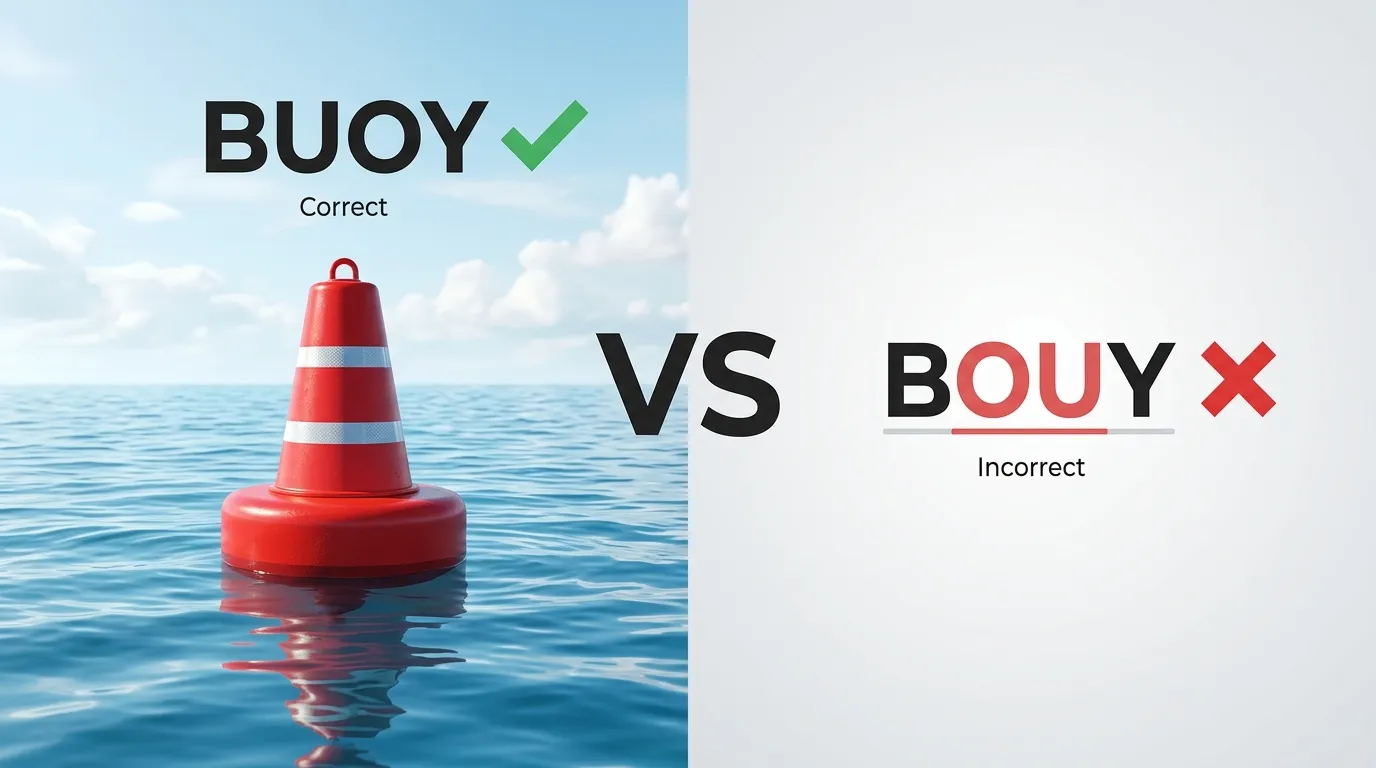
Buoy is the correct English spelling. Bouy is a misspelling and should not be used in standard writing.
I once reviewed a student’s essay about ocean safety. Everything looked great until I noticed the sentence: “The rescue team placed a bouy near the shore.”
At first, the mistake seemed minor. After all, bouy looks very similar to buoy. The letters are simply reversed. Yet that small change turns a correct English word into a spelling error.
This confusion is surprisingly common. Many English learners, students, and writers accidentally write bouy because it feels more natural to spell words in the order they are pronounced. Since buoy has an unusual spelling, people often second-guess themselves.
The good news is that the rule is simple.
There is only one correct spelling in modern English: buoy.
In this guide, you’ll learn what buoy means, why people misspell it as bouy, common mistakes to avoid, real-world examples, and an easy trick to remember the correct spelling forever.
Buoy or Bouy :Quick Answer
The correct spelling is buoy.
- ✅ Buoy = a floating object used in water.
- ❌ Bouy = incorrect spelling.
Examples
✅ The red buoy marked the safe swimming area.
✅ A rescue buoy was attached to the boat.
❌ The red bouy marked the safe swimming area.
❌ The rescue bouy was attached to the boat.
If you’re writing about a floating marker or life-saving device, always use buoy.
The Origin / Background of Buoy or Bouy
The word buoy has a long maritime history.
It entered English through older European languages connected to shipping and navigation. For centuries, sailors used buoys to mark channels, hazards, and safe routes across oceans, rivers, and harbors.
Because the spelling developed over time, it does not follow the simple spelling patterns found in many modern English words.
This unusual letter arrangement is one reason people mistakenly write bouy.
The confusion happens because:
- The letters look like they should be reversed.
- The pronunciation does not clearly reveal the spelling.
- English learners often spell words phonetically.
- Typing errors commonly swap the letters.
Despite these challenges, dictionaries recognize only one standard spelling: buoy.
Buoy Explained : Meaning and Uses
A buoy is a floating object placed in water.
It serves several purposes:
- Marking safe navigation routes
- Warning about hazards
- Identifying underwater structures
- Supporting rescue operations
- Assisting swimmers and boaters
Common Types of Buoys
- Navigation buoys
- Mooring buoys
- Rescue buoys
- Weather-monitoring buoys
- Marker buoys
Comparison Table
| Term | Meaning | When to Use | Region/Context |
| Buoy | Floating water marker or flotation device | All standard English writing | Worldwide |
| Bouy | Misspelling of buoy | Never recommended | Incorrect usage |
Example Sentences
- The buoy helped guide ships into the harbor.
- Lifeguards threw a rescue buoy into the water.
- The yellow buoy marked a restricted area.
Which Version Should You Use?
The answer is simple.
Use buoy every time.
For Students
Always write buoy in assignments, exams, and essays.
For Bloggers
Use buoy in all articles related to boating, safety, fishing, or marine topics.
For Businesses
Marine businesses, shipping companies, and safety organizations should always use the correct spelling: buoy.
For Global Audiences
There is no American vs British difference here.
Both American English and British English use buoy.
Common Mistakes with Buoy or Bouy
Mistake 1
❌ The bouy floated near the dock.
✅ The buoy floated near the dock.
Why?
Bouy is not a recognized standard English spelling.
Mistake 2
❌ Rescue bouys were deployed.
✅ Rescue buoys were deployed.
Why?
The plural of buoy is buoys.
Mistake 3
❌ The harbor was marked with several bouys.
✅ The harbor was marked with several buoys.
Why?
The spelling remains buoy even in plural form.
Mistake 4
❌ Spell-check isn’t necessary for buoy.
✅ Verify the spelling because many people accidentally type “bouy.”
Why?
The letter order often causes typing errors.
Mistake 5
❌ Assuming bouy is a British spelling.
✅ Both British and American English use buoy.
Why?
There is no accepted regional variant.
Buoy in Real-World Examples
Professional Email
“Please inspect the navigation buoy before tomorrow’s vessel departure.”
News Headline
“Coast Guard Replaces Damaged Buoy Near Harbor Entrance”
Social Media Post
“Spotted a bright red buoy while kayaking today.”
Formal Report
“The warning buoy remained operational throughout the storm season.”
Marine Safety Manual
“Maintain a safe distance from all navigation buoys.”
Educational Textbook
“A buoy helps guide ships and boats safely through waterways.”
Buoy : Data, Trends & Usage
The keyword buoy or bouy receives regular search interest because many people are unsure which spelling is correct.
Search Intent
Primary search intent:
Informational
Users want to verify the correct spelling.
Audiences Most Interested
- Students
- English learners
- Writers
- Boaters
- Sailors
- Maritime professionals
Regions with Interest
Searches commonly come from:
- United States
- United Kingdom
- Canada
- Australia
- New Zealand
Why This Matters Today
Spelling accuracy affects credibility.
Using buoy correctly helps your writing look professional and avoids confusion, especially in educational, technical, and marine contexts.
Buoy Comparison Table
| Term/Variant | Meaning | Region/Context | Best Used When |
| Buoy | Floating marker or flotation device | Worldwide English | All standard writing |
| Buoys | Plural form of buoy | Worldwide English | Referring to multiple floating markers |
| Bouy | Misspelling | Incorrect English | Never use |
| Bouys | Misspelling of buoys | Incorrect English | Never use |
Frequently Asked Questions
Q: What does buoy mean?
A: A buoy is a floating object used to mark locations, hazards, routes, or safe areas in water.
Q: Is bouy a real word?
A: No. Bouy is considered a spelling mistake. Standard English dictionaries recognize only buoy.
Q: How do you use buoy correctly?
A: Use buoy whenever referring to a floating marker or flotation device. Example: “The buoy marked the entrance to the harbor.”
Q: Buoy vs bouy :what’s the difference?
A: Buoy is the correct spelling. Bouy is an incorrect spelling caused by reversing the letters.
Q: Is buoy acceptable in formal writing?
A: Yes. Buoy is the standard spelling in academic, professional, and technical writing.
Q: Which version is correct : buoy or bouy?
A: Buoy is always correct. Bouy should be avoided.
Q: Where does the word buoy come from?
A: The word has maritime origins and entered English through older European nautical vocabulary.
Q: Can buoy be used in boating and safety contexts?
A: Yes. The term is widely used in marine navigation, rescue operations, and water safety.
Conclusion
The choice between buoy and bouy is straightforward.
Only one spelling is correct:
- ✅ Buoy
- ❌ Bouy
Remember these key points:
- A buoy is a floating marker or flotation device.
- Bouy is a misspelling.
- Both American and British English use buoy.
- The plural form is buoys.
The easiest way to avoid mistakes is to remember the exact letter order: B-U-O-Y.
Once you learn that sequence, the confusion disappears.
Now you know exactly how to use buoy correctly. Bookmark this guide so you never misspell it again, and share it with someone who still writes bouy by mistake.
Read More: Excell or Excel: Correct Spelling Made Easy

Professional content writer delivering insightful, accurate, and reader-friendly articles across multiple niches with a focus on quality and value.