Both “realises” and “realizes” are correct spellings of the same word ,the difference is regional. “Realizes” is American English. “Realises” is British, Australian, and South Asian English.
Same meaning. Different spelling. Different audience.
The Origin Behind the Confusion
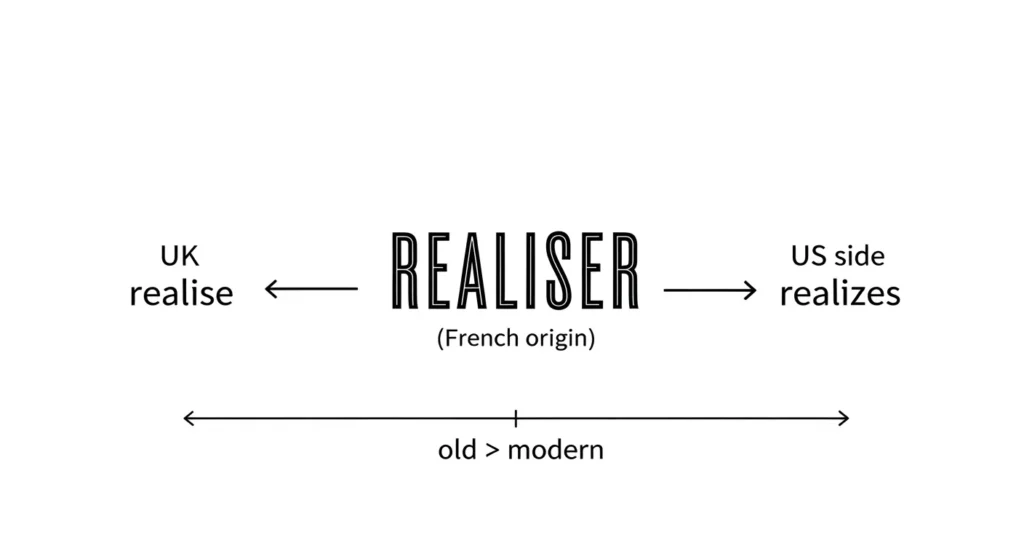
The word comes from the French réaliser, which entered English in the 17th century. It means “to make real” or “to become aware.”
In the 19th century, American English began standardizing “ize” endings for many verbs. Noah Webster, the man behind the first American dictionary, pushed hard for simplified, phonetic spellings.
British English kept both “ise” and “ize” for a long time. Today, most British style guides (including Oxford) accept “ize” but prefer “ise” in everyday use. That’s where the split lives.
The confusion grows because the internet mixes audiences. A Pakistani freelancer writing for a UK client needs to know which version to use and why.
Realises vs. Realizes ,Key Differences Explained
| Term | Spelling Rule | Region/Context | When to Use |
| Realizes | ,ize ending | United States, Canada | Writing for US clients, American publications |
| Realises | ,ise ending | UK, Australia, Pakistan, India | Writing for British or Commonwealth audiences |
| Either | Both accepted | Neutral international contexts | Academic writing (check style guide first) |
The rule applies to the whole verb family:
- realize / realise
- realized / realised
- realizing / realising
- realization / realisation
If you switch one, switch them all. Mixing “ize” and “ise” in the same piece looks unprofessional.
Which Version Should You Use?
The answer depends on who reads your content ,not where you live.
For US clients or American websites: Use realizes. Full stop. American SEO clients, US publications, and US,based platforms expect this spelling.
For UK, Australian, or European clients: Use realises. British readers notice the difference. It signals you understand their market.
For Pakistani or South Asian audiences: Realises is standard because Pakistan follows British English conventions ,inherited from colonial,era education systems.
For global or neutral content: Check the client’s brand guidelines. If none exist, ask. If you still can’t confirm, realizes is safer because American English dominates global digital content.
For SEO content: Match the spelling to the target audience’s search language. British users search “realises.” American users search “realizes.” Using the wrong one won’t kill rankings, but it does affect trust and perceived quality.
Common Mistakes Writers Make
Mistake 1: Mixing both spellings in one article
“She realizes the problem, but her team realised it first.”
Correction: Pick one and stick to it throughout.
Mistake 2: Guessing instead of checking Many writers just pick one randomly. This creates inconsistency across a client’s website ,especially when multiple writers contribute content.
Mistake 3: Assuming “ize” is always American Some “ize” words are correct in British English too ,like “organize” and “recognize.” The “ise” vs. “ize” split only applies to certain verbs. Don’t overgeneralize.
Mistake 4: Using spell,check blindly Microsoft Word’s default is often American English. If you’re writing for a UK client and your spell,check is set to en,US, it will flag “realises” as wrong ,even though it isn’t.
Fix: Always set your editor language to match your target audience.
Mistake 5: Ignoring derivative words Changing “realize” to “realise” but forgetting “realization” → “realisation” breaks consistency.
Realises / Realizes in Real,World Examples
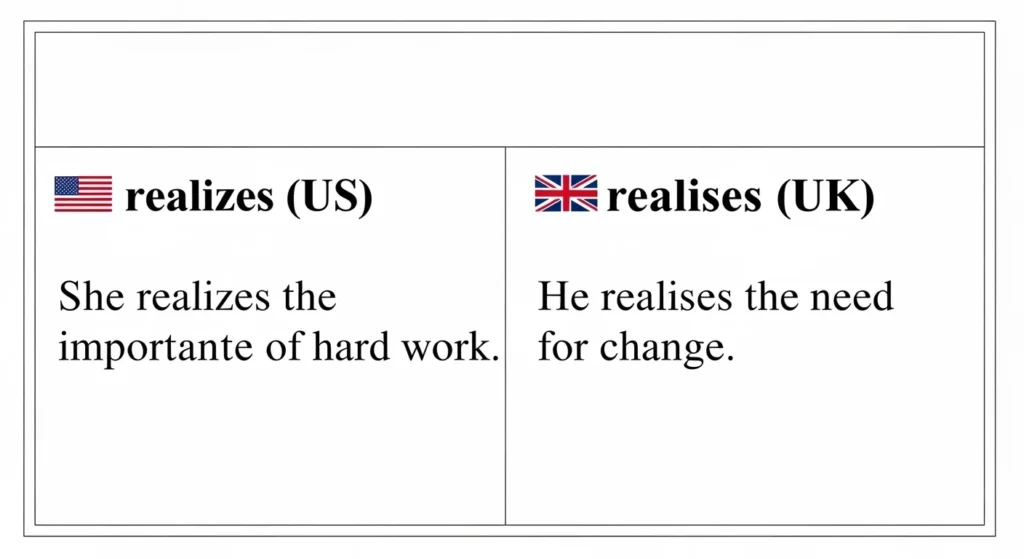
In a professional email (UK client):
“I realise this timeline is tight, but I’m confident we can deliver the local SEO audit by Friday.”
In a news headline (US publication):
“Google Realizes the Power of Hyperlocal Search ,Here’s What It Means for Small Businesses”
In a social media post (Australian audience):
“Every business owner realises too late that Google Maps rankings drive foot traffic. Don’t be that business.”
In a formal report (South Asian market):
“The organization realises the importance of consistent NAP citations across all local directories.”
Each example sounds natural ,because the spelling matches the audience.
Realises vs. Realizes ,Data, Trends & Usage
Search behavior by region:
- “Realizes” dominates in the US, Canada, and Latin American English searches.
- “Realises” is preferred in the UK, Ireland, Australia, New Zealand, India, and Pakistan.
Why this matters for SEO content writers:
If you’re a freelancer targeting UK or US clients, the spelling you use signals your familiarity with their market. A US client reviewing a proposal that uses “realises” may notice the mismatch ,even subconsciously.
Content intent: This is primarily an informational query ,writers, students, and non,native English speakers want clarity on which spelling is “right.” The best answer isn’t “one is correct” ,it’s “both are correct, depending on context.”
Trend insight: As AI writing tools grow, maintaining regional spelling consistency becomes more important ,not less. AI models often default to American English, which creates errors in British,English content.
Full Comparison Table
| Term/Variant | Meaning | Region/Context | Best Used When |
| Realizes | To become aware of; to make real | United States, Canada | Writing for American clients or publications |
| Realises | Identical meaning, different spelling | UK, Australia, NZ, India, Pakistan | Writing for British/Commonwealth audiences |
| Realization | The noun form (American) | United States | US blogs, reports, web content |
| Realisation | The noun form (British) | UK, Australia, South Asia | British,market content |
| Realized / Realised | Past tense forms | Regional split (same as above) | Match whichever base form you’ve chosen |
FAQ
Q: Is “realises” or “realizes” correct? A: Both are correct. “Realizes” is American English. “Realises” is British and Commonwealth English. Use the version that matches your audience’s regional standard.
Q: Which spelling should I use for SEO content writing? A: Match the spelling to your target market. For US clients, use “realizes.” For UK or Australian clients, use “realises.” Consistency matters more than which version you pick.
Q: Does the spelling difference affect Google rankings? A: Not directly. But using British spellings for a US,targeted page ,or vice versa ,can reduce relevance signals for region,specific queries. For local SEO, always match the spelling to the target market.
Q: Is “realizes” or “realises” more professional? A: Neither is more professional. The professional choice is using the correct version for your audience and being consistent throughout your content.
Q: Can I use “realizes” when writing for a Pakistani audience? A: Pakistan follows British English conventions in formal and educational writing. For Pakistani audiences, “realises” is the more locally appropriate spelling ,though “realizes” is widely understood.
Q: Why do British style guides sometimes use “ize” endings? A: Oxford University Press traditionally accepted “ize” as an alternative, calling it the “Oxford spelling.” However, most everyday British publications now default to “ise.” When in doubt, follow your client’s style guide.
Q: How do I remember which spelling is which? A: Simple rule ,“Z” for America, like the letter at the end of “USA”. American English uses “ize.” British English uses “ise.”
Conclusion
Here’s what you need to walk away with:
- Both spellings are correct: “realizes” is American, “realises” is British.
- Your audience decides: not your personal preference or location.
- Consistency is everything: pick one and apply it across all related words (realized, realising, realization).
- For SEO work: match spelling to the target market to strengthen regional relevance signals.
Whether you’re writing service pages, blog posts, or client proposals ,the right spelling is the one your reader expects to see.
Now you know exactly how to use realises and realizes ,go update your style guide and never second,guess it again. And if you manage a team of writers, share this with them. Consistent spelling is a small detail that signals big professionalism.
Read More: Targetted or Targeted: Which One Is Correct?

Professional content writer delivering insightful, accurate, and reader-friendly articles across multiple niches with a focus on quality and value.