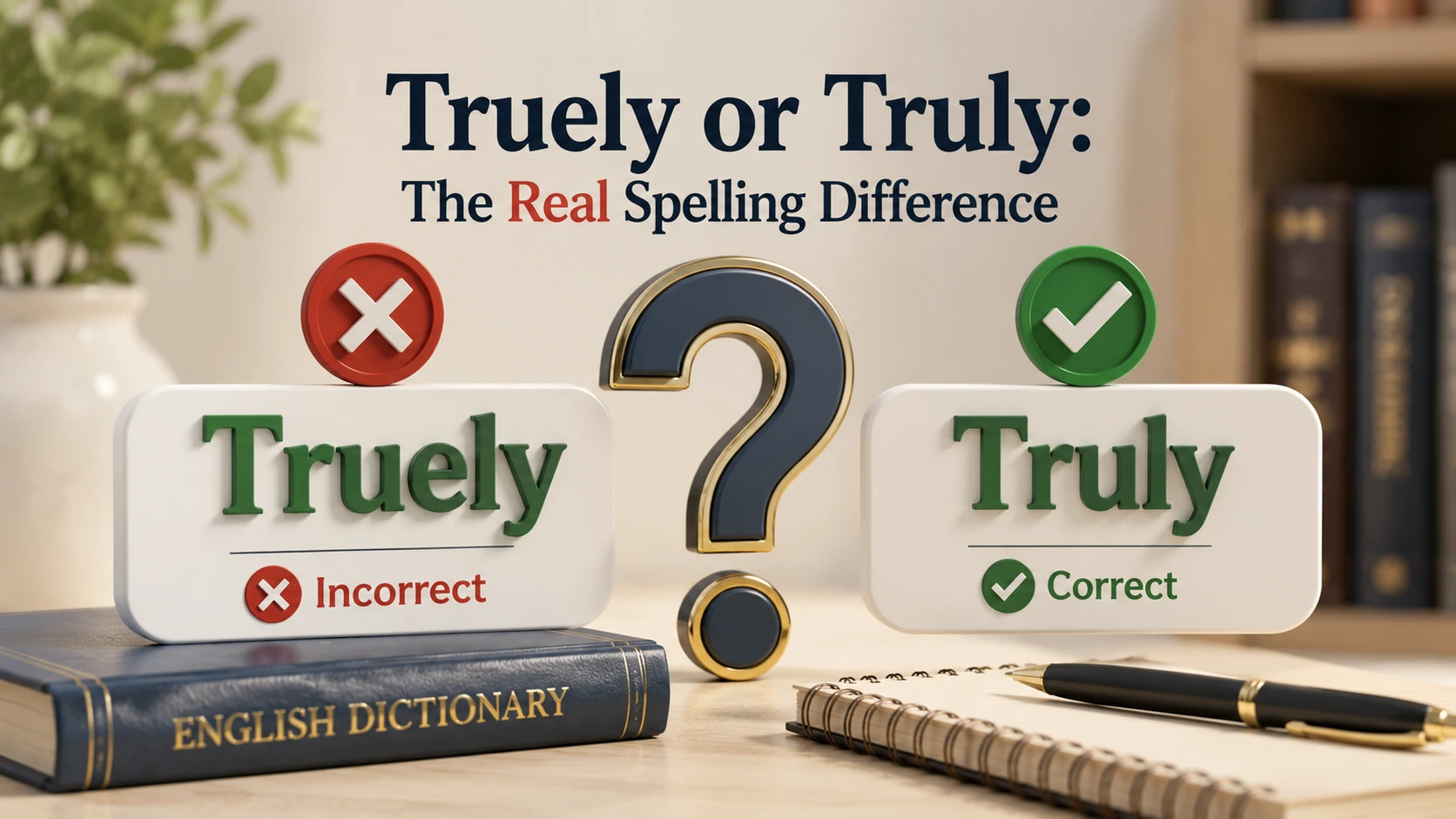
Truely is a common spelling mistake. The correct spelling is truly, which means “in a real, sincere, or genuine way.”
Have you ever typed a sentence like “I truely appreciate your help” and wondered if something looked wrong? This small spelling mistake happens to many English learners because the word seems like it should keep the letter e from “true.”
When I first started helping students improve their writing, I noticed that words ending in -ly often created confusion. Many learners write words based on how they sound, not how they are actually spelled. Truely or truly is one of those tricky word pairs where pronunciation can make the wrong spelling feel correct.
The good news is that the rule is simple once you understand it. The correct form is truly, while truely is considered a misspelling in standard English.
In this guide, you will learn why the extra e disappears, where the word comes from, how to use it correctly, and how to avoid making this common mistake again.
Truely or Truly: Quick Answer
Truly is the correct spelling. It means honestly, genuinely, really, or in a sincere way.
The spelling truely is incorrect in modern standard English.
Examples:
- ✅ She truly cares about her family.
- ✅ I am truly grateful for your support.
- ❌ She truely cares about her family.
The confusion happens because the base word is true. Many people think adding -ly creates truely, but English spelling rules remove the final e in this case.
How to Pronounce Truly
Truly (TROO-lee)
Truly is pronounced TROO-lee.
- UK: /ˈtruː.li/
- US: /ˈtruː.li/
The stress falls on the first syllable (TROO), while the second syllable (lee) is spoken softly.
Example: She truly appreciates your help.
The Origin and Background of Truly
The word truly comes from the Old English word trēowe, which meant “faithful,” “loyal,” or “trustworthy.”
Over time, the word developed into true in modern English. It described something that was accurate, honest, or real.
When English speakers added the suffix -ly, meaning “in a particular way,” the spelling changed.
The word became:
True + ly = Truly
The final e was dropped to make the spelling easier and more natural.
This spelling pattern appears in many English words. When a word ends with a silent e and receives a suffix beginning with a vowel, the final e is often removed.
Examples:
- True → Truly
- Due → Duly
- Gentle → Gently
- Simple → Simply
However, not every word follows the same pattern, which is why learners often feel confused.
The incorrect spelling truely looks logical because it keeps the original word visible. But English spelling does not always follow the way words appear. Some changes happen because of pronunciation, history, and common usage.
Truely or Truly Explained: Key Difference
The difference between truly and truely is not about meaning. It is about correct spelling.
| Term | Meaning | When to Use | Region/Context |
|---|---|---|---|
| Truly | In a real, honest, or sincere way | Use in all standard writing | Worldwide English |
| Truely | No accepted meaning as a standard word | Avoid using it | Common spelling mistake |
Why Is Truly Correct?
The word truly follows a common English spelling rule. When adding -ly to an adjective ending in -e, the final e is usually removed.
For example:
- True → Truly
- Absolute → Absolutely
- Complete → Completely
The word still keeps the same meaning, but the spelling becomes shorter.
Why Do People Write Truely?
Many writers make this mistake because they connect the spelling directly to the original word true.
They think:
True + ly = Truely
This seems reasonable, but English spelling does not always work like simple addition.
The correct form has been established through common usage and dictionary standards:
True + ly = Truly
Examples of Truly in Everyday English
The word truly is used in many situations because it expresses honesty, emotion, or strong belief.
Expressing Feelings
- I am truly happy for your success.
- She was truly surprised by the gift.
Showing Appreciation
- We are truly thankful for your kindness.
- I truly appreciate your help.
Describing Something Real
- This is a truly beautiful place.
- He is a truly talented artist.
In each sentence, truly adds the meaning of “really” or “genuinely.”
Which Version Should You Use?
The choice between truly and truely is simple: always use truly in your writing.
Unlike some English words that have British and American spelling differences, this word does not have two accepted versions. The spelling truly is correct in all major forms of English.
Whether you are writing an email, essay, social media post, or professional document, choose truly.
Use truly when you want to express:
- Honesty: “I truly believe in your ability.”
- Strong feelings: “She was truly excited about the opportunity.”
- Realness: “It was a truly unforgettable experience.”
The incorrect spelling truely should be avoided because readers may see it as a spelling error.
A simple memory trick can help:
True loses the “e” before adding “-ly.”
Remember:
✅ True → Truly
❌ True → Truely
Common Mistakes with Truly
Many people make spelling mistakes with this word because the original adjective true creates confusion. Here are the most common errors and how to fix them.
Mistake 1: Adding “e” Before “ly”
Wrong:
I am truely sorry for the mistake.
Correct:
I am truly sorry for the mistake.
The final e is removed before adding -ly.
Mistake 2: Thinking Truely Is a British Spelling
Wrong idea:
Truely is the British version of truly.
Correct:
Truly is the correct spelling everywhere.
This is not a regional difference like color/colour or center/centre.
Mistake 3: Using Truly When You Mean “Completely”
Sometimes learners use truly when they need a stronger word.
Example:
The box is truly empty.
This means the box is genuinely empty. However, if you mean “nothing is inside at all,” words like completely or totally may be clearer.
Mistake 4: Confusing Truly With Truthfully
These words are related but not always interchangeable.
- Truly = genuinely or really
- Truthfully = honestly or without lying
Examples:
I truly admire her work.
(I genuinely admire her work.)
Truthfully, I forgot the appointment.
(I am honestly admitting something.)
Truly in Real-World Examples
Understanding how truly appears in real situations helps you use it naturally.
1. Professional Email
Dear Sarah,
I truly appreciate your quick response and support during this project. Your help made a big difference.
Here, truly shows sincere gratitude.
2. News Article
The discovery was truly remarkable and changed the way scientists understood the topic.
In news writing, truly adds emphasis to an important statement.
3. Social Media Post
Feeling truly grateful for everyone who supported my journey.
People often use truly online to express genuine emotions.
4. Formal Document
The organization is truly committed to improving customer service standards.
In formal writing, truly creates a stronger sense of sincerity.
tweak or tweek: Complete Guide to Correct Usage
Truly: Data, Trends & Usage
Searches for truly or truely usually come from people checking spelling before writing. The search intent is mainly informational.
People commonly search this phrase because:
- They are unsure if the extra “e” is needed.
- They write based on pronunciation.
- They want to improve grammar and spelling accuracy.
The correct spelling truly appears widely in books, websites, professional writing, and everyday communication.
The incorrect form truely appears online mainly because of typing mistakes and confusion with the original word true.
This topic matters because small spelling errors can affect how professional your writing looks. Learning simple spelling patterns helps you write with more confidence.
Standalone Comparison Table: Truly vs Truely
| Term/Variant | Meaning | Region/Context | Best Used When |
|---|---|---|---|
| Truly | Genuinely, honestly, or really | Standard English worldwide | Use in all types of writing |
| Truely | Incorrect spelling | Common spelling mistake | Avoid using it |
Easy Ways to Remember the Correct Spelling
If you often forget this spelling, try these simple tricks:
- Remember that true loses its “e” before -ly.
- Think of the phrase: “A true person speaks truly.”
- Check the word visually: TRULY has only one “e” the one in “true” disappears.
Small spelling rules like this can make a big difference in clear communication.
FAQ Section: Truely or Truly
Q: What does truly mean?
A: Truly means genuinely, honestly, or in a real way. It is used when you want to show that something is sincere, accurate, or deeply felt.
Q: Is truely a correct spelling?
A: No, truely is not considered a correct spelling in standard English. The correct form is truly.
Q: Why is truly spelled without an e?
A: The final e in true is removed when adding the suffix -ly. This creates the correct spelling truly instead of truely.
Q: How do you use truly correctly in a sentence?
A: Use truly when you mean “really,” “genuinely,” or “sincerely.” For example: “I truly appreciate your kindness” means your appreciation is honest and real.
Q: Is truely or truly a British or American spelling difference?
A: No, this is not a British and American spelling variation. Truly is the correct spelling in both American and British English.
Q: Where does the word truly come from?
A: The word comes from the Old English idea of being faithful, loyal, and trustworthy. It developed from the word true and later became truly when the suffix -ly was added.
Q: Can truly be used in formal writing?
A: Yes, truly is suitable for formal writing, including emails, reports, essays, and professional documents. It adds a sense of sincerity and emphasis.
Final Thoughts
The difference between truely or truly is a simple spelling issue, but it causes confusion for many English writers. The correct spelling is always truly.
Remember these key points:
- Truly means genuinely, honestly, or really.
- Truely is a common spelling mistake.
- The final e from true disappears before adding -ly.
- Unlike some English words, this is not a regional spelling difference.
Good spelling often comes from understanding small patterns. Once you learn why true becomes truly, the mistake becomes much easier to avoid.
Whenever you write an email, essay, article, or social media post, choose truly with confidence. This small correction can make your writing look clearer and more professional.
Now you know exactly how to use truly; go try it in your next piece of writing and avoid this common spelling mistake forever.
Truely or truly? Discover the correct spelling, meaning, and usage with clear examples. Learn why “truly” is the only accepted form today.
Ninth or Nineth: Which One Is Correct?

As an English language enthusiast, I love diving into the tricky details of word differences and spelling variations. My mission is to explain confusing terms and make them accessible to everyone, helping readers to communicate with clarity and confidence.