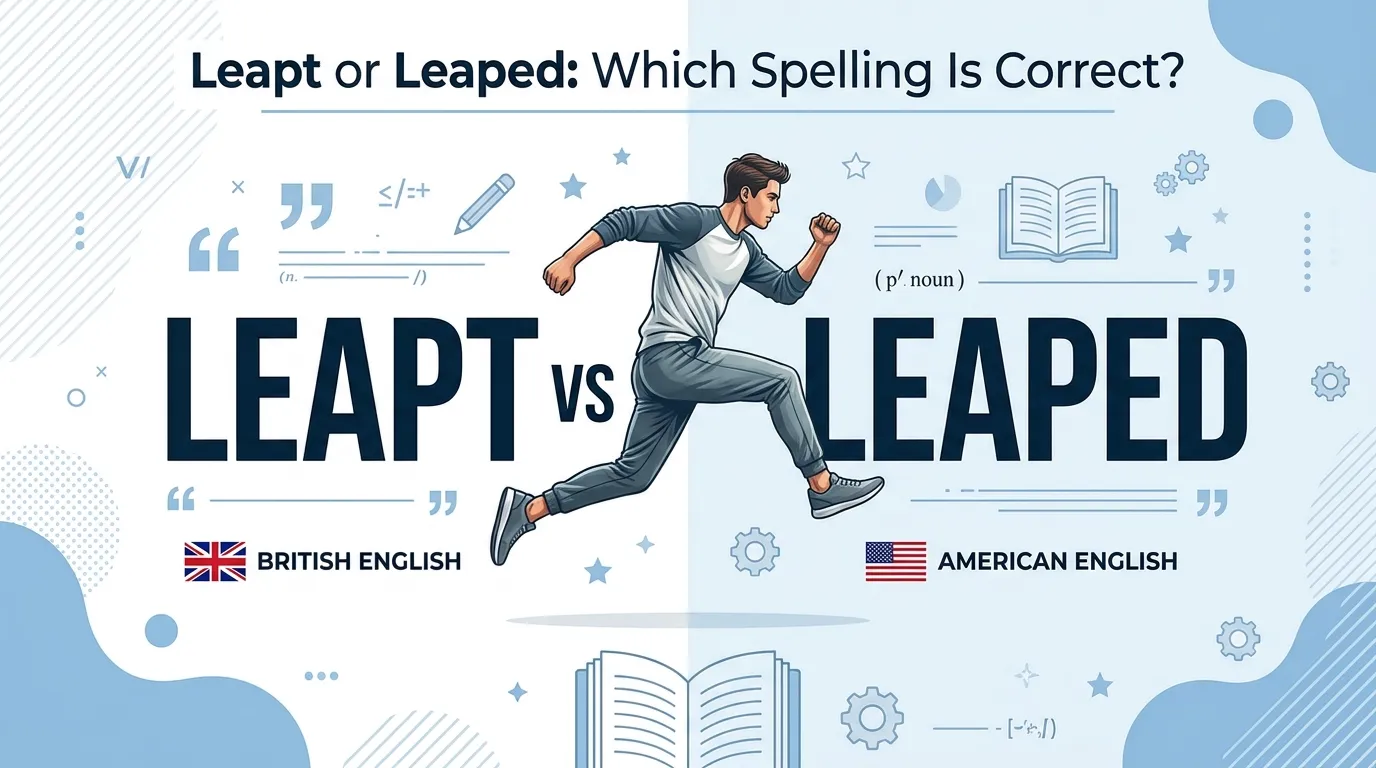
Leapt and leaped are both correct past-tense forms of “leap”; leapt is more common in British English, while leaped is common in American English.
Have you ever stopped while writing and wondered, “Should I write leapt or leaped?” You are not alone. Both forms are correct, and both come from the verb leap. The confusion happens because English uses two common forms for the past tense and past participle of this verb.
Leapt is more common in British English and is also widely understood around the world. Leaped is especially common in American English. Both forms have the same basic meaning: to jump or move quickly into the air.
For example:
- The cat leapt over the wall.
- The cat leaped over the wall.
These sentences mean the same thing. The main difference is regional preference and style, not meaning.
In this guide, we will explain leapt or leaped, their history, British and American usage, common mistakes, and real-life examples. You will also learn which form is best for school, work, websites, and formal writing.
Leapt or Leaped: Quick Answer
Leapt and leaped are both correct past-tense forms of leap.
| Present | Past | Past Participle |
|---|---|---|
| leap | leapt | leapt |
| leap | leaped | leaped |
Examples
- The boy leapt over the fence.
- The boy leaped over the fence.
- She has leapt into action.
- She has leaped into action.
The meaning does not change.
Leapt is more common in British English, while leaped is more common in American English.
The Origin of Leapt or Leaped

The verb leap is very old. It comes from Old English hlēapan, which meant “to jump” or “to leap.”
Over time, English developed different ways to form the past tense of verbs.
Some verbs use -ed:
- walk → walked
- jump → jumped
- play → played
Other verbs have irregular forms:
- go → went
- sing → sang
- take → took
Leap can work in both ways. It can take the regular ending -ed, giving us leaped, or use the older irregular form leapt.
This is why both forms exist today.
The spelling difference is not a mistake. It is a result of the way English has changed over hundreds of years.
British English vs American English Spelling
British and American English often have different preferences for certain words. Leapt and leaped are a good example.
In British English, leapt is often preferred.
The deer leapt across the road.
In American English, leaped is often preferred.
The deer leaped across the road.
However, Americans also understand leapt, and British speakers understand leaped.
Comparison Table
| Feature | Leapt | Leaped |
|---|---|---|
| Meaning | Jumped | Jumped |
| Spelling | Irregular form | Regular -ed form |
| British English | Very common | Correct but less common |
| American English | Correct but less common | Very common |
| Formal writing | Correct | Correct |
| Past tense | Yes | Yes |
| Past participle | Yes | Yes |
So, neither spelling is wrong.
Which Spelling Should You Use?

Your choice can depend on your audience.
For American English
Use leaped if you are writing mainly for people in the United States.
The company leaped ahead of its competitors.
For British English
Use leapt if your audience is mainly in the UK.
The horse leapt over the fence.
For Commonwealth English
Leapt is often a natural choice in countries that follow British English traditions, such as the UK and many Commonwealth countries.
For Global Writing
Both forms are easy to understand. The most important thing is to stay consistent.
If your website uses British English, use leapt. If it uses American English, use leaped.
Common Mistakes with Leapt or Leaped
Here are some common mistakes learners make.
Mistake 1: Thinking One Form Is Wrong
❌ Leaped is always wrong.
❌ Leapt is always wrong.
✅ Both are correct.
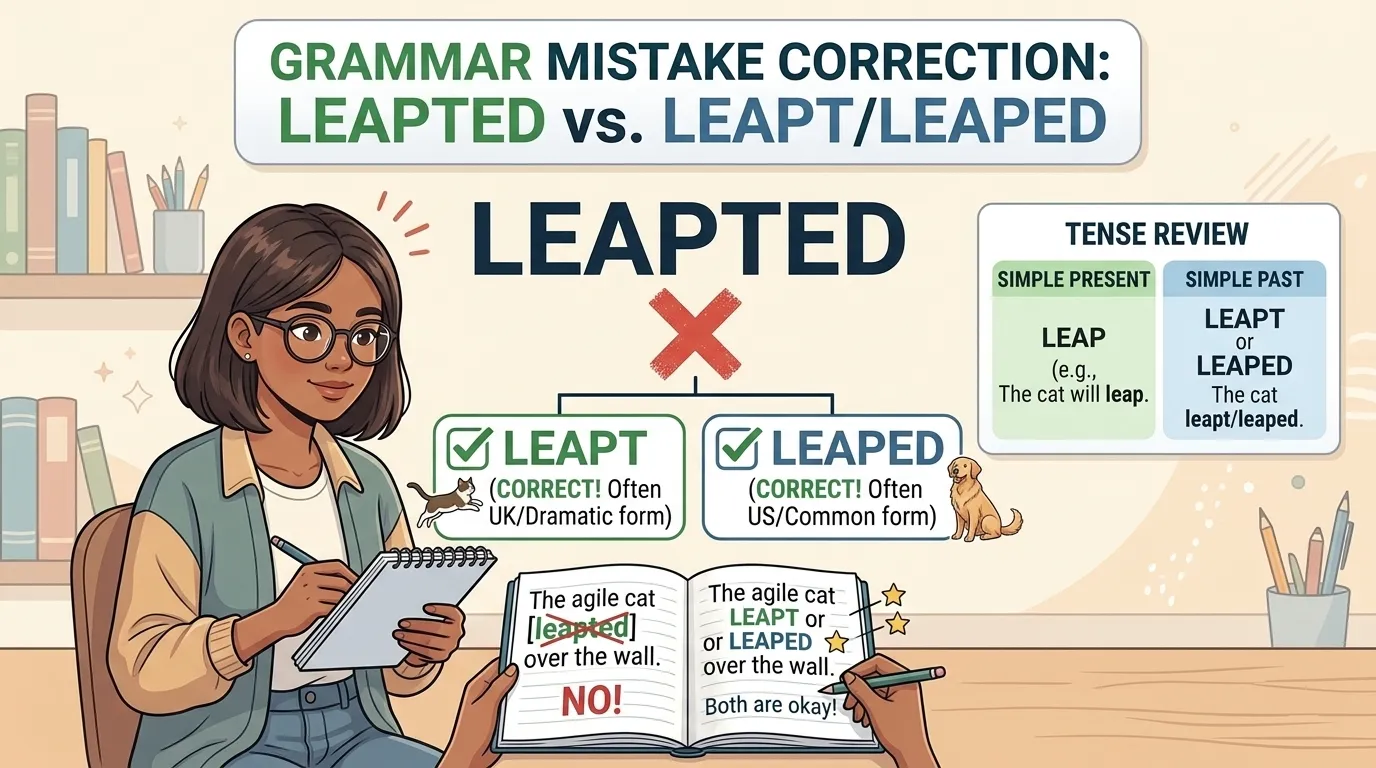
Mistake 2: Using “Leapted”
❌ The dog leapted over the gate.
There is no word leapted.
Correct:
✅ The dog leapt over the gate.
or
✅ The dog leaped over the gate.
Mistake 3: Mixing Forms in One Style
If you are writing for an American audience, it is usually better to use leaped consistently.
If you are writing for a British audience, leapt may be the better choice.
Mistake 4: Confusing “Leap” and “Leapt”
Leap is the present form.
I leap over the puddle.
Leapt is a past form.
I leapt over the puddle yesterday.
Leapt or Leaped in Everyday Examples
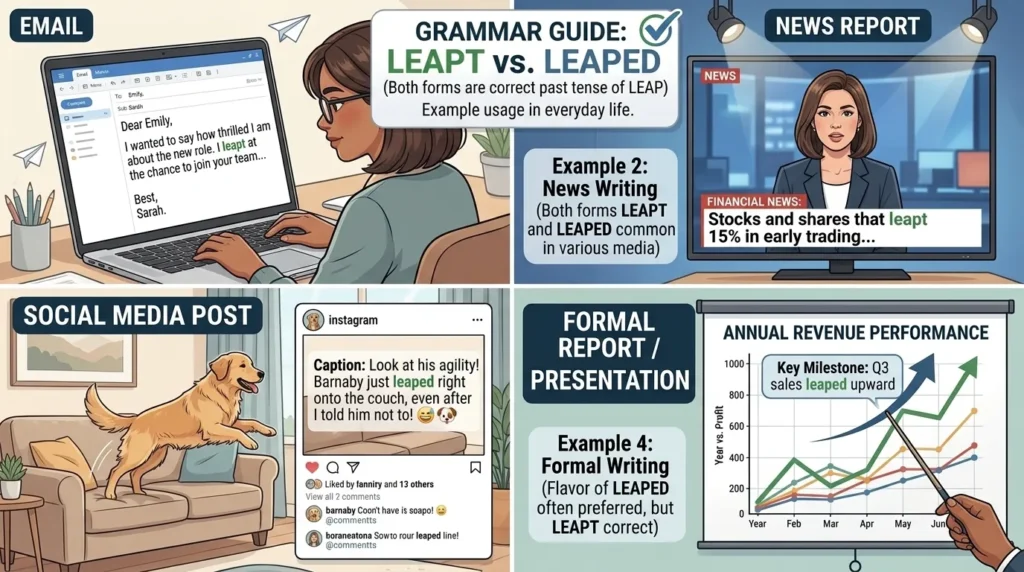
Both forms can appear in everyday and professional writing.
In Emails
I leapt at the chance to join the project.
American style:
I leaped at the chance to join the project.
In News Writing
Shares leapt after the company announced strong results.
American news style may use:
Shares leaped after the company announced strong results.
On Social Media
My dog leapt onto the sofa!
Or:
My dog leaped onto the sofa!
Both are correct.
In Formal Writing
The population leapt from one million to two million.
Or:
The population leaped from one million to two million.
The choice depends mainly on your preferred variety of English.
See Also: Countries or Country’s: Which Is Correct?
Leapt or Leaped: Google Trends & Usage Data
Search interest for “leapt or leaped” comes from people who want to know which past-tense form is correct. The question is especially common among English learners, students, writers, editors, and bloggers.
Usage also varies by region.
- Leapt has a strong connection with British English.
- Leaped is strongly associated with American English.
- Both forms are understood internationally.
- In dictionaries and professional writing, both forms are accepted.
Google Trends can show changes in search interest over time, but search data should not be treated as a complete measure of actual word usage. People may search for leapt or leaped because they are unsure about the spelling, even though both forms are correct.
Regional Preference
| Region | Common Preference |
|---|---|
| United States | Leaped |
| United Kingdom | Leapt |
| Australia | Leapt is common |
| New Zealand | Leapt is common |
| Canada | Both are used |
| International English | Both are understood |
Leapt vs Leaped: Side-by-Side Comparison
| Word | Type | Meaning | Example |
|---|---|---|---|
| Leap | Present | To jump | I leap over the stream. |
| Leapt | Past | Jumped | I leapt over the stream. |
| Leaped | Past | Jumped | I leaped over the stream. |
| Leapt | Past participle | Jumped | She has leapt into action. |
| Leaped | Past participle | Jumped | She has leaped into action. |
The key point is simple: leapt and leaped have the same meaning.
FAQs About Leapt or Leaped
1. Is “leapt” correct?
Yes. Leapt is a correct past tense and past participle of leap.
2. Is “leaped” correct?
Yes. Leaped is also correct and is especially common in American English.
3. Which is more common in British English?
Leapt is generally the more common choice in British English.
4. Which is more common in American English?
Leaped is generally more common in American English.
5. Can I use “leapt” in American English?
Yes. Americans understand leapt, and it is not grammatically wrong.
6. Can I use “leaped” in British English?
Yes. Leaped is correct, although leapt may sound more natural in British English.
7. Does leapt mean something different from leaped?
No. They have the same basic meaning. The main difference is regional and stylistic preference.
Conclusion
The choice between leapt or leaped is easier than it may seem. Both words are correct forms of the verb leap, and both mean “jumped.” The main difference is regional preference.
Leapt is especially common in British English and is widely used in other varieties influenced by British English. Leaped is more common in American English. Both forms can be used in everyday speech, emails, news reports, school writing, and formal documents.
If you are writing for an American audience, leaped is usually the safer choice. For a British audience, leapt is often more natural. For a global audience, either form works well.
Most importantly, never use “leapted.” That form is incorrect.
So, when you see leapt or leaped, remember this simple rule: both are correct; choose the form that matches your English style and audience.

Ali Hassan is an English language writer and educator who specializes in grammar, spelling, and commonly confused words. He creates simple and easy-to-understand content to help students, writers, and English learners improve their English with confidence.