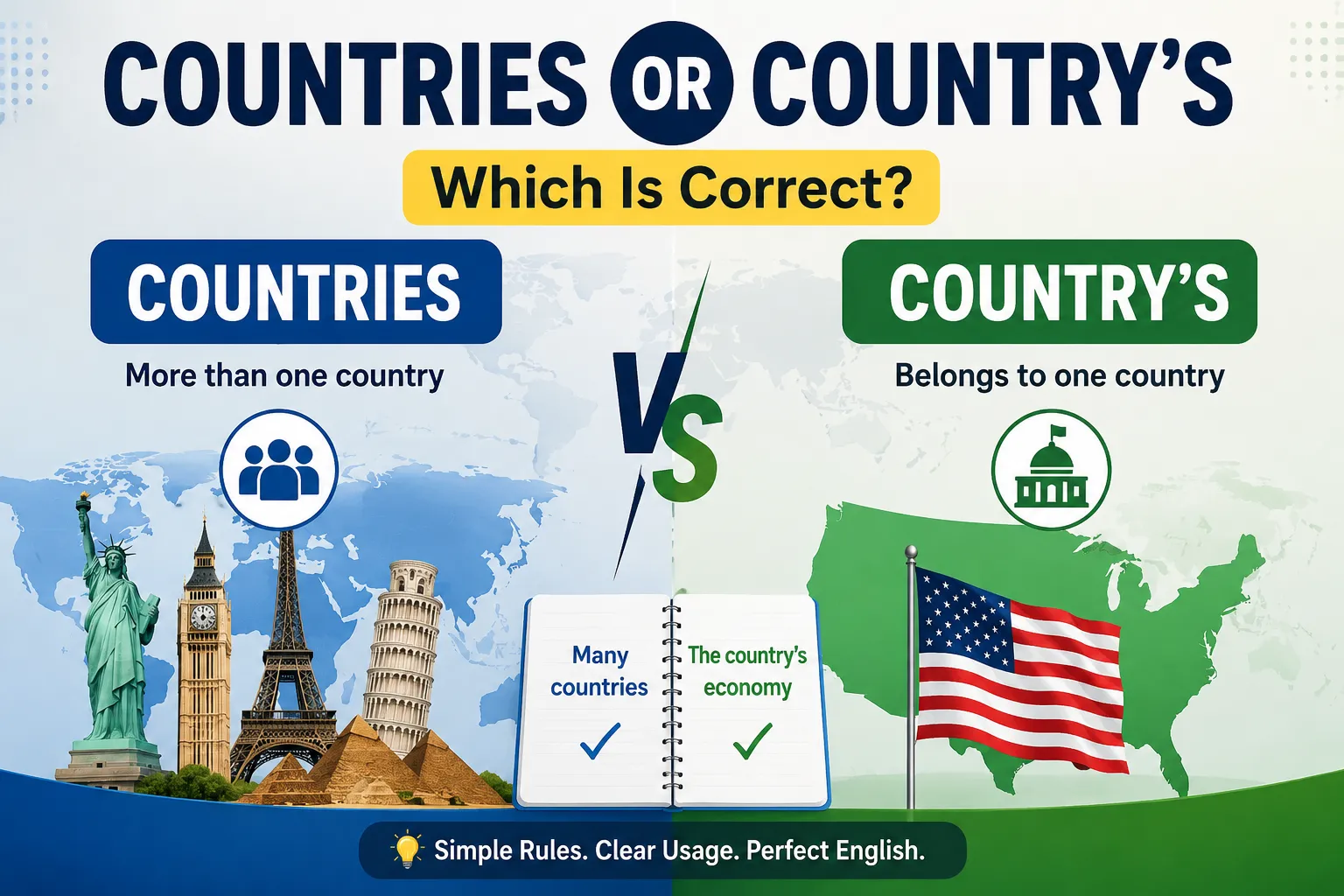
Countries is the plural of country, while country’s shows that something belongs to one country.
Have you ever stopped while writing and wondered, “Should I use countries or country’s?” You are not alone. These two forms look similar, but they have very different meanings. One is a plural form, while the other shows possession.
The word countries means more than one country. For example, “Many countries have beautiful mountains.” The word country’s means something belongs to one country. For example, “The country’s economy is growing.”
People often search for countries or country’s because the apostrophe can be confusing. English uses apostrophes for possession, but not for normal plural nouns. This simple rule can help you avoid many common spelling mistakes.
In this guide, you will learn the difference between countries and country’s, where these forms come from, how British and American English use them, and which form you should use in different situations. You will also see simple examples from emails, news, social media, and formal writing.
By the end, you will know exactly when to write countries and when to write country’s.
Countries or Country’s: Quick Answer
The correct form depends on what you want to say.
- Countries = plural of country. It means two or more countries.
- Country’s = possessive form of country. It means something belongs to one country.
Examples
Countries:
- Many countries speak English.
- We visited three countries last year.
- Different countries have different laws.
Country’s:
- The country’s capital is beautiful.
- The country’s economy is growing.
- The country’s leader gave a speech.
Easy rule
Think of it this way:
countries = more than one country
country’s = something belongs to one country
So, if you are talking about several nations, use countries. If you are showing ownership or connection to one country, use country’s.
The Origin of Countries or Country’s
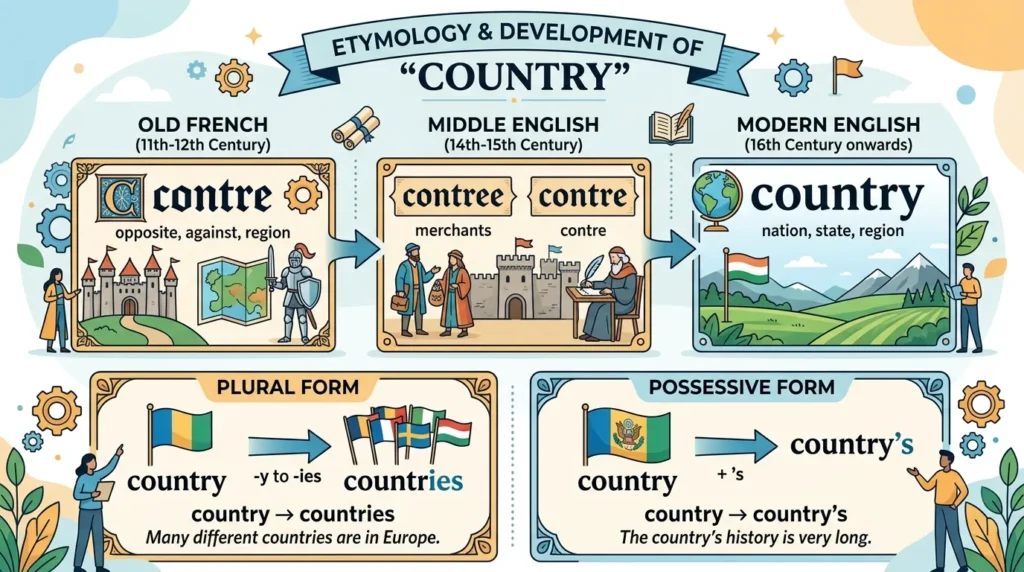
The word country comes from Old French contre, which was related to the idea of an area or region. Over time, the word developed into the English country.
The plural form follows a common English spelling rule.
When a noun ends in consonant + y, the y usually changes to ies when making the plural.
For example:
- country → countries
- city → cities
- family → families
- story → stories
This is why countrys is incorrect.
The form country’s is different. The apostrophe and s show possession.
For example:
- the country’s flag
- the country’s people
- the country’s history
Here, country’s means “belonging to the country” or “related to the country.”
The apostrophe is not used to make the plural countries.
British English vs American English Spelling
There is no difference between British and American English when using countries and country’s.
Both forms follow the same spelling and grammar rules.
| Meaning | British English | American English | Example |
|---|---|---|---|
| More than one country | countries | countries | Many countries joined the event. |
| Belonging to one country | country’s | country’s | The country’s flag is red. |
| Plural with apostrophe | ❌ countrys | ❌ countrys | Incorrect |
| Possessive plural | countries’ | countries’ | The countries’ leaders met. |
Countries
Use countries when you mean more than one country.
Several countries took part in the competition.
Country’s
Use country’s when something belongs to or is connected with one country.
The country’s population is growing.
Countries’
There is also a third form: countries’.
This means something belongs to more than one country.
The countries’ leaders signed an agreement.
This gives us three useful forms:
- country = one country
- countries = more than one country
- country’s = belonging to one country
- countries’ = belonging to more than one country
Which Spelling Should You Use?
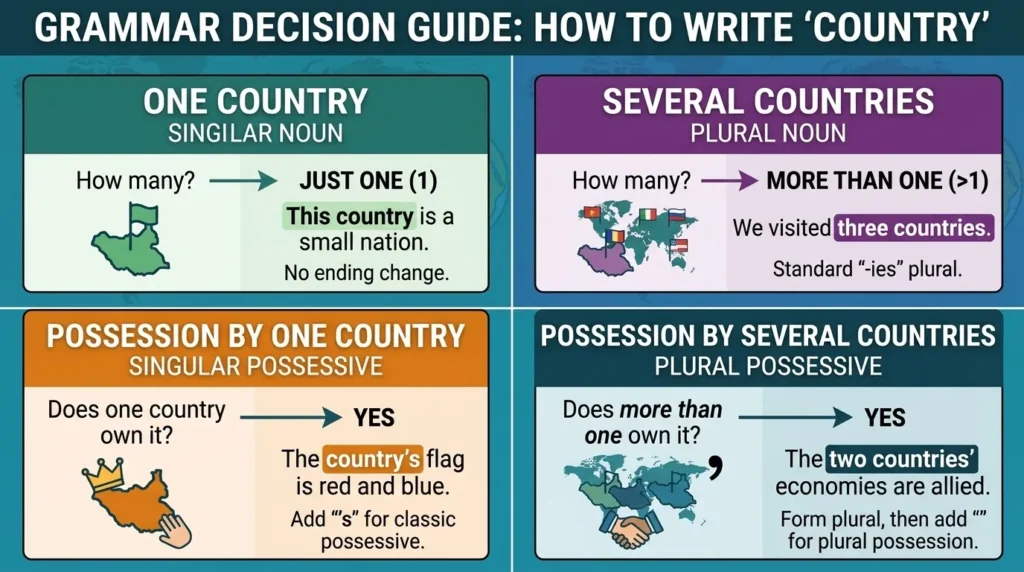
The answer is simple: use the form that matches your meaning.
If you mean several countries
Use countries.
Many countries have national parks.
If you mean something belonging to one country
Use country’s.
The country’s education system needs improvement.
If you mean something belonging to several countries
Use countries’.
The countries’ governments worked together.
This rule works in American English, British English, Australian English, Canadian English, and other standard forms of English.
If you write for a global audience, the same spelling rules apply. You do not need to choose between countries and country’s based on the country of your readers.
Choose based on meaning, not location.
Common Mistakes with Countries or Country’s
Here are some common mistakes to avoid.
Mistake 1: Using “countrys”
❌ I have visited many countrys.
✅ I have visited many countries.
The plural of country is countries, not countrys.
Mistake 2: Using “country’s” for a plural
❌ Many country’s have large cities.
✅ Many countries have large cities.
You need countries because you are talking about more than one country.
Mistake 3: Forgetting the apostrophe for possession
❌ The countries economy is growing.
If you mean one country:
✅ The country’s economy is growing.
Mistake 4: Confusing “countries’” and “country’s”
Use country’s for one country:
The country’s laws changed.
Use countries’ for several countries:
The countries’ laws are different.
Quick correction table
| Incorrect | Correct | Why? |
|---|---|---|
| countrys | countries | Plural spelling |
| country’s are | countries are | More than one country |
| countries economy | country’s economy | Possession |
| country’s leaders | country’s leaders | One country |
| country’s leaders | countries’ leaders | Several countries |
Countries or Country’s in Everyday Examples
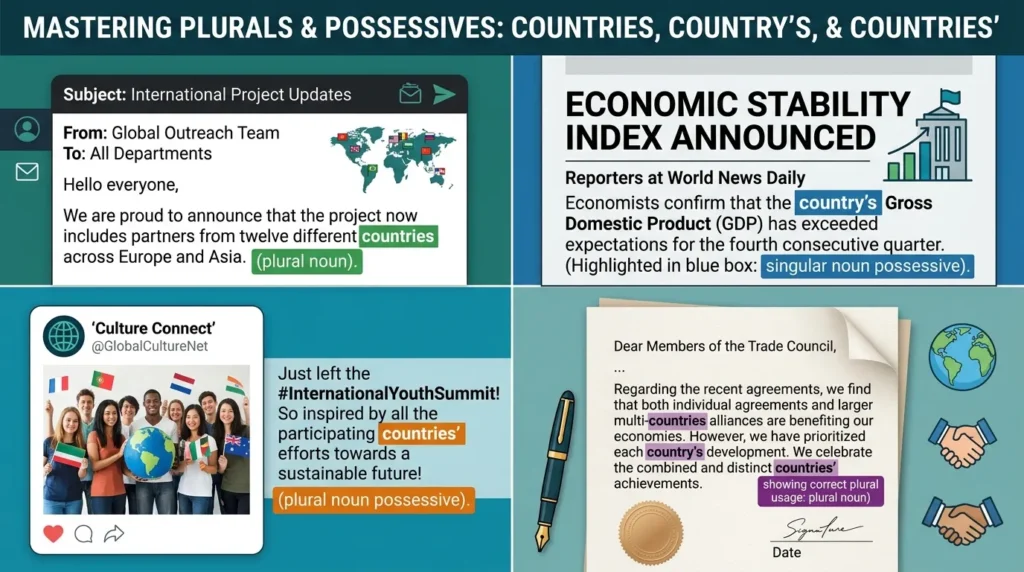
You can see these words in many types of writing.
In Emails
Our company works with clients from several countries.
Possessive example:
We follow the country’s business laws.
In News
News articles often use countries when discussing several nations.
Several countries announced new trade plans.
They use country’s for information about one nation.
The country’s economy showed strong growth.
On Social Media
You might write:
I would love to visit more countries.
Or:
The country’s culture is amazing.
In Formal Writing
In school, academic, and business writing, the same rules apply.
Different countries have different education systems.
The country’s education policy has changed.
The countries’ representatives met to discuss the issue.
See Also: Angle or Angel: What’s the Difference and Which Word Is Correct?
Countries or Country’s: Google Trends & Usage Data
Search interest for countries or country’s usually comes from people who are unsure about plural and possessive forms.
The two forms have very different uses, so comparing their raw search popularity is not the same as comparing two synonyms.
Countries is naturally much more common in general English because people often discuss multiple nations, travel, geography, politics, business, and international events.
Country’s is also common, but its use depends on a possessive structure. It usually appears before a noun:
- country’s economy
- country’s population
- country’s history
- country’s government
- country’s capital
Search patterns can also vary by country and language background. English learners may search for these forms when learning plural nouns, apostrophes, or possessive nouns.
Google Trends can help show search interest by location and time, but it should not be treated as a grammar authority. For correct usage, standard English grammar rules are more important than search volume.
Countries or Country’s: Comparison Table
| Word | Meaning | Number | Example |
|---|---|---|---|
| country | One nation | One | This country is beautiful. |
| countries | More than one nation | Two or more | Many countries are beautiful. |
| country’s | Something belonging to one country | One | The country’s flag is famous. |
| countries’ | Something belonging to several countries | Two or more | The countries’ leaders met. |
| countrys | Incorrect spelling | — | ❌ Do not use it. |
FAQs About Countries or Country’s
1. Is “countries” or “country’s” correct?
Both are correct, but they have different meanings. Countries is the plural of country. Country’s is the possessive form of country.
2. What is the plural of country?
The plural is countries.
One country → two countries
3. Is “countrys” correct?
No. Countrys is incorrect. The correct plural spelling is countries.
4. When should I use “country’s”?
Use country’s when something belongs to or is connected with one country.
The country’s capital is large.
5. What is the difference between country’s and countries’?
Country’s means belonging to one country.
Countries’ means belonging to more than one country.
6. Is “countries’” correct?
Yes. Countries’ is the possessive form of the plural countries.
The countries’ governments agreed on the plan.
7. Do British and American English spell these words differently?
No. Both British and American English use countries, country’s, and countries’ in the same way.
Conclusion
The difference between countries or country’s is simple once you understand the meaning of the apostrophe.
Use countries when you mean more than one country. For example, “Many countries have different cultures.” Use country’s when something belongs to one country. For example, “The country’s population is growing.”
There is also countries’, which shows possession by more than one country. For example, “The countries’ leaders met yesterday.”
Remember the basic pattern:
country = one
countries = more than one
country’s = belonging to one
countries’ = belonging to more than one
These rules are the same in British and American English. The key is not the type of English you use. The key is the meaning of your sentence.
If you remember this simple rule, you can avoid common mistakes such as countrys and using country’s as a plural. Always ask yourself: “Am I talking about several countries, or am I showing possession?” That question will help you choose the correct form every time.

Ali Hassan is an English language writer and educator who specializes in grammar, spelling, and commonly confused words. He creates simple and easy-to-understand content to help students, writers, and English learners improve their English with confidence.