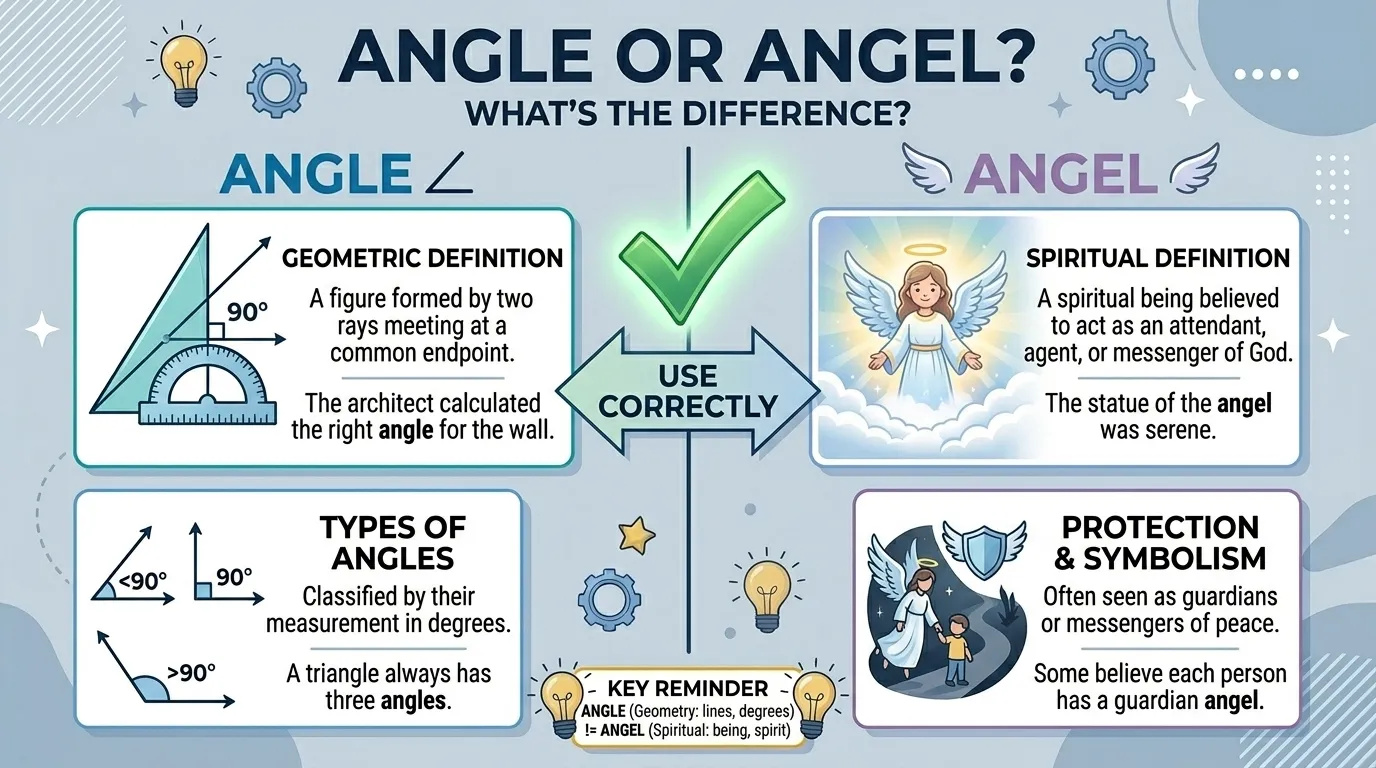
Angle refers to a shape, direction, position, or viewpoint.
Angel refers to a spiritual being or someone who is very kind and helpful.
Have you ever written angle or angel and stopped to ask which word is correct? You are not alone. These two words look almost the same, but they have very different meanings. One small letter can change the whole meaning of a sentence.
Angle and angel are both correct English words. The word you need depends on what you want to say. Angle is used for a shape, direction, viewpoint, or position. For example, “The camera was at a good angle.” Angel usually means a spiritual being, such as in “The story is about a guardian angel.”
People often search for angle or angel because the words are easy to mix up when reading or typing. The confusion can happen in school work, emails, social media posts, and everyday writing.
This guide explains the difference between angle and angel, their origins, common mistakes, and correct examples. By the end, you will know exactly when to use each word.
Angle or Angel: Quick Answer
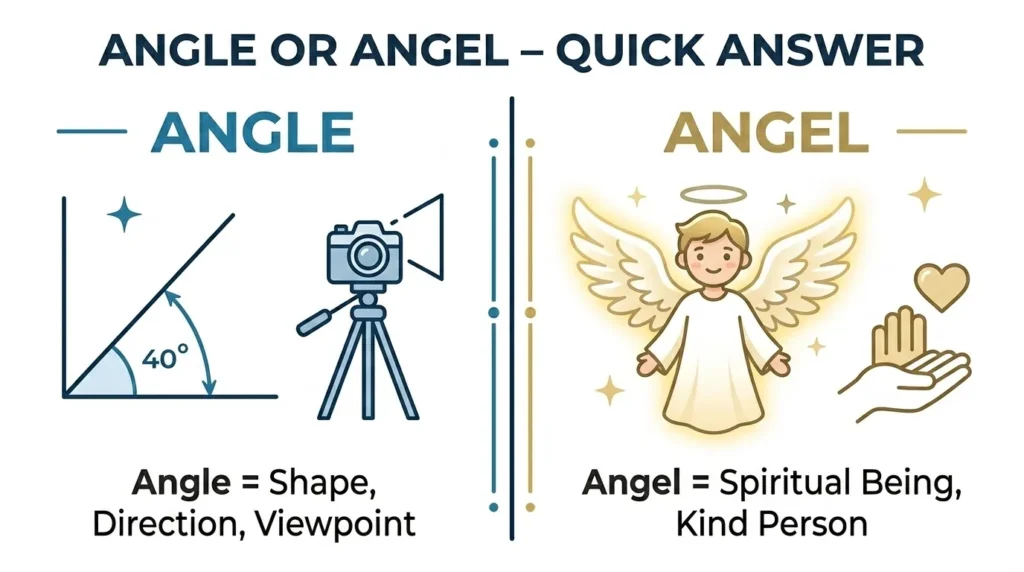
The quick answer is simple:
- Angle = a shape, direction, position, or viewpoint.
- Angel = a spiritual being or a person who is very kind or helpful.
Examples
Angle:
- Look at the picture from another angle.
- The two lines form a right angle.
- We need a better camera angle.
Angel:
- The angel appeared in the story.
- She believes her grandmother is her guardian angel.
- You are an angel for helping me.
A useful memory trick is:
Angle = geometry and viewpoints
Angel = a heavenly or kind being
Both spellings are correct, but they cannot normally be used in place of each other.
The Origin of Angle or Angel
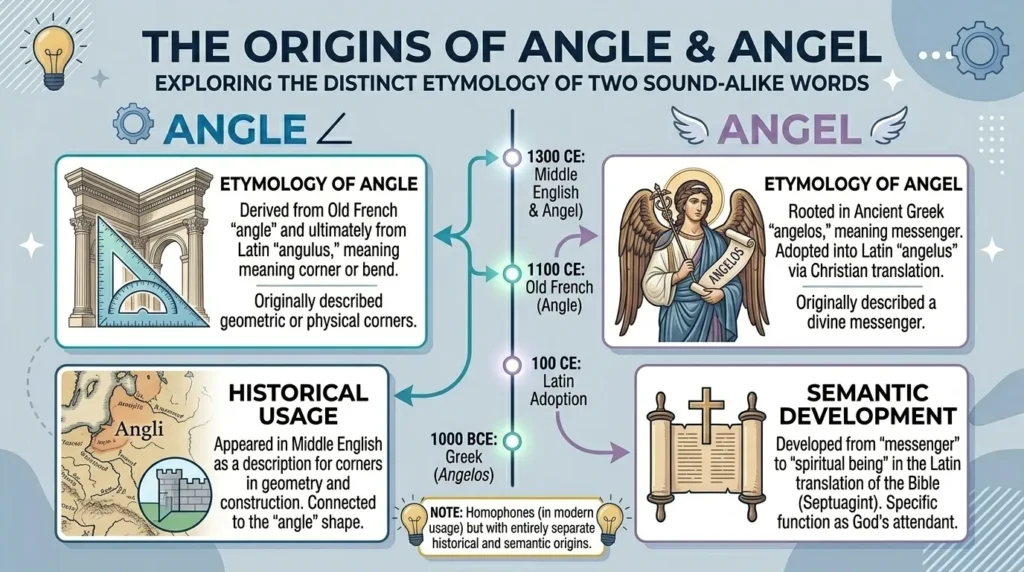
The words angle and angel have different histories, even though they look and sound similar.
The Origin of Angle
The word angle comes from Old French angle and Latin angulus, meaning a corner or bend. It became part of English through French.
Over time, angle developed several related meanings. It can describe the space between two lines, the direction of an object, or a particular way of looking at something.
For example:
- a 90-degree angle
- a camera angle
- a different angle on a problem
The Origin of Angel
The word angel comes from Greek angelos, meaning “messenger.” It passed into Latin and later Old English through religious language.
An angel is usually described as a spiritual being who serves as a messenger or helper.
For example:
- a guardian angel
- an angel in a religious story
- “You are an angel!” as a way to thank someone
The similar spelling is mainly a coincidence. The words have different roots and meanings.
British English vs American English Spelling
There is no major British-American spelling difference between angle and angel.
Both British English and American English use:
- angle
- angel
The meaning also stays the same in both forms of English.
| Word | British English | American English | Meaning |
|---|---|---|---|
| Angle | angle | angle | Direction, shape, or viewpoint |
| Angel | angel | angel | Spiritual being or kind person |
Examples in Both Varieties
British English:
The photographer changed the camera angle.
American English:
The photographer changed the camera angle.
British English:
The angel was part of the Christmas story.
American English:
The angel was part of the Christmas story.
So, unlike words such as colour/color or centre/center, you do not need a different spelling for angle or angel based on the country.
See Also: Kindergarden or Kindergarten? The Correct Spelling Explained
Which Spelling Should You Use?
You should choose the word based on its meaning, not your country.
Use “Angle” When:
You are talking about:
- geometry
- direction
- position
- photography
- a viewpoint
- a way of presenting an idea
Example:
Try looking at the problem from another angle.
Use “Angel” When:
You are talking about:
- a spiritual being
- a religious figure
- a guardian
- a very kind or helpful person
Example:
My mother was an angel when I needed help.
For US, UK, and Global Readers
The spelling is the same in American English, British English, Canadian English, Australian English, and most other forms of standard English.
The key is to focus on meaning.
Common Mistakes with Angle or Angel
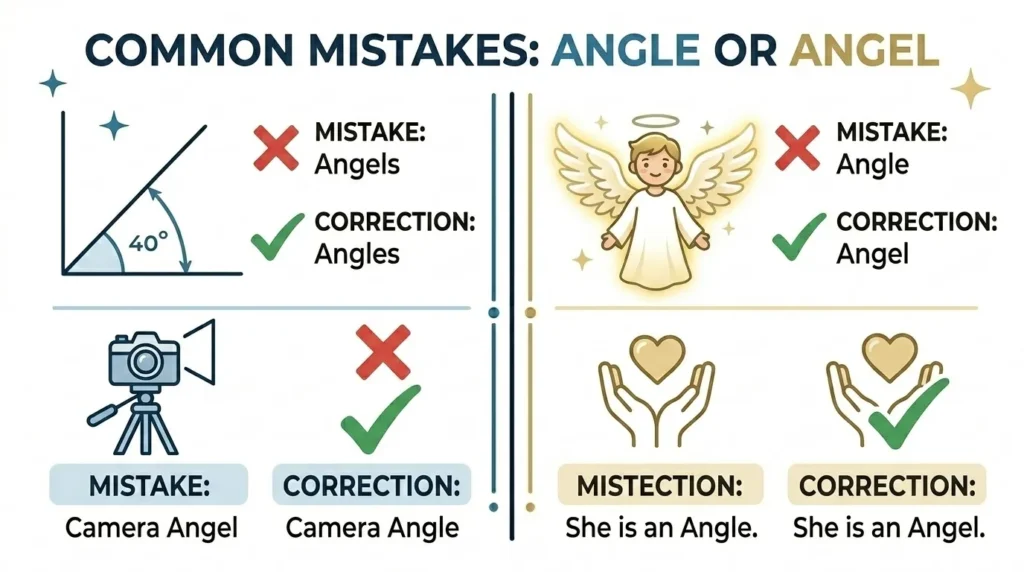
Because these words are so similar, writers often use one when they mean the other.
Mistake 1: Using “Angel” for Geometry
❌ The triangle has three angels.
✅ The triangle has three angles.
Here, angle is correct because the sentence is about geometry.
Mistake 2: Using “Angle” for a Spiritual Being
❌ The angle protected the child.
✅ The angel protected the child.
Here, angel is correct because the sentence refers to a spiritual being.
Mistake 3: Confusing “Camera Angle” and “Angel”
❌ Change the camera angel.
✅ Change the camera angle.
A camera has a position or viewpoint, so angle is correct.
Mistake 4: Calling Someone an “Angle”
❌ You are such an angle!
✅ You are such an angel!
When you call someone an angel, you mean they are kind, helpful, or wonderful.
Angle or Angel in Everyday Examples
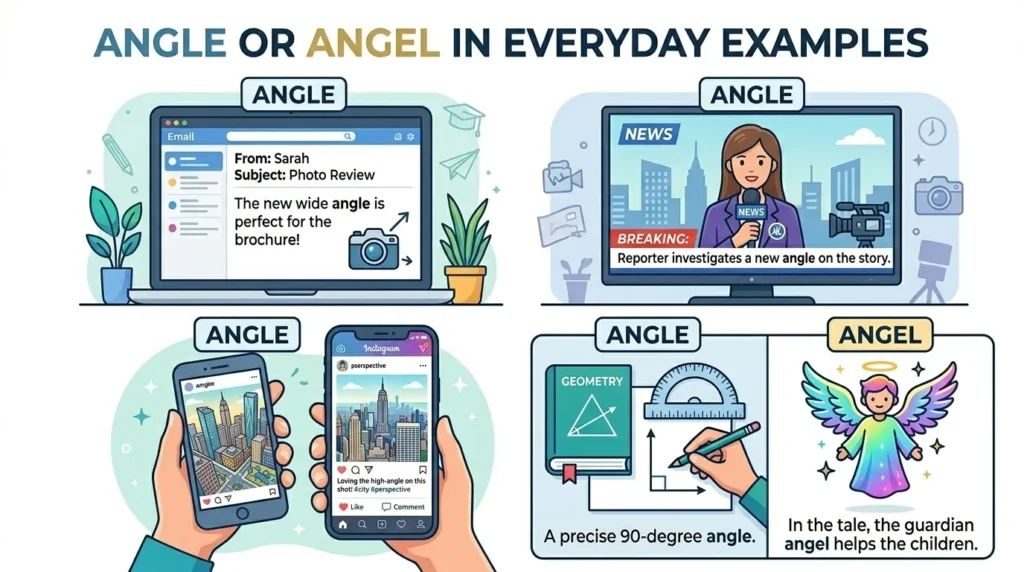
Both words appear often in everyday English, but they are used in very different situations.
In Emails
Angle:
Could you send me the photo from a different angle?
Angel:
Thank you for helping me. You are an angel!
In News
Angle:
The reporter looked at the story from a new angle.
News writers often use angle to describe a particular way of covering a story.
On Social Media
Angle:
This photo looks great from this angle.
Angel:
My little sister is a real angel.
In Formal Writing
Angle:
The study examines the issue from a new angle.
Angel:
The text describes an angel as a messenger.
In School Writing
Angle:
A right angle measures 90 degrees.
Angel:
The story describes an angel who helps the main character.
Angle or Angel: Comparison Table
| Feature | Angle | Angel |
|---|---|---|
| Spelling | Angle | Angel |
| Main meaning | Shape, direction, or viewpoint | Spiritual being |
| Common use | Math, photography, writing | Religion, stories, everyday speech |
| Example | Find the correct angle. | The angel helped him. |
| Related word | Angular | Angelic |
| British spelling | Angle | Angel |
| American spelling | Angle | Angel |
| Pronunciation | Usually “ANG-gul” | Usually “AYN-jul” |
The biggest difference is the first vowel sound and the meaning.
Angle or Angel: Google Trends & Usage Data
Search interest for angle is generally broad because it is used in many fields. People may search for it when studying geometry, photography, journalism, design, or mathematics.
Angel also has wide use. It appears in religious discussions, books, movies, names, songs, social media, and everyday expressions.
Search patterns can change by country and topic. For example, searches for angle may be linked to math or photography, while searches for angel may be linked to religion, entertainment, or personal names.
It is also important to remember that search popularity does not mean one spelling is more correct than the other. Angle and angel are both standard English words.
When checking search trends, always look at the context. A high number of searches for angel does not mean it should replace angle in a sentence about geometry.
FAQs About Angle or Angel
1. Is “angle” or “angel” correct?
Both are correct words. Angle refers to a shape, direction, or viewpoint. Angel usually refers to a spiritual being or a very kind person.
2. What is the difference between angle and angel?
An angle is related to geometry, direction, position, or viewpoint. An angel is a spiritual being or, informally, a very kind person.
3. Is “angel” a spelling mistake for “angle”?
No. Angel is a real English word. It is only a mistake when you use it when you mean angle.
4. Is “angle” used in math?
Yes. In mathematics and geometry, an angle is formed when two lines or rays meet.
5. How do you remember angle vs angel?
Think of angle as a geometry word and angel as a heavenly word. You can remember angel by connecting it with angelic.
6. Is the spelling different in British and American English?
No. Both British and American English use angle and angel with the same spelling.
7. Can “angel” mean a kind person?
Yes. In informal English, you can call someone an angel when they are very kind or helpful.
Conclusion
The difference between angle and angel is easy to understand once you focus on meaning. Angle is used for a shape, direction, position, or viewpoint. It is common in math, photography, journalism, and everyday speech. For example, you can talk about a right angle, a camera angle, or a new angle on a problem.
Angel, on the other hand, usually refers to a spiritual being. It can also describe someone who is very kind or helpful. For example, you might say, “The angel appeared in the story,” or “You are an angel for helping me.”
There is no British or American spelling difference between these two words. Both varieties use angle and angel.
The best way to avoid mistakes is to remember their meanings. If you are talking about geometry, direction, or viewpoint, use angle. If you mean a spiritual being or a kind person, use angel. Once you learn this simple difference, choosing the correct word becomes easy.

Ali Hassan is an English language writer and educator who specializes in grammar, spelling, and commonly confused words. He creates simple and easy-to-understand content to help students, writers, and English learners improve their English with confidence.