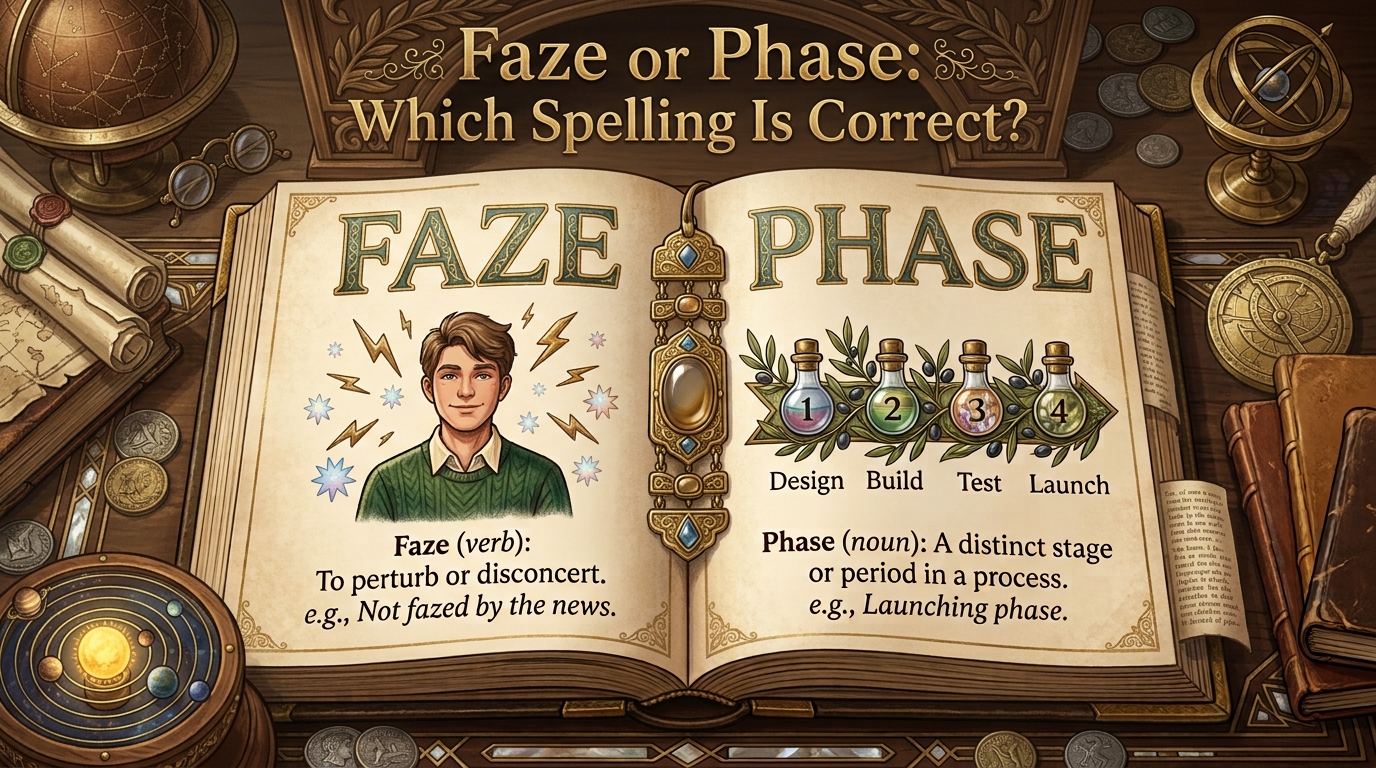
Faze means to disturb or upset someone, while phase means a stage or period in a process.
Have you ever written a sentence and wondered whether faze or phase is the right word? You are not alone. These two words sound the same, which makes them easy to confuse. However, they have different meanings and should not be used in the same situations.
People often search for faze or phase because both words are pronounced /feɪz/, but their meanings are completely different. Faze is a verb that means to disturb, worry, upset, or unsettle someone. Phase usually means a stage or period in a process. It can also be used as a verb in phrases such as phase in and phase out. Cambridge defines faze as upsetting or worrying someone, while phase refers to a stage or period that forms part of a longer process.
This guide explains the difference between faze or phase in simple language. You will learn their meanings, origins, common mistakes, British and American usage, everyday examples, and practical rules for choosing the correct word.
Faze or Phase: Quick Answer

Both faze and phase are correct words. The correct choice depends on what you mean.
When to use faze
Use faze when you mean to disturb, worry, upset, or unsettle someone.
The criticism did not faze her.
Nothing seems to faze him.
When to use phase
Use phase when you mean a stage, period, or part of a process.
The project is entering its final phase.
The first phase of the research is complete.
Easy memory trick:
Faze = disturb someone.
Phase = a stage or period.
The two words sound alike, but their meanings and spellings are different.
The Origin of Faze or Phase
The origin of faze
The verb faze appeared in American English around 1830. Etymological records connect it with the older dialect word feeze, meaning to frighten, alarm, or discomfit. Its deeper history can be traced to Old English forms meaning to drive away or put to flight.
Over time, faze developed its modern meaning of disturbing or unsettling someone.
For example:
The difficult question did not faze the student.
The related word unfazed means not disturbed or worried. It has been recorded since the early 20th century.
The origin of phase
Phase has a completely different history. It entered English in the early 18th century in connection with the changing appearance of the moon. The word came through Modern Latin from Greek phasis, meaning appearance.
Its meaning later expanded from the appearance of the moon to a particular stage or period of development.
For example:
The company is entering a new phase of growth.
The word phase is now common in science, business, education, technology, and everyday English.
Why do faze and phase cause confusion?
The main reason is pronunciation. Faze and phase are pronounced the same way in both British and American English. Cambridge gives the pronunciation of faze as /feɪz/ in both varieties.
They are therefore homophones, meaning they sound alike but have different spellings and meanings.
British English vs American English Spelling
Is there a British and American spelling difference?
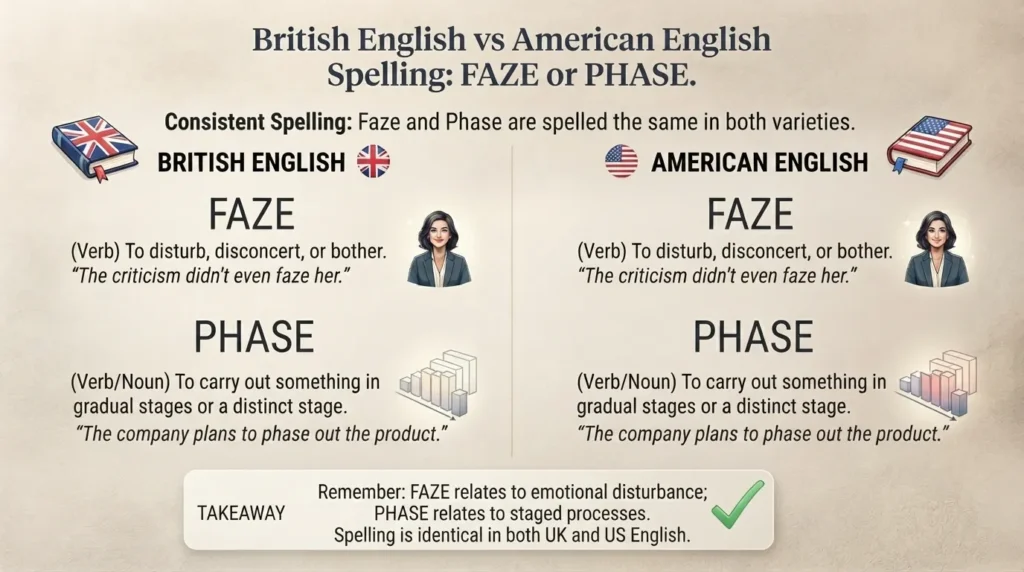
No. Faze and phase are not British and American spelling variations.
Both British and American English use:
| Word | British English | American English | Meaning | Example |
|---|---|---|---|---|
| Faze | Faze | Faze | To disturb or upset | The news did not faze her. |
| Fazed | Fazed | Fazed | Disturbed or upset | He was not fazed by the criticism. |
| Phase | Phase | Phase | A stage or period | The project entered a new phase. |
| Phased | Phased | Phased | Done in stages | The changes were phased in. |
So, unlike colour and color or centre and center, you do not choose faze or phase based on whether you are writing for a British or American audience.
The meaning determines the spelling.
How are the words used in both varieties?
British and American writers use faze when referring to someone’s emotional reaction.
The pressure did not faze the player.
Both varieties also use phase for stages and periods.
The project has reached its final phase.
The basic distinction remains the same in both forms of English.
Which Spelling Should You Use?
American English
Use faze when something does not bother or unsettle a person.
Public speaking does not faze her.
Use phase for a stage or period.
The company is entering a new phase.
British English
The same rule applies in British English.
The criticism did not faze him.
The project is in its second phase.
There is no regional spelling choice between these two words.
UK and Commonwealth Countries
Writers in the UK and Commonwealth countries should also choose the word according to its meaning.
Do not assume that faze is an American spelling of phase. They are separate words with different histories.
International Readers
For international writing, use the word that matches your intended meaning.
If you mean disturb, choose faze.
If you mean stage, choose phase.
This simple rule works regardless of the reader’s country.
Academic and Professional Writing
Be especially careful with these words in formal writing. A spelling mistake can change the meaning of your sentence.
For example:
The criticism did not faze the researcher.
This means the researcher was not disturbed.
But:
The criticism did not phase the researcher.
This does not express the intended meaning.
Common Mistakes with Faze or Phase
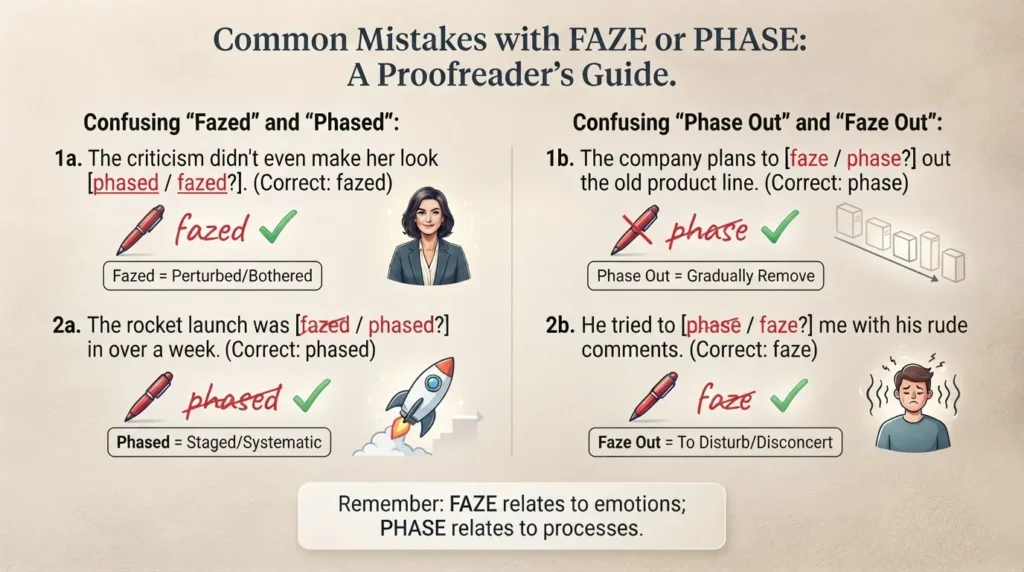
Mistake 1: Using phase instead of faze
Incorrect:
The difficult situation did not phase her.
Correct:
The difficult situation did not faze her.
Why: The sentence means that the situation did not upset or disturb her.
Mistake 2: Using faze for a stage
Incorrect:
The project has entered a new faze.
Correct:
The project has entered a new phase.
Why: A stage or period in a process is a phase.
Mistake 3: Writing phased when you mean fazed
Incorrect:
She was not phased by the criticism.
Correct:
She was not fazed by the criticism.
Why: Fazed is the past form of faze, meaning disturbed or upset.
Mistake 4: Writing faze out
Incorrect:
The company will faze out the old system.
Correct:
The company will phase out the old system.
Why: Phase out means to remove something gradually or in planned stages.
Mistake 5: Assuming the words are spelling variations
Incorrect idea:
Faze is the American spelling and phase is the British spelling.
Correct idea:
Faze and phase are different words. Their meanings, not regional spelling rules, determine which one you should use.
Read more 👉: Emphasises or Emphasizes: Which Spelling Is Correct?
Faze or Phase in Everyday Examples
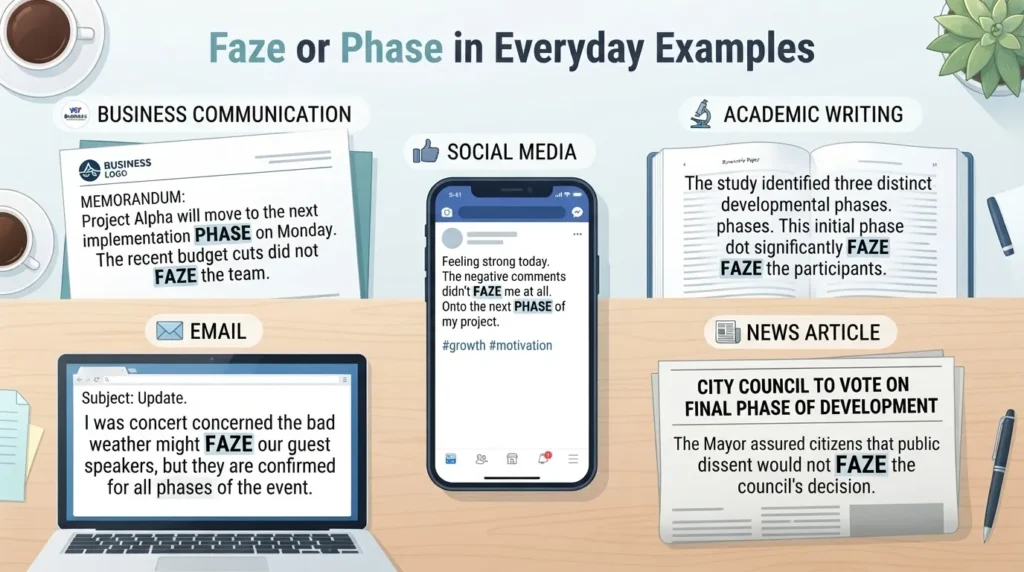
In Emails
Faze:
The unexpected delay did not faze our team.
Phase:
We have completed the first phase of the project.
In News Writing
Faze:
The athlete was not fazed by the pressure.
Phase:
The government has begun the next phase of the plan.
On Social Media
Faze:
Negative comments do not faze me.
Phase:
I think this is just a temporary phase.
In Academic Writing
Faze:
The unexpected result did not faze the researchers.
Phase:
The second phase of the study focused on data collection.
In Business Communication
Faze:
The challenging question did not faze the manager.
Phase:
The company is preparing for the next phase of expansion.
In Formal Writing
Faze:
The criticism did not faze the author.
Phase:
The research project has entered its final phase.
Faze or Phase: Google Trends & Usage Data
What do people search for?
People often search for faze or phase because the words sound identical. Common search intent includes questions about phrases such as not fazed, phase out, and the difference between faze and phase.
The words also appear in very different contexts. Faze is mainly associated with reactions, emotions, pressure, criticism, and confidence. Phase is widely used for stages, processes, development, science, projects, and gradual changes.
Is one word more popular?
It is difficult to give a reliable worldwide popularity percentage without a specific Google Trends search, country, date range, and search category. Search volume can also reflect very different meanings and phrases.
For that reason, exact percentages or rankings should not be presented without current data.
The established usage distinction is clear. Faze means to disturb or upset someone, while phase generally means a stage or period and can also be a verb meaning to introduce or remove something gradually.
Where are the words used?
Both words are used in British and American English.
Faze is common when discussing:
- Emotional reactions
- Pressure
- Criticism
- Fear
- Confidence
- Difficult situations
Phase is common when discussing:
- Projects
- Development
- Science
- Technology
- Business
- Processes
- Periods of life
Faze or Phase Comparison
| Variation | Correct? | Meaning | Region | Part of Speech | Example |
|---|---|---|---|---|---|
| Faze | Yes | To disturb or upset | British and American | Verb | Nothing can faze her. |
| Fazed | Yes | Disturbed or upset | British and American | Verb | He was not fazed by the news. |
| Phase | Yes | A stage or period | British and American | Noun | The project is in its final phase. |
| Phase | Yes | To introduce or remove gradually | British and American | Verb | They will phase out the old system. |
| Phased | Yes | Done in stages | British and American | Verb or adjective | The changes were phased in. |
Faze Meaning and Related Forms
Faze meaning and faze definition
The faze meaning is simple: to disturb, upset, worry, or unsettle someone. It is almost always used to describe a reaction, usually in the negative, to say that someone was not bothered by something difficult or unexpected.
The tough question did not faze the candidate.
Fazes and fazing
Faze follows regular verb rules. The present tense form for a singular subject is fazes, and the continuous form is fazing.
Nothing ever fazes him. (fazes)
The constant criticism was not fazing her at all. (fazing)
Nothing fazes me
“Nothing fazes me” is one of the most common phrases built from this word. It means that a person stays calm and unbothered no matter what happens.
After years in customer service, nothing fazes me anymore.
Faze him or phase him?
Faze him is correct when you mean someone was not disturbed or upset.
The heckler did not faze him.
Phase him is not a standard expression. “Phase” describes stages in a process, not a person’s reaction, so it does not pair naturally with a pronoun like “him” in this way. If you see “phase him,” it is almost always a misspelling of faze him.
FAQs About Faze or Phase
1. Which spelling is correct, faze or phase?
Both are correct, but they have different meanings. Faze means to disturb or upset someone, while phase usually means a stage or period.
2. What is the difference between faze and phase?
Faze is a verb related to someone’s emotional reaction. Phase usually refers to a stage or period and can also describe something introduced or removed gradually.
3. Are both spellings accepted?
Yes. Both faze and phase are standard English words. They are not alternative spellings of the same word.
4. Which spelling should I use in American English?
Use faze when you mean disturb or upset. Use phase when you mean a stage, period, or gradual process.
5. Which spelling should I use in British English?
The same rule applies in British English. Use faze for disturbance and phase for a stage or period.
6. Which form is better for formal writing?
Both forms are appropriate in formal writing when used correctly. The important thing is to choose the word that matches your intended meaning.
7. Which version should international readers use?
There is no special international spelling. Use faze for disturb and phase for stage or period. This rule works for readers worldwide.
Conclusion
Knowing the difference between faze or phase is simple once you connect each word with its meaning. Faze is a verb that means to disturb, upset, worry, or unsettle someone. Phase usually means a stage or period in a process. It can also be used as a verb in expressions such as phase in and phase out.
The most useful rule is easy to remember: faze means disturb, while phase means stage. For example, “The criticism did not faze her” means that the criticism did not upset her. “The project entered a new phase” means that the project moved into a new stage.
There is no British versus American spelling difference between these words. Both varieties of English use faze and phase in the same way. When writing emails, academic papers, business documents, news articles, or social media posts, always choose the word based on its meaning.
Once you remember this simple distinction, you can avoid one of the most common homophone mistakes in English.