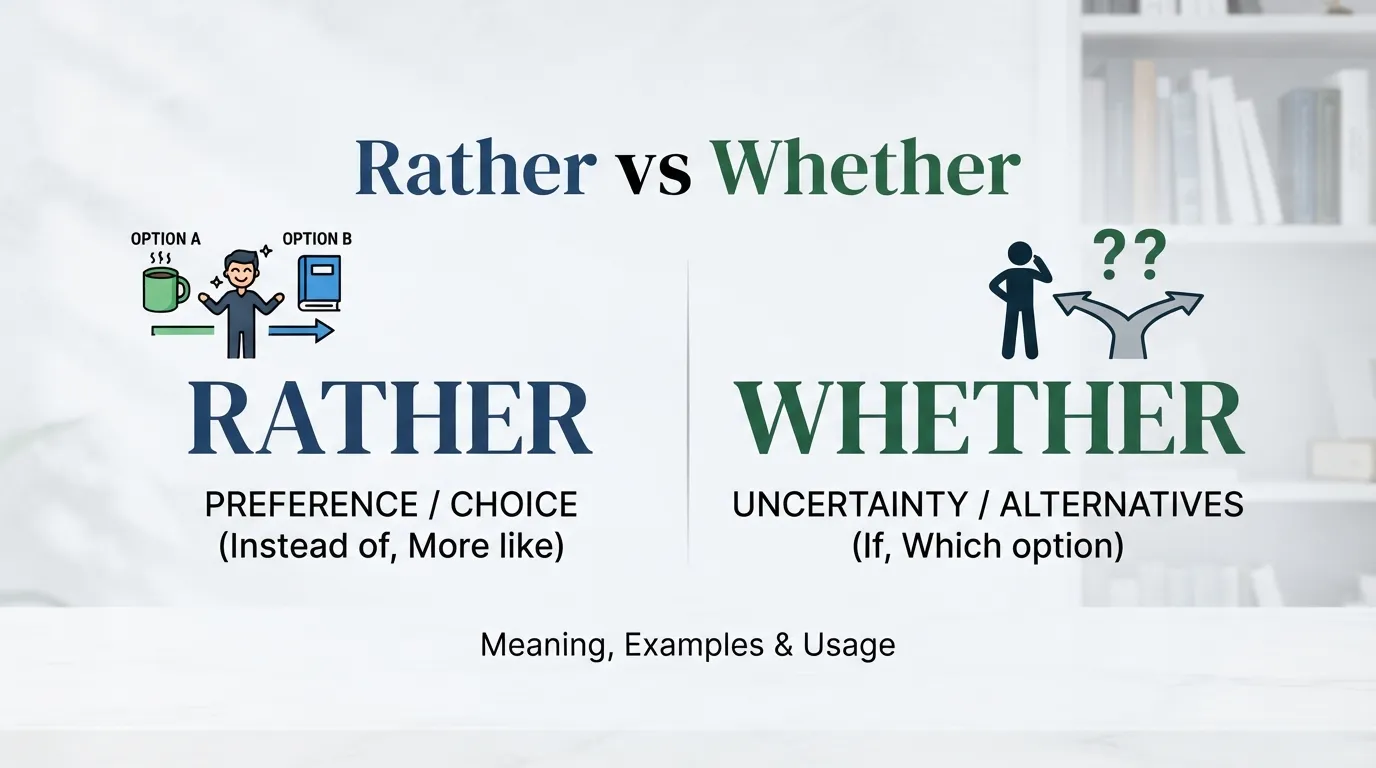
Use rather to express preference or degree, and use whether to talk about choices, alternatives, or uncertainty.
Have you ever paused mid sentence, unsure if you should write “whether” or “rather”? You are not alone. These two words look nothing alike, yet writers mix them up constantly, especially in fast typing, voice to text apps, and casual messaging. The confusion usually comes from two places: both words appear in similar sentence positions (often before “than” or “or”), and both relate to choices in some way. But their jobs in a sentence are completely different. “Whether” presents options or uncertainty, almost like an invisible “if.” “Rather” expresses preference, contrast, or intensity. Getting them confused can change the entire meaning of a sentence, or make it grammatically incorrect. This guide gives you a fast, clear answer first, then walks through the history of both words, how they are used around the world, common mistakes people make, and real examples from emails, news, and social media, so you never second guess yourself again.
Rather vs Whether: Quick Answer
- Whether = used to talk about a choice between options or an uncertain outcome. Example: I do not know whether she is coming to the party.
- Rather = used to show preference, correction, or a stronger degree. Example: I would rather walk than take the bus.
A simple test: if you can replace the word with “if” and the sentence still makes sense, use whether. If you can replace it with “instead” or “more accurately,” use rather.
The Origin of Rather vs Whether
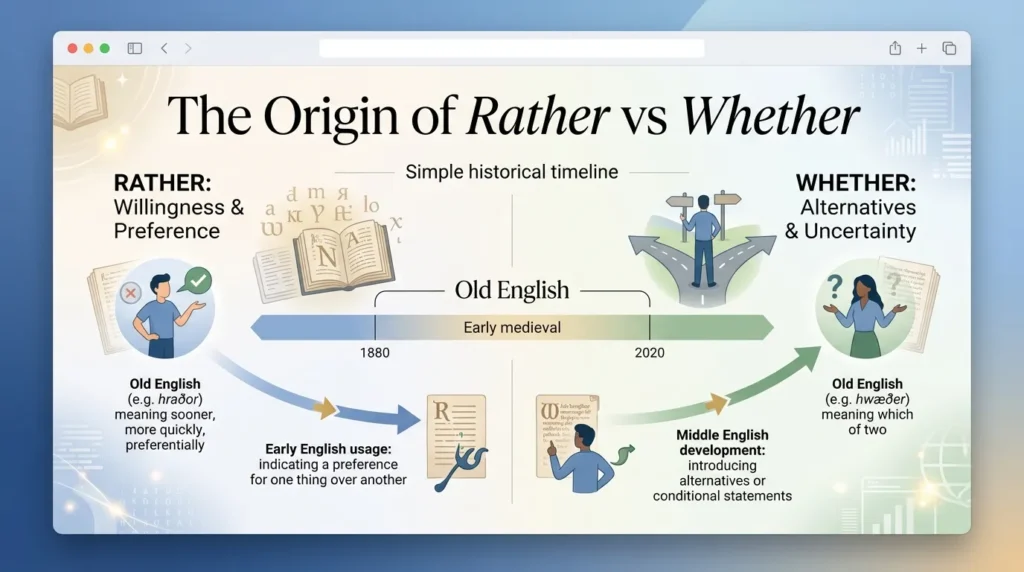
Both words come from Old English, and neither one is a spelling variation of the other. They evolved along separate paths.
Whether comes from the Old English word “hwæðer,” meaning “which of two.” It has always carried the idea of choosing between two or more possibilities. Over centuries, the spelling simplified from “hwæðer” to “whether,” but its core meaning barely changed.
Rather comes from “hraþor,” the comparative form of “hræd,” an Old English word meaning “quick” or “ready.” Originally it meant “more quickly” or “sooner,” and over time this shifted into the modern sense of preference, something you would choose “sooner” than another option.
So while they are unrelated in origin, both words developed meanings tied to choice and comparison, which is likely why people confuse them today.
British English vs American English Spelling
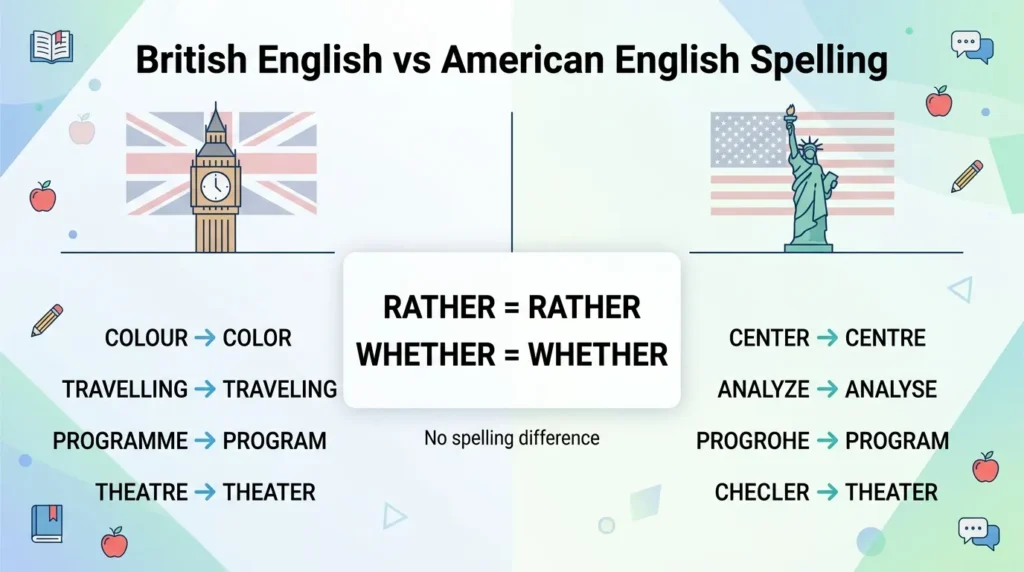
Here is something important: rather and whether are spelled exactly the same in both British and American English. Unlike words such as “colour/color” or “realise/realize,” there is no regional spelling split for these two words.
What does differ slightly between regions is usage style and formality. British English tends to use “whether” more freely in formal writing, including phrases like “whether or not,” while American English sometimes shortens this to just “whether” in casual contexts. “Rather” is used in both dialects in nearly identical ways, though British speakers use it more often as a mild interjection meaning “yes, definitely,” a usage that is rare in American English today.
| Feature | British English | American English |
|---|---|---|
| Spelling of “whether” | whether | whether |
| Spelling of “rather” | rather | rather |
| “whether or not” usage | Common in formal writing | Often shortened to “whether” |
| “rather” as agreement (e.g., “Rather!”) | Occasionally used, informal, older style | Rarely used |
| Overall difference | None in spelling | None in spelling |
Which Spelling Should You Use?
Since there is no spelling difference, this section is really about which word fits your sentence, no matter where you are writing from.
- For US readers: Use “whether” for choices and conditions, and “rather” for preference. American style guides recommend dropping “or not” after whether unless needed for clarity, for example “I wonder whether it will rain” is preferred over “whether or not it will rain.”
- For UK and Commonwealth readers: The same rules apply. “Whether or not” is common in formal UK writing, especially legal and business documents, so keep it if your style guide calls for it.
- For global or ESL writers: Focus on meaning rather than region. Ask yourself: am I describing a choice (whether) or a preference (rather)? That question works everywhere.
Read more 👉: Address or Adress: Which Spelling Is Actually Correct?
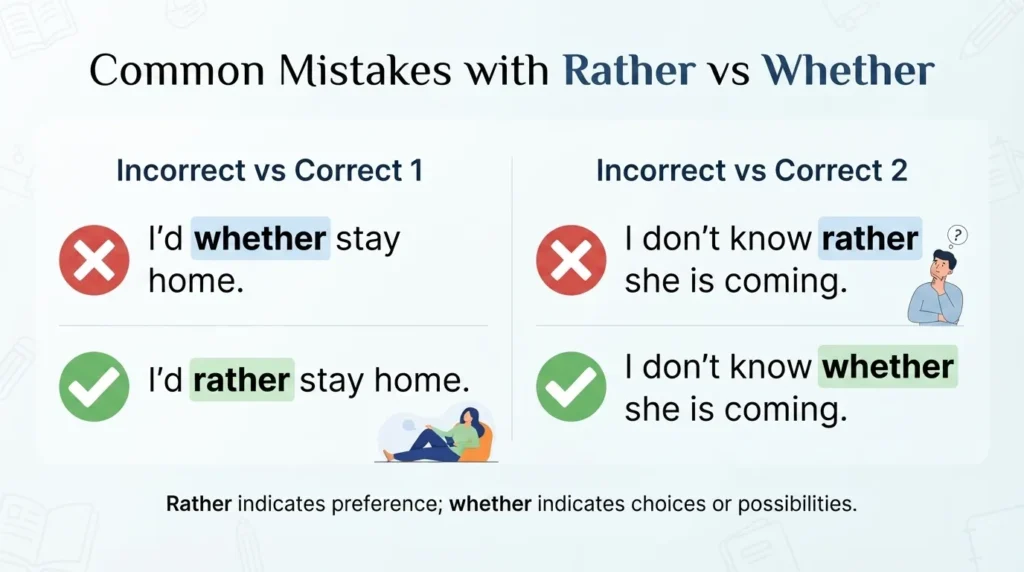
Common Mistakes with Rather vs Whether
- Using “weather” instead of “whether.” Wrong: I do not know weather I should go. Right: I do not know whether I should go.
- Using “rather” when the sentence needs a choice, not a preference. Wrong: I am not sure rather she left already. Right: I am not sure whether she left already.
- Adding “or not” unnecessarily after whether. Wrong (in tight formal writing): Whether or not it rains, we will go. Better: Whether it rains or not, we will go, or simply: Even if it rains, we will go.
- Forgetting “than” after rather in comparisons. Wrong: I would rather stay home going out. Right: I would rather stay home than go out.
- Using rather to describe uncertainty. Wrong: She asked rather I was coming. Right: She asked whether I was coming.
Rather and Whether in Everyday Examples
In emails: “Please confirm whether you will attend the meeting on Friday.” “I would rather schedule the call for next week if possible.”
In news headlines: “Officials debate whether new policy will reduce costs.” “Voters seem to prefer a slower approach rather than rapid change.”
On social media: “Not sure whether I should post this or wait until tomorrow lol.” “Honestly I would rather binge watch the whole season tonight.”
In formal writing: “The committee must determine whether the proposal meets legal requirements.” “The report suggests a phased rollout rather than an immediate launch.”
Rather vs Whether: Google Trends and Usage Data
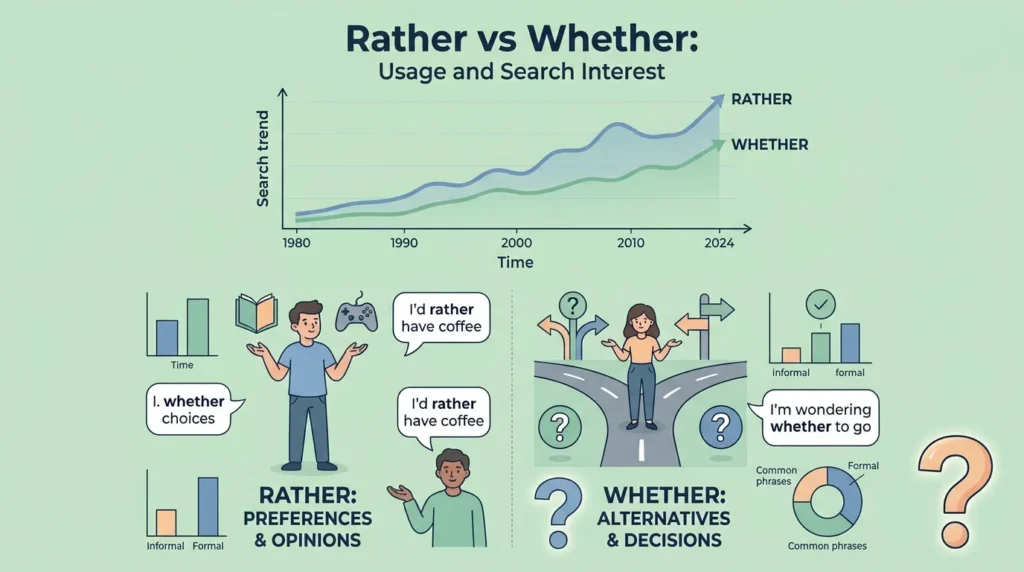
Search interest for both terms stays fairly steady worldwide, since they are common everyday words rather than trending slang. “Whether” tends to see slightly higher search volume overall, largely because people search for grammar help with phrases like “whether or not” and “whether vs if.” “Rather” sees consistent interest tied to phrases like “would rather” and “rather than,” especially among English learners practicing comparative sentence structures.
English speaking countries such as the United States, the United Kingdom, India, Canada, and Australia show the highest search activity for both terms, often from students, writers, and non native speakers checking grammar rules before submitting essays, emails, or assignments.
| Variation | Common Use | Formality Level |
|---|---|---|
| whether | Choices, conditions, uncertainty | Neutral to formal |
| whether or not | Emphasized choice, formal writing | Formal |
| rather | Preference, correction | Neutral to formal |
| would rather | Everyday preference statements | Informal to neutral |
| rather than | Direct comparison between two things | Neutral to formal |
Frequently Asked Questions
1. What is the difference between rather and whether? “Whether” introduces a choice or condition, while “rather” expresses preference or contrast.
2. Can I use “whether” and “if” interchangeably? Often yes, especially in casual speech, but “whether” is preferred in formal writing and when presenting two clear options.
3. Is “whether or not” grammatically correct? Yes, it is correct, though many style guides suggest using just “whether” unless “or not” adds necessary emphasis.
4. What comes after “rather” in a sentence? Usually “than,” as in “rather than,” when making a comparison, for example “I would rather read than watch TV.”
5. Is rather formal or informal? “Rather” works in both formal and informal writing. It sounds slightly more formal than “kind of” or “pretty,” but less formal than academic alternatives like “somewhat.”
6. Do British and American English spell these words differently? No, both “rather” and “whether” are spelled identically in British and American English. Only usage style varies slightly.
7. How can I remember the difference quickly? Think “whether equals which,” since both start with “wh” and involve choosing between options. “Rather” pairs naturally with “than,” so if you need a comparison word, reach for rather.
Conclusion
“Rather” and “whether” may sound similar in certain sentences, but they serve very different purposes. “Whether” signals a choice, condition, or uncertainty, often standing in for “if.” “Rather” expresses preference, correction, or a stronger alternative, and usually pairs with “than.” There is no British versus American spelling difference here, so writers everywhere can focus purely on meaning instead of regional rules. The simplest way to choose correctly is to test the sentence: if “if” fits, use whether; if “instead” or “more precisely” fits, use rather. Watch out for the classic mix ups, confusing “whether” with “weather,” or forgetting “than” after “rather,” since these small errors are easy to catch once you know what to look for. With this guide, you now have a quick answer, the word history, real world examples, and a comparison table to reference anytime you are unsure, so your writing stays clear, correct, and confident in any setting, formal or casual.




1 thought on “Rather vs Whether: What Is the Difference and When to Use Each”