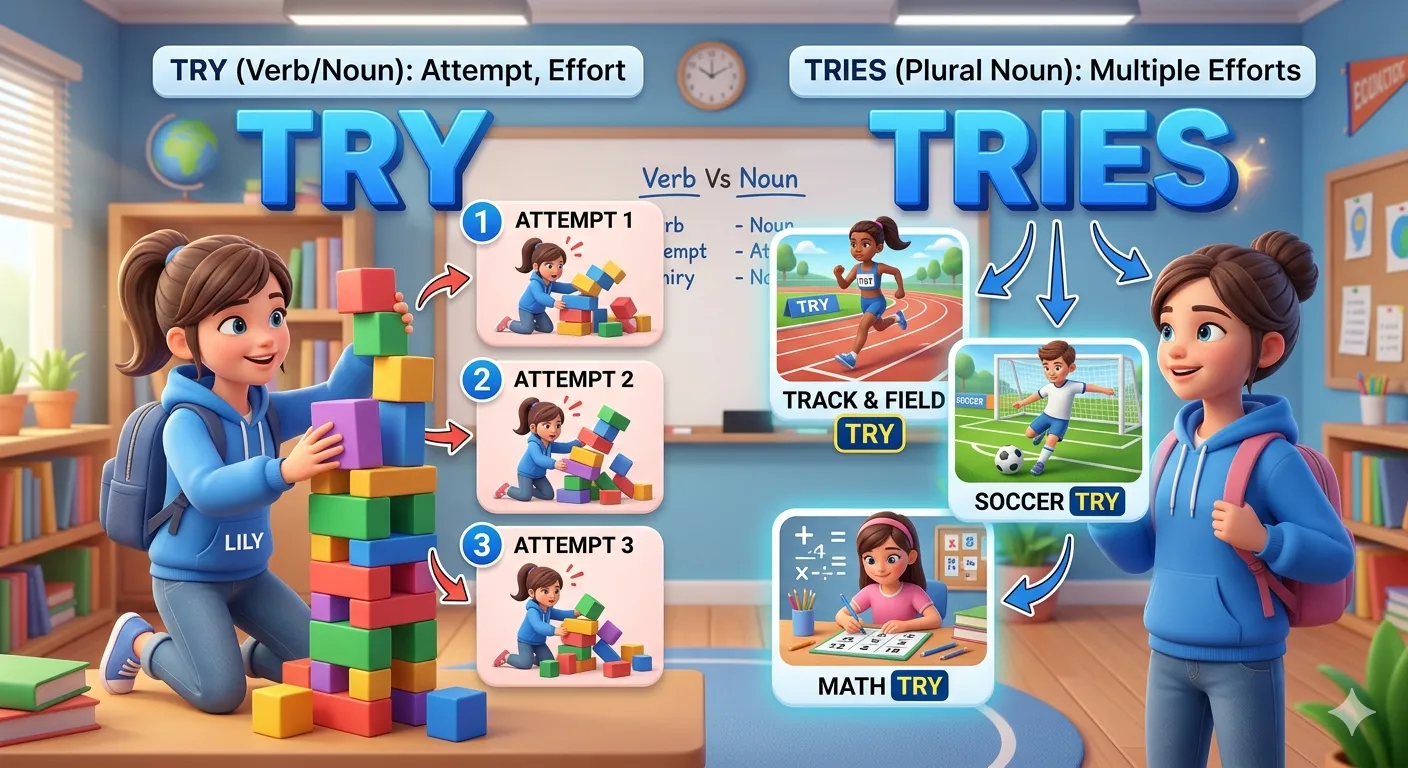
Tries is the correct spelling in standard English. Trys is a misspelling and should not be used in academic, professional, or everyday writing. When the verb try is used with he, she, it, or a singular noun, it becomes tries.
English spelling can be tricky, especially when words change form. One spelling question that confuses many learners is whether the correct word is trys or tries.
I remember reviewing an article written by a talented student who consistently wrote sentences like “He trys his best” and “She trys to help everyone.” The ideas were excellent, but the repeated spelling mistake made the writing look less polished.
The confusion makes sense. Most English verbs simply add -s when used with third-person singular subjects. For example:
- Run → Runs
- Read → Reads
- Walk → Walks
Naturally, many people assume that try should become trys. However, English follows a different rule for words ending in y after a consonant.
This guide explains everything you need to know about trys or tries, including grammar rules, examples, common mistakes, real-world usage, similar words, and practical tips for remembering the correct spelling.
By the end, you’ll never hesitate when writing tries again.
✅ Trys or Tries – Quick Answer
The correct spelling is:
Tries ✅
The incorrect spelling is:
Trys ❌
When try is used with he, she, it, or a singular noun, the y changes to i and -es is added.
Examples
✅ She tries hard every day.
✅ He tries to stay positive.
✅ The company tries new marketing strategies.
❌ She trys hard every day.
❌ He trys to stay positive.
📚 The Origin / Background of Trys or Tries
The word try entered English through Old French and has been used for centuries to mean attempting, testing, or making an effort.
Over time, English developed spelling conventions for verbs ending in a consonant plus y.
Instead of adding only -s, English changes the y to i before adding -es.
This rule helps maintain pronunciation consistency.
Similar Examples
| Base Verb | Correct Form |
| Try | Tries |
| Cry | Cries |
| Fly | Flies |
| Carry | Carries |
| Worry | Worries |
| Study | Studies |
Because many verbs simply take -s, people often assume trys follows the same pattern.
It does not.
🔍 Why Does Try Become Tries?
English follows a specific grammar rule.
Rule
When a verb ends with:
Consonant + Y
Change the Y to I and add ES.
Formula
Try → Tries
Cry → Cries
Carry → Carries
Exception
When a verb ends with:
Vowel + Y
Simply add S.
Examples:
- Play → Plays
- Enjoy → Enjoys
- Stay → Stays
- Buy → Buys
This difference explains why:
✅ Tries
but
✅ Plays
🔍 Trys or Tries Explained Key Differences
| Term | Meaning | Correct? | Context |
| Tries | Third-person singular form of try | ✅ Yes | Standard English |
| Trys | Misspelling | ❌ No | Avoid |
Correct Examples
✅ She tries her best.
✅ He tries every week.
✅ The athlete tries to improve.
Incorrect Examples
❌ She trys her best.
❌ He trys every week.
❌ The athlete trys to improve.
🧠 Understanding Verb Forms of Try
Learning all forms of the verb makes the rule easier.
| Form | Example |
| Base Form | Try |
| Third-Person Singular | Tries |
| Past Tense | Tried |
| Past Participle | Tried |
| Present Participle | Trying |
Examples
- I try every day.
- She tries every day.
- They tried yesterday.
- We are trying now.
🎯 Which Version Should You Use?
For Students
Always write tries in assignments and exams.
For Bloggers
Use tries to maintain credibility and professionalism.
For Business Professionals
Choose tries in emails, reports, and presentations.
For English Learners
Memorize this simple rule:
Consonant + Y = IES
Recommended Choice
Always use:
✅ Tries
Never use:
❌ Trys
⚠️ Common Mistakes with Trys or Tries
| Mistake | Correction |
| She trys her best. | She tries her best. |
| He trys to win. | He tries to win. |
| My friend trys again. | My friend tries again. |
| The company trys new methods. | The company tries new methods. |
Why These Mistakes Happen
1. Overgeneralization
People assume all verbs simply add -s.
2. Forgetting the Y Rule
Many writers learn the rule but forget it while typing.
3. Autocorrect Dependence
Some writers rely too heavily on spellcheck tools.
4. ESL Challenges
English learners often transfer grammar rules from their native language.
🌎 Tries in Real-World Examples
Professional Email
“Our customer service team tries to respond within 24 hours.”
News Article
“The government tries several approaches to reduce inflation.”
Academic Writing
“The researcher tries different methods to collect data.”
Social Media Post
💪 “She tries every day and never quits.”
Business Report
“The company tries innovative solutions to improve productivity.”
📈 Trys or Tries Data, Trends & Usage
Thousands of users search for trys or tries every month.
Who Searches This Topic?
- Students
- Teachers
- English learners
- Writers
- Bloggers
- Job seekers
Search Intent
Informational
Users want to know:
- Which spelling is correct
- Why the spelling changes
- Grammar rules
- Usage examples
Why It Matters
Correct spelling improves:
- Academic grades
- Professional credibility
- Reader trust
- SEO content quality
📖 Similar Words That Follow the Same Rule
Many English verbs follow the exact same pattern.
| Base Verb | Correct Form |
| Cry | Cries |
| Fly | Flies |
| Carry | Carries |
| Study | Studies |
| Worry | Worries |
| Reply | Replies |
Example Sentences
✅ She studies every evening.
✅ He carries heavy boxes.
✅ The bird flies south for winter.
Recognizing these patterns makes spelling easier.
📊 Standalone Comparison Table
| Term/Variant | Meaning | Region/Context | Best Used When |
| Tries | Correct form of try | Global English | All writing |
| Trys | Misspelling | None | Avoid |
| Try | Base verb | Global English | Present tense |
| Tried | Past tense | Global English | Past actions |
| Trying | Present participle | Global English | Ongoing actions |
Frequently Asked Questions
Q: What does tries mean?
A: Tries means makes an effort or attempts something.
Q: Is trys ever correct?
A: No. In standard English, trys is considered incorrect.
Q: Why does try become tries?
A: Because verbs ending in a consonant plus y change y to i before adding -es.
Q: Is tries acceptable in formal writing?
A: Yes. It is the correct and preferred spelling.
Q: What is the past tense of try?
A: The past tense is tried.
Q: Does every word ending in y follow this rule?
A: No. Words ending with a vowel plus y usually add only -s.
Q: How can I remember the rule?
A: Remember:
Consonant + Y → IES
🎯 Conclusion
The choice between trys and tries is simple once you understand the grammar rule. Tries is the correct spelling, while trys is a misspelling that should be avoided.
Key takeaways:
- Tries is correct.
- Trys is incorrect.
- Change y to i and add -es.
- The rule applies to many similar verbs.
- Using correct spelling improves clarity and professionalism.
Small grammar rules often have a big impact on how your writing is perceived. Mastering words like tries helps you communicate more clearly and confidently in school, work, and everyday life.
Now you know exactly how to use tries correctly. Bookmark this guide so you never second-guess trys or tries again, and share it with anyone who struggles with English spelling rules.
Read More:
Fact or Cap: Meaning, Origin, Examples & How to Use It 🧢

📚✨ I’m an English enthusiast and author dedicated to exploring word differences, spelling variations, and common language questions. By drawing on trusted dictionaries, language resources, and practical usage examples, I create clear, reliable content that helps readers learn with confidence and communicate more effectively. ✍️🌍