
Eerie is the correct English word. It means strange, spooky, or unsettling. Eery is a common misspelling of eerie.
A few years ago, I was editing a short horror story written by a student. The story was excellent. The suspense was strong. The setting felt dark and mysterious. Yet one word kept appearing throughout the piece: eery.
At first glance, it looked right. Many people make the same mistake. The word sounds simple, but its spelling often causes confusion. Even experienced writers sometimes pause and wonder whether they should write eery or eerie.
You may have searched this phrase because you saw both spellings online. Perhaps a spell checker flagged one version. Maybe you’re writing a story, article, social media post, or school assignment and want to avoid an embarrassing mistake.
The good news is that the answer is straightforward. Only one spelling is accepted in standard English. Once you understand why the confusion exists, you’ll never second-guess yourself again.
Let’s clear up the mystery behind eery or eerie and learn how to use the correct form with confidence.
Eery or Eerie : Quick Answer
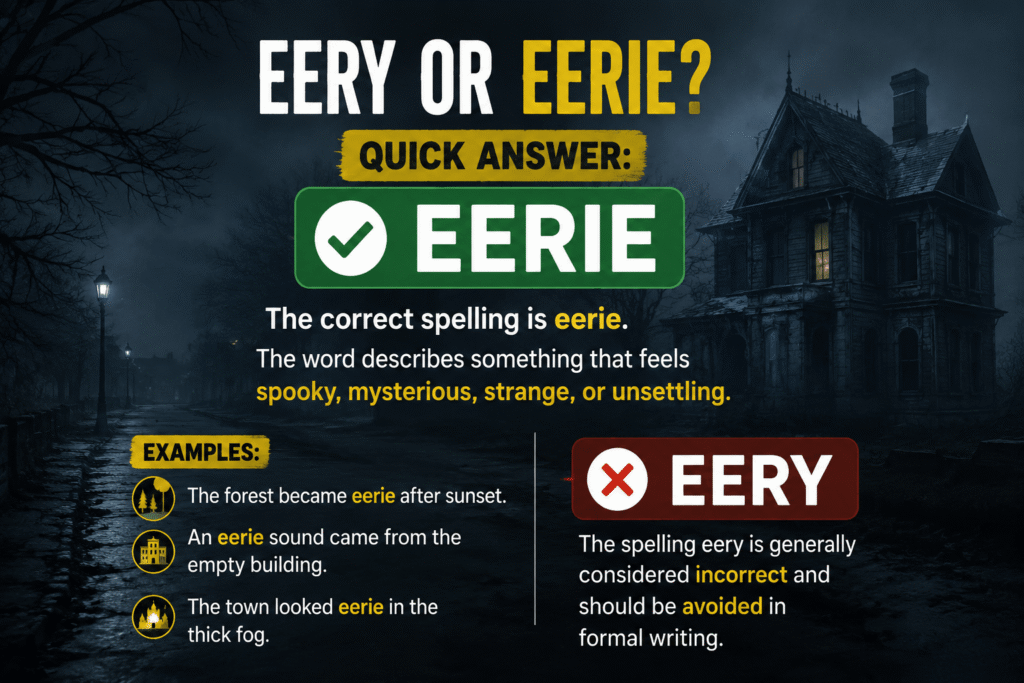
The correct spelling is eerie.
The word describes something that feels spooky, mysterious, strange, or unsettling.
Examples:
- The forest became eerie after sunset.
- An eerie sound came from the empty building.
- The town looked eerie in the thick fog.
The spelling eery is generally considered incorrect and should be avoided in formal writing.
The Origin / Background of Eery or Eerie
The word eerie has a fascinating history.
It comes from an old Scottish word that meant fearful, frightened, or affected by supernatural forces. Over time, English speakers adopted the term to describe places, sounds, and situations that create an uneasy feeling.
The unusual spelling is one reason people get confused.
Many English words follow predictable spelling patterns. Eerie does not. The double “e” at the beginning and the ending “ie” make it look unusual.
Because of this, many writers simplify it to eery, assuming it follows a more common pattern. However, dictionaries and style guides recognize only eerie as the standard spelling.
Eery or Eerie Explained : Key Differences
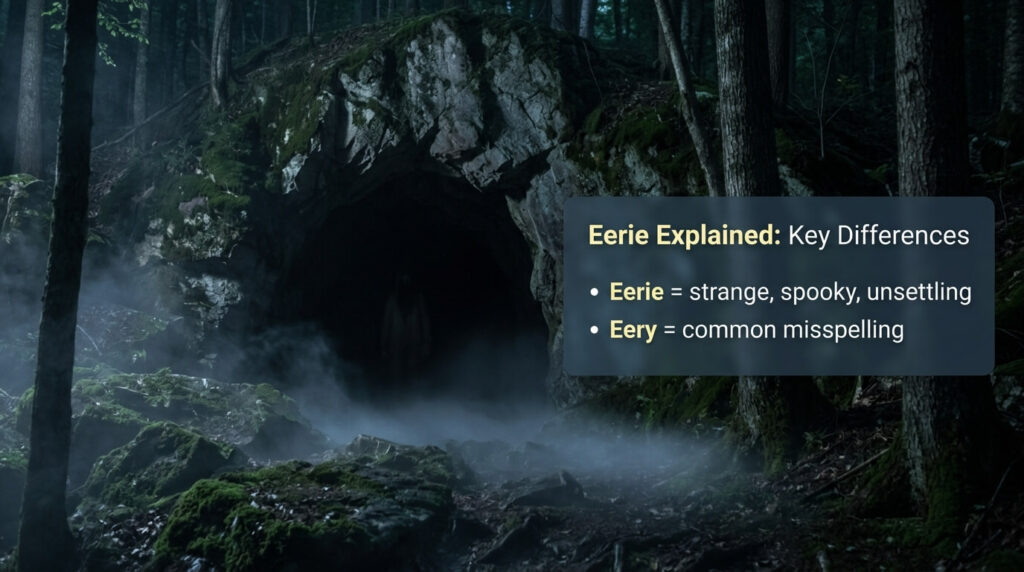
Although these words look similar, they are not equal in standard English.
| Term | Meaning | When to Use | Region/Context |
| Eerie | Strange, spooky, unsettling | Always when describing something mysterious | Standard English worldwide |
| Eery | Common misspelling of eerie | Generally avoid | Informal mistakes or typos |
Examples
Correct:
- The cave had an eerie atmosphere.
- We heard an eerie whisper in the dark.
Incorrect:
- The cave had an eery atmosphere.
- We heard an eery whisper.
Whenever you want to describe a creepy feeling, choose eerie.
Which Version Should You Use?
For Students
Use eerie.
Teachers and examiners expect the standard spelling.
For Professional Writers
Always choose eerie.
Editors will usually correct eery immediately.
For Bloggers and Content Creators
Use eerie to maintain credibility and avoid spelling errors.
For Global Audiences
Use eerie.
It is accepted in American English, British English, Canadian English, and Australian English.
Final Recommendation
There is no situation where eery is preferred over eerie in standard modern English.
Excell or Excel: Correct Spelling Made Easy 📊✅
Common Mistakes with Eery or Eerie
Here are mistakes people frequently make.
| Mistake | Correction |
| eery house | eerie house |
| eery silence | eerie silence |
| eery feeling | eerie feeling |
| eery music | eerie music |
| eery atmosphere | eerie atmosphere |
Why These Errors Happen
- The pronunciation makes people guess the spelling.
- The word has an unusual letter pattern.
- Some writers type quickly and drop one “i.”
- People assume simpler spellings are correct.
A good trick is to remember that eerie contains five letters after the first “e”: e-e-r-i-e.
Eery or Eerie in Real-World Examples
Professional Email
“During the site inspection, employees reported an eerie noise coming from the unused section of the building.”
News Headline
“Residents Report Eerie Sounds Near Abandoned Factory”
Social Media Post
“That fog rolling over the lake tonight looks seriously eerie.”
Formal Report
“The investigation noted an eerie absence of activity in the area during the observation period.”
These examples show how naturally eerie fits into different types of writing.
Eery or Eerie : Data, Trends & Usage
People search for eery or eerie because spelling uncertainty is common.
Search Intent
The primary search intent is:
- Informational
- Educational
- Grammar-related
- Spelling verification
Who Searches This Term?
- Students
- Writers
- Bloggers
- Authors
- English learners
- Content marketers
Where Interest Is Highest
Searches often come from English-speaking countries, including:
- United States
- United Kingdom
- Canada
- Australia
- India
Why It Matters Today
More people publish content online than ever before. A small spelling mistake can affect credibility, SEO performance, and reader trust. Knowing the correct form helps your writing appear polished and professional.
Standalone Comparison Table
| Term/Variant | Meaning | Region/Context | Best Used When |
| Eerie | Strange, spooky, unsettling | Standard English worldwide | Always |
| Eery | Misspelling of eerie | Informal typo or mistake | Never in formal writing |
Frequently Asked Questions
Q: What does eerie mean?
A: Eerie means strange, mysterious, spooky, or unsettling. It often describes places, sounds, or situations that feel supernatural or uncomfortable.
Q: Is eery a real word?
A: Most dictionaries do not recognize eery as the standard spelling. It is usually treated as a misspelling of eerie.
Q: Which version is correct, eery or eerie?
A: Eerie is the correct spelling. It is the accepted form in modern English.
Q: Can I use eerie in formal writing?
A: Yes. The word is appropriate in essays, reports, novels, articles, and professional communication when the context fits.
Q: Why do people spell eerie as eery?
A: The unusual spelling pattern causes confusion. Many writers simplify the word based on pronunciation.
Q: Is eerie used in British and American English?
A: Yes. Both British and American English use the spelling eerie.
Q: Can eerie describe people?
A: Yes. It can describe a person’s behavior, voice, smile, or appearance if it creates an unsettling feeling.
Conclusion
The debate over eery or eerie has a simple answer. Eerie is the correct spelling, while eery is generally a misspelling. The word comes from Scottish roots and is used to describe something strange, mysterious, spooky, or unsettling.
Remember these key points:
- Eerie is the accepted spelling.
- Eery should be avoided in formal writing.
- The word works in both British and American English.
- It commonly describes creepy places, sounds, and situations.
The next time you write about a haunted house, a mysterious noise, or an unsettling feeling, you’ll know exactly which spelling to choose.
Bookmark this guide so you never second-guess “eery or eerie” again, and share it with anyone who struggles with tricky English spellings.
Eery or eerie explained: correct spelling, meaning, usage examples, writing tips, and mistakes. Learn which version is right.

As an English language enthusiast, I love diving into the tricky details of word differences and spelling variations. My mission is to explain confusing terms and make them accessible to everyone, helping readers to communicate with clarity and confidence.