
Since is a word about time or reasons . Sense means awareness, perception, or good judgment . They sound similar but mean entirely different things.
I’ll be honest : I mixed these up embarrassingly late in my writing career.
I was editing a student’s essay when I spotted it: “It doesn’t make since.” I almost laughed. Then I remembered writing something similar in high school and feeling completely confident about it.
Here’s the thing: since and sense sound almost identical when you speak fast. Your brain hears one word. Your fingers type the other. Nobody notices : until someone does.
This mistake shows up in emails, essays, social media, and even professional reports. It’s one of the most common spelling errors in English, and it’s surprisingly easy to fix once you understand the difference.
This guide will show you exactly what each word means, when to use each one, and how to never mix them up again. No grammar jargon. No textbook boredom. Just clear answers you can use today.
Since or Sense : Quick Answer
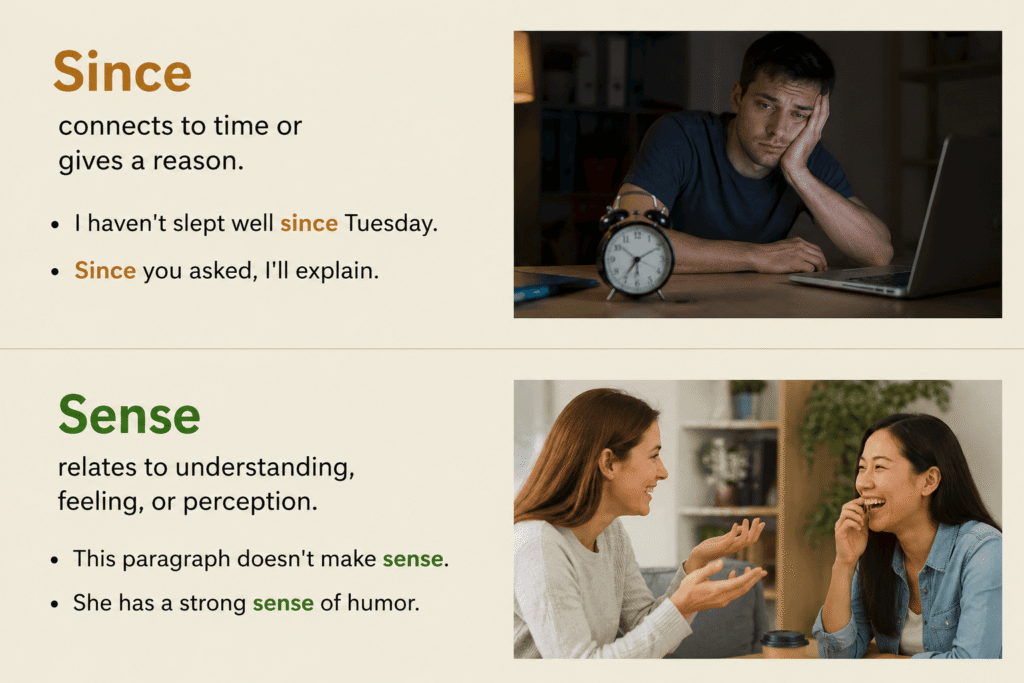
Since connects to time or gives a reason.
- “I haven’t slept well since Tuesday.”
- “Since you asked, I’ll explain.”
Sense relates to understanding, feeling, or perception.
- “This paragraph doesn’t make sense.”
- “She has a strong sense of humor.”
Different words. Different jobs. Simple as that.
The Origin & Background of Since and Sense
Both words come from Old English : but from completely different roots.
Since evolved from the Old English word siþþan, meaning “after that” or “from then on.” Over centuries, it shifted into the Middle English sins or sithence, then finally became the modern since. It has always carried the idea of time passing.
Sense traces back to the Latin word sensus, meaning perception or feeling. It entered English through Old French around the 14th century. We still use it in words like sensitive, sensation, and nonsense.
The confusion comes from pronunciation. In fast, casual speech, both words sound like a single syllable : somewhere between sinse and sence. Regional accents can blur the distinction even further.
Spelling them correctly is purely about knowing which word you actually mean.
Since vs Sense : Key Differences Explained
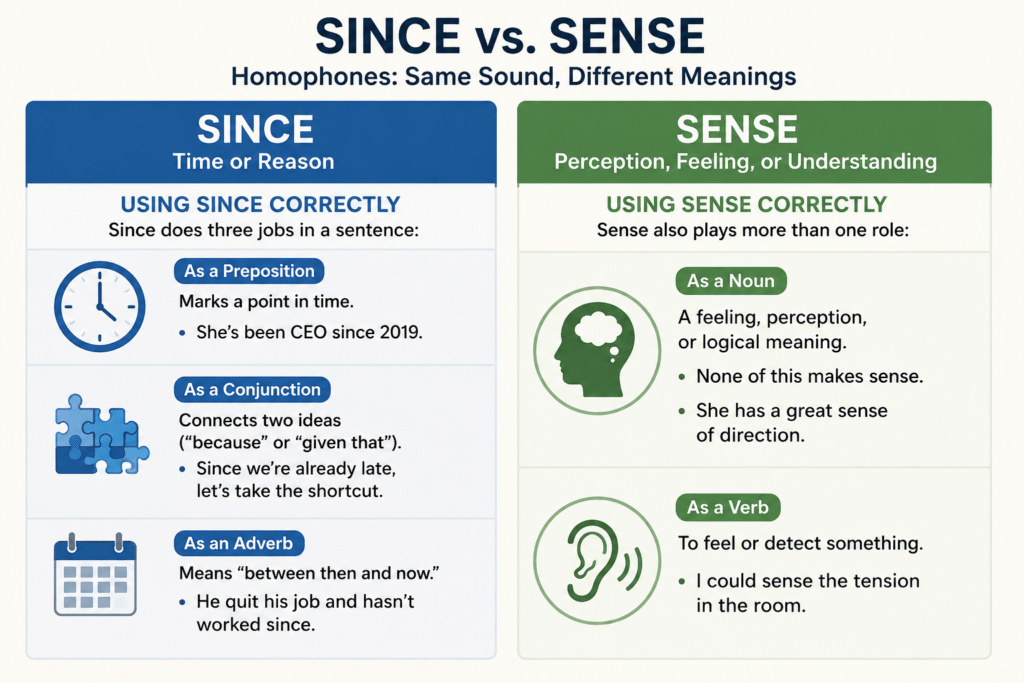
These words are homophones in many dialects : words that sound similar but have different meanings and spellings.
Here’s how they break down:
| Word | Part of Speech | Core Meaning | Example |
| Since | Preposition / Conjunction / Adverb | Time or reason | “Since last year, prices have risen.” |
| Sense | Noun / Verb | Perception, feeling, or understanding | “I sense something is wrong.” |
Using Since Correctly
Since does three jobs in a sentence:
- As a preposition : marks a point in time
- “She’s been CEO since 2019.”
- As a conjunction : connects two ideas (“because” or “given that”)
- “Since we’re already late, let’s take the shortcut.”
- As an adverb : means “between then and now”
- “He quit his job and hasn’t worked since.”
Using Sense Correctly
Sense also plays more than one role:
- As a noun : a feeling, perception, or logical meaning
- “None of this makes sense.”
- “She has a great sense of direction.”
- As a verb : to feel or detect something
- “I could sense the tension in the room.”
Which Word Should You Use?
Ask yourself one question: Am I talking about time, a reason, or understanding/feeling?
- Time or reason? → Use since
- Understanding, perception, or meaning? → Use sense
For students and beginners: If you’re unsure, replace the word with “because” or “from that moment.” If it still makes sense, use since. If not, you probably want sense.
For professionals and writers: “Make since” is never correct. The phrase is always “make sense.” If you remember nothing else from this guide, remember that.
For non-native English speakers: Think of sense as related to sensation : both involve perception. Think of since as connected to a sequence : it always involves a timeline or order of events.
Common Mistakes with Since and Sense
Here are the errors that appear most often and how to fix them.
Mistake 1: “It doesn’t make since.” ✅ Correct: “It doesn’t make sense.” Why it happens: The phrase is spoken quickly and the brain defaults to familiar sounds.
Mistake 2: “Sense you already know, let’s move on.” ✅ Correct: “Since you already know, let’s move on.” Why it happens: The conjunction use of since is often spoken softly at the start of sentences.
Mistake 3: “I’ve had a strange since about this.” ✅ Correct: “I’ve had a strange sense about this.” Why it happens: The noun form of sense gets forgotten when people write quickly.
Mistake 4: “Common since tells us to save money.” ✅ Correct: “Common sense tells us to save money.” Why it happens: This is one of the most searched mistakes online : common sense is a fixed phrase.
Mistake 5: “He left sense the beginning of term.” ✅ Correct: “He left since the beginning of term.” Why it happens: Phonetic spelling : people write what they hear.
Since and Sense in Real-World Examples
Seeing both words in context makes everything click faster.
In a professional email:
“Since your last message, I’ve reviewed the proposal. It makes perfect sense to move forward with Option B.”
In a news headline:
“Housing Prices Highest Since 2008 : Analysts Sense a Slowdown Ahead”
In a social media post:
“Haven’t left the house since Saturday. I sense a Netflix binge coming on. 📺”
In a formal report:
“Since the policy was enacted in Q1, team performance has improved. This outcome makes sense given the structural changes implemented.”
Notice how naturally each word fits. The wrong choice would feel jarring instantly.Mitosis or Meiosis: Complete Easy Guide for Students
Mitosis or Meiosis: Complete Easy Guide for Students
Since vs Sense : Data, Trends & Usage
“Since or sense” is one of the top searched spelling confusion queries in English.
Google Trends shows consistent search volume across the US, UK, India, and Pakistan : particularly from students and professionals writing in English as a second language.
The most searched phrase is “does not make since” : which signals exactly the mistake covered in this guide. Millions of people type this phrase and then wonder if something looks off.
This is firmly an informational search intent topic. People want quick clarity, not academic lectures.
The confusion spikes during back-to-school periods (August–September) and in January, when professional writing picks up after the holiday break.
Understanding this distinction isn’t just grammar trivia. Clear writing builds trust. A single wrong word can undermine an otherwise polished email or essay.
Full Comparison Table
| Term | Meaning | Region/Context | Best Used When |
| Since (time) | From a point in the past until now | All English dialects | Talking about when something started |
| Since (reason) | Because / given that | Formal and informal writing | Giving a reason or cause |
| Sense (noun) | Understanding, logic, or perception | All contexts | Referring to meaning, feeling, or one of the five senses |
| Sense (verb) | To feel or detect | Slightly more formal | Describing an intuition or awareness |
| Common sense | Practical judgment | Fixed phrase — don’t alter | Referring to basic wisdom or logic |
| Make sense | To be logical or understandable | Fixed phrase — always use sense | Asking if something is clear or logical |
FAQ: Since vs Sense
Q: What does since mean? A: Since refers to a point in time (“since Monday”) or gives a reason (“since you asked”). It connects a past moment to the present or explains why something happened.
Q: What does sense mean? A: Sense means understanding, logic, or perception. As a noun: “This makes sense.” As a verb: “I can sense your frustration.” It relates to feeling or awareness.
Q: Is it “make since” or “make sense”? A: Always make sense. “Make since” is never correct in any context. This is the single most common error with these two words.
Q: Can since mean “because”? A: Yes. “Since you’re already here, let’s begin” means “because you’re already here.” This use of since is perfectly correct in both formal and informal writing.
Q: Is sense acceptable in formal writing? A: Absolutely. Sense is a standard English word used in every register : from casual conversation to academic papers to legal documents.
Q: What are the five senses? A: Sight, hearing, smell, taste, and touch. Each involves perception , which is why sense carries the meaning of awareness or feeling.
Q: How do I remember which word to use? A: Try this trick: Sense shares letters with sensation , both involve feeling or perception. Since shares a structure with sequence , it always involves time or order. Link the spelling to the meaning.
Conclusion
Here’s what matters most:
- Since = time or reason. Use it when talking about when something started or why something happened.
- Sense = perception, feeling, or understanding. Use it when meaning, logic, or awareness is involved.
- “Make sense” is always correct. “Make since” never is.
- When in doubt, swap the word : if “because” or “from that point” fits, use since. If “understanding” or “perception” fits, use sense.
These two words trip up native speakers and language learners alike. The good news? Now you know exactly what each one means and how to use it with confidence.
Since or sense explained : meaning, spelling, correct usage, and real examples. Learn which word to use and avoid the most common mistakes.
Lead or Leed: Meaning, Spelling & Correct Usage ✍️

As an English language enthusiast, I love diving into the tricky details of word differences and spelling variations. My mission is to explain confusing terms and make them accessible to everyone, helping readers to communicate with clarity and confidence.