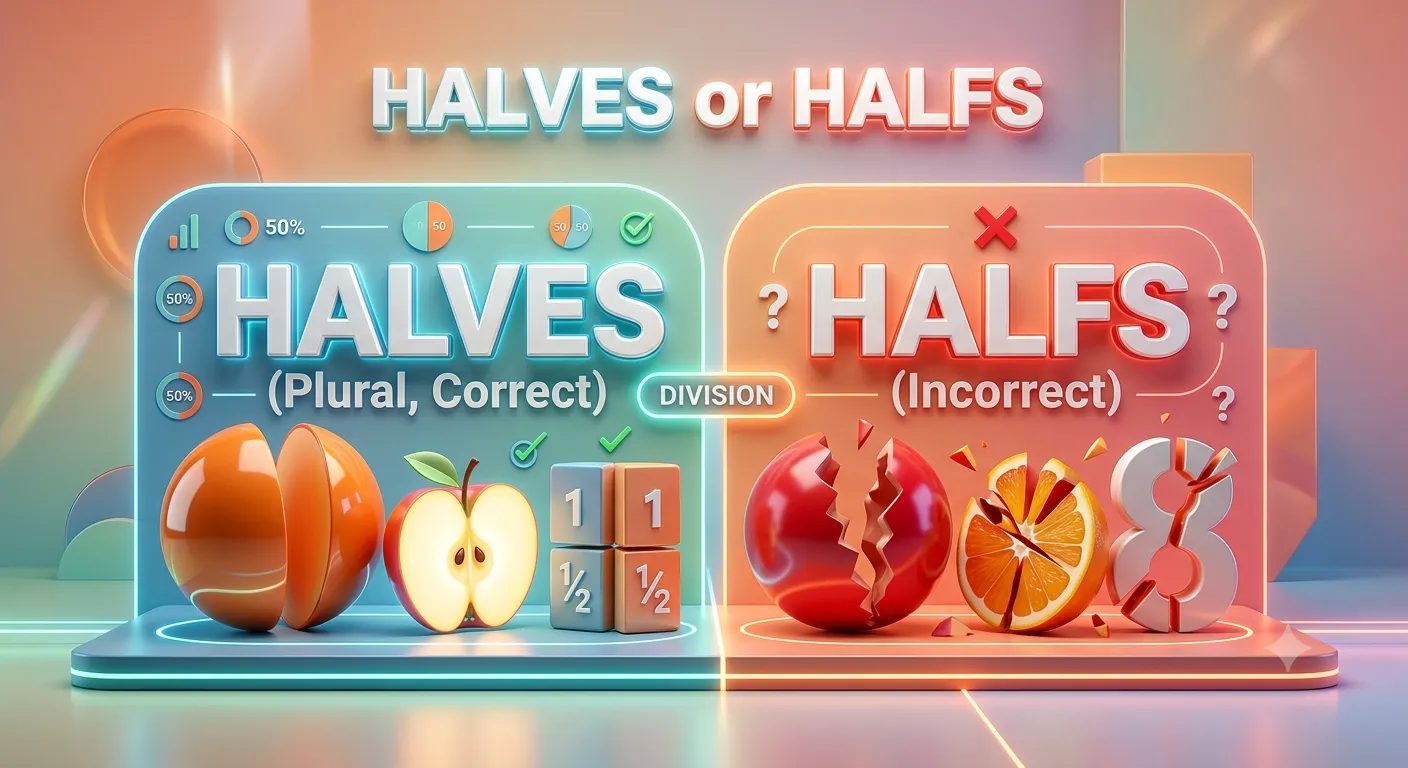
Halves is the correct plural form of half. Halfs is considered incorrect in standard English. For example, “I cut the orange into two halves” is correct, while “two halfs” is not.
I still remember reviewing a batch of student essays where the same spelling mistake kept appearing. The students wrote halfs instead of halves. At first glance, the error seemed logical. After all, many English nouns simply add an s to form the plural. If book becomes books and pen becomes pens, why shouldn’t half become halfs?
The answer lies in one of English grammar’s most interesting patterns: irregular plurals.
Many people search for “halfs or halves” because they want a quick answer. Others want to understand why the spelling changes. Some are preparing for exams. Others are writing emails, reports, essays, or blog posts and want to avoid mistakes.
The good news is that this rule is easy once you understand it. In this guide, you’ll learn the correct spelling, the grammar rule behind it, common mistakes, pronunciation tips, examples, quizzes, and memory tricks that make the answer impossible to forget.
Halfs or Halves Quick Answer
The correct plural of half is halves.
Correct
- Two halves of an apple
- The two halves were equal
- Both halves of the project were completed
Incorrect
- Two halfs of an apple
- The two halfs were equal
- Both halfs of the project were completed
Whenever you need the plural form, use halves.
What Is the Plural of Half?
The plural form of half is halves.
Singular
- Half a cake
- Half an hour
- Half the team
Plural
- Two halves of a cake
- The day was divided into two halves
- Both halves of the team played well
This change happens because half follows an irregular plural pattern in English.
Why Do People Write “Halfs”?
The mistake is understandable.
Most English nouns become plural by adding s or es:
- Car → Cars
- Chair → Chairs
- Box → Boxes
People naturally assume that:
- Half → Halfs
However, English contains many exceptions. Half belongs to a special group of words that change f to ves when pluralized.
That is why the correct form is:
- Half → Halves
Not:
- Half → Halfs
The Origin and History of Half
The word half comes from Old English. Over time, many words ending in f developed a different plural form.
Instead of adding s, the final sound softened and evolved into a v sound before taking the plural ending.
This historical change created words such as:
- Half → Halves
- Leaf → Leaves
- Wolf → Wolves
- Knife → Knives
- Shelf → Shelves
Modern English still uses these forms today.
Halfs vs Halves Comparison Table
| Term | Meaning | Correct? | Usage |
| Half | One of two equal parts | Yes | Singular |
| Halves | More than one half | Yes | Plural |
| Halfs | Non-standard spelling | No | Avoid |
Understanding Irregular Plurals
English contains two major plural patterns.
Regular Plurals
These simply add s or es.
Examples:
- Cat → Cats
- Dog → Dogs
- Class → Classes
Irregular Plurals
These change spelling.
Examples:
- Man → Men
- Child → Children
- Tooth → Teeth
- Half → Halves
Because half belongs to the irregular group, you must memorize its plural form.
The F to VES Rule Explained
Many English nouns ending in f or fe change to ves in the plural.
Examples
| Singular | Plural |
| Half | Halves |
| Leaf | Leaves |
| Knife | Knives |
| Wife | Wives |
| Wolf | Wolves |
| Calf | Calves |
| Shelf | Shelves |
| Life | Lives |
This is one of the most useful spelling patterns in English.
Important Exceptions to the F to VES Rule
Not every word ending in f follows the pattern.
Examples
| Singular | Plural |
| Roof | Roofs |
| Chief | Chiefs |
| Belief | Beliefs |
| Cliff | Cliffs |
| Proof | Proofs |
This is one reason learners get confused.
English often mixes rules and exceptions.
Which Version Should You Use?
For Students
Use halves.
Teachers and exams expect standard grammar.
For Professionals
Use halves.
Reports, emails, and presentations should always use the correct form.
For Content Writers
Use halves.
Search engines and readers expect proper spelling.
For Everyone
Always use halves when writing the plural form.
Common Mistakes with Halfs or Halves
Mistake #1
❌ Two halfs of the cake
✅ Two halves of the cake
Mistake #2
❌ Both halfs were equal
✅ Both halves were equal
Mistake #3
❌ The game has two halfs
✅ The game has two halves
Mistake #4
❌ Divide it into four halfs
✅ Divide it into four halves
Mistake #5
❌ The orange was cut into halfs
✅ The orange was cut into halves
Pronunciation Guide
Many learners also wonder how to pronounce halves.
Half
Pronounced:
haf
Halves
Pronounced:
havz
Notice how the f sound changes to a v sound.
This pronunciation change helps explain the spelling change.
Halves in Real-World Examples
Professional Email
Dear Team,
The project has been divided into two halves. Each department will manage one section.
Regards
News Headline
Both Halves of the Match Delivered Exciting Action
Social Media Post
Just shared my sandwich into two halves with my friend!
Business Report
Revenue growth was analyzed across both halves of the fiscal year.
Academic Writing
The study compared the two halves of the sample population.
25 Example Sentences Using Halves
- The apple was cut into two halves.
- Both halves tasted sweet.
- The football match had two halves.
- The teacher divided the class into halves.
- The cake came in equal halves.
- Both halves were measured carefully.
- The town was separated into two halves.
- The report covered both halves of the year.
- She folded the paper into halves.
- The orange split into perfect halves.
- The company reviewed both halves of the project.
- The twins looked like two halves of a whole.
- The pie was shared in halves.
- The river divided the city into halves.
- The team performed better in the second half.
- The book was published in two halves.
- The melon was cut into halves.
- The bridge connected two halves of the region.
- The puzzle consisted of two matching halves.
- The budget was split into halves.
- Both halves needed repairs.
- The design showed symmetrical halves.
- The room was divided into halves.
- The schedule was organized into halves.
- The discussion covered both halves equally.
Mini Quiz
Choose the correct option.
- Two _____ of the orange.
- A. Halfs
- B. Halves
- Both _____ were equal.
- A. Halves
- B. Halfs
- The correct plural of half is:
- A. Halfs
- B. Halves
Answers
- B
- A
- B
Data, Trends and Search Intent
Search Intent
The keyword halfs or halves has informational search intent.
Users want:
- Correct spelling
- Grammar rules
- Usage examples
- Writing guidance
Popular Audiences
- Students
- ESL learners
- Teachers
- Writers
- Bloggers
- Editors
Why Interest Remains High
Many English learners encounter irregular plurals every day. Small spelling mistakes can affect grades, professionalism, and credibility.
Frequently Asked Questions
Q: What is the plural of half?
A: The plural of half is halves.
Q: Is halfs ever correct?
A: No. Standard English uses halves as the plural form.
Q: Why does half become halves?
A: It follows a historical spelling pattern where some words ending in f change to ves.
Q: How do you pronounce halves?
A: It is pronounced with a v sound, similar to “havz.”
Q: Is halves used in formal writing?
A: Yes. It is correct in academic, professional, and business writing.
Q: What words are similar to half?
A: Leaf/leaves, knife/knives, wife/wives, shelf/shelves, and wolf/wolves.
Q: Can halves be used in mathematics?
A: Yes. Mathematics frequently uses the term when discussing fractions and equal parts.
Conclusion
If you have been wondering whether to use halfs or halves, the answer is simple. Halves is the correct plural form of half, and halfs should be avoided in standard English.
Remember these key points:
- Half = singular
- Halves = plural
- Halfs = incorrect
- Half follows the F-to-VES spelling pattern
- Use halves in school, work, and everyday writing
Once you understand the rule, the choice becomes easy. The next time you divide an apple, a cake, or a project into two equal parts, you’ll know exactly which word to write.
Bookmark this guide so you never second-guess halfs or halves again, and share it with anyone who struggles with English plural forms.
Read More:
Fact or Cap: Meaning, Origin, Examples & How to Use It 🧢

📚✨ I’m an English enthusiast and author dedicated to exploring word differences, spelling variations, and common language questions. By drawing on trusted dictionaries, language resources, and practical usage examples, I create clear, reliable content that helps readers learn with confidence and communicate more effectively. ✍️🌍