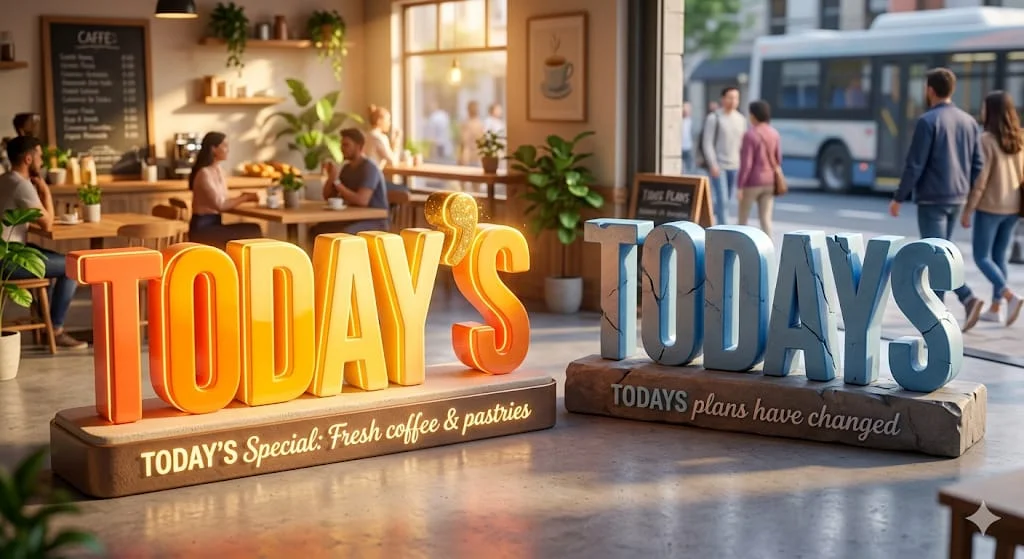
Today’s is the correct form when you mean belonging to today or happening today. Todays without an apostrophe is almost always incorrect in standard English.
A few years ago, I was editing a blog post for a client when I noticed a headline that read, “Todays Top News.” At first glance, it looked perfectly normal. In fact, many readers would probably never notice anything wrong with it. Yet one tiny punctuation mark was missing, and that small mistake changed the correctness of the phrase.
This error appears everywhere. You can find it in social media posts, emails, advertisements, websites, and even business documents. People often write phrases such as “todays weather,” “todays meeting,” or “todays headlines” without realizing that standard English requires an apostrophe.
The reason for the confusion is simple. Apostrophes can be tricky. They are used for contractions and possession, and many writers are unsure when each rule applies. Since the word today already ends with a “y,” adding an apostrophe can feel unnecessary to some people.
If you’ve ever paused while typing and wondered whether to write todays or today’s, you’re not alone. This guide will clear up the confusion once and for all. You’ll learn the correct spelling, understand why it is correct, see real-world examples, discover common mistakes, and gain confidence in using the word properly in every situation.
Today’s or Todays Quick Answer
The correct form is today’s.
The apostrophe shows possession. In this case, it means something belongs to, relates to, or occurs on the current day.
Examples
✅ Today’s weather is sunny.
✅ Today’s meeting starts at 10 a.m.
✅ Today’s news includes major sports updates.
✅ Today’s lesson focuses on grammar.
❌ Todays weather is sunny.
❌ Todays meeting starts at 10 a.m.
❌ Todays news includes major sports updates.
In standard English, you should almost always use today’s, not todays.
Think of it this way: if you can replace the phrase with “the weather of today” or “the meeting of today,” then the possessive form today’s is needed.
📚 The Origin / Background of Today’s or Todays
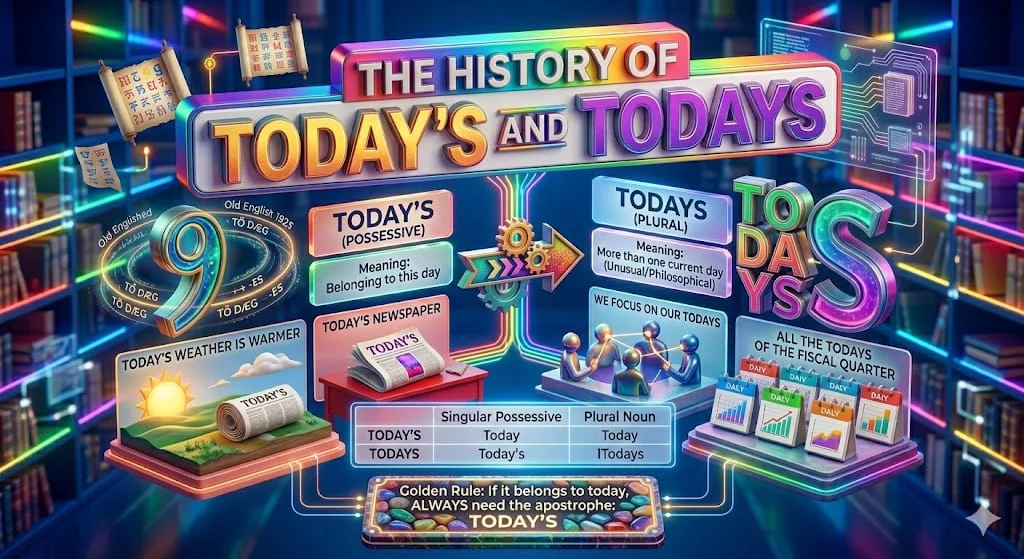
Understanding where the word comes from makes the rule easier to remember.
The word today has roots in Old English. Earlier forms included expressions that meant “on this day” or “during this day.” Over centuries, these expressions evolved into the single word we use now.
English grammar later developed a standard way to show possession. Most singular nouns form possession by adding ‘s.
Examples include:
- The teacher’s book
- The company’s website
- The student’s notebook
The same rule applies to words that represent time.
Examples:
- Today’s schedule
- Tomorrow’s plans
- Yesterday’s events
- Sunday’s match
- Next week’s meeting
Many people become confused because time words do not seem like traditional owners. A day cannot physically own something. However, English often uses possessive forms to show association rather than ownership.
For example:
- Today’s weather
- Tomorrow’s forecast
- Yesterday’s news
In each case, the possessive form simply connects the noun to a specific time period.
Major style guides, including those used by newspapers, universities, and publishing companies, recognize today’s as the correct form.
🔍 Today’s or Todays Explained Key Differences
The difference between these two forms is small visually but significant grammatically.
| Term | Meaning | When to Use | Region/Context |
| Today’s | Belonging to or related to today | Correct in all standard writing | Global English |
| Todays | Usually considered incorrect | Rarely used | Not standard English |
Why the Apostrophe Matters
The apostrophe tells readers that the word is possessive.
Consider these examples:
✅ Today’s forecast predicts rain.
✅ Today’s lesson was interesting.
✅ Today’s headlines focus on technology.
✅ Today’s menu includes vegetarian options.
Without the apostrophe:
❌ Todays forecast predicts rain.
❌ Todays lesson was interesting.
❌ Todays menu includes vegetarian options.
These versions are considered grammatical errors.
A Simple Memory Trick
Ask yourself:
“What day does this belong to?”
If the answer is today, use today’s.
For example:
- Today’s assignment
- Today’s report
- Today’s special offer
The apostrophe helps show that connection.
✅ Which Version Should You Use?
The answer is straightforward.
For Students
Use today’s in essays, homework assignments, exams, and classroom writing. Teachers expect standard grammar, and using the correct form demonstrates attention to detail.
For Bloggers and Content Writers
Always choose today’s. Readers notice grammar mistakes, and search engines tend to favor high-quality content. Correct punctuation improves credibility.
For Business Professionals
Use today’s in:
- Emails
- Reports
- Presentations
- Proposals
- Meeting notes
Professional communication should follow standard grammar rules.
For Journalists
News organizations consistently use today’s in headlines and articles.
Examples:
- Today’s Top Stories
- Today’s Market Update
- Today’s Weather Report
For Social Media Users
Even in casual writing, today’s remains the correct choice. While social media often ignores grammar rules, proper punctuation makes your writing clearer and more professional.
Recommended Choice
Use today’s every time you mean something related to the current day.
There are very few situations where todays would be acceptable in standard English writing.
⚠️ Common Mistakes with Today’s or Todays
Many writers make the same errors repeatedly.
| Mistake | Correction |
| Todays weather report | Today’s weather report |
| Todays news headlines | Today’s news headlines |
| Todays date is June 14 | Today’s date is June 14 |
| Todays meeting agenda | Today’s meeting agenda |
| Todays special offer | Today’s special offer |
| Todays homework assignment | Today’s homework assignment |
Why These Mistakes Happen
1. Forgetting the Apostrophe
People often type quickly and skip punctuation marks.
2. Confusing Possession with Plurals
Some writers mistakenly think adding an apostrophe changes a word into a plural. It does not.
3. Relying on Autocorrect
Autocorrect tools do not always catch grammar mistakes.
4. Copying Incorrect Examples
Many websites and social media posts contain grammar errors. Repeated exposure can make incorrect forms seem normal.
5. Lack of Grammar Confidence
Some writers know an apostrophe might be needed but are unsure where to place it.
How to Avoid These Errors
- Proofread before publishing.
- Read the sentence aloud.
- Ask whether the noun relates to today.
- Use grammar-checking tools.
- Remember the phrase “belonging to today.”
🌎 Today’s or Todays in Real-World Examples
Seeing the word in context helps reinforce the rule.
Professional Email
Subject: Today’s Project Update
Hello Team,
Please review today’s progress report before the afternoon meeting. We will discuss the results during today’s conference call.
Thank you.
News Headline
Today’s Market Report Shows Strong Growth
The headline correctly uses today’s because the report relates to the current day.
Social Media Post
☀️ Today’s weather is perfect for a walk!
The apostrophe correctly connects the weather to today.
Formal Document
According to today’s financial statement, revenue increased by 12%.
This is the preferred form in professional writing.
Classroom Example
Today’s homework assignment is due tomorrow.
Website Banner
Today’s Special Offer: Save 25% on All Products
Businesses frequently use this structure in advertising.
Daily Planner
- Today’s goals
- Today’s appointments
- Today’s priorities
These examples all require the possessive form.
📈 Today’s or Todays Data, Trends & Usage
Search data shows that thousands of people search for todays or today’s every month.
Who Searches for This Topic?
The audience includes:
- Students
- Bloggers
- Content writers
- Journalists
- Business professionals
- Teachers
- English learners
Most Common Search Intent
Informational
People want answers to questions such as:
- Which spelling is correct?
- Why is there an apostrophe?
- Is today’s possessive?
- Can todays ever be correct?
- How should it appear in headlines?
Why Interest Remains High
Digital communication continues to grow.
People write every day through:
- Emails
- Text messages
- Blog posts
- Social media updates
- Reports
- Online courses
Because writing is more visible than ever, grammar questions remain popular.
Regional Interest
Searches come from:
- United States
- United Kingdom
- Canada
- Australia
- India
- Other English-speaking regions
The rule remains the same across these countries.
Why This Matters Today
Good grammar builds trust. Whether you’re writing a school paper, business proposal, or social media caption, correct punctuation helps readers focus on your message rather than your mistakes.
📊 Standalone Comparison Table
| Term/Variant | Meaning | Region/Context | Best Used When |
| Today’s | Something related to the current day | Standard English worldwide | All formal and informal writing |
| Todays | Generally incorrect spelling | Rarely accepted | Avoid in standard writing |
| Tomorrow’s | Something related to tomorrow | Standard English | Future events |
| Yesterday’s | Something related to yesterday | Standard English | Past events |
| Sunday’s | Something related to Sunday | Standard English | Events occurring on Sunday |
| Week’s | Something related to a week | Standard English | Time-based possession |
Frequently Asked Questions
Q: What does today’s mean?
A: Today’s means something belongs to, relates to, or happens on the current day. The apostrophe shows possession or association with today.
Q: How do you use today’s correctly?
A: Use today’s before a noun. Examples include today’s weather, today’s meeting, today’s lesson, and today’s headlines.
Q: Today’s vs todays — what’s the difference?
A: Today’s is the correct possessive form. Todays without an apostrophe is generally considered incorrect in standard English.
Q: Is today’s acceptable in formal writing?
A: Yes. It is the standard form used in academic papers, business documents, newspapers, reports, and professional communication.
Q: Which version is correct — todays or today’s?
A: Today’s is correct. The apostrophe should be included whenever the word relates to something occurring on the current day.
Q: Where does today’s come from?
A: It combines the word today with the possessive ending ‘s, following standard English grammar rules.
Q: Can today’s be used in headlines?
A: Absolutely. Headlines such as Today’s Top Stories, Today’s Sports News, and Today’s Weather Forecast are common and correct.
Q: Is todays ever correct?
A: In standard English, todays is generally considered incorrect. Most style guides recommend using today’s whenever possession or association is intended.
Q: Why do people forget the apostrophe?
A: Many people type quickly, rely on autocorrect, or misunderstand apostrophe rules. As a result, the punctuation mark is often omitted accidentally.
Q: Does today’s show ownership?
A: Not always ownership in the literal sense. It often shows association with the current day, such as today’s news or today’s schedule.
🎯 Conclusion
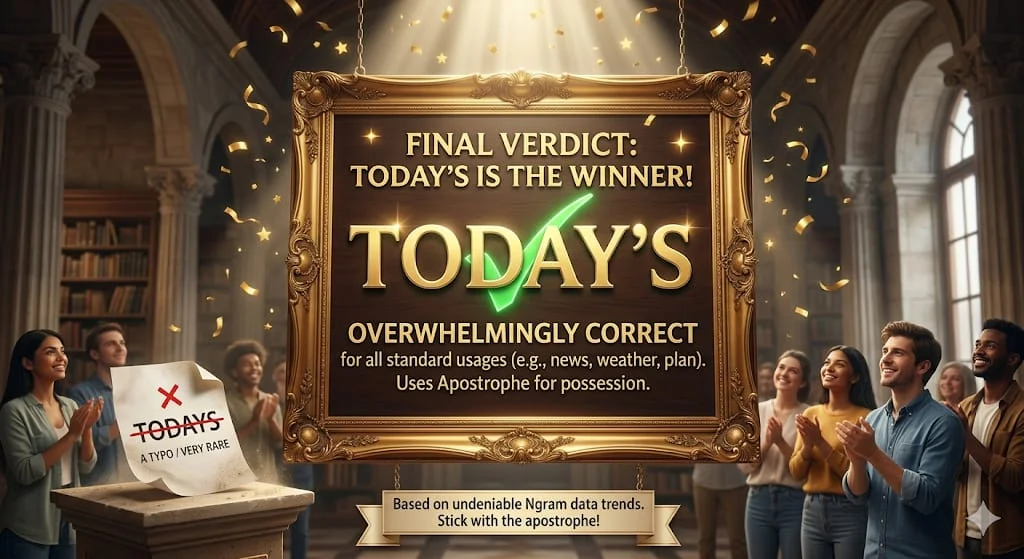
The debate between todays and today’s becomes very simple once you understand the grammar rule behind it. The correct form is today’s because the apostrophe shows possession or association. It connects a noun to the current day and follows standard English grammar conventions.
Let’s review the most important points:
- Today’s is the correct spelling.
- Todays is usually incorrect.
- The apostrophe shows possession or association.
- Use today’s in emails, reports, articles, headlines, advertisements, and everyday writing.
- The rule applies across American, British, Canadian, and Australian English.
Although the difference is only one small punctuation mark, it has a big impact on correctness and professionalism. Proper grammar helps readers trust your writing and understand your message more easily.
The next time you write about the weather, news, meeting, lesson, schedule, or date, remember the simple rule: if it relates to the current day, use today’s.
Now you know exactly how to use today’s correctly. Bookmark this guide so you never second-guess todays or today’s again, and share it with anyone who still gets confused by this common grammar question.
Meta Description: Today’s or todays explained clearly. Learn correct spelling, usage, examples, grammar rules, and avoid common writing mistakes today.
Rea More:
Excell or Excel: Correct Spelling Made Easy 📊✅

📚✨ I’m an English enthusiast and author dedicated to exploring word differences, spelling variations, and common language questions. By drawing on trusted dictionaries, language resources, and practical usage examples, I create clear, reliable content that helps readers learn with confidence and communicate more effectively. ✍️🌍