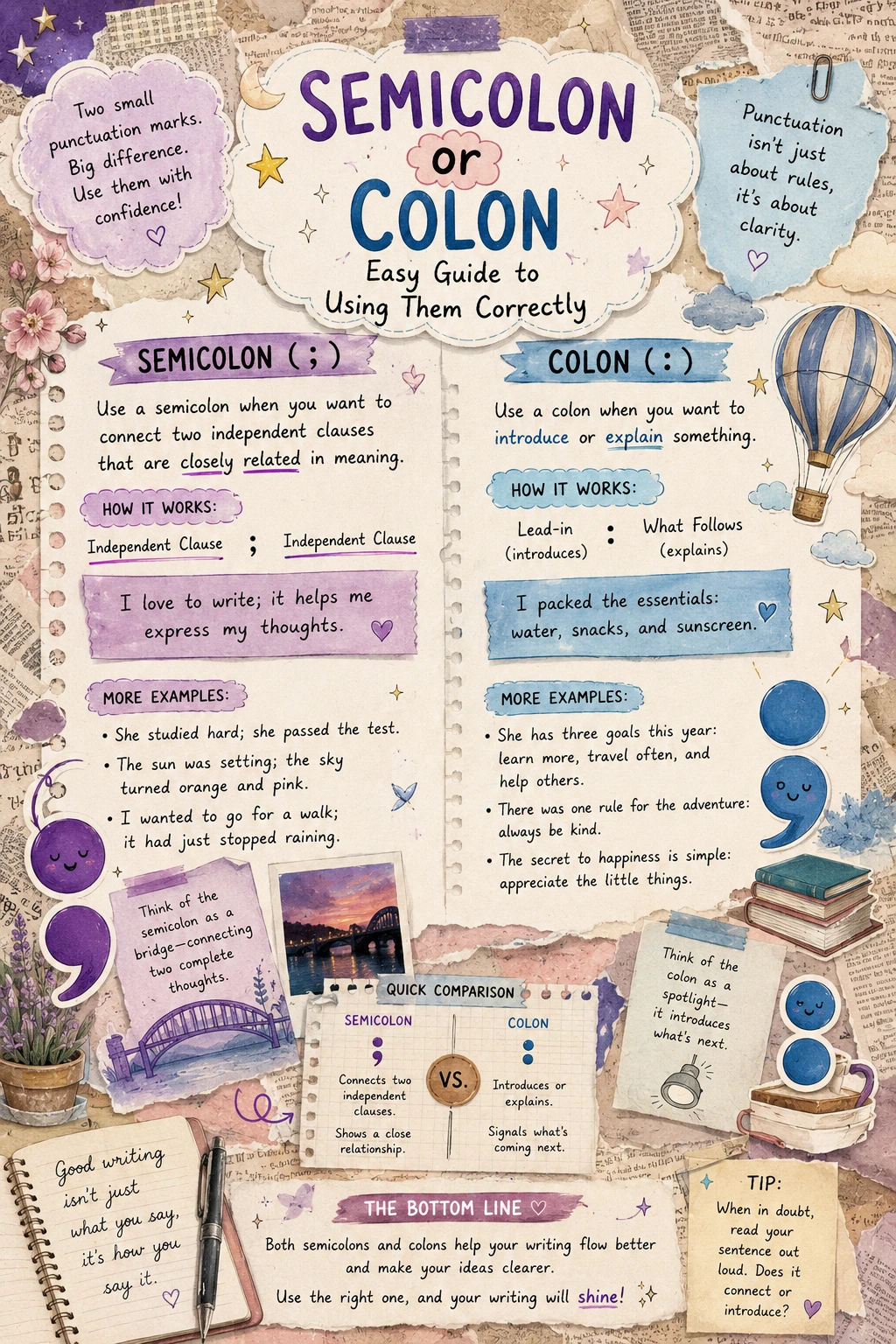
Use a semicolon (;) to connect closely related sentences. Use a colon (:) to introduce a list, explanation, quote, or example. Example: I bought three things: bread, milk, and eggs. / I was tired; I went to bed early.
A few years ago, I was editing an article for a client when I noticed something surprising. The writer had used semicolons and colons almost everywhere. Some were correct. Most were not.
That isn’t unusual.
Many students, bloggers, business professionals, and even experienced writers struggle with these two punctuation marks. At first glance, they look similar. Both use dots. Both create pauses. Yet they serve very different purposes.
You may have searched for semicolon or colon because you’re writing an essay, an email, a report, or even a social media post. Perhaps you know both marks exist, but you’re unsure which one belongs in your sentence.
The good news is that the difference is much simpler than many grammar books make it seem.
Once you understand the purpose of each punctuation mark, choosing the right one becomes easy.
By the end of this guide, you’ll know exactly when to use a semicolon, when to use a colon, common mistakes to avoid, and how professional writers use them every day.
Let’s clear up the confusion.
Semicolon or Colon Quick Answer
A semicolon (;) joins two closely related independent clauses without using a conjunction.
Example:
- The rain stopped; the sun came out.
A colon (:) introduces information that explains or expands on what came before it.
Example:
- She had one goal: to finish the project.
Think of it this way:
- Semicolon = connects
- Colon = introduces
The Origin / Background of Semicolon or Colon
Both punctuation marks have been around for centuries.
The colon comes from Ancient Greek writing. Early scholars used it to indicate pauses in speech and reading.
The semicolon appeared later. It was introduced by Italian printer Aldus Manutius in the late 1400s. His goal was to create a pause stronger than a comma but weaker than a period.
Why do people confuse them?
Because both marks create pauses and separate ideas. Many writers assume they can be used interchangeably.
They cannot.
A semicolon links ideas that could stand alone as complete sentences.
A colon points forward to information that follows.
That small difference changes everything.
Semicolon or Colon Explained — Key Differences
Understanding the difference becomes easy when you compare their jobs side by side.
| Term | Meaning | When to Use | Region/Context |
| Semicolon (;) | Connects related complete sentences | Between two independent clauses | Used worldwide in formal writing |
| Colon (:) | Introduces information | Before lists, explanations, examples, quotes | Used worldwide in formal and informal writing |
Semicolon Examples
Correct:
- I love coffee; my sister prefers tea.
- The meeting ended early; everyone went home.
Both sides can stand alone as complete sentences.
Colon Examples
Correct:
- Bring these items: a notebook, a pen, and a ruler.
- He knew the truth: he had missed the deadline.
The second part explains or expands the first.
Quick Test
Ask yourself:
Does the second part introduce something?
- Yes → Use a colon.
Are both sides complete sentences that are closely related?
- Yes → Use a semicolon.
Which Version Should You Use?
Your choice depends on what you’re trying to say.
For Students
Use a semicolon when linking related ideas in essays.
Example:
- The experiment failed; the researchers tried again.
Use a colon before examples and lists.
Example:
- The report covered three topics: safety, cost, and efficiency.
For Business Professionals
Use colons in emails and reports when introducing information.
Example:
- Action items: submit reports by Friday.
Use semicolons when connecting related statements.
Example:
- Sales increased this quarter; profits rose as well.
For Content Writers and Bloggers
Colons often improve readability in headings and subheadings.
Example:
- Travel Tips: How to Pack Light
Semicolons help create smooth sentence flow.
For Global and Neutral Writing
Follow this simple rule:
- Introducing? Use a colon.
- Connecting? Use a semicolon.
Common Mistakes with Semicolon or Colon
Here are the errors I see most often.
| Mistake | Correction |
| I bought: milk and eggs. | I bought milk and eggs. |
| I was hungry: I made lunch. | I was hungry; I made lunch. |
| Bring these items; bread, milk, eggs. | Bring these items: bread, milk, eggs. |
| She studies hard; because she wants good grades. | She studies hard because she wants good grades. |
| My favorite color is; blue. | My favorite color is: blue. |
Why These Mistakes Happen
- Writers use colons before incomplete lists.
- Writers replace semicolons with colons when connecting sentences.
- Many people treat both marks as decorative punctuation rather than tools with specific jobs.
Remember:
- Colon introduces
- Semicolon connects
Semicolon or Colon in Real-World Examples
Professional Email
Correct colon usage:
Dear Team,
Please review the following items: budget updates, project timelines, and staffing needs.
Correct semicolon usage:
The proposal was approved; implementation begins next week.
News Headline
Using a colon:
Mayor Announces New Plan: Downtown Improvements Begin Soon
Using a semicolon:
Storm Ends; Recovery Efforts Continue
Social Media Post
Using a colon:
Weekend goals: relax, read, and recharge.
Using a semicolon:
Finished my workout; feeling great today.
Formal Report
Using a colon:
The study identified three challenges: cost, staffing, and training.
Using a semicolon:
The first phase succeeded; the second phase requires adjustments.
Semicolon or Colon Data, Trends & Usage
Search interest in semicolon or colon remains strong because punctuation is a common challenge for students and professionals.
Who Searches This Topic Most?
- Students writing essays
- Job seekers preparing applications
- Bloggers and content creators
- Business professionals writing reports
- English language learners
Search Intent
The primary search intent is:
Informational
Users want to understand:
- Which punctuation mark is correct
- How to use each one
- Examples of proper usage
- Common grammar mistakes
Why This Matters Now
Clear writing is more important than ever.
Whether you’re writing an email, blog post, academic paper, or social media update, proper punctuation improves readability and professionalism.
A single punctuation mark can change how readers understand your message.
Semicolon vs Colon Comparison Table
| Term/Variant | Meaning | Region/Context | Best Used When |
| Semicolon (;) | Links related complete sentences | Academic, business, publishing | Connecting closely related ideas |
| Colon (:) | Introduces information | Academic, business, online writing | Presenting lists, examples, explanations |
| Comma (,) | Separates sentence elements | Universal | Short pauses and item separation |
| Period (.) | Ends a sentence | Universal | Ending complete thoughts |
Frequently Asked Questions
Q: What does semicolon or colon mean?
A semicolon and a colon are punctuation marks with different purposes. A semicolon connects related sentences, while a colon introduces information that follows.
Q: How do you use semicolon or colon correctly?
Use a semicolon between closely related complete sentences. Use a colon before lists, examples, explanations, or quotations.
Q: Semicolon vs comma what’s the difference?
A comma creates a short pause and often works with conjunctions. A semicolon joins complete sentences without needing a conjunction.
Q: Is a semicolon acceptable in formal writing?
Yes. Semicolons are widely accepted in academic, professional, and business writing when used correctly.
Q: Which is correct semicolon or colon?
Neither is always correct. The right choice depends on your sentence. Use a colon to introduce information and a semicolon to connect related ideas.
Q: Where does the semicolon come from?
The semicolon was introduced in the late 15th century by Italian printer Aldus Manutius to create a pause between a comma and a period.
Q: Can semicolons and colons be used in emails?
Absolutely. Both punctuation marks are common in professional emails, reports, presentations, and business communication.
Conclusion
Understanding semicolon or colon doesn’t have to be difficult.
Remember these key points:
- A semicolon connects two closely related complete sentences.
- A colon introduces information such as lists, explanations, examples, or quotes.
- They are not interchangeable.
- Using the correct punctuation makes your writing clearer and more professional.
When you’re unsure, ask a simple question:
Am I introducing something or connecting something?
If you’re introducing information, choose a colon.
If you’re linking related thoughts, choose a semicolon.
Mastering this small grammar rule can make a big difference in your writing confidence.
Now you know exactly how to use semicolon or colon go try it in your next piece of writing. Bookmark this guide so you never second-guess these punctuation marks again.
Sleeve or Sleave: Complete Guide to Correct Usage✅

📚✨ I’m an English enthusiast and author dedicated to exploring word differences, spelling variations, and common language questions. By drawing on trusted dictionaries, language resources, and practical usage examples, I create clear, reliable content that helps readers learn with confidence and communicate more effectively. ✍️🌍