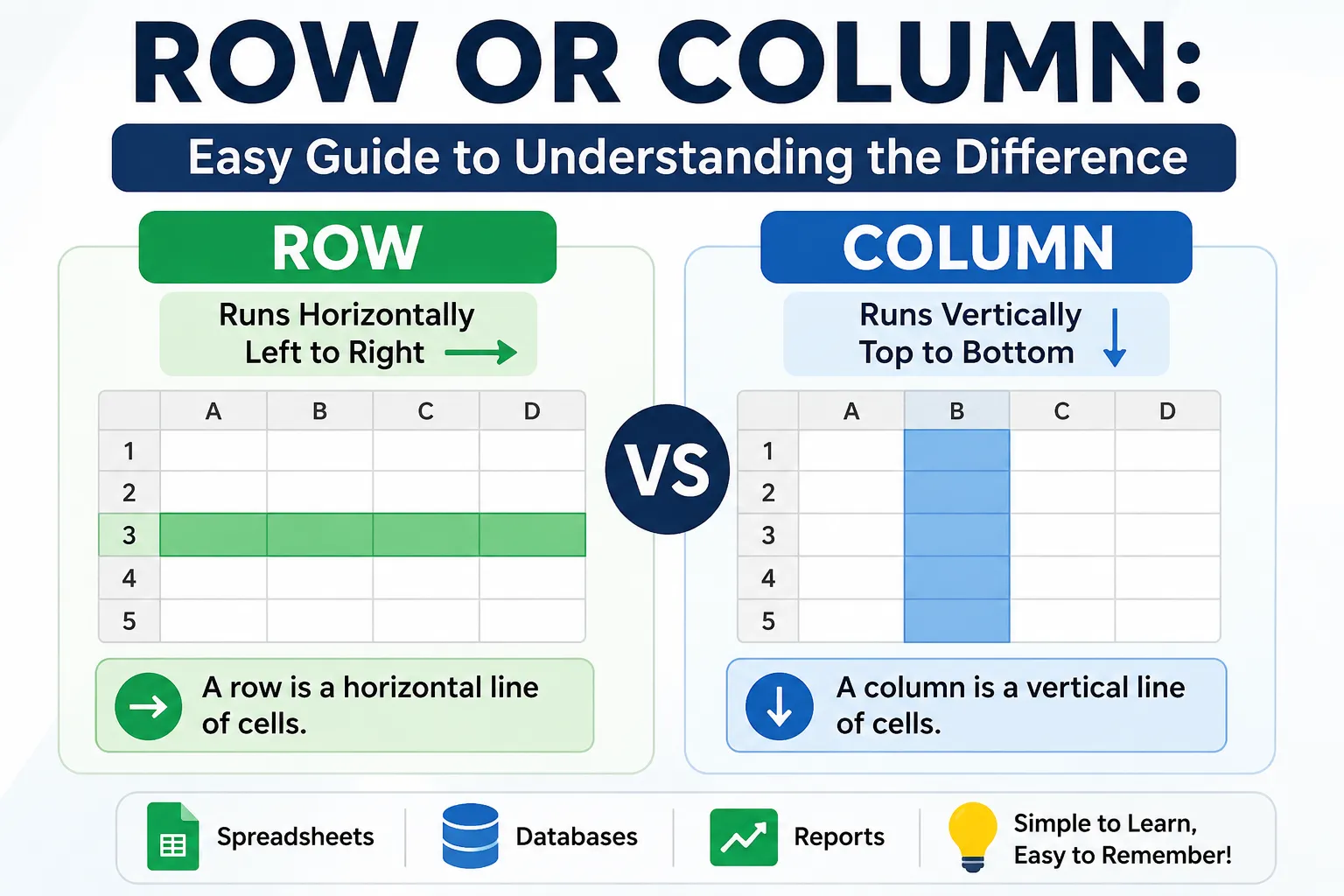
A row runs horizontally from left to right, while a column runs vertically from top to bottom. Rows and columns work together to organize information in tables, spreadsheets, databases, and charts.
A few years ago, I was helping a student create a spreadsheet for a school project. Everything looked fine until I asked him to enter data into a specific column. He started filling cells across the page instead of down it.
That small mistake led to a common question:
What is the difference between a row and a column?
Many people mix them up. It happens in school, at work, and even when using tools like Excel or Google Sheets. The terms seem simple, yet they often cause confusion because both are used together in tables and spreadsheets.
If you have ever wondered whether rows go across or down, you are not alone.
This guide will make the difference easy to remember. You will learn what rows and columns are, where they came from, how they are used, common mistakes to avoid, and which one you should use in different situations.
Let’s clear up the confusion once and for all.
Row or Column: Quick Answer
A row is a horizontal line of data. It moves from left to right across a page or screen.
A column is a vertical line of data. It moves from top to bottom.
Simple Examples
| Example | Row | Column |
|---|---|---|
| School attendance sheet | One student’s information | Student names section |
| Spreadsheet | Data across cells | Data down cells |
| Database | One record | One category |
Think of it this way:
- Rows run across
- Columns stand tall
This simple memory trick helps many people remember the difference.
The Origin / Background of Row or Column
The words row and column have been used for hundreds of years.
The word row comes from old words meaning a line of things arranged side by side. Farmers often used rows when planting crops.
The word column comes from the Latin word columna, which means a pillar or upright support. Ancient buildings often had large stone columns standing vertically.
The confusion exists because tables use both at the same time. When you look at a spreadsheet filled with data, it is easy to lose track of which direction is which.
Software programs like Microsoft Excel, Google Sheets, and databases made these terms even more common. Today, understanding them is a basic digital skill.
Row or Column Explained: Key Differences
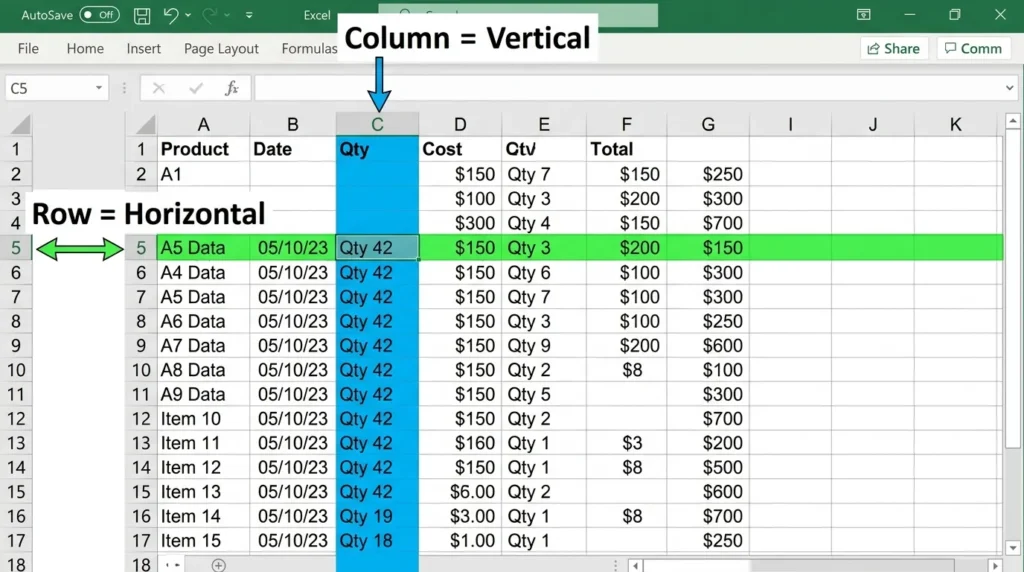
Although rows and columns work together, they serve different purposes.
Comparison Table
| Term | Meaning | When to Use | Region/Context |
|---|---|---|---|
| Row | Horizontal group of cells | Storing one complete record | Tables, spreadsheets, databases |
| Column | Vertical group of cells | Organizing similar data types | Tables, spreadsheets, databases |
Understanding Rows
Rows move horizontally.
Example:
| Name | Age | City |
|---|---|---|
| Sarah | 22 | London |
The information about Sarah forms one row.
Understanding Columns
Columns move vertically.
| Name |
|---|
| Sarah |
| John |
| Emma |
All names appear in one column.
Easy Memory Trick
- Row = Road = Goes across
- Column = Pillar = Goes up and down
Many teachers use this trick because it works well.
Which Version or Approach Should You Use?
The answer depends on what you are doing.
For Students
Use rows for individual records.
Example:
- One student’s information
- One test result
- One survey response
For Spreadsheet Users
Use columns for categories.
Example:
- Name
- Age
- Department
Keeping similar data in one column makes sorting and filtering easier.
For Database Users
A common practice is:
- One row = one record
- One column = one field
This structure keeps data organized.
For General Use
Remember:
- If data goes left to right, think row
- If data goes top to bottom, think column
That rule works almost every time.
Common Mistakes with Row or Column
Many people make the same errors.
Mistake 1
| Wrong | Correct |
|---|---|
| Calling a vertical list a row | Call it a column |
Why it happens:
People often focus on the data instead of the direction.
Mistake 2
| Wrong | Correct |
|---|---|
| Entering category names in rows | Place categories in columns |
Why it happens:
Beginners may not understand spreadsheet structure.
Mistake 3
| Wrong | Correct |
|---|---|
| Mixing row numbers with column letters | Learn each label system |
Why it happens:
Programs like Excel use numbers for rows and letters for columns.
Mistake 4
| Wrong | Correct |
|---|---|
| Assuming rows and columns mean the same thing | Understand their directions |
Why it happens:
Both are part of the same table.
Mistake 5
| Wrong | Correct |
|---|---|
| Sorting only part of a row | Sort the entire dataset |
Why it happens:
Users may accidentally break the data structure.
Row or Column in Real World Examples
Let’s see how these terms appear in everyday situations.
Professional Email
“Please add each employee’s details in a separate row and place salaries in the designated column.”
News Article
“The report showed that each column represented a different year of economic growth.”
Social Media Post
“Excel tip: Remember that a row goes across and a column goes down.”
Formal Report
“Customer information was stored by assigning one customer per row and one data type per column.”
These examples show how often the terms appear in business, education, and technology.
Row or Column: Data, Trends & Usage
Interest in row or column remains strong because spreadsheets are used everywhere.
Search Intent
The keyword falls mainly into the informational category.
Users usually want to:
- Understand the difference
- Learn spreadsheet basics
- Improve Excel skills
- Avoid mistakes in data entry
Who Searches Most?
Common audiences include:
- Students
- Teachers
- Office workers
- Data analysts
- Spreadsheet beginners
Where Is It Most Relevant?
The topic is highly relevant in:
- Schools
- Universities
- Businesses
- Government offices
- Data management roles
Why It Matters Today
As more work moves online, people use spreadsheets daily. Knowing the difference between a row and a column helps prevent errors and improves data organization.
Row vs Column Comparison Table
| Term/Variant | Meaning | Region/Context | Best Used When |
|---|---|---|---|
| Row | Horizontal line of data | Universal | Recording one complete item or record |
| Column | Vertical line of data | Universal | Grouping similar information together |
| Row Number | Numeric row identifier | Excel, Sheets | Finding a specific record |
| Column Letter | Alphabetic column identifier | Excel, Sheets | Finding a specific field |
| Database Row | Individual record | Databases | Storing one entry |
| Database Column | Data field | Databases | Storing one attribute |
Frequently Asked Questions
Q: What does row or column mean?
A row is a horizontal line of data, while a column is a vertical line of data. Together, they create tables and spreadsheets.
Q: How do you use row and column correctly?
Use rows for complete records and columns for categories of information. This keeps data organized and easy to manage.
Q: Row vs column: what’s the difference?
A row goes left to right. A column goes top to bottom. Direction is the main difference.
Q: Is row or column acceptable in formal writing?
Yes. Both terms are standard in business, education, research, and technical documents.
Q: Which is correct: row or column?
Both are correct. They refer to different parts of a table or spreadsheet.
Q: Where do the terms row and column come from?
Row comes from words meaning a line arranged side by side. Column comes from the Latin word for an upright pillar.
Q: Can row and column be used in Excel?
Absolutely. Excel uses numbered rows and lettered columns to identify cells and organize data.
Conclusion
Understanding row or column is easier once you remember one simple rule: rows go across, columns go down.
A row holds a complete record. A column groups similar information together. This structure helps organize data in spreadsheets, databases, reports, and many other tools.
You also learned where these terms come from, how they are used in real situations, and the mistakes people often make. Whether you are a student, office worker, or spreadsheet beginner, knowing the difference will save time and prevent errors.
The next time you open a spreadsheet, look at the direction of the data first. That simple habit can instantly tell you whether you are working with a row or a column.
Now you know exactly how to use row and column correctly. Bookmark this guide so you never mix them up again, and share it with someone who still does.
Read more: iPad or Laptop: Complete Guide to Choosing the Right Device

I am an English language writer dedicated to creating clear, accurate, and easy-to-understand content. My goal is to help readers build confidence in their language and communication skills.