A few years ago, I noticed a strange spot near the crown of my head while looking in the mirror. At first glance, it looked like my hair was thinning. Naturally, I panicked.
Like many people, my first thought was, “Am I going bald?”
After taking photos, checking old pictures, and speaking with a hair specialist, I learned something surprising. The spot had always been there. It was simply a cowlick.
This confusion happens to thousands of people every day. You see more scalp than usual. Your hair parts differently. A photo taken under bright light suddenly makes you worry.
The problem is that a cowlick and early balding can sometimes look very similar. Both can appear around the crown area. Both may reveal more scalp than expected.
If you’re searching for answers, you’re likely trying to figure out whether what you’re seeing is normal or a sign of hair loss.
In this guide, you’ll learn how to tell the difference, what signs to watch for, common mistakes people make, and when it might be time to seek professional advice.
Let’s start with the basics.
Cowlick or Balding : Quick Answer
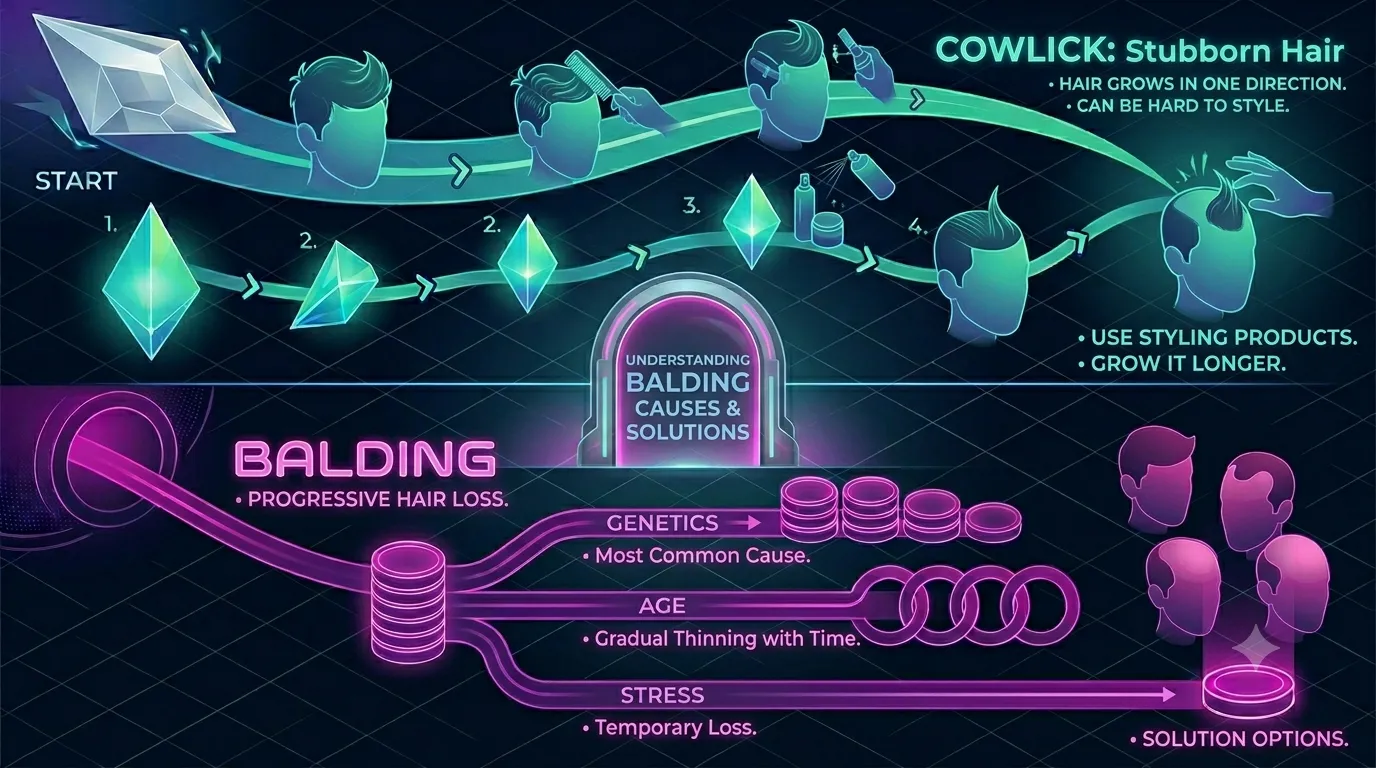
A cowlick is a natural section of hair that grows in a different direction from the surrounding hair. It is present from birth and usually stays the same throughout life.
Balding, on the other hand, involves gradual hair thinning or hair loss. It often changes over time and may expose increasing amounts of scalp.
Simple Examples
- A crown swirl that has looked the same for years is likely a cowlick.
- A spot that keeps getting larger over months may be balding.
The Origin / Background of Cowlick or Balding
The word cowlick comes from an old observation. People noticed that the pattern looked similar to hair that had been licked by a cow’s tongue.
The term has been used for generations to describe stubborn sections of hair that grow in unusual directions.
Balding comes from the word “bald,” which refers to partial or complete hair loss. Hair loss has been documented throughout history and can happen due to genetics, aging, hormones, stress, or medical conditions.
Confusion exists because both cowlicks and early hair loss often appear near the crown. Bright lighting, wet hair, and certain hairstyles can make the scalp more visible, causing unnecessary worry.
Cowlick or Balding Explained : Key Differences
The easiest way to identify the difference is to watch for changes over time.
A cowlick remains relatively stable. Balding progresses.
Comparison Table
| Term | Meaning | When to Use | Region/Context |
| Cowlick | Natural hair growth pattern | Hair grows in a swirl or unusual direction | Worldwide |
| Balding | Progressive hair loss | Hair density decreases over time | Worldwide |
| Crown Cowlick | Swirl at the crown | Natural scalp visibility | Common in adults |
| Crown Thinning | Hair loss at crown | Increasing scalp exposure | Hair loss discussions |
Key Signs of a Cowlick
- Present since childhood
- Hair grows in a spiral pattern
- Does not noticeably expand
- Hair density remains normal
Key Signs of Balding
- Hair becomes thinner
- More scalp becomes visible
- Hairline may recede
- Changes continue over months or years
Which Version or Approach Should You Use?
If you’re trying to determine whether you’re dealing with a cowlick or balding, use the approach that fits your situation.
For Beginners
Take photos every month under the same lighting.
Why?
A cowlick stays mostly unchanged. Balding usually progresses.
For People With a Family History of Hair Loss
Pay close attention to:
- Crown density
- Hairline changes
- Increased shedding
Family history can increase the likelihood of male or female pattern hair loss.
For People Unsure About What They See
Visit a dermatologist or hair specialist.
Professional scalp examinations can quickly identify whether you’re seeing a natural cowlick or actual thinning.
For a Neutral and Reliable Assessment
Compare current photos with pictures from one, three, and five years ago.
This is often the easiest way to spot real change.
Common Mistakes with Cowlick or Balding
Many people misjudge what they see.
Here are some common errors.
| Mistake | Correction |
| Assuming scalp visibility means balding | Cowlicks often show scalp naturally |
| Judging from one photo | Compare multiple photos over time |
| Checking only under bright light | Use consistent lighting conditions |
| Ignoring family history | Genetics can provide important clues |
| Self-diagnosing too quickly | Seek professional evaluation if unsure |
Why These Mistakes Happen
Modern smartphone cameras can exaggerate scalp visibility.
Strong overhead lighting can also make healthy hair appear thinner than it actually is.
Cowlick or Balding in Real-World Examples
Professional Email
“After reviewing my recent photos, I am unsure whether the crown area is a cowlick or balding pattern. I would appreciate a professional evaluation.”
News Headline
“Experts Explain How to Tell the Difference Between a Cowlick and Balding“
Social Media Post
“Spent an hour worrying about hair loss. Turns out it was just a cowlick the whole time!”
Formal Report
“The patient reported concerns regarding cowlick or balding appearance at the crown region. Examination showed normal hair density.”
Cowlick or Balding : Data, Trends & Usage
Interest in cowlick or balding searches has grown as people become more aware of hair health.
Most Common Search Intent
Informational
People want answers to questions such as:
- Is this normal?
- Am I losing my hair?
- How can I tell the difference?
Regions With Strong Interest
Searches are common in:
- United States
- United Kingdom
- Canada
- Australia
- India
Audiences Most Interested
- Men aged 18–45
- Women noticing crown thinning
- People with family history of hair loss
Why This Matters Now
High-resolution smartphone cameras and social media photos make people notice small details they may have ignored in the past.
As a result, more people are questioning whether they have a cowlick or early-stage balding.
Cowlick or Balding Comparison Table
| Term/Variant | Meaning | Region/Context | Best Used When |
| Cowlick | Natural hair swirl | Everyday use | Hair pattern discussion |
| Crown Cowlick | Cowlick at crown | Hair styling | Discussing scalp visibility |
| Balding | Progressive hair loss | Medical and general use | Discussing thinning hair |
| Crown Thinning | Reduced density at crown | Hair-loss evaluation | Monitoring hair changes |
| Male Pattern Baldness | Genetic hair loss | Medical context | Diagnosed hair loss |
| Female Pattern Hair Loss | Female thinning pattern | Medical context | Women’s hair-loss discussions |
Frequently Asked Questions
Q: What does cowlick or balding mean?
A: It refers to the challenge of determining whether visible scalp is caused by a natural hair swirl or actual hair loss. The two can look similar, especially at the crown.
Q: How do you use cowlick or balding correctly?
A: Use it when discussing uncertainty about a hair pattern. For example: “I’m trying to figure out if it’s a cowlick or balding.”
Q: Cowlick vs balding : what’s the difference?
A: A cowlick is a natural growth pattern. Balding involves gradual hair thinning and loss of density over time.
Q: Is cowlick or balding acceptable in formal writing?
A: Yes. It is commonly used in articles, medical discussions, forums, and educational content about hair health.
Q: Which is correct : cowlick or balding?
A: Neither is more correct. They describe different conditions. One is a natural hair pattern, and the other is hair loss.
Q: Where does the term cowlick come from?
A: The word originated from the idea that the hair pattern resembles hair licked by a cow.
Q: Can cowlick or balding be discussed in medical settings?
A: Absolutely. Dermatologists and hair specialists often evaluate whether crown visibility is due to a cowlick or early hair loss.
Conclusion
The difference between cowlick or balding often comes down to one key factor: change over time.
A cowlick is a natural hair pattern. It usually stays the same for years. Balding involves ongoing hair loss and reduced density. Looking at old photos, tracking changes, and paying attention to hair thickness can help you identify what’s really happening.
Remember these key points:
- A cowlick is normal and common.
- Balding usually progresses over time.
- Consistent photos are one of the best tools for comparison.
- Professional advice can provide certainty when you’re unsure.
If you’re worried about your hair, don’t panic after looking at a single photo. Take a step back. Compare past images. Monitor changes carefully.
Now you know exactly how to tell the difference between cowlick or balding. Bookmark this guide so you never second-guess what you’re seeing in the mirror again.
Read More: Authorised or Authorized: The Complete Guide to Correct Usage

SEO enthusiast focused on improving website visibility and driving organic growth through effective optimization strategies.