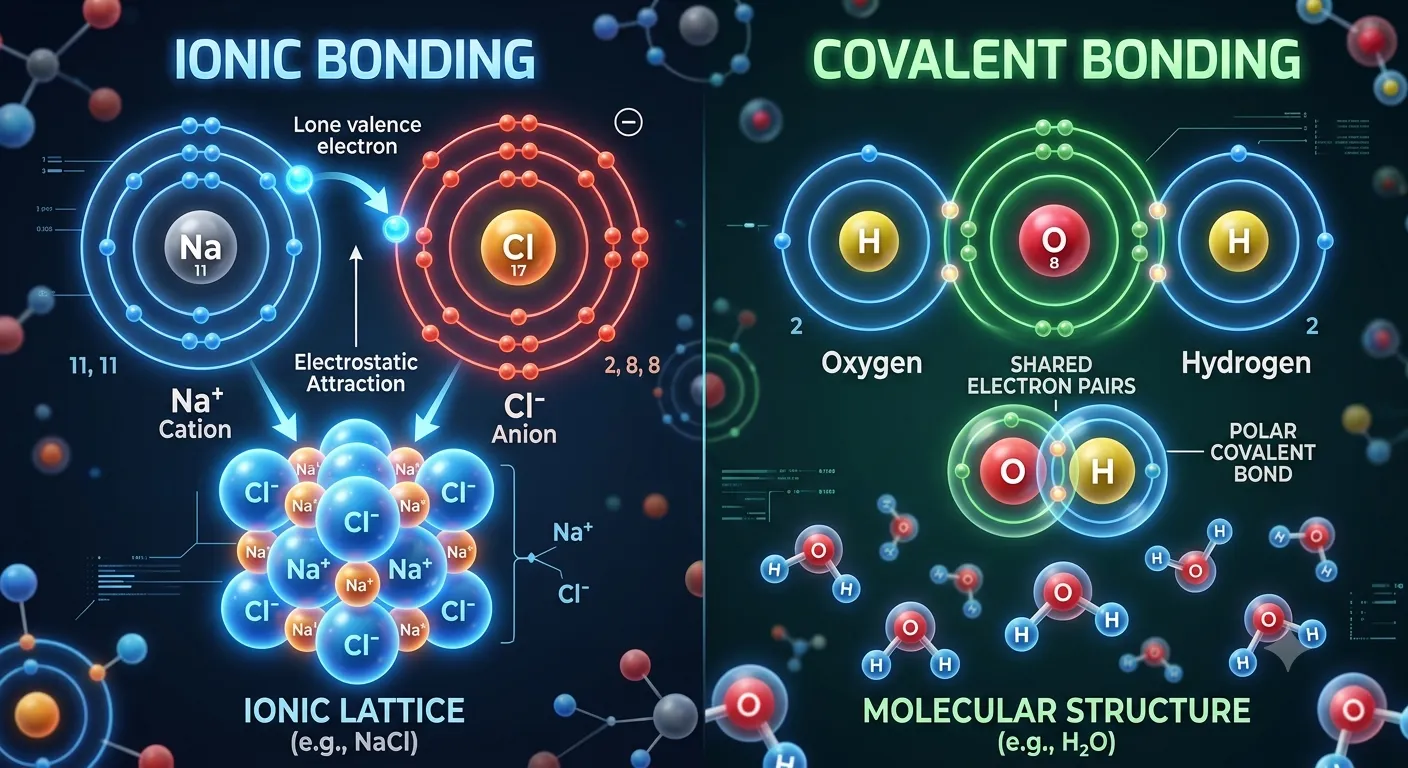
Ionic and covalent bonds are two major types of chemical bonds. Ionic bonds form when electrons are transferred between atoms, while covalent bonds form when atoms share electrons.
🧪 Ionic or Covalent: Easy Guide to Understanding Chemical Bonds
I still remember the first chemistry class where the teacher asked a simple question: “What holds atoms together?” Most students thought the answer would be straightforward. Instead, we discovered an entire world of chemical bonding.
At first, terms like ionic bonds and covalent bonds can sound complicated. Many students struggle to remember which bond involves sharing electrons and which involves transferring them. To make matters worse, chemistry textbooks often explain these concepts using technical language that can feel overwhelming.
Yet understanding ionic and covalent bonds is essential because they explain how substances form and why materials behave differently. The salt on your dinner table, the water you drink, the oxygen you breathe, and even the DNA in your body all depend on chemical bonds.
If you’ve searched for ionic or covalent, you’re probably trying to determine the difference between these two bond types, identify examples, or learn how to tell them apart. This guide will make the topic simple, practical, and easy to remember.
By the end, you’ll know exactly what ionic and covalent bonds are, how they form, their properties, real-world examples, and how to identify them in chemistry problems.
⚡ Ionic or Covalent Quick Answer
Ionic Bond
An ionic bond forms when one atom transfers electrons to another atom.
Example:
- Sodium (Na) + Chlorine (Cl) → Sodium Chloride (NaCl)
Covalent Bond
A covalent bond forms when atoms share electrons.
Example:
- Hydrogen (H) + Oxygen (O) → Water (H₂O)
Simple Rule
- Transfer electrons → Ionic
- Share electrons → Covalent
This is the easiest way to remember the difference.
📚 The Origin and Background of Chemical Bonds
Scientists once wondered why atoms joined together to form substances.
In the early twentieth century, researchers discovered that electrons play a major role in chemical bonding. Atoms naturally seek stability, often by achieving a full outer electron shell.
To become stable, atoms may:
- Gain electrons
- Lose electrons
- Share electrons
These interactions create chemical bonds.
Over time, scientists classified these interactions into different bond types, including ionic and covalent bonds.
Today, these concepts form the foundation of modern chemistry.
🔬 What Is an Ionic Bond?
An ionic bond occurs when one atom gives electrons to another atom.
This creates:
- A positive ion (cation)
- A negative ion (anion)
Because opposite charges attract, the ions stick together.
Example: Sodium Chloride (Table Salt)
Step 1
Sodium has one electron in its outer shell.
Step 2
Chlorine needs one electron to complete its outer shell.
Step 3
Sodium transfers its electron to chlorine.
Step 4
The resulting ions attract each other.
Result:
Na⁺ + Cl⁻ → NaCl
This attraction creates an ionic bond.
⚛️ What Is a Covalent Bond?
A covalent bond forms when atoms share electrons.
Instead of transferring electrons, atoms contribute electrons to a shared pair.
Example: Water (H₂O)
Oxygen needs two additional electrons.
Each hydrogen atom needs one more electron.
By sharing electrons:
- Hydrogen becomes stable.
- Oxygen becomes stable.
The shared electrons create covalent bonds.
Result:
H₂O
🔍 Ionic vs Covalent Bonds Explained
| Feature | Ionic Bond | Covalent Bond |
| Electron Behavior | Transfer | Share |
| Atoms Involved | Metal + Nonmetal | Nonmetal + Nonmetal |
| Bond Strength | Strong | Strong |
| Electrical Conductivity | Conducts when dissolved | Usually poor conductor |
| Melting Point | High | Lower |
| Examples | NaCl, MgO | H₂O, CO₂ |
⚖️ Ionic or Covalent: Key Differences
1. Electron Movement
Ionic
Electrons move from one atom to another.
Example:
Na → Cl
Covalent
Electrons are shared.
Example:
H ↔ H
2. Types of Elements
Ionic Bonds
Usually form between:
- Metals
- Nonmetals
Examples:
- Sodium + Chlorine
- Magnesium + Oxygen
Covalent Bonds
Usually form between:
- Nonmetals
Examples:
- Hydrogen + Oxygen
- Carbon + Oxygen
3. Physical Properties
Ionic Compounds
Often:
- Hard
- Brittle
- High melting points
Covalent Compounds
Often:
- Softer
- Lower melting points
- More likely to exist as gases or liquids
🧠 How to Tell If a Compound Is Ionic or Covalent
Many students need a quick method.
Rule 1
If the compound contains:
Metal + Nonmetal
➡️ Usually Ionic
Examples:
- NaCl
- MgO
- CaCl₂
Rule 2
If the compound contains:
Nonmetal + Nonmetal
➡️ Usually Covalent
Examples:
- H₂O
- CO₂
- CH₄
Quick Identification Table
| Compound | Ionic or Covalent? |
| NaCl | Ionic |
| H₂O | Covalent |
| CO₂ | Covalent |
| MgO | Ionic |
| NH₃ | Covalent |
| KBr | Ionic |
🌎 Ionic Bonds in Real Life
Ionic compounds are everywhere.
Table Salt
NaCl
Used daily in food preparation.
Calcium Chloride
Used to melt ice on roads.
Magnesium Oxide
Found in medicines and industrial products.
Potassium Iodide
Used in nutritional supplements.
💧 Covalent Bonds in Real Life
Covalent compounds are equally important.
Water
H₂O
Essential for life.
Carbon Dioxide
CO₂
Produced during respiration.
Methane
CH₄
Used as fuel.
Oxygen Gas
O₂
Required for breathing.
🏭 Applications of Ionic Compounds
Ionic compounds have many industrial uses.
Medicine
Used in:
- Antacids
- Supplements
- Electrolyte solutions
Agriculture
Used in fertilizers.
Manufacturing
Important in:
- Ceramics
- Glass production
- Chemical processing
Food Industry
Common salts improve flavor and preservation.
🔬 Applications of Covalent Compounds
Biology
DNA and proteins contain covalent bonds.
Fuels
Natural gas contains methane.
Plastics
Most plastics rely on covalent bonding.
Pharmaceuticals
Many medicines consist of covalent molecules.
⚠️ Common Mistakes with Ionic and Covalent Bonds
| Mistake | Correction |
| Ionic bonds share electrons | Ionic bonds transfer electrons |
| Covalent bonds transfer electrons | Covalent bonds share electrons |
| All compounds are ionic | Many are covalent |
| Metals form covalent bonds only | Metals often form ionic bonds |
Why Students Get Confused
Similar Terminology
Scientific terms can sound intimidating.
Memorization Without Understanding
Students often memorize instead of understanding electron behavior.
Lack of Real Examples
Learning becomes easier when linked to everyday substances.
📈 Ionic or Covalent Data, Trends & Usage
Who Searches This Topic?
- Middle school students
- High school students
- College students
- Chemistry teachers
- Exam candidates
Search Intent
Educational / Informational
People want to know:
- Bond differences
- Identification methods
- Examples
- Homework help
- Test preparation
Why It Matters
Chemical bonding is one of the most important topics in chemistry because it explains:
- Reactions
- Materials
- Biological systems
- Industrial processes
📊 Standalone Comparison Table
| Property | Ionic | Covalent |
| Electron Action | Transfer | Share |
| Typical Elements | Metal + Nonmetal | Nonmetal + Nonmetal |
| Conducts Electricity | Yes (when dissolved) | Usually No |
| Melting Point | High | Lower |
| Structure | Crystal lattice | Molecules |
| Example | NaCl | H₂O |
| Example | MgO | CO₂ |
| Example | KBr | CH₄ |
🎓 Tips for Remembering the Difference
Remember This Phrase
“Ionic = I Gave It Away”
Electrons are transferred.
Remember This Phrase
“Covalent = Cooperative Sharing”
Electrons are shared.
Shortcut
- Metal + Nonmetal → Ionic
- Nonmetal + Nonmetal → Covalent
This works for most introductory chemistry questions.
Frequently Asked Questions
Q: What is the main difference between ionic and covalent bonds?
A: Ionic bonds transfer electrons, while covalent bonds share electrons.
Q: Is water ionic or covalent?
A: Water (H₂O) is covalent because the atoms share electrons.
Q: Is table salt ionic or covalent?
A: Table salt (NaCl) is ionic because sodium transfers an electron to chlorine.
Q: Which bond is stronger?
A: Both can be very strong, but ionic bonds often create compounds with very high melting points.
Q: How can I quickly identify an ionic compound?
A: Look for a metal and a nonmetal together.
Q: Why do atoms form bonds?
A: Atoms form bonds to become more stable.
Q: Is carbon dioxide ionic or covalent?
A: Carbon dioxide (CO₂) is covalent because carbon and oxygen share electrons.
Q: Can covalent compounds conduct electricity?
A: Most covalent compounds are poor conductors of electricity.
🎯 Conclusion
Understanding ionic or covalent bonds is one of the most important steps in learning chemistry. Although the concepts may seem complex at first, the basic difference is surprisingly simple.
Remember these key points:
- Ionic bonds transfer electrons.
- Covalent bonds share electrons.
- Metal + Nonmetal = Usually Ionic.
- Nonmetal + Nonmetal = Usually Covalent.
- Ionic compounds often have high melting points and conduct electricity when dissolved.
- Covalent compounds form many of the substances essential for life.
Whether you’re studying for a chemistry exam, completing homework, or simply curious about how matter works, knowing the difference between ionic and covalent bonds will help you understand the world at the atomic level.
Now you know exactly how to identify ionic or covalent compounds. Bookmark this guide so you can quickly review these concepts whenever you need them.
Read More:
Lead or Leed: Meaning, Spelling & Correct Usage ✍️

📚✨ I’m an English enthusiast and author dedicated to exploring word differences, spelling variations, and common language questions. By drawing on trusted dictionaries, language resources, and practical usage examples, I create clear, reliable content that helps readers learn with confidence and communicate more effectively. ✍️🌍