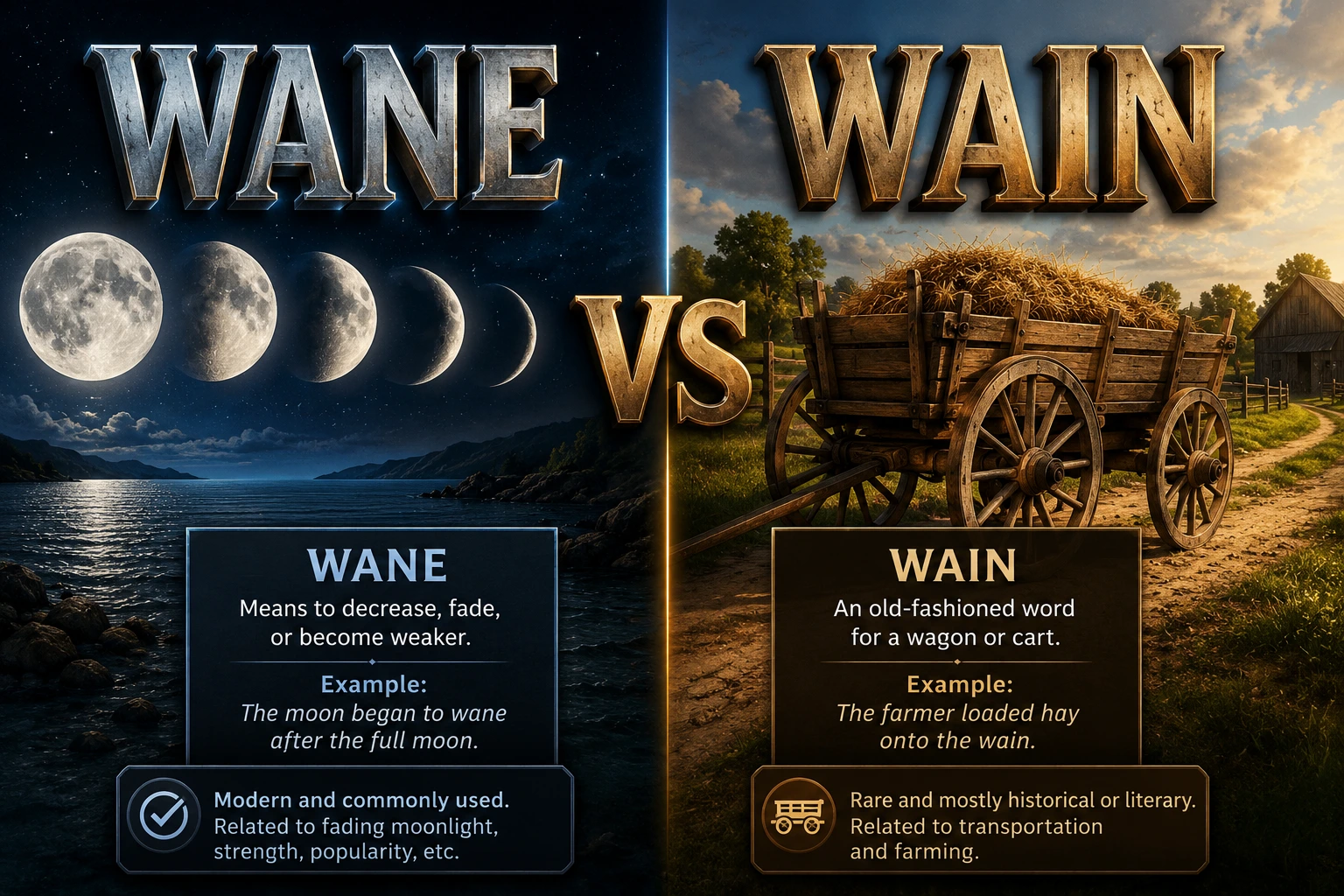
Wane means to decrease, fade, or become weaker over time. Wain is an old-fashioned word that means a wagon or cart. In modern English, wane is usually the correct choice. For example, “Public interest began to wane after the announcement” is correct.
I still remember editing a student’s essay several years ago. The sentence read, “My excitement for the project started to wain after a few weeks.” At first glance, the spelling looked reasonable. The word sounded right. Yet something felt off.
The correct word was actually wane.
That small spelling difference completely changed the meaning of the sentence. The student was talking about excitement fading over time, not a wagon or cart. It was a simple mistake, but it highlighted a common problem many English learners and native speakers face.
Words that sound alike often create confusion. Some have similar spellings. Others share pronunciation but have very different meanings. Wane and wain belong to that group.
Many people search for wane or wain because they have seen both spellings online and want to know which one is correct. Others may have encountered the words in books, articles, historical novels, or school assignments and are unsure when each should be used.
The good news is that once you understand the meaning of each word, the difference becomes very easy to remember.
In this guide, you will learn the meanings of wane and wain, their history, their correct usage, common mistakes, real-world examples, and practical tips that will help you choose the right word every time.
Wane or Wain Quick Answer
If you only need a fast answer, here it is:
- Wane = to decrease, fade, weaken, or become less.
- Wain = a wagon, cart, or old vehicle used to carry goods.
Quick Examples
✅ The excitement began to wane.
✅ His influence started to wane.
✅ The moon will wane during the next phase.
✅ The farmer loaded hay onto the wain.
✅ The merchant traveled with a wooden wain.
For everyday writing, emails, school assignments, blog posts, and professional documents, wane is the word most people need.
The Origin and Background of Wane or Wain
Understanding where these words came from helps explain why they are so different despite looking similar.
The History of Wane
The word wane comes from the Old English word wanian, which meant “to lessen,” “decrease,” or “diminish.”
People have used this word for hundreds of years to describe things becoming smaller or weaker.
Originally, it was often associated with the moon.
When the moon appears to shrink after a full moon, it is said to be waning.
Over time, the meaning expanded to include many other situations.
Today, people use wane when talking about:
- Interest
- Power
- Popularity
- Influence
- Energy
- Confidence
- Enthusiasm
Examples:
- Her confidence began to wane.
- The team’s momentum started to wane.
- Interest in the trend quickly waned.
The History of Wain
The word wain comes from the Old English word wægn.
Its meaning was much more concrete.
A wain was simply a wagon or cart used for transportation.
Before trucks and modern vehicles existed, people relied on horse-drawn carts to move goods and supplies.
Those carts were often called wains.
The term became less common as transportation evolved. Today, it survives mainly in:
- Historical literature
- Poetry
- Classic novels
- Academic discussions of older English
Because modern speakers rarely encounter the word, many mistakenly think wain is an alternative spelling of wane.
It is not.
Wane or Wain Explained Key Differences
The easiest way to understand these words is to compare them directly.
| Term | Meaning | When to Use | Region/Context |
| Wane | To fade or decrease | Everyday English | Worldwide |
| Wain | Wagon or cart | Historical contexts | Rare usage |
Understanding Wane
Think about anything that becomes less over time.
That is where wane belongs.
Examples:
- Interest wanes.
- Energy wanes.
- Popularity wanes.
- Influence wanes.
- Enthusiasm wanes.
Understanding Wain
Think about an old wooden vehicle.
That is where wain belongs.
Examples:
- The farmer repaired his wain.
- The merchant drove a heavy wain.
- The horse pulled a large wain.
The meanings are completely unrelated.
One refers to decline.
The other refers to transportation.
Which Version Should You Use?
For most writers, the answer is simple.
For Students
Use wane when discussing change, decline, or reduction.
Examples:
- My motivation began to wane.
- Interest in the topic started to wane.
For Bloggers
Use wane in articles and online content.
Examples:
- Consumer interest may wane after the launch period.
- Demand tends to wane during the off-season.
For Business Professionals
Use wane in reports and workplace communication.
Examples:
- Customer engagement has started to wane.
- Market enthusiasm may wane over time.
For Novelists
Use wain only when describing historical settings or old transportation methods.
Examples:
- The merchant arrived in a wooden wain.
- The village road was crowded with wains.
For Global English
Use wane whenever you mean:
- Decline
- Reduction
- Fading
- Weakening
That choice will almost always be correct.
Common Mistakes with Wane or Wain
Many people make the same errors.
Here are the most common ones.
Mistake 1
❌ Interest in the product began to wain.
✅ Interest in the product began to wane.
Why?
Interest can decrease. It cannot become a wagon.
Mistake 2
❌ His popularity started to wain.
✅ His popularity started to wane.
Why?
Popularity fades.
Mistake 3
❌ Public support continued to wain.
✅ Public support continued to wane.
Why?
Support can decline.
Mistake 4
❌ The moon will wain tonight.
✅ The moon will wane tonight.
Why?
The moon’s shrinking phase is called waning.
Mistake 5
❌ The farmer loaded grain onto a wane.
✅ The farmer loaded grain onto a wain.
Why?
Here the word refers to a cart.
Easy Memory Tricks
Need a simple way to remember the difference?
Trick #1: Wane = Weak
Both words start with W.
If something becomes weaker, it wanes.
Trick #2: Wain = Wagon
Both words start with Wa.
Think:
Wain = Wagon
That connection helps many learners remember the meaning.
Trick #3: Moon Connection
If you’re talking about the moon becoming smaller, always choose wane.
The phrase waning moon is extremely common.
Wane or Wain in Real World Examples
Let’s see how the words appear in everyday communication.
Professional Email
Subject: Customer Engagement Update
Dear Team,
Recent reports suggest customer engagement may begin to wane unless new campaigns are introduced.
Best regards,
Marketing Manager
News Headline
Public Interest Begins to Wane After Initial Excitement
Social Media Post
My motivation always starts to wane halfway through winter.
Academic Writing
Researchers found that participant enthusiasm tended to wane over time.
Business Report
Sales growth may wane during the fourth quarter due to seasonal trends.
Historical Novel
The old wain rattled down the dusty road behind the horses.
Poetry Example
The weary horse pulled the ancient wain beneath the fading sun.
Wane in Common Expressions
You will encounter wane in many common phrases.
Wane Interest
- Interest began to wane.
- Public interest waned quickly.
Wane Influence
- His influence has waned.
- Their authority is waning.
Wane Confidence
- Investor confidence began to wane.
- Confidence can wane during uncertainty.
Wane Energy
- My energy started to wane.
- Productivity often wanes late in the day.
Wane Enthusiasm
- Enthusiasm waned after the first week.
- Support slowly waned.
These are all natural and common expressions.
Wane or Wain Data, Trends & Usage
Search behavior reveals some interesting facts.
Search Intent
The keyword wane or wain falls into the informational category.
People searching this term usually want:
- Correct spelling
- Usage guidance
- Writing help
- Grammar clarification
Popular Audiences
The topic is frequently searched by:
- Students
- Teachers
- Writers
- Editors
- Bloggers
- English learners
Why the Confusion Exists
Several factors contribute:
- Similar spelling
- Similar pronunciation
- Rare use of wain
- Autocorrect limitations
- Historical appearances in books
Modern Usage Reality
In modern English, wane appears far more often than wain.
Most people may never encounter wain outside literature or historical texts.
That means if you are unsure, there is a very high chance you actually mean wane.
Complete Comparison Table
| Term/Variant | Meaning | Region/Context | Best Used When |
| Wane | Become less or weaker | Modern English | Talking about decline |
| Waned | Past tense of wane | Modern English | Referring to a completed decline |
| Waning | Currently decreasing | Modern English | Ongoing reduction |
| Wain | Wagon or cart | Historical writing | Describing old vehicles |
| Wains | Multiple wagons | Historical writing | Referring to several carts |
Frequently Asked Questions
Q: What does wane mean?
A: Wane means to decrease, weaken, fade, or become less over time. It often describes interest, energy, influence, popularity, or confidence.
Q: What does wain mean?
A: Wain is an old word for a wagon or cart. It is mainly found in historical texts and literature.
Q: Which is more common, wane or wain?
A: Wane is much more common in modern English. Most writers use it regularly, while wain is rarely used today.
Q: Is wain a misspelling of wane?
A: No. Wain is a real word with its own meaning. However, people often mistakenly use it when they actually mean wane.
Q: Can wane be used in formal writing?
A: Yes. Wane is perfectly acceptable in academic, professional, business, and journalistic writing.
Q: What is a waning moon?
A: A waning moon is a moon that appears to be getting smaller after the full moon phase.
Q: Why do people confuse wane and wain?
A: The words have similar spellings and pronunciations, which makes them easy to mix up.
Q: Is wain still used today?
A: Yes, but mostly in historical writing, poetry, literature, and discussions of older forms of transportation.
Q: Can enthusiasm wane?
A: Absolutely. Enthusiasm is one of the most common things described as waning.
Q: Can a vehicle be called a wain today?
A: Technically yes, but it sounds old-fashioned. Most modern writers would simply say wagon or cart.
Conclusion
The difference between wane and wain is simple once you know the meanings.
Wane means to fade, weaken, decrease, or become less over time. It is the word used when discussing declining interest, shrinking influence, fading enthusiasm, reduced energy, or the changing phases of the moon.
Wain, on the other hand, is a historical term for a wagon or cart. While it is still a valid English word, it appears mainly in literature, poetry, and historical writing.
If you are writing an email, article, report, essay, blog post, social media update, or business document, wane will almost always be the correct choice when talking about decline or reduction.
Remember this simple rule:
If something is becoming weaker, use “wane.” If you’re talking about an old wagon, use “wain.”
That one sentence can save you from this mistake forever.
Now you know exactly how to use wane or wain with confidence. Bookmark this guide so you never second-guess the difference again, and share it with someone who has struggled with these confusing words.
Semicolon or Colon: Easy Guide to Using Them Correctly

📚✨ I’m an English enthusiast and author dedicated to exploring word differences, spelling variations, and common language questions. By drawing on trusted dictionaries, language resources, and practical usage examples, I create clear, reliable content that helps readers learn with confidence and communicate more effectively. ✍️🌍