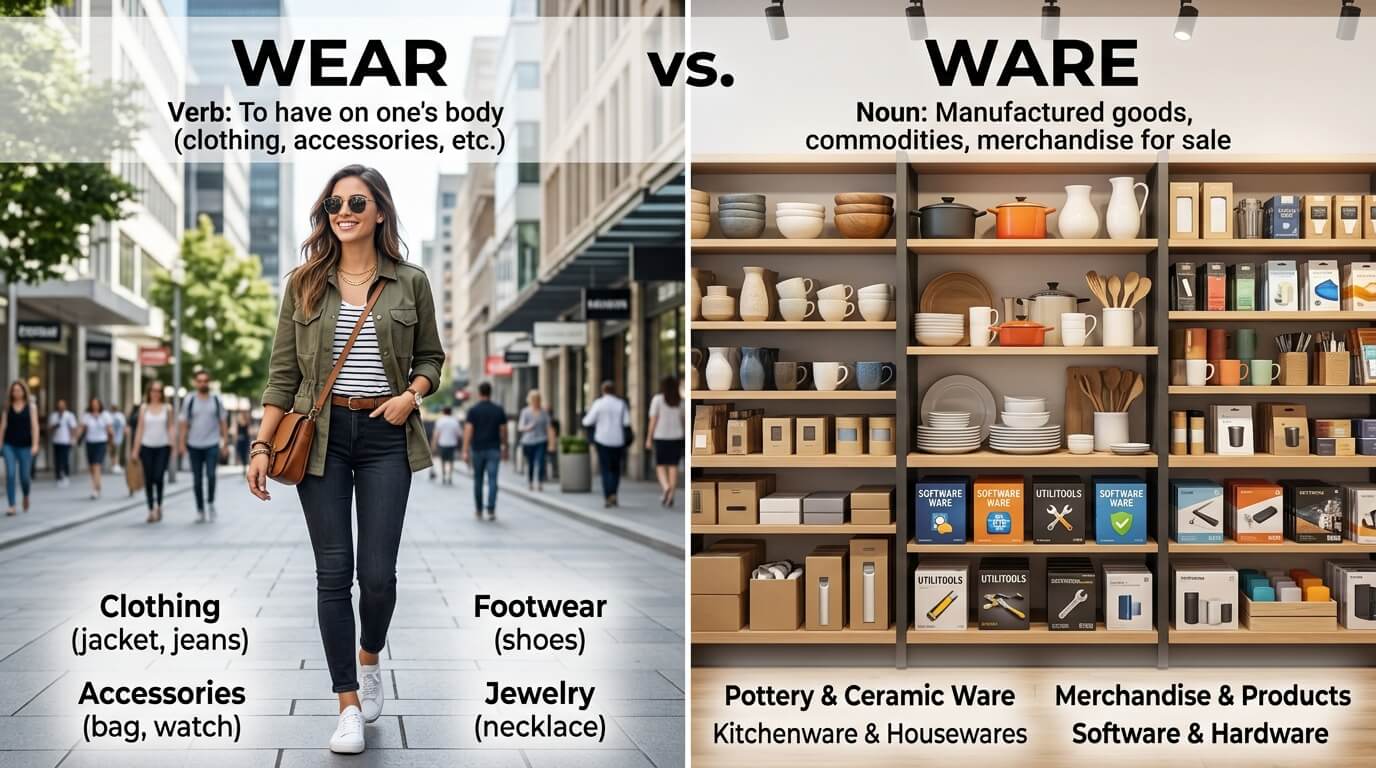
Wear means to have clothing on your body or to use something over time. Ware refers to goods, products, or merchandise.
A few years ago, I was proofreading a student’s business email when I spotted a funny mistake. The sentence read, “We wear electronic products worldwide.”
The writer meant ware, not wear.
One small letter changed the entire meaning.
This confusion happens more often than you might think.Many English learners search for wear vs ware because the two words sound identical but have completely different meanings. Since wear and ware sound exactly alike, many English learners mix them up in writing. Spell checkers may not always catch the mistake because both words are correct English words.
You may have seen phrases like software, tableware, or sportswear and wondered why some use “ware” while others use “wear.” Perhaps you’ve typed the wrong word in an email or school assignment.
The good news is that the difference is easy to understand once you know the meaning behind each word.
By the end of this guide, you’ll know exactly when to use wear and when to use ware, along with practical examples, common mistakes, and simple memory tricks that make the distinction easy to remember.
Let’s clear up the confusion.
Wear or Ware: Quick Answer

The difference comes down to meaning.
- Wear relates to clothing, using something, or gradual damage.
- If you’re wondering how to spell wear, the correct spelling is W-E-A-R when talking about clothing, usage, or damage from use.
- Ware refers to goods, products, or items for sale.
The wear vs ware meaning difference is simple: wear relates to clothing and use, while ware refers to products and merchandise.
Examples
- I wear glasses every day.
- The store sells ceramic ware.
Although they sound the same, they belong in completely different situations.
The Origin: Background of Wear or Ware
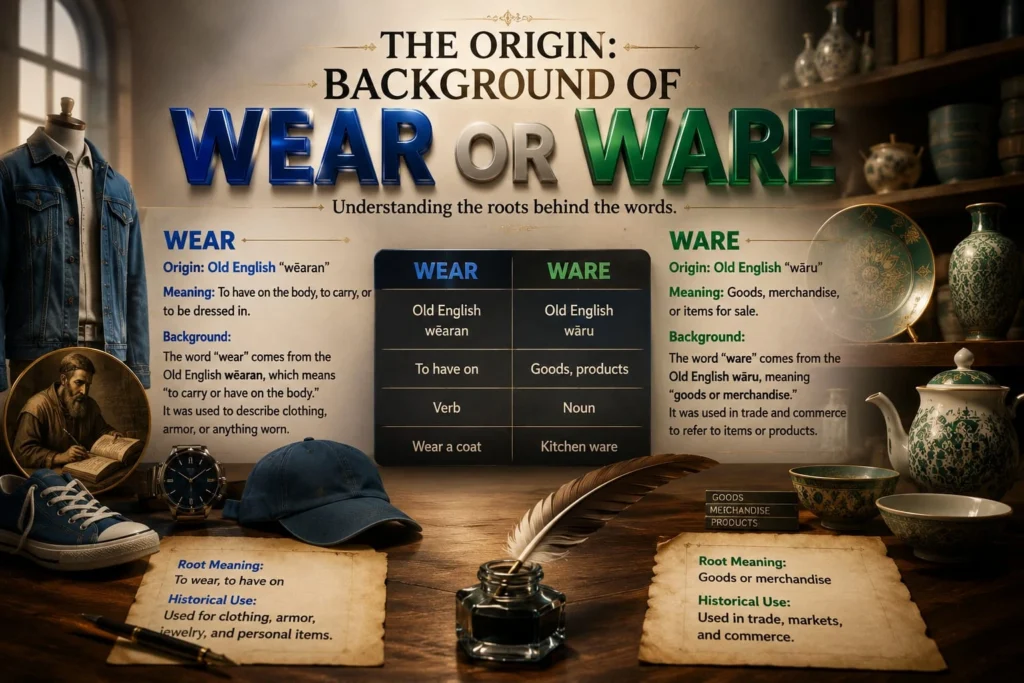
The words have different histories.
Wear comes from ancient Germanic roots connected to carrying, using, and clothing. Over time, it developed meanings related to putting on clothes and using objects until they become worn.
Ware comes from old words meaning goods, merchandise, or products for trade.
Centuries ago, merchants sold their “wares” in markets. That usage continues today in words such as:
- Software
- Hardware
- Kitchenware
- Glassware
- Tableware
Because the words are pronounced the same way, writers often confuse them when typing.
The meanings, however, remain very different.
Wear or Ware Explained: Key Differences
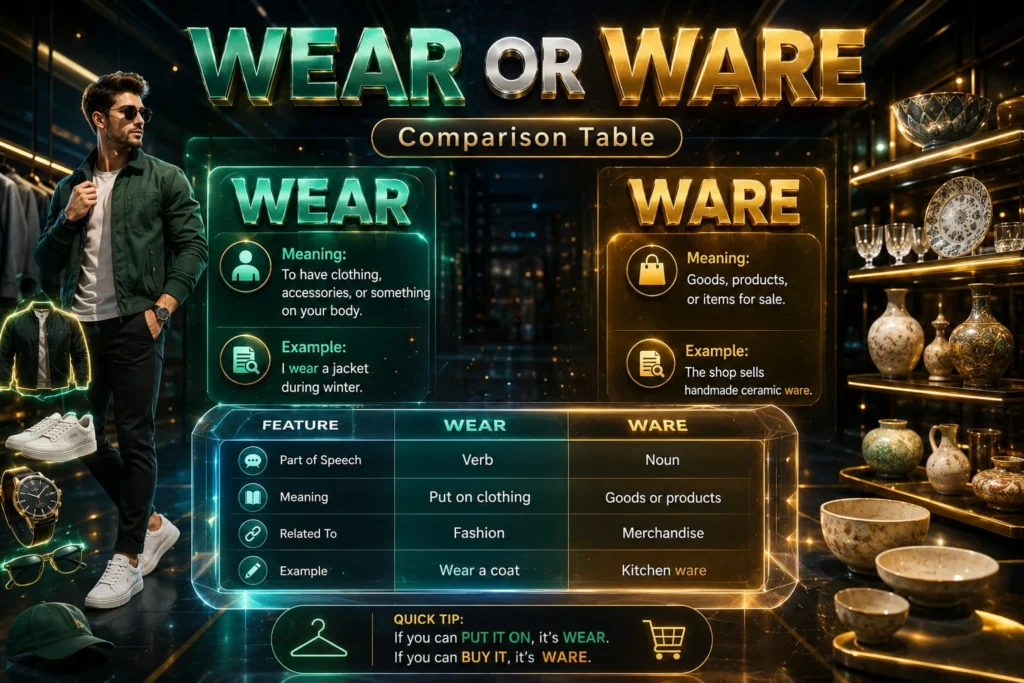
People also confuse wares or wears because the words look similar but serve different purposes in a sentence.
The easiest way to separate these words is to think about the context.
| Term | Meaning | When to Use | Region/Context |
| Wear | Put on clothing | Talking about clothes | Global English |
| Wear | Use over time | Talking about usage | Global English |
| Wear | Damage from use | Talking about deterioration | Global English |
| Ware | Goods or merchandise | Talking about products | Business and retail |
| Ware | Product category | Compound words like software | Technology and commerce |
Examples of Wear
- I wear a coat when it rains.
- She wears contact lenses.
- Daily use can wear out the battery.
Examples of Ware
- The market sells handmade ware.
- The company develops software.
- The store offers decorative kitchenware.
The key difference is simple.
Wear involves using or carrying something.
Ware involves products or goods.
Which Version Should You Use?
The correct choice depends on what you want to say.
If You Mean Clothing
Use wear.
Example:
- I wear sneakers every day.
If You Mean Using Something
Use wear.
Example:
- Heavy traffic can wear down roads.
- People often wonder about wear down or ware down. The correct phrase is wear down because it describes gradual damage or reduction caused by repeated use.
If You Mean Products or Merchandise
Use ware.
Example:
- The shop sells pottery ware.
If You Mean Technology Products
Use ware.
Examples:
- Software
- Hardware
- Firmware
For Students and Writers
Ask yourself:
“Am I talking about using something or selling something?”
If it involves use, choose wear.
If it involves products, choose ware.
Common Mistakes with Wear or Ware
These mistakes appear frequently in writing.
Mistake 1
❌ I ware glasses.
✅ I wear glasses.
Why?
Clothing and personal items require wear.
Mistake 2
❌ The store sells kitchen wear.
✅ The store sells kitchenware.
Why?
Products and merchandise require ware.
Mistake 3
❌ The company develops softwear.
✅ The company develops software.
Why?
Software belongs to the ware family of words.
Mistake 4
❌ This machine ware out quickly.
✅ This machine wore out quickly.
Why?
The verb is wear, and the past tense is wore.
Mistake 5
❌ We export electronic wear worldwide.
✅ We export electronic ware worldwide.
❌ I like to ware something comfortable at home.
✅ I like to wear something comfortable at hom
Why?
Products and goods use ware.
Plain or Plane: Easy Guide to Use the Right Word
Wear or Ware in Real-World Examples
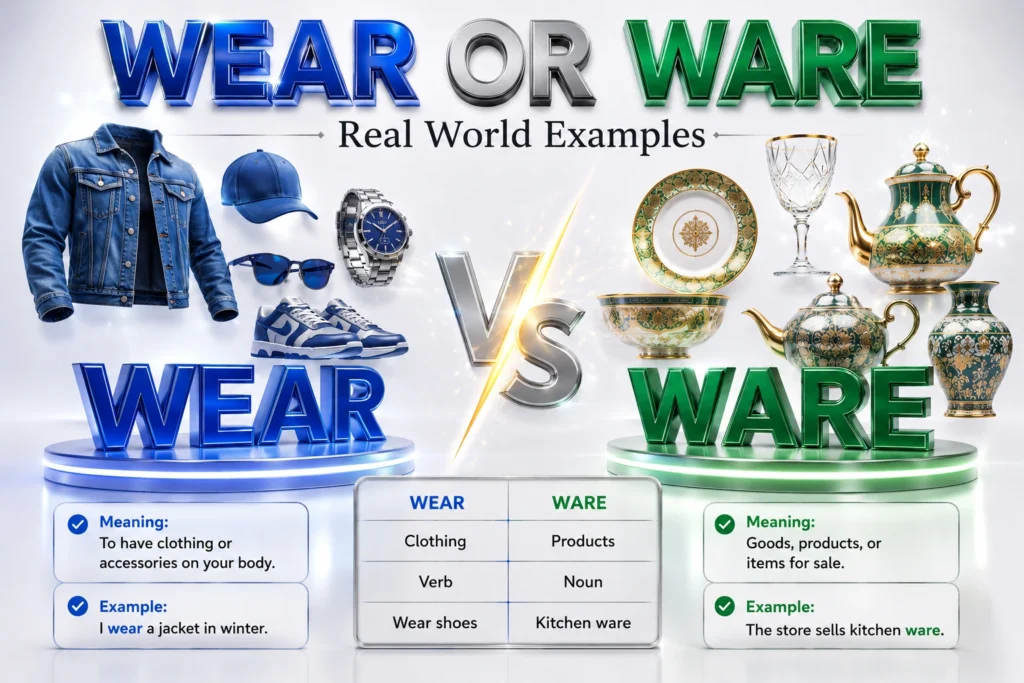
Professional Email
“Employees should wear safety equipment at all times.”
“Our company distributes computer hardware and software.”
News Headline
“Workers Required to Wear Protective Helmets”
“Local Business Expands Kitchenware Product Line”
Social Media Post
“I love to wear comfortable shoes when traveling.”
“Just bought some beautiful handmade pottery ware.”
Formal Report
“Staff members must wear identification badges.”
“The retailer increased sales of household ware products.”
Wear or Ware: Data, Trends & Usage
The keyword wear or ware remains popular because it involves a common homophone error.
Who Searches This Topic?
- English learners
- Students
- Teachers
- Professional writers
- Job seekers
- Business professionals
Search Intent
The keyword is mainly:
- Informational
- Educational
- Grammar-related
- Writing-focused
Why It Matters Today
Digital communication moves quickly.
Many people write emails, reports, social media posts, and academic papers every day.
A simple mistake between wear and ware can make professional writing look careless. Understanding the difference improves clarity and confidence.
Wear or Ware Comparison Table
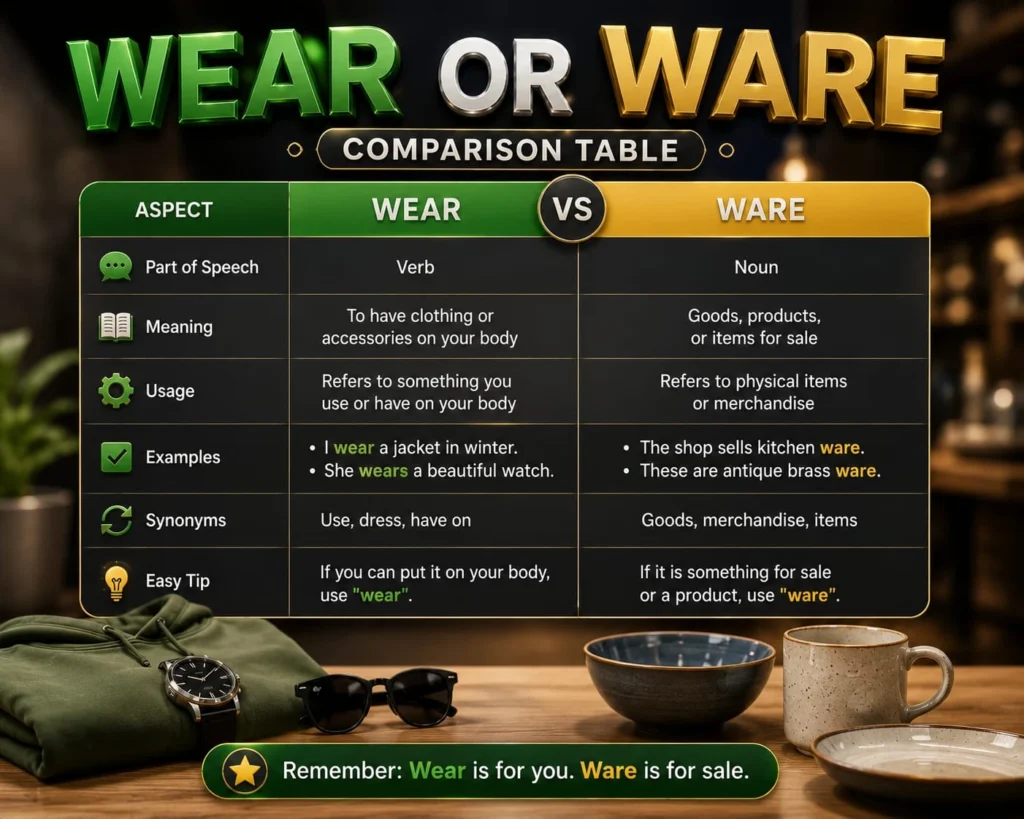
| Term/Variant | Meaning | Region/Context | Best Used When |
| Wear | Put on clothing | Global English | Talking about clothes |
| Wear | Use over time | Global English | Discussing usage |
| Wear | Damage from use | Global English | Describing deterioration |
| Ware | Goods or merchandise | Retail and commerce | Talking about products |
| Software | Computer programs | Technology | Referring to digital products |
| Kitchenware | Kitchen products | Retail | Discussing household goods |
Frequently Asked Questions

Q: What does wear mean?
A: Wear usually means putting on clothing, using something, or causing gradual damage through use.
Q: What is ware ?
A: Wear means putting on clothing, using something over time, or damage caused by repeated use.
Q: How do I use wear correctly?
A: Use wear when talking about clothing, accessories, or the act of using something over time.
Q: How do I use ware correctly?
A: Use ware when referring to products, merchandise, or compound words like software, hardware, and kitchenware.
Q: Which is correct: wear glasses or ware glasses?
A: The correct phrase is wear glasses because glasses are something you put on your body.
Q: Where does the word ware come from?
A: Ware comes from older words related to goods, merchandise, and products sold by merchants.
Q: Can wear and ware ever mean the same thing?
A: No. They sound alike but have completely different meanings and uses.
Q: Is “ware clothing” correct?
A: No. “Ware clothing” is incorrect. Use wear when talking about clothes because wear relates to putting something on your body.
Q: Is it wear out or ware out?
A: The correct phrase is wear out. Use wear when talking about something becoming damaged, weaker, or unusable after repeated use. “Ware out” is incorrect.
Conclusion
Understanding ware or wear helps you write more accurately in school, work, and daily communication.
The difference between wear and ware becomes easy once you focus on meaning.
Use wear when talking about clothing, usage, or damage from use.
Use ware when talking about goods, merchandise, products, or technology-related items.
Remember these key points:
- Wear = clothing or use.
- Ware = products or merchandise.
- The words sound the same but mean different things.
- Context determines the correct choice.
- Learning the difference improves your writing immediately.
The next time you pause while writing, think about whether you’re discussing something you use or something that is sold. That simple question usually gives you the answer.
Now you know exactly how to use wear or ware—go try it in your next piece of writing. Bookmark this guide so you never second-guess these words again, and share it with someone who’s been confused about the difference.
Wear or ware explained with meanings, examples, grammar tips, and common mistakes. Learn the correct usage every time.
Bare or Bear: The Complete Guide to Using Them Correctly

As an English language enthusiast, I love diving into the tricky details of word differences and spelling variations. My mission is to explain confusing terms and make them accessible to everyone, helping readers to communicate with clarity and confidence.