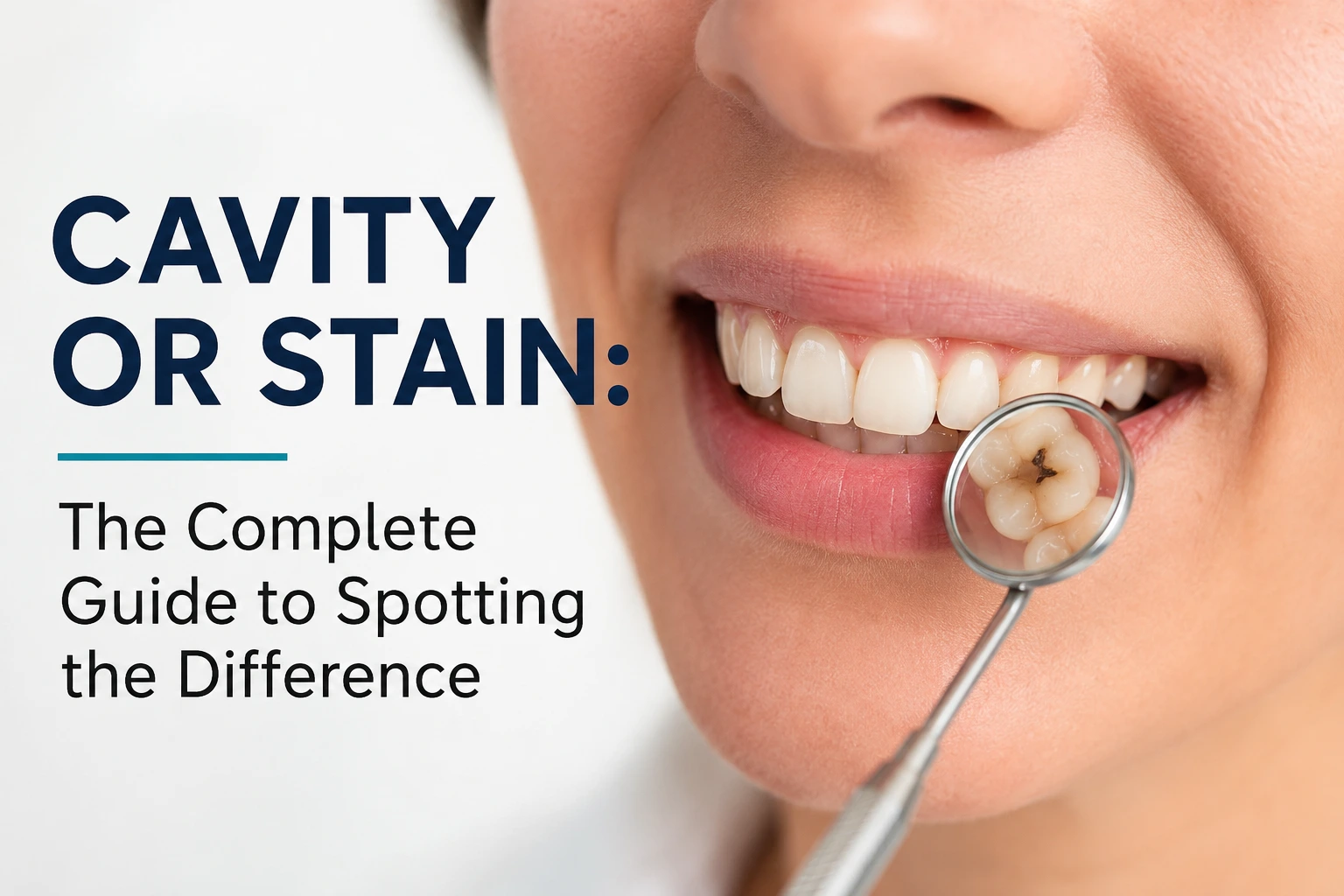
A cavity is permanent tooth damage caused by decay, while a stain is a discoloration on the tooth surface. A dark spot from coffee is often a stain, but a hole caused by bacteria is a cavity.
Have you ever looked in the mirror and noticed a dark spot on your tooth? Your first thought was probably, “Is this a cavity?”
I’ve had this question myself. A few years ago, I spotted a brown mark on one of my teeth after drinking coffee regularly. I worried that I needed a filling. After a dental visit, I learned it was only a stain.
Many people face the same confusion. Cavities and stains can look very similar. Both may appear as dark, brown, or black spots on teeth. Yet they are very different problems.
Knowing the difference matters. A stain is often cosmetic. A cavity can lead to pain, infection, and costly treatment if ignored.
In this guide, you’ll learn how to tell a cavity from a stain, what causes each one, common mistakes people make, and when it’s time to visit a dentist. By the end, you’ll know exactly what those spots on your teeth might mean.
Cavity or Stain: Quick Answer
A cavity is tooth decay. It happens when bacteria produce acids that damage the enamel and create holes in the tooth.
A stain is a color change on the surface of a tooth. It does not usually damage the tooth structure.
Simple Examples
- A yellow tooth caused by coffee = stain
- A small hole that feels rough = cavity
- Dark marks from smoking = stain
- A painful spot sensitive to sweets = cavity
The easiest rule is this:
Stains change color. Cavities change structure.
The Origin: Background of Cavity or Stain
Understanding these terms helps explain why they are often confused.
What Is a Cavity?
The word cavity comes from the Latin word cavitas, meaning “hollow space.”
Dentists use the term to describe a hole or damaged area in a tooth caused by decay.
What Is a Stain?
The word stain comes from old French and Germanic roots meaning “to discolor” or “mark.”
In dentistry, a stain refers to unwanted coloring on or inside a tooth.
Why the Confusion Exists
Both cavities and stains can:
- Look brown or black
- Appear as small spots
- Develop gradually
- Be hard to see without close inspection
Because of these similarities, many people mistake one for the other.
Cavity or Stain Explained : Key Differences
The biggest difference is that a cavity damages the tooth, while a stain mainly affects appearance.
| Term | Meaning | When to Use | Region/Context |
| Cavity | Tooth decay causing damage or holes | Dental diagnosis and treatment | Worldwide |
| Stain | Tooth discoloration without structural damage | Cosmetic dental concerns | Worldwide |
| Surface Stain | Stain on enamel | From food, drinks, smoking | Common everywhere |
| Internal Stain | Discoloration inside tooth | Trauma, medication, aging | Dental care |
Key Signs of a Cavity
- Tooth pain
- Sensitivity to cold or sweets
- Visible hole
- Rough texture
- Bad breath
- Food getting stuck
Key Signs of a Stain
- Smooth tooth surface
- No pain
- No sensitivity
- Color changes only
- Often linked to coffee, tea, wine, or smoking
Quick Comparison
| Feature | Cavity | Stain |
| Causes damage | Yes | No |
| Causes pain | Often | Rarely |
| Changes tooth color | Sometimes | Yes |
| Creates holes | Yes | No |
| Needs treatment | Usually | Sometimes cosmetic |
| Can worsen over time | Yes | Usually slowly |
Which Version or Approach Should You Use?
The right approach depends on what you’re seeing.
For People With Pain or Sensitivity
Assume it could be a cavity.
Pain is one of the strongest warning signs of tooth decay.
For People With Surface Discoloration
It may simply be a stain.
This is especially true if:
- You drink coffee
- You drink tea
- You smoke
- You consume dark-colored foods
For Parents
Watch children’s teeth closely.
Dark spots in children can quickly develop into cavities.
For General Use
If you’re unsure, schedule a dental checkup.
Only a dentist can confirm whether a spot is a cavity or a stain.
Common Mistakes With Cavity or Stain
Many people make incorrect assumptions.
Mistake 1: Assuming Every Dark Spot Is a Cavity
❌ Mistake: “My tooth is brown, so I must have decay.”
✅ Correction: Brown spots can be harmless stains.
Why it happens: Cavities and stains often look alike.
Mistake 2: Ignoring a Spot Because It Doesn’t Hurt
❌ Mistake: “No pain means no cavity.”
✅ Correction: Early cavities often cause no pain.
Why it happens: Symptoms may not appear until decay becomes deeper.
Mistake 3: Using Whitening Products on Cavities
❌ Mistake: Whitening toothpaste will fix decay.
✅ Correction: Whitening products remove stains, not cavities.
Why it happens: People confuse discoloration with structural damage.
Mistake 4: Self-Diagnosing Online
❌ Mistake: Comparing photos on the internet.
✅ Correction: Dental exams are more reliable.
Why it happens: Lighting and image quality can be misleading.
Mistake 5: Delaying Treatment
❌ Mistake: Waiting months to see if it improves.
✅ Correction: Cavities get worse without treatment.
Why it happens: Early decay may seem minor.
Cavity or Stain in Real, World Examples
Professional Email
“I noticed a dark spot on my molar and would like an appointment to determine whether it is a cavity or a stain.”
News Headline
“Dentists Warn That Tooth Stains Can Sometimes Hide Early Signs of Decay.”
Social Media Post
“Thought I had a cavity, but my dentist said it was only a coffee stain. What a relief!”
Formal Report
“The examination revealed superficial enamel staining with no evidence of active cavities.”
Latter or Ladder: The Complete Guide to Using the Right Word
Cavity or Stain : Data, Trends & Usage
Interest in cavity-versus-stain searches has grown as more people pay attention to dental health and cosmetic appearance.
Who Searches This Topic Most?
- Adults concerned about oral health
- Coffee and tea drinkers
- Smokers
- Parentshttps://versuswords.com/latter-or-ladder/ of young children
- People considering teeth whitening
Search Intent
The primary search intent is:
Informational
Users want to know:
- Is this spot dangerous?
- Do I need a dentist?
- Can whitening fix it?
- How can I tell the difference?
Why This Matters Today
People are taking more photos and videos than ever before. Tooth appearance has become a major concern. As a result, many people notice stains earlier and wonder if they are signs of decay.
Standalone Comparison Table
| Term/Variant | Meaning | Region/Context | Best Used When |
| Cavity | Tooth decay creating damage | Dental diagnosis | Discussing oral health problems |
| Stain | Surface or internal discoloration | Cosmetic dentistry | Discussing tooth color |
| Surface Stain | External discoloration | Coffee, tea, smoking | Cosmetic concerns |
| Internal Stain | Staining inside tooth | Aging, trauma, medication | Professional dental evaluation |
| Tooth Decay | General disease process | Dentistry | Explaining cavity formation |
Frequently Asked Questions
Q: What does cavity or stain mean?
A cavity is permanent tooth damage caused by decay. A stain is discoloration that changes the appearance of a tooth without usually damaging it.
Q: How do you use cavity or stain correctly?
Use “cavity” when referring to tooth decay and damage. Use “stain” when referring to discoloration or color changes on teeth.
Q: Cavity vs stain , what’s the difference?
A cavity damages tooth structure and may require treatment. A stain mainly affects appearance and may be removed through cleaning or whitening.
Q: Is cavity or stain acceptable in formal writing?
Yes. Both terms are widely accepted in professional dental reports, educational materials, and medical discussions.
Q: Which is more serious, a cavity or a stain?
A cavity is more serious because it can worsen and affect tooth health. A stain is usually a cosmetic issue.
Q: Where does the term cavity come from?
The word comes from the Latin cavitas, meaning a hollow space or hole.
Q: Can a stain turn into a cavity?
A stain itself does not become a cavity. However, stained areas can sometimes hide decay underneath, which is why dental exams are important.
Conclusion
The difference between a cavity and a stain is simpler than it first appears. A cavity is a form of tooth decay that damages the tooth. A stain is mainly a change in color. While both can look similar, they behave very differently.
Remember these key points:
- Cavities damage teeth
- Stains affect appearance
- Pain and sensitivity often suggest decay
- Only a dentist can provide a definite diagnosis
If you notice a dark spot, don’t panic. It may be nothing more than a harmless stain. At the same time, don’t ignore it. Early detection can save your tooth, your time, and your money.
Now you know exactly how to tell a cavity from a stain. Bookmark this guide so you never second-guess the difference again, and share it with someone who has wondered whether that dark spot needs attention.

I am an English author, language explorer dedicated to analyzing words, phrases, and idioms. Through my writing, I uncover subtle language differences and help readers improve their communication skills. My content helps readers navigate English with clarity and confidence.