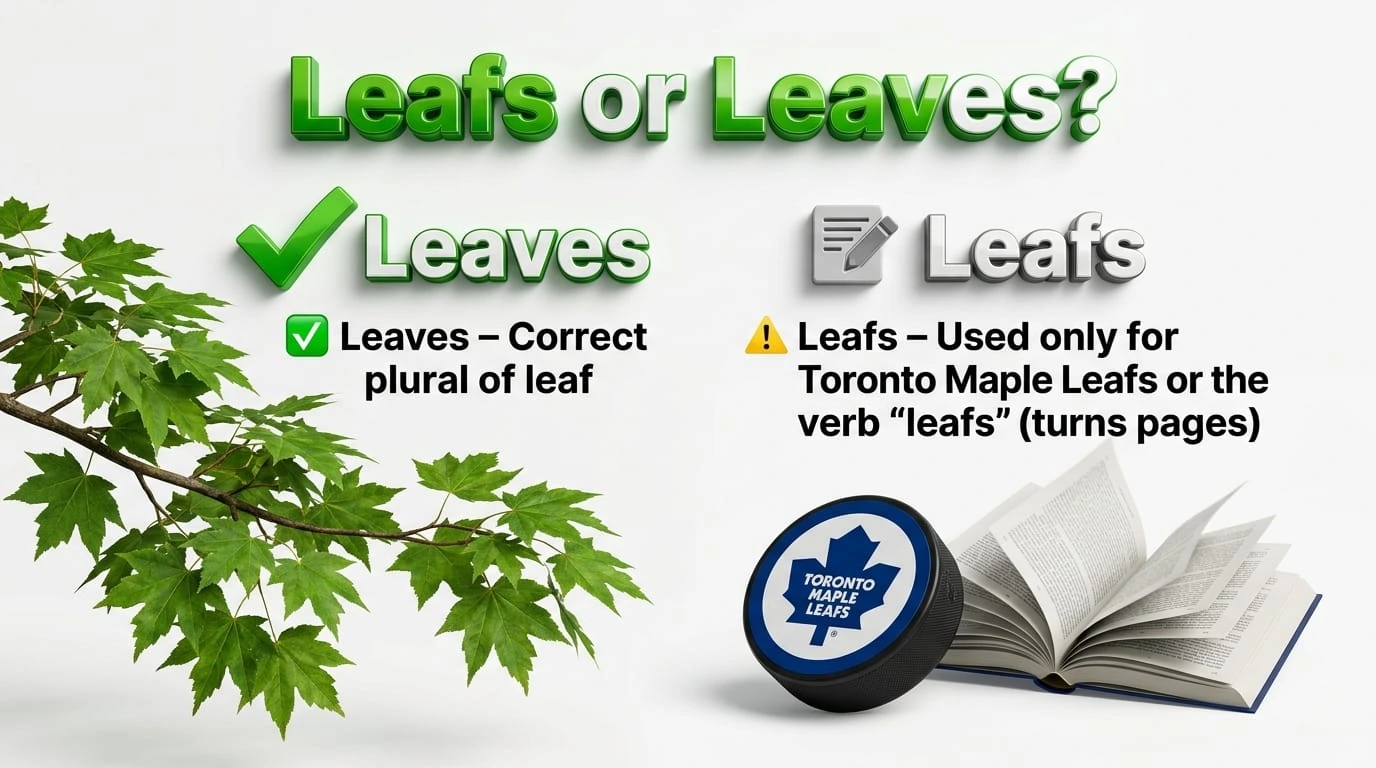
Leaves is the correct plural of leaf in almost every situation. Leafs is only correct in specific contexts, such as the name of the Toronto Maple Leafs hockey team or as the verb leafs (meaning “turns pages”).
Have you ever typed “leafs” and watched your spell checker underline it? I remember doing exactly that while writing a nature article years ago. I paused, convinced both words looked right. After all, if we say roofs and chiefs, why not leafs?
That small moment led me to discover one of English’s most common grammar questions. Many people search for leafs or leaves because they are unsure which plural form to use. The confusion grows when they see Toronto Maple Leafs, making them wonder if both spellings are correct.
The truth is simpler than it seems. Leaves is the standard plural of leaf, while leafs has only a few special uses. Knowing the difference will help you write more confidently, whether you’re working on school assignments, emails, blog posts, or everyday conversations.
In this guide, you’ll learn the origin of both words, understand when each one is correct, avoid common mistakes, and remember the rule with easy examples.
Leafs or Leaves: Quick Answer
The correct plural of leaf is leaves.
Use leafs only when referring to the Toronto Maple Leafs or as the verb leafs, meaning flips through pages quickly.
Examples
- ✅ The trees lost their leaves in autumn.
- ✅ She leafs through the magazine every morning.
- ✅ The Toronto Maple Leafs won the game.
Quick Memory Tip:
If you’re talking about more than one leaf on a plant or tree, always use leaves.
The Origin of Leafs or Leaves
The word leaf comes from the Old English word lēaf, which meant the flat green part of a plant.
English has a spelling rule where some nouns ending in -f or -fe change to -ves when they become plural.
For example:
- Leaf → Leaves
- Wolf → Wolves
- Knife → Knives
- Life → Lives
This change has existed for hundreds of years and became part of standard English grammar.
So why does leafs exist?
It appears mainly because leaf is also a verb. When someone quickly turns the pages of a book, we say they leaf through it.
Example:
- He leafs through the newspaper before breakfast.
Another famous exception is the Toronto Maple Leafs. The hockey team intentionally kept Leafs instead of Leaves as part of its official name.
This is why both words exist, but they are used in very different situations.
Leafs or Leaves Explained: Key Differences
Although these words look similar, they do not mean the same thing.
| Term | Meaning | When to Use | Region/Context |
| Leaves | Plural of leaf | Plants, trees, nature | Worldwide |
| Leafs | Third-person verb of leaf or proper noun | Turning pages or Toronto Maple Leafs | Worldwide |
Use Leaves
Use leaves whenever you mean more than one leaf.
Examples:
- The garden is covered with leaves.
- Green leaves help plants make food.
- Children collected colorful leaves.
Use Leafs
Use leafs only in these situations:
As a verb
- She leafs through her notebook.
- He leafs through old family photos.
As a team name
- The Toronto Maple Leafs have loyal fans across the world.
Outside these cases, leafs is usually incorrect.
Which Version Should You Use?
For almost everyone, the answer is simple.
Students
Use leaves when writing essays, homework, or exams because it is the correct plural of leaf.
Teachers and Writers
Choose leaves in books, articles, reports, and educational content unless you’re talking about the verb or the hockey team.
Nature and Gardening Websites
Always use leaves when describing plants, flowers, trees, or forests.
Sports Fans
Use Leafs only when referring to the Toronto Maple Leafs.
Global English
Whether you’re writing in American English, British English, Canadian English, or Australian English, the plural of leaf is leaves.
There is no British vs American spelling difference for this word.
Common Mistakes with Leafs or Leaves
Many learners make the same mistakes because they assume every noun ending in -f simply adds -s.
Here are the most common errors.
| Mistake | Correct Form | Why |
| The tree has many leafs. | The tree has many leaves. | Standard plural form |
| Autumn leafs cover the road. | Autumn leaves cover the road. | Talking about plant leaves |
| He leaves through the magazine. | He leafs through the magazine. | Refers to turning pages |
| Toronto Maple Leaves | Toronto Maple Leafs | Official team name |
| I collected five leafs. | I collected five leaves. | Correct plural noun |
Why These Mistakes Happen
People often get confused because:
- Leafs looks like a regular plural.
- The hockey team’s name makes Leafs seem correct everywhere.
- Many English nouns simply add -s, but leaf follows a different grammar rule.
- The verb leafs adds another layer of confusion.
A simple trick is to remember:
- Leaves = More than one leaf.
- Leafs = Turning pages or the Toronto Maple Leafs.
Halves or Halfs: The Easy Guide to Correct Usage ✅
Leafs or Leaves in Real-World Examples
Seeing these words in everyday situations makes the difference much easier to remember.
Professional Email
✅ Please move the leaves from the entrance before the meeting begins.
✅ She leafs through the report before presenting it to the team.
News Headline
✅ Fallen Leaves Cover City Parks During Autumn.
✅ Toronto Maple Leafs Win Season Opener.
Social Media Post
✅ The colorful leaves make this park look magical! 🍁
✅ He leafs through his favorite comic every weekend.
Formal Report
✅ The collected leaves were examined to identify tree species.
✅ The librarian leafs through historical records to verify the information.
Leafs or Leaves: Data, Trends & Usage
The keyword “leafs or leaves” has steady search interest throughout the year because it solves a common English grammar question. Search volume usually increases during the autumn season, when people write about trees, nature, gardening, and seasonal activities.
The topic is especially popular in:
- United States
- Canada
- United Kingdom
- Australia
- India
Search Intent
- Primary Intent: Informational
- Audience: Students, English learners, writers, bloggers, teachers, and editors
Why It Matters Today
Many people also search this keyword because they see the Toronto Maple Leafs and wonder whether leafs is becoming an accepted plural. Understanding the difference helps you avoid grammar mistakes while recognizing the few situations where leafs is correct.
Leafs vs Leaves Comparison Table
| Term/Variant | Meaning | Region/Context | Best Used When |
| Leaves | Plural of leaf | Worldwide | Talking about plants, trees, or nature |
| Leafs | Verb (leafs through) | Worldwide | Describing someone turning pages |
| Leafs | Proper noun | Canada & sports | Referring to the Toronto Maple Leafs |
Frequently Asked Questions
Q: Is it leafs or leaves?
A: Leaves is the correct plural of leaf. Use leafs only as a verb or when referring to the Toronto Maple Leafs.
Q: Why is the plural of leaf “leaves”?
A: English has a spelling rule where some nouns ending in -f change to -ves in the plural. That’s why leaf becomes leaves.
Q: Is “leafs” ever grammatically correct?
A: Yes. Leafs is correct as the third-person singular form of the verb leaf, meaning to flip through pages, and in the official name Toronto Maple Leafs.
Q: Which word should I use in formal writing?
A: If you mean more than one leaf, always use leaves. It is the standard form used in books, newspapers, schools, and professional writing.
Q: Is “leafs” a British spelling?
A: No. British English and American English both use leaves as the plural of leaf. Leafs is not a regional spelling variation.
Q: Why is the hockey team called the Toronto Maple Leafs instead of Maple Leaves?
A: The team chose Maple Leafs as its official name when it was founded. It is a proper noun, so it does not follow the normal plural rule.
Q: How can I remember the difference between leafs and leaves?
A: Think of this simple rule: Nature has leaves. Books have someone who leafs through them. This memory trick works in almost every situation.
Conclusion
The difference between leafs or leaves is easier than it first appears. If you’re talking about more than one leaf on a tree or plant, leaves is always the correct plural. It follows a long-standing English grammar rule that changes some words ending in -f to -ves.
The word leafs has only two common uses. It can describe someone quickly turning the pages of a book, or it can appear as part of the official name Toronto Maple Leafs. Outside these special cases, leaves is the word you should choose.
Whenever you’re unsure, ask yourself a simple question: Am I talking about plants or pages? If it’s plants, use leaves. If it’s flipping through a book or the hockey team leafs may be correct.
Now you know exactly how to use leafs or leaves with confidence. Bookmark this guide so you never second-guess the correct word again, and share it with someone who has been confused by this common English question.
Leafs or leaves explained with meanings, examples, correct usage, grammar rules, and tips to avoid common mistakes in everyday English.
Hoofs or Hooves: Which Plural Is Correct?🐴 ✅

As an English language enthusiast, I love diving into the tricky details of word differences and spelling variations. My mission is to explain confusing terms and make them accessible to everyone, helping readers to communicate with clarity and confidence.