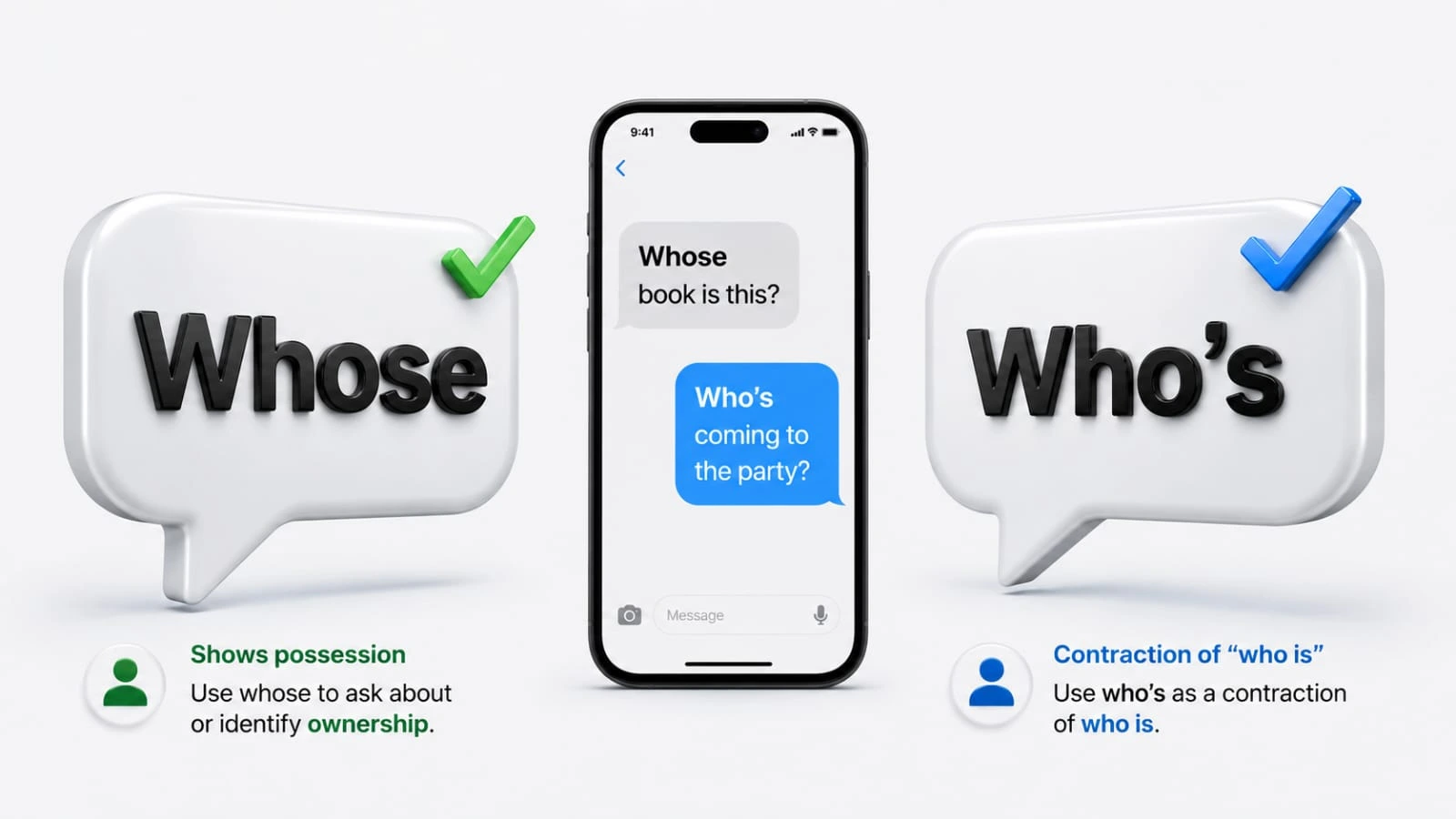
“Whose” shows possession, meaning “belonging to whom.” “Who’s” is a contraction of “who is” or “who has.” They are two different words, not spelling variants of each other
I once texted a group chat asking “who’s bag is this?” after a weekend trip. A friend replied with just one word: “whose.” I stared at my phone, genuinely confused about what I’d done wrong.
If you’ve made this exact mistake, you’re in very good company. These two words sound identical when spoken, yet they serve completely different grammatical roles, one shows ownership, the other is simply a shortened phrase.
This guide breaks down exactly what each word means, gives you a foolproof test to tell them apart instantly, and shows how to avoid this mix-up for good in texts, emails, and formal writing.
Quick Answer
“Whose” indicates possession, asking or describing who something belongs to.
- ✅ Whose jacket is on the chair?
“Who’s” is a contraction, short for “who is” or “who has.”
- ✅ Who’s coming to the party tonight?
- ❌ Who’s jacket is on the chair?
The test: try expanding the word to “who is” or “who has.” If that makes sense, use the apostrophe version. If it doesn’t, use the possessive form instead.
The Origin of This Confusion
“Whose” comes from Old English hwæs, the possessive form of “who,” used since Old English to indicate ownership or association. It has always functioned as a possessive pronoun, similar to “his,” “hers,” or “theirs.”
The contraction developed much later, following a general English pattern of combining pronouns with “is” or “has” using an apostrophe, the same pattern seen in “it’s” (it is), “she’s” (she is), and “that’s” (that is). Because English typically uses apostrophes to show possession too, as in “the dog’s leash,” many writers assume the apostrophe version must be the possessive one here as well. That assumption is exactly backward, and it’s the root of nearly every mix-up between these two words.
Key Differences and Uses
| Term | Function | Meaning | Example |
|---|---|---|---|
| Whose | Possessive pronoun | Belonging to whom | Whose car is parked outside? |
| Who’s | Contraction | Who is / who has | Who’s been using my charger? |
| Who | Base pronoun | Refers to a person | Who called earlier? |
Notice that “whose” never contains an apostrophe, despite indicating possession, while “who’s” always does, since it stands in for two separate words joined together.
Which One Should You Use?
When asking about ownership
Use whose. This applies any time you’re identifying who something belongs to.
When shortening “who is” or “who has”
Use who’s, always with the apostrophe. Try expanding the sentence first to confirm it fits.
For formal or professional writing
Double-check both forms carefully, since this mix-up is common even in polished business writing and published content.
For quick self-checks while typing
Expand the word mentally before committing to a spelling. If “who is” or “who has” fits, add the apostrophe. If not, drop it.
Parties or Party’s: Easy Guide to Stop Grammar Mistakes (2026)
Common Mistakes
Mistake 1: Using the contraction for possession
✅ Whose phone keeps buzzing?
❌ Who’s phone keeps buzzing?
Why it happens: Writers assume an apostrophe always signals ownership, which is true for nouns but not for this particular pronoun pair.
Mistake 2: Dropping the apostrophe when a contraction is needed
✅ Who’s responsible for locking up tonight?
❌ Whose responsible for locking up tonight?
Why it happens: Writers overcorrect after learning the possessive rule, then avoid the apostrophe even when it’s actually required.
Mistake 3: Assuming spellcheck will catch the error
✅ Proofread carefully, since both forms are spelled correctly on their own.
❌ Relying on autocorrect to flag an incorrect word choice.
Why it happens: Because both words exist independently in the dictionary, spellcheck tools won’t catch a simple swap.
Mistake 4: Mixing both forms in the same sentence incorrectly
✅ Who’s going to ask whose idea started this?
❌ Whose going to ask who’s idea started this?
Why it happens: When both words appear close together, it becomes easy to reverse them by accident.
Real-World Examples
Professional email:
“Could you confirm whose signature is required on this document before we proceed?”
News headline:
“Investigation Underway to Determine Who’s Responsible for the Data Breach”
Social media post:
“Whose idea was it to watch a horror movie right before bed? 😅”
Formal document:
“The committee will determine whose proposal best meets the project’s requirements.”
Notice how the possessive form appears in ownership-related contexts, while the contraction shows up whenever “who is” or “who has” fits naturally.
Search Trends & Usage Data
Search interest in this word pair stays consistently high, driven largely by students, professionals, and ESL learners confirming correct grammar before sending emails or submitting assignments. This falls into the informational search category, with people wanting a fast, reliable answer rather than a lengthy grammar lesson.
This confusion appears frequently in casual texting and social media, where quick typing increases the odds of an accidental swap. Because both words are common and grammatically valid on their own, this remains one of the most persistent word-choice errors in everyday English writing.
Comparison Table
| Term | Meaning | Function | Best Used When |
|---|---|---|---|
| Whose | Belonging to whom | Possessive pronoun | Asking about or describing ownership |
| Who’s | Who is / who has | Contraction | Shortening a sentence with “is” or “has” |
| Who | Refers to a person | Subject pronoun | Asking about or identifying a person |
Frequently Asked Questions
Q: What does “whose” mean?
A: “Whose” is a possessive pronoun used to ask or describe who something belongs to, such as “Whose keys are these?”
Q: How do you use “who’s” correctly in a sentence?
A: Use “who’s” whenever you can expand it to “who is” or “who has,” such as “Who’s calling?” meaning “Who is calling?”
Q: What’s the actual difference between these two words?
A: “Whose” shows possession, while “who’s” is a contraction. They sound identical but serve completely different grammatical functions.
Q: Is the contraction form acceptable in formal writing?
A: Yes, when used correctly. “Who’s” works in formal writing whenever it truly stands in for “who is” or “who has.”
Q: Which spelling is correct for asking about ownership?
A: “Whose” is correct for ownership. If you’re asking who owns something, never use an apostrophe.
Q: Where does “whose” come from?
A: It comes from Old English hwæs, the possessive form of “who,” used consistently for centuries to indicate ownership or association.
Q: Can these two words ever be used interchangeably?
A: No. They serve entirely different grammatical roles, and swapping one for the other always changes or breaks the meaning of the sentence.
Final Takeaway
Here’s the short version. The possessive form shows ownership. The contraction stands in for “who is” or “who has.” They aren’t variant spellings, they’re grammatically distinct words that simply sound the same.
Key points to remember:
- The test: Try expanding to “who is” or “who has.” If it fits, use the apostrophe
- Watch the exception: Unlike most possessives, the ownership form never takes an apostrophe
- Fast typing causes most errors: Slow down and proofread when both words appear close together
- No shortcuts: Spellcheck won’t catch this mix-up, since both words are valid on their own
Once you lock in the expansion test, you’ll never confuse these two words again.
Bookmark this guide so you never second-guess your word choice again, and share it with anyone who’s made the same mistake in a text.
Whose vs who’s explained, correct meaning, usage, and examples. Learn the simple trick to never mix them up again.
Lead or Led: Meaning, Difference & Examples

As an English language enthusiast, I love diving into the tricky details of word differences and spelling variations. My mission is to explain confusing terms and make them accessible to everyone, helping readers to communicate with clarity and confidence.