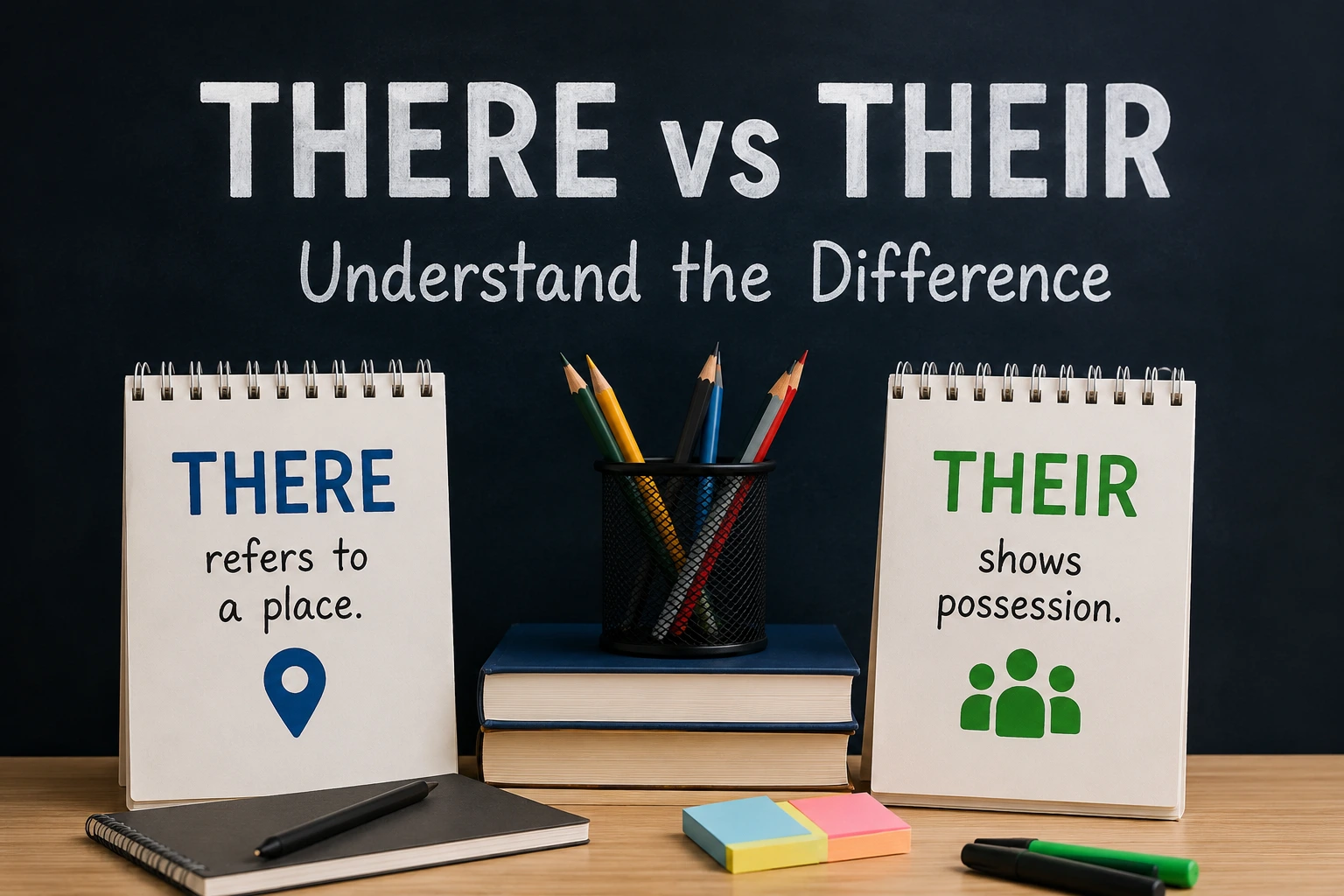
There refers to a place or introduces something, while their shows that something belongs to them.
Example: “Put the books there.” / “They left their books at home.”
Have you ever typed a sentence, looked at there and their, and suddenly wondered which one belongs there?
You are not alone. I have seen this mistake many times in everyday writing. Even people who speak English well can mix up these two words because they sound exactly the same.
The problem is simple: there and their have different meanings, but they share the same pronunciation. This makes them homophones. When you write quickly, your brain may choose the wrong spelling without you noticing.
A sentence such as “They left there bags over there” looks almost right at first glance. But one word is wrong. The correct sentence is “They left their bags over there.”
The good news is that you do not need a complicated grammar rule to remember the difference. A simple test can help you choose the right word every time.
Let’s break down there or their with clear rules, examples, common mistakes, and easy memory tricks.
There or Their: Quick Answer
The easiest way to remember the difference is this:
- There = a place or a word used to introduce something.
- Their = belonging to them.
Examples with there
The keys are there on the table.
Here, there points to a place.
There is a problem with the printer.
Here, there introduces the fact that a problem exists.
Examples with their
The students finished their homework.
The homework belongs to the students.
They brought their children to the party.
The children are connected to or belong to them.
A quick memory trick
Look at the word their.
It contains heir, which is a person who receives something that belongs to someone else.
You can use this as a memory clue:
Their = belonging to them.
For there, think of here.
Both there and here can refer to places:
- Come here.
- Go there.
This simple connection can help you remember the difference.
The Origin and Background of There or Their
There and their have different histories, even though they sound the same today.
The word there comes from Old English þǣr, which was used to refer to a location or place. Over time, its spelling changed into the modern English form there.
Their has a different origin. It developed from forms used in Old Norse and Middle English to show possession. It eventually became the modern possessive word their.
English borrowed words from many languages over its long history. That is one reason English has many words that sound alike but have different spellings and meanings.
There are many examples of these words:
- there / their / they’re
- to / too / two
- your / you’re
- hear / here
- right / write
- its / it’s
These words are called homophones when they have the same pronunciation but different meanings or spellings.
So, the confusion between there and their is not caused by poor English. The words genuinely sound alike. The key is learning what each spelling does in a sentence.
There or Their Explained: Key Differences
The main difference is their function.
| Term | Meaning | When to Use | Region/Context |
|---|---|---|---|
| There | A place or existence | To point to a place or introduce something | Standard English |
| Their | Belonging to them | To show possession | Standard English |
| They’re | They are | As a contraction of “they are” | Standard English |
1. There = a place
Use there when you are talking about a location.
The car is parked there.
Please put the box there.
I saw your brother standing there.
A useful test is to replace there with a place phrase.
The car is there.
You could say:
The car is in that place.
The meaning still works.
2. There = existence
There can also introduce a person, thing, or situation.
There is a mistake in this sentence.
There are three books on the desk.
There was a loud noise outside.
In these sentences, there does not mean a physical place. It helps introduce what exists or happens.
3. Their = possession
Use their when something belongs to, is connected with, or is associated with them.
The children packed their bags.
The bags belong to the children.
The workers returned to their office.
The office is associated with the workers.
The players celebrated their victory.
The victory belongs to or is connected with the players.
The easiest test
Ask yourself:
Does the word mean “belonging to them”?
If yes, use their.
They forgot their tickets.
The tickets belong to them.
If the answer is no, ask whether you are talking about a place or introducing something that exists.
If so, use there.
Which Version Should You Use?
You do not need to choose between there and their based on British or American English.
Both are standard in British English and American English.
The choice depends on meaning, not region.
For students
Use there for a place or existence.
Use their for possession.
This basic rule will cover most sentences you write.
For professional writing
Be extra careful with these words in:
- Emails
- Reports
- Resumes
- Business documents
- School assignments
- Articles
- Formal letters
A spelling mistake can change the meaning of a sentence or make your writing look careless.
For global English
The same rule works in standard English around the world.
You should not change there to their based on whether your reader is from the United States, United Kingdom, Canada, Australia, or another English-speaking region.
The meaning decides the spelling.
Common Mistakes with There or Their
These mistakes happen because the words sound identical.
Mistake 1: Using “their” for a place
❌ The restaurant is over their.
✅ The restaurant is over there.
Why?
The sentence refers to a place. Therefore, you need there.
Mistake 2: Using “there” for possession
❌ The students opened there books.
✅ The students opened their books.
Why?
The books belong to the students. Use their.
Mistake 3: Confusing “there” with “they’re”
❌ There going to arrive soon.
✅ They’re going to arrive soon.
Why?
They’re means they are.
Try replacing the word:
They are going to arrive soon.
The sentence works, so they’re is correct.
Mistake 4: Using “their” after “there is”
❌ Their is a problem with the computer.
✅ There is a problem with the computer.
Why?
The sentence introduces the existence of a problem. It does not show possession.
Mistake 5: Writing “their” when you mean “they’re”
❌ Their planning to visit tomorrow.
✅ They’re planning to visit tomorrow.
Why?
They’re = they are.
They are planning to visit tomorrow.
That sentence makes sense, so they’re is correct.
There or Their in Real-World Examples
Knowing the rule is useful. Seeing the words in real situations makes the difference easier to remember.
Professional email
Hi Sarah,
I checked the documents, and they’re on the desk there. Please ask the team to review their copies before the meeting.
Notice how all three forms can appear in one short message:
- they’re = they are
- there = a place
- their = belonging to them
News headline or article
There Are New Rules for Drivers in the City
Here, there introduces the existence of new rules.
Another example:
Local Students Celebrate Their Success
Here, their shows that the success belongs to the students.
Social media post
We finally reached the beach! The view from there was amazing, and the kids loved their first swim.
There refers to the place.
Their refers to the kids.
Formal document or report
There are several reasons for the change. Each department should review their current procedures.
In the first sentence, there introduces the existence of reasons.
In the second, their refers to the departments and shows association or possession.
A Simple Memory Trick for There or Their
If you often mix up these words, use two quick clues.
Think: “There” has “here” inside it
Here and there both refer to places.
Come here.
Go there.
So when you are talking about a location, think there.
Think: “Their” = “belonging to them”
That is their house.
Ask:
Whose house?
Their house.
This works for almost anything:
- their car
- their home
- their idea
- their teacher
- their project
- their decision
If you can ask “Whose?”, their may be the correct choice.
There or Their: Standalone Comparison Table
| Term/Variant | Meaning | Region/Context | Best Used When |
|---|---|---|---|
| There | A place | All standard English | Pointing to a location |
| There | Existence | All standard English | Introducing something that exists |
| Their | Belonging to them | All standard English | Showing possession or association |
| They’re | They are | All standard English | Replacing “they are” |
Compare these sentences
The children are playing there.
This tells us where they are playing.
The children brought their toys.
This tells us whose toys they brought.
They’re playing outside.
This means they are playing outside.
One small spelling change can create three different meanings.
There or Their: Data, Trends & Usage
The search for “there or their” reflects a common English-learning problem: people often know what they want to say but hesitate over the spelling.
The topic has strong informational search intent. People usually search for these words when they want to:
- Check a sentence
- Learn the difference
- Improve their grammar
- Prepare for school or exams
- Write better emails
- Avoid spelling mistakes
- Understand English homophones
The confusion also appears across many levels of English learning. Beginners often need the basic rule, while advanced writers may make the mistake when typing quickly.
There is also a third word that makes the problem harder: they’re.
That means learners are often dealing with a three-way distinction:
There = place or existence
Their = possession
They’re = they are
Learning all three together is more useful than memorizing there and their alone.
The most important insight is simple: do not choose the word because it sounds right. Choose it because its meaning fits the sentence.
FAQs About There or Their
Q: What does “there” mean?
A: There can refer to a place, as in “The keys are there.” It can also introduce something that exists, as in “There is a problem.”
Q: What does “their” mean?
A: Their is a possessive word. It shows that something belongs to or is connected with more than one person or group. For example, “They lost their tickets.”
Q: How do you use “there” correctly?
A: Use there for a place or to introduce existence. For example, “The shop is over there” and “There are five students in the room.”
Q: How do you use “their” correctly?
A: Use their to show possession or association. For example, “The players wore their uniforms.” Ask “Whose?” If the answer is “belonging to them,” their is usually correct.
Q: What is the difference between there, their, and they’re?
A: There refers to a place or introduces something. Their shows possession. They’re is short for they are.
Q: Is “there” acceptable in formal writing?
A: Yes. There is a standard English word and is completely acceptable in formal writing. Use it when the meaning calls for it.
Q: Is “their” correct in formal writing?
A: Yes. Their is also standard English. It is used to show possession or association, such as “Employees should submit their reports.”
Q: Which is correct: “their house” or “there house”?
A: Their house is correct when you mean that the house belongs to them. There house is incorrect because there does not show possession.
Q: Can “there” and “their” be used in the same sentence?
A: Yes. For example: “They left their bags over there.” Their shows possession, while there refers to a place.
Q: Why do people confuse there and their?
A: They are homophones, so they sound the same when spoken. Their different meanings and spellings can make them easy to mix up when writing quickly.
Conclusion:
The difference between there and their is much easier once you focus on meaning instead of sound.
Remember these three rules:
- There = a place or something that exists.
- Their = belonging to them.
- They’re = they are.
When you see a sentence with there or their, ask a simple question.
Are you talking about a place? Use there.
Are you showing possession? Use their.
Can you replace the word with “they are”? Use they’re.
For example:
They left their coats over there, and they’re coming back for them.
Once you learn to look at the meaning, these words stop being confusing. You do not have to guess based on how they sound.
Worse or Worst: What’s The Difference?

As an English language enthusiast, I love diving into the tricky details of word differences and spelling variations. My mission is to explain confusing terms and make them accessible to everyone, helping readers to communicate with clarity and confidence.