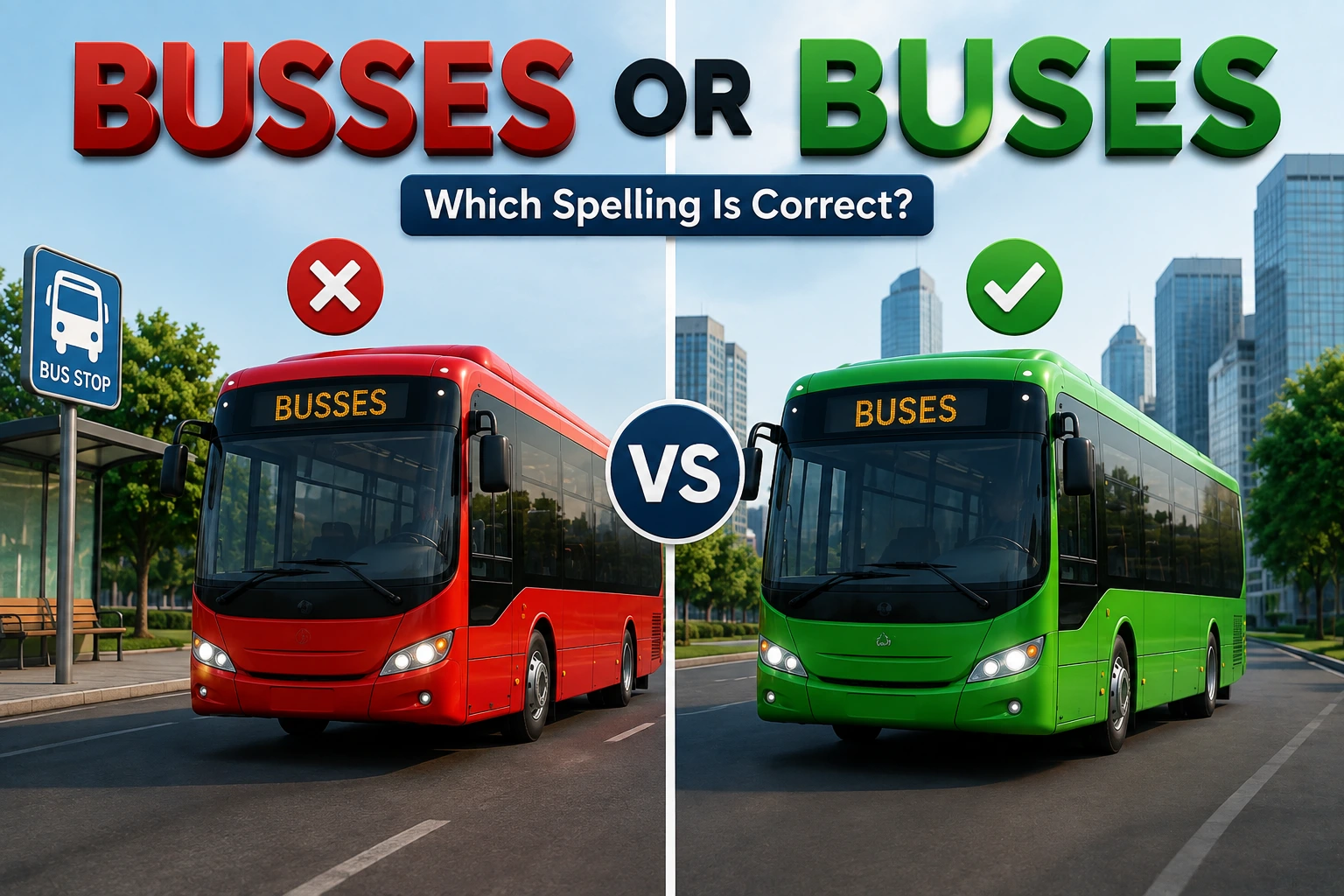
Buses is the standard and most widely preferred plural of bus. Busses is also a valid plural form, but it is much less common in modern English.
Have you ever typed busses and wondered if you needed one more letter? I have seen this small spelling question many times while checking English writing. At first glance, both busses and buses look correct. That is what makes this word pair confusing.
The good news is that both forms can be found in dictionaries. However, they are not equally common. Buses is the spelling most writers use today when talking about more than one bus. Busses is an accepted variant, but it is much less common.
This difference matters when you are writing an essay, school assignment, website article, email, or formal report. You want your spelling to look natural to your readers.
In this guide, you’ll learn the difference between busses and buses, how to pronounce them, where the spellings came from, and when each form is appropriate. You’ll also see real examples and a simple rule that makes the choice easy.
Busses or Buses: Quick Answer
Buses is the preferred plural spelling of bus in modern English.
Busses is also used as a plural, but it is uncommon compared with buses. For general writing, buses is the safer and more natural choice.
Examples
- There were five buses outside the school. ✅
- The city added more buses to the route. ✅
- Several busses were parked near the station. ✔️ Less common
If you are writing for a broad audience, choose buses.
Busses and Buses Pronunciation
Both buses and busses, when used as the plural of bus, are normally pronounced the same way.
buses (BUS-iz)
busses (BUS-iz)
| Word | Pronunciation | Meaning |
| Bus | BUS | One vehicle |
| Buses | BUS-iz | More than one bus |
| Busses | BUS-iz | Less common plural of bus |
The extra s in busses does not create a different pronunciation.
So, when you hear someone say buses, you cannot tell from the sound which spelling they would use.
The Origin and Background of Buses and Busses
The word bus is a shortened form of omnibus, a Latin word meaning “for all.” The word became associated with public transportation in the 19th century.
As the short form bus became common in English, speakers needed a plural form. Both buses and busses developed as possible spellings.
English has many words that form plurals by adding -es. Because bus already ends in s, writers sometimes choose busses by analogy with words such as glass → glasses.
However, buses became the more common spelling for the plural of bus.
Why Does “Busses” Exist?
English spelling is not always perfectly regular. Different spellings can develop over time, especially when a word ends in a letter that already appears in its plural ending.
Busses follows a pattern that may look natural to some writers.
But modern usage strongly favors buses for the plural of the vehicle bus.
A Small Historical Connection
The word bus is also connected to the French term omnibus, which was used for public passenger vehicles. Over time, English speakers shortened the word to bus.
Today, bus is a normal everyday word used around the world.
Busses vs Buses Explained
The main difference is not meaning. Both can refer to more than one bus.
The real difference is usage and frequency.
| Term | Meaning | When to Use | Region/Context |
| Buses | Plural of bus | General modern writing | Standard English worldwide |
| Busses | Less common plural of bus | When following the variant spelling | Less common in modern English |
| Bus | One public or private passenger vehicle | Singular form | Everyday English |
When to Use Buses
Use buses when you mean more than one bus.
Examples:
- The school has three buses.
- Public buses run every fifteen minutes.
- The new buses are more comfortable.
- Several buses stopped at the station.
This is the spelling most readers expect.
When to Use Busses
Busses can be used as a plural form of bus, but it is much less common.
For example:
Several busses arrived at the terminal.
The sentence is understandable, and the spelling can be found in English usage. However, buses would be the more natural choice for most readers.
Which Form Is Better?
If you are unsure, use buses.
It is:
- More common
- More widely recognized
- Preferred in most modern writing
- Safer for academic and professional work
You do not need to worry that busses is completely wrong. It is simply not the usual choice.
Which Version Should You Use?
For most writers, the answer is simple: use buses.
For Students
Use buses in school assignments, exams, and essays.
Example:
Many buses transport students to school each morning.
This is the spelling your readers will most likely expect.
For Professionals
Use buses in emails, reports, websites, and business documents.
Example:
The company operates more than 100 buses across the region.
It looks clean and standard.
For Bloggers and Content Writers
Buses is also the better choice for online content.
It is the form most readers recognize immediately. It also matches the spelling people commonly use when searching for information about public transportation.
For Legal or Historical Texts
If you are quoting an older document or following a particular source’s spelling, you may encounter busses.
In that case, keep the original spelling when accuracy requires it.
For Global English
Choose buses.
It is the clearest neutral form for an international audience.
Common Mistakes with Busses and Buses
These two spellings cause fewer problems once you know that buses is the normal choice.
| ❌ Less Preferred | ✅ Preferred |
| The city has twenty busses. | The city has twenty buses. |
| Several busses arrived late. | Several buses arrived late. |
| School busses are parked outside. | School buses are parked outside. |
| The new busses are electric. | The new buses are electric. |
Mistake 1: Thinking Busses Is Always Wrong
It is not.
Busses is a recognized variant plural of bus. The issue is that it is much less common than buses.
So it is better to say:
Buses = preferred
Busses = acceptable but uncommon
Mistake 2: Adding Only “S”
Some learners write:
bus → buss
This is not the normal plural form.
The standard plural is:
bus → buses
Mistake 3: Confusing Bus With Buss
There is another English word, buss, which can mean a kiss, especially in older or literary English.
Its plural can be busses.
That means busses can sometimes have a completely different meaning from multiple vehicles.
Example:
The old poem mentions several busses.
Depending on context, this could refer to kisses rather than vehicles.
This is another reason context matters.
Mistake 4: Assuming More Letters Mean Better Spelling
English spelling does not always work that way.
Because bus ends in s, adding another s may look logical. But common modern usage favors buses.
Busses or Buses in Real-World Examples
Seeing the preferred spelling in different situations can make the choice easier.
Professional Email
Several buses will be available outside the main entrance at 8:00 a.m.
Here, buses is used as the plural of bus.
News Headline
City Adds 50 New Buses to Public Transport Fleet
The headline uses the standard modern spelling.
Social Media Post
The new electric buses are finally on the road! 🚌
Again, buses is the natural choice.
Formal Report
The transport department operates more than 500 buses across the city.
Buses works well in formal and professional writing.
School Assignment
Students use school buses to travel safely to and from campus.
For academic writing, buses is the best choice.
Everyday Conversation
There are two buses waiting outside.
This is the spelling you should expect in normal modern English.
Busses or Buses: Data, Trends & Usage
The search intent behind busses or buses is mainly informational. People usually want to know which spelling is correct and whether busses is a mistake.
Which Word Is More Common?
Buses is far more common in modern English when referring to multiple vehicles.
You will see it in:
- Transport websites
- News reports
- School materials
- Government information
- Travel guides
- Business documents
- Everyday writing
Busses appears much less often.
Why Does This Matter?
When two spellings are technically possible, frequency matters. A familiar spelling makes your writing easier to read.
For most readers:
Buses looks normal.
While:
Busses may make them stop and wonder whether it is a typo.
That is why buses is the strongest choice for general writing.
Standalone Comparison Table
| Term/Variant | Meaning | Region/Context | Best Used When |
| Bus | One passenger vehicle | Worldwide English | Talking about one vehicle |
| Buses | More than one bus | Standard modern English | Almost all general writing |
| Busses | Variant plural of bus | Less common English usage | When a source or style specifically uses it |
| Buss | A kiss; also a verb in older usage | Literary or historical context | Rare contexts unrelated to transportation |
Frequently Asked Questions
Q: Is busses or buses correct?
A: Both buses and busses can be used as plurals of bus. However, buses is the standard and much more common spelling in modern English.
Q: Which spelling should I use in formal writing?
A: Use buses. It is the more common and widely accepted form, so it is the safest choice for academic, professional, and general writing.
Q: Is busses a spelling mistake?
A: Not always. Busses is a recognized variant plural of bus, although it is much less common. For most writing, buses is preferred.
Q: Why does busses have two s’s?
A: The spelling busses developed as a variant plural of bus. It can also be the plural of buss, an older word meaning a kiss.
Q: What is the plural of bus?
A: The most common plural is buses. Busses is also possible, but modern English strongly favors buses.
Q: How do you pronounce buses and busses?
A: When both words mean multiple vehicles, they are normally pronounced the same: BUS-iz. The spelling difference does not normally change the pronunciation.
Q: Is buses correct in American and British English?
A: Yes. Buses is the standard plural form in both American and British English. Busses may appear as a less common variant.
Conclusion
The difference between busses and buses is easier than it first seems. Both spellings can refer to more than one bus, but they are not equally common.
The key points are simple:
- Buses is the standard and preferred plural of bus.
- Busses is an accepted but much less common variant.
- Both forms are normally pronounced the same when they refer to multiple vehicles.
- Busses can also be the plural of buss, an older word meaning a kiss.
- For school, business, website, and general writing, buses is the safest choice.
You do not need to worry if you have seen busses before. It is not automatically a spelling error. However, if you want your writing to look natural and familiar to most readers, choose buses.
Complement or Compliment: What’s The Difference?

As an English language enthusiast, I love diving into the tricky details of word differences and spelling variations. My mission is to explain confusing terms and make them accessible to everyone, helping readers to communicate with clarity and confidence.