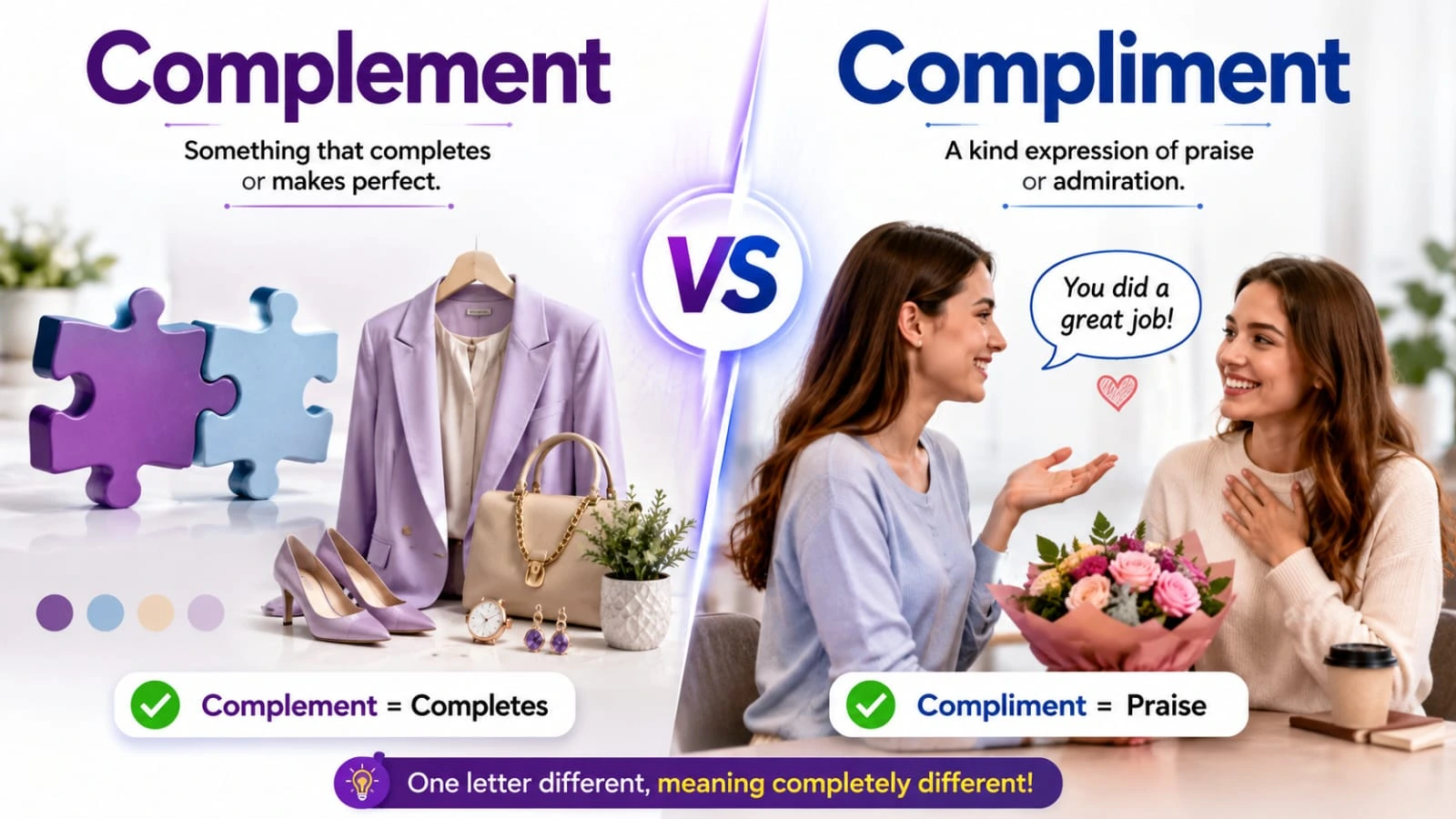
Complement means something that completes or goes well with something else. Compliment means a kind word, praise, or admiration. The two words sound alike but have very different meanings. __________________________________________________________________________
Have you ever paused while writing an email because you couldn’t remember whether it was complement or compliment? I know I have. Early in my writing journey, I once wrote, “Your shoes really complemented me.” A friend smiled and gently pointed out that I meant complimented, not complemented. It was a small mistake, but one I never forgot.
Many English learners, students, and even native speakers mix up these two words because they look and sound almost the same. A single extra letter changes the meaning completely. That can make your writing confusing or even embarrassing in professional situations.
The good news is that the difference is simple once you understand it. In this guide, you’ll learn what complement and compliment mean, when to use each one, easy memory tricks, and plenty of real-life examples. By the end, you’ll never have to guess which word is correct again.
Complement or Compliment: Quick Answer
The difference is easy to remember:
- Complement = something that completes, improves, or matches another thing.
- Compliment = praise, admiration, or a nice thing you say to someone.
Simple Examples
- The blue tie complements his suit perfectly. ✅
- She gave me a wonderful compliment about my presentation. ✅
- Fresh herbs complement the flavor of the soup. ✅
- He complimented his teammate after the match. ✅
A quick trick is this:
- Complement has an E, just like Complete.
- Compliment has an I, just like I admire you.
Once you remember that, choosing the right word becomes much easier.
The Origin of Complement and Compliment
Understanding where these words came from makes them much easier to remember.
Origin of Complement
The word complement comes from the Latin word complere, which means “to fill up” or “to complete.” Later, it entered English through French and kept the same basic meaning.
That is why complement still means something that completes, improves, or goes well with something else.
Examples:
- A scarf can complement a winter outfit.
- Good teamwork complements strong leadership.
- Lemon juice complements grilled fish.
The original meaning of “complete” is still easy to see.
Origin of Compliment
The word compliment has a different history. It comes from the Italian word complimento, meaning a courteous expression or act of respect. It later entered French before becoming part of English.
Today, compliment means expressing admiration, respect, or praise.
Examples:
- She received many compliments on her speech.
- The teacher complimented the student for working hard.
- His manager paid him a sincere compliment.
Although the spellings differ by only one letter, their histories explain why their meanings are completely different.
Complement vs Compliment Explained
Both words are pronounced almost the same. That is why they are often confused. The easiest way to tell them apart is by asking one simple question:
- Is someone giving praise? → Use compliment.
- Is something completing or improving another thing? → Use complement.
Here is a quick comparison.
| Term | Meaning | When to Use | Context |
| Complement | Something that completes, matches, or improves another thing | When two things work well together | Fashion, food, design, business, relationships |
| Compliment | Praise, admiration, or kind words | When expressing appreciation or respect | Daily conversation, school, workplace, writing |
When to Use Complement
Use complement when one thing makes another thing better or more complete.
Examples:
- The curtains complement the furniture beautifully.
- Red wine complements steak.
- His patience complements her creativity.
- The software features complement each other.
Think of it as adding balance or completeness.
When to Use Compliment
Use compliment when someone says something nice or expresses admiration.
Examples:
- Thank you for the lovely compliment.
- My teacher complimented my essay.
- She received several compliments about her new hairstyle.
- He complimented the chef on the delicious meal.
In every case, the word involves praise or appreciation.
The Easy Memory Trick
Many learners remember the difference with this simple idea:
- Complement = Complete
- Both contain the letter E.
- If something completes another thing, use complement.
- Compliment = I Like It
- Compliment contains the letter I.
- You give praise because I like something.
This tiny spelling clue can save you from making one of the most common English writing mistakes.
Which Version Should You Use?
The answer depends on what you want to say.
Use “Complement” When Something Completes Another Thing
Choose complement if one thing improves, matches, or completes another.
This word is common in:
- Fashion
- Food and cooking
- Interior design
- Business
- Art
- Relationships
Examples:
- The wallpaper complements the room.
- Fresh basil complements tomato sauce.
- Her skills complement the rest of the team.
Use “Compliment” When You Mean Praise
Choose compliment when talking about kind words, admiration, or appreciation.
This word is common in:
- Everyday conversations
- Professional emails
- School
- Workplace feedback
- Social media
Examples:
- She gave me a lovely compliment.
- My boss complimented me on my report.
- Everyone complimented the bride’s dress.
Recommendations for Different Audiences
| Audience | Best Choice | Why |
| Students | Learn both meanings | They often appear in exams and writing assignments. |
| Professionals | Use the correct word carefully | It helps your emails and reports look polished. |
| Writers and Bloggers | Match the meaning to the sentence | Precision builds credibility. |
| English Learners | Remember the memory trick | It prevents one of the most common spelling mistakes. |
| Global Readers | Learn both words | Both are standard English worldwide. |
A Simple Rule to Remember
Ask yourself one question:
Am I talking about praise or about completing something?
- Praise? → Compliment
- Completing or matching? → Complement
If you answer that question first, you’ll almost never choose the wrong word.
Common Mistakes with Complement and Compliment
Because these words are homophones, many people swap them accidentally. Here are the mistakes you should avoid.
Mistake 1: Using “Compliment” for Matching Things
❌ The sofa compliments the curtains.
✅ The sofa complements the curtains.
Why?
The sofa is matching the curtains, not praising them.
Mistake 2: Using “Complement” for Praise
❌ She gave me a wonderful complement.
✅ She gave me a wonderful compliment.
Why?
She said something kind. That is praise.
Mistake 3: Forgetting the Verb Forms
Both words can be nouns and verbs.
Examples:
Complement
- This sauce complements grilled chicken.
- The colors complement each other.
Compliment
- She complimented my presentation.
- I always compliment good work.
Always think about the meaning before choosing the spelling.
Mistake 4: Trusting Spell Check Alone
Spell check often accepts both words because both are correct English words.
For example:
❌ Your necklace complimented your dress.
There is no spelling error, but the meaning is wrong.
Always read the sentence carefully.
Mistake 5: Thinking They Are Interchangeable
Many learners believe these words can replace each other.
They cannot.
Compare these sentences:
- The wine complements the meal. ✅
- The waiter complimented the chef. ✅
Each sentence uses a completely different meaning.
Complement or Compliment in Real-World Examples
Seeing the words in real situations makes the difference much easier to remember.
Professional Email
Thank you for your compliment regarding my presentation. I truly appreciate your feedback.
Here, someone is expressing praise.
Business Report
The new software features complement our existing security system.
The features improve the system by working together.
News Headline
Local Coach Compliments Team After Championship Victory
The coach praises the players.
Restaurant Review
Fresh herbs perfectly complement the rich tomato sauce.
The herbs improve the flavor.
Social Media Post
Thanks for all the kind compliments on my graduation photos!
People are giving praise.
Fashion Blog
Neutral accessories complement bright summer outfits.
The accessories complete the overall look.
Office Conversation
Manager:
I’d like to compliment you on your excellent customer service.
Employee:
Thank you. That means a lot.
Interior Design Article
Soft lighting complements the modern furniture and creates a relaxing atmosphere.
The lighting matches and enhances the room.
These examples show that compliment always relates to praise, while complement refers to things working well together.
Complement or Compliment: Data, Trends & Usage
Many people search for complement or compliment because the words sound identical but have different meanings. This makes them one of the most commonly confused word pairs in English.
Who Searches for This Topic Most?
People looking up this topic often include:
- Students preparing for English exams
- English language learners
- Content writers and bloggers
- Business professionals
- Teachers and editors
Search Intent
| Factor | Details |
| Primary Search Intent | Informational |
| Secondary Intent | Improve writing accuracy |
| Common Questions | Which word is correct? What is the difference? How do I remember them? |
| Difficulty | Beginner to Intermediate |
Why It Matters Today
Clear writing builds trust. Whether you’re sending a business email, posting on social media, or writing an essay, using complement and compliment correctly shows attention to detail. A single letter can completely change the meaning of your sentence.
Standalone Comparison Table
| Term/Variant | Meaning | Region/Context | Best Used When |
| Complement | Something that completes, improves, or matches another thing | Standard English worldwide | Talking about things that work well together |
| Complement (Verb) | To complete or enhance something | Formal and everyday English | Describing matching colors, food, skills, or design |
| Compliment | Praise or admiration | Standard English worldwide | Giving kind words to someone |
| Compliment (Verb) | To express praise or appreciation | Everyday conversation, school, workplace | Thanking or praising another person |
Frequently Asked Questions
Q1. What is the difference between complement and compliment?
Complement means to complete, improve, or match something. Compliment means praise, admiration, or a kind remark. Although they sound alike, they have completely different meanings.
Q2. How do I remember complement vs compliment?
Use this simple trick:
- Complement = Complete (both contain E)
- Compliment = I admire you (both contain I)
This memory trick helps many learners choose the correct spelling quickly.
Q3. Is it “compliment” or “complement” someone’s outfit?
It depends on what you mean.
If you praise someone’s outfit, you compliment it.
If one clothing item matches another, it complements it.
Examples:
- I complimented her beautiful dress.
- Her shoes complement her dress perfectly.
Q4. Can complement and compliment be verbs?
Yes.
Both words work as nouns and verbs.
Examples:
- The colors complement each other.
- She complimented me on my presentation.
Always choose the word based on its meaning.
Q5. Are complement and compliment interchangeable?
No.
They are different words with different meanings.
Using one instead of the other changes the meaning of the sentence.
Q6. Which word is correct in formal writing?
Both are correct.
Use complement when discussing things that complete or improve each other.
Use compliment when expressing praise or appreciation.
Professional writing requires choosing the right one for the context.
Q7. Why do people confuse complement and compliment?
They are homophones, which means they have the same pronunciation but different spellings and meanings. Because they sound identical, writers often choose the wrong spelling unless they think about the context.
Conclusion
The difference between complement and compliment is much simpler than it first appears. Once you understand the meaning behind each word, you’ll rarely confuse them again.
Remember these key points:
- Complement means to complete, improve, or match something.
- Compliment means to praise or admire someone.
- The easiest memory trick is Complement = Complete and Compliment = I admire you.
- Always think about the meaning of your sentence before choosing the spelling.
Small spelling choices make a big difference in clear communication. Whether you’re writing an email, an essay, a social media post, or a professional report, using the correct word helps your writing look polished and confident.
Now you know exactly when to use complement and compliment. Bookmark this guide for future reference, and share it with anyone who still mixes up these commonly confused words.
Carmel or Caramel? Stop Making This Sweet Spelling Mistake

As an English language enthusiast, I love diving into the tricky details of word differences and spelling variations. My mission is to explain confusing terms and make them accessible to everyone, helping readers to communicate with clarity and confidence.