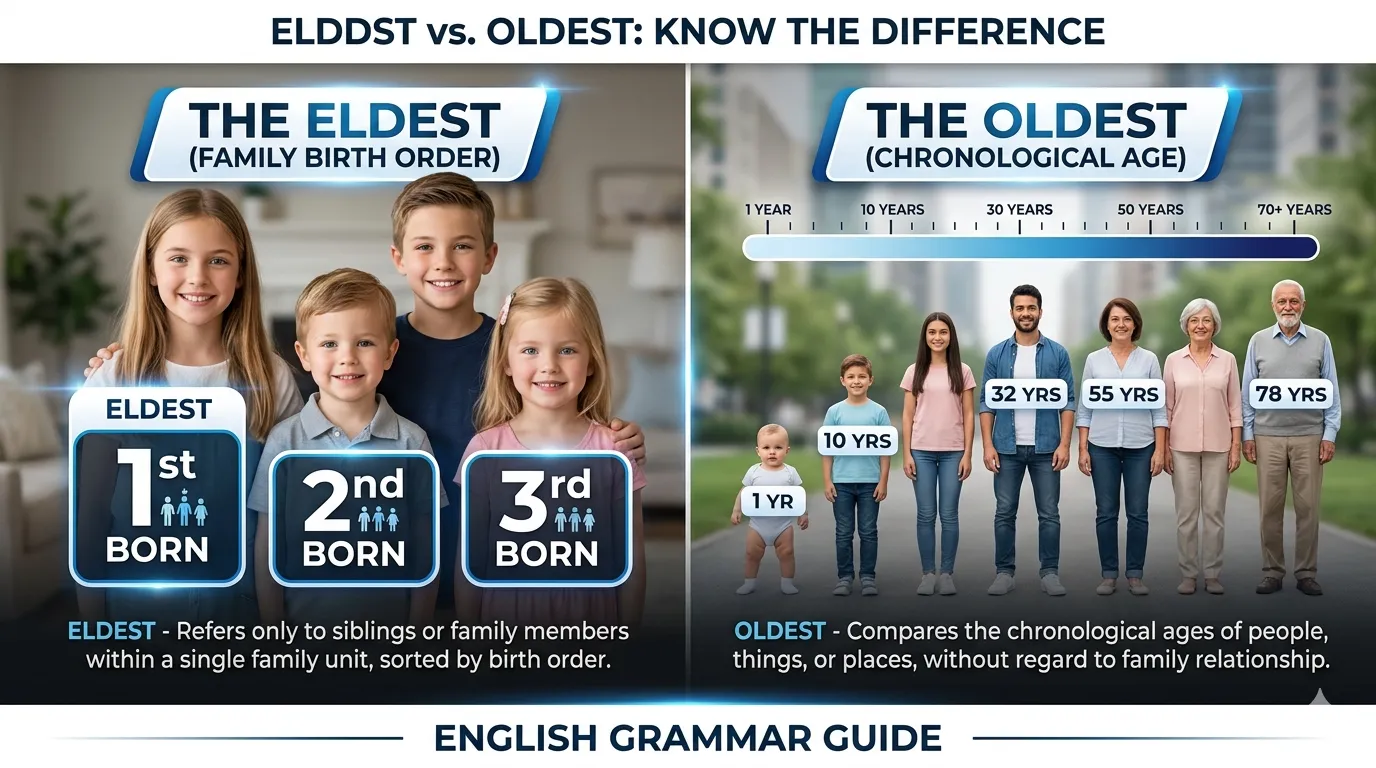
Eldest and oldest both refer to the person or thing with the greatest age. Eldest is usually used for people within a family, while oldest can be used for people, objects, places, and anything else. For example, “She is my eldest sister” and “This is the oldest building in town.”
A few years ago, I was editing a student’s essay when I noticed the sentence: “My oldest brother is a doctor.” It was not wrong. Yet the student had been told that “eldest brother” sounded better. That simple question started a lively discussion.
Many English learners face the same confusion. Should you say eldest son or oldest son? Is one more correct than the other? Do native speakers use both? And does it matter in formal writing?
The confusion happens because both words relate to age. They often seem interchangeable. However, there are small differences in meaning, tone, and usage that can help you sound more natural and precise.
If you have ever paused while writing an email, school assignment, report, or social media post because of this question, you are not alone.
By the end of this guide, you will know exactly when to use eldest, when to use oldest, and how to avoid common mistakes. Let’s clear up the confusion once and for all.
Eldest or Oldest : Quick Answer
Eldest is mainly used for the oldest person in a family relationship.
Oldest is broader. It can describe people, animals, buildings, companies, traditions, and more.
Examples
- My eldest daughter just started university.
- My oldest daughter just started university.
- This is the oldest castle in the country.
- ❌ This is the eldest castle in the country.
When talking about family members, both words often work. Outside family relationships, oldest is usually the correct choice.
The Origin / Background of Eldest or Oldest

Both words come from the ancient roots of English.
The word old has existed for hundreds of years. Over time, English created comparison forms:
- Old
- Older
- Oldest
At the same time, English developed another family-related form:
- Elder
- Eldest
Historically, elder and eldest were often used when comparing people, especially relatives.
That tradition remains today.
This history explains why many people still say:
- eldest son
- eldest daughter
- eldest brother
- eldest sister
The confusion exists because modern English accepts oldest in many of these situations too. As language evolved, oldest became the more common and flexible choice.
Eldest or Oldest Explained : Key Differences or Variations
The biggest difference is context.
Eldest
Use eldest mainly for family relationships.
Examples:
- My eldest child lives abroad.
- Her eldest brother is an engineer.
Oldest
Use oldest for almost everything.
Examples:
- The oldest tree in the park.
- The oldest employee in the company.
- The oldest university in the region.
Comparison Table
| Term | Meaning | When to Use | Region/Context |
| Eldest | Most senior in age among family members | Family relationships | Formal and traditional English |
| Oldest | Greatest age among people or things | General use | Worldwide English |
| Elder | Older person compared with another | Family and formal comparisons | Traditional English |
| Older | More age than another person or thing | Everyday comparisons | Common modern English |
Simple Comparison
- My eldest son is 18. ✅
- My oldest son is 18. ✅
- The oldest museum in the city. ✅
- The eldest museum in the city. ❌
Which Version Should You Use?
Your audience matters.
For Students
Use oldest if you are unsure.
Why?
Because it works in almost every situation.
Example:
- My oldest sibling studies medicine.
For Formal Family References
Use eldest when discussing family members.
Example:
- The couple’s eldest daughter received the award.
This sounds slightly more formal and polished.
For Business Writing
Use oldest in most cases.
Examples:
- The company’s oldest branch.
- The oldest employee on the team.
For Global English
Choose oldest.
It is more common and widely understood across regions.
Quick Recommendation
- Family relationships → eldest or oldest
- Objects and things → oldest
- When unsure → oldest
Common Mistakes with Eldest or Oldest
Many learners make the same errors.
Mistake 1
| Incorrect | Correct |
| The eldest building in town | The oldest building in town |
Why?
Buildings are not family members.
Mistake 2
| Incorrect | Correct |
| My oldest than brother | My older brother |
Why?
Use older, not oldest, when comparing two people.
Mistake 3
| Incorrect | Correct |
| She is elder than me | She is older than me |
Why?
Older than is more common in modern English.
Mistake 4
| Incorrect | Correct |
| My eldest car | My oldest car |
Why?
Cars cannot be described as eldest.
Mistake 5
| Incorrect | Correct |
| The oldest of two sisters | The elder of two sisters |
Why?
Traditionally, elder is used when comparing two siblings.
Eldest or Oldest in Real-World Examples
Professional Email
Our eldest daughter will attend the conference on behalf of the family business.
News Headline
City’s oldest library celebrates 150 years of service.
Social Media Post
Happy birthday to my oldest friend. Thanks for being there through everything!
Formal Report
The company’s oldest manufacturing facility remains operational today.
Family Biography
John was the eldest son of the family and inherited the estate.
These examples show how naturally each word fits different contexts.
Eldest or Oldest : Data, Trends & Usage
Modern English usage reveals an interesting pattern.
Most Common Searches
People often search:
- eldest meaning
- oldest meaning
- eldest vs oldest
- eldest child or oldest child
- eldest son meaning
Regions Most Interested
Interest is high among:
- English learners
- Students
- Writers
- Editors
- Job seekers preparing formal documents
Search Intent
Primary intent: Informational
Users want to know:
- Which word is correct
- When each word should be used
- Whether they are interchangeable
Current Usage Trend
In modern English, oldest appears far more often than eldest.
Why?
Because it works in more situations and sounds natural in everyday conversation.
Why This Matters Now
Clear communication matters more than ever. Whether you are writing an email, creating content, or preparing an academic paper, choosing the right word helps you sound confident and professional.
Standalone Comparison Table
| Term/Variant | Meaning | Region/Context | Best Used When |
| Eldest | Oldest family member | Formal and family contexts | Talking about children, siblings, relatives |
| Oldest | Greatest age overall | Universal English | General situations and objects |
| Elder | Older of two people | Traditional English | Comparing family members |
| Older | More age than another | Everyday English | Comparing people or things |
Frequently Asked Questions
Q: What does eldest mean?
A: Eldest means the oldest person in a family group. It is commonly used for children, brothers, sisters, and other relatives.
Q: How do you use eldest correctly?
A: Use it when referring to the oldest family member. For example, “Her eldest son graduated from college.”
Q: Eldest vs oldest : what’s the difference?
A: Eldest is mainly for family relationships. Oldest works for both people and things.
Q: Is eldest acceptable in formal writing?
A: Yes. In fact, many formal documents and biographies use eldest when discussing family members.
Q: Which version is correct : eldest or oldest?
A: Both can be correct. The best choice depends on context. Use eldest for family members and oldest for broader situations.
Q: Where does eldest come from?
A: It comes from older forms of English that used elder and eldest to describe age within families.
Q: Can eldest be used for buildings or objects?
A: No. Use oldest for buildings, companies, books, trees, and other non-family subjects.
Conclusion
The debate between eldest and oldest is not about right versus wrong. It is about choosing the most natural word for the situation.
Remember these key points:
- Eldest is mainly used for family members.
- Oldest works for both people and things.
- Both can describe the oldest child in a family.
- When in doubt, oldest is usually the safer choice.
English contains many small distinctions like this one. Learning them helps your writing feel smoother and more professional. The good news is that the difference is simple once you understand the context.
If you are talking about siblings, children, or relatives, eldest adds a traditional touch. For everything else, oldest is the clear winner.
Now you know exactly how to use eldest and oldest: go try it in your next piece of writing. Bookmark this guide so you never second-guess these words again, and share it with someone who has been confused by them.
Leopard or Jaguar: Spotting the Difference 🐆

“I am a dedicated and hardworking individual with a passion for learning and personal growth. I am committed to achieving goals and continuously improving my skills.”