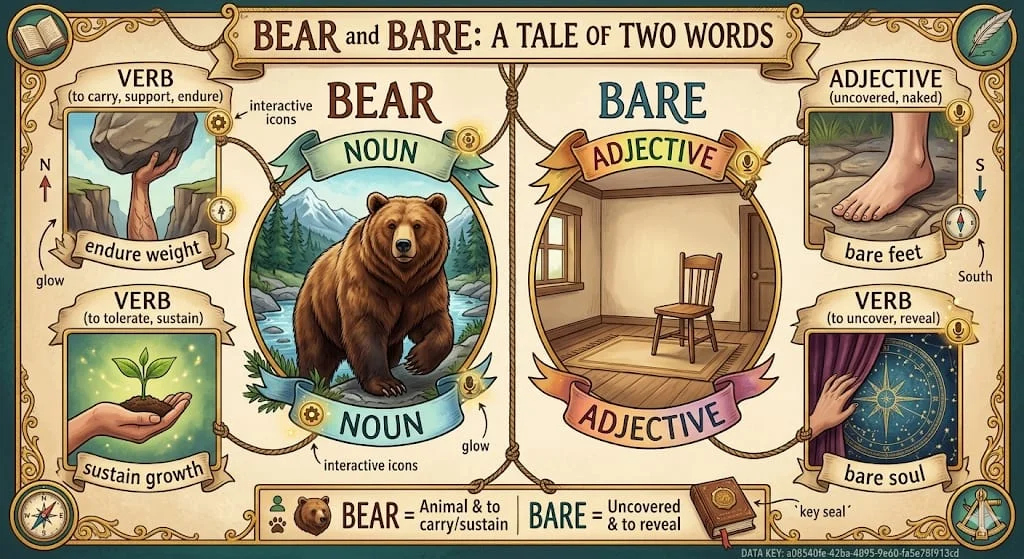
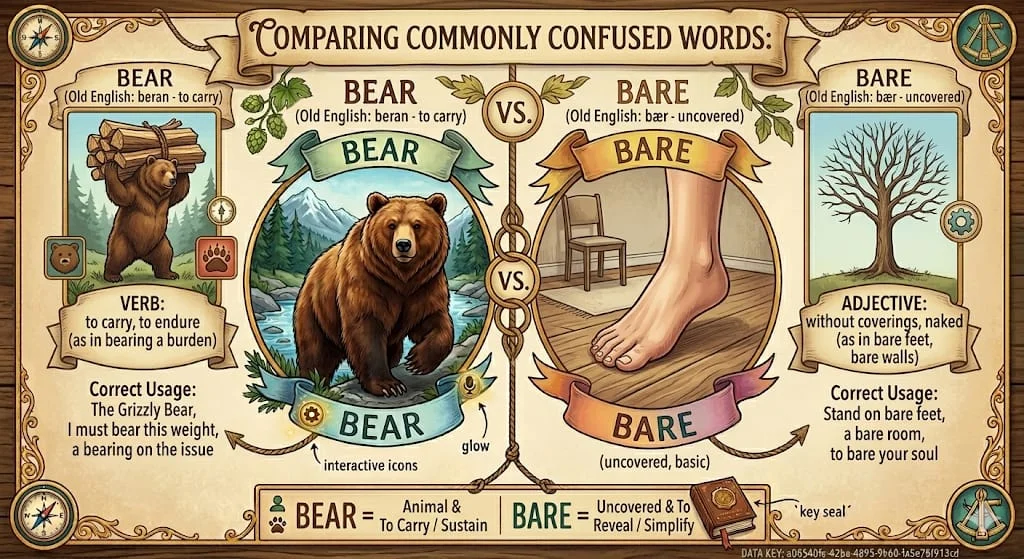
Bare means uncovered, exposed, plain, or without something. Bear means to carry, endure, support, or refers to the large furry animal. For example, “She walked with bare feet on the sand,” but “I can’t bear the loud noise.”
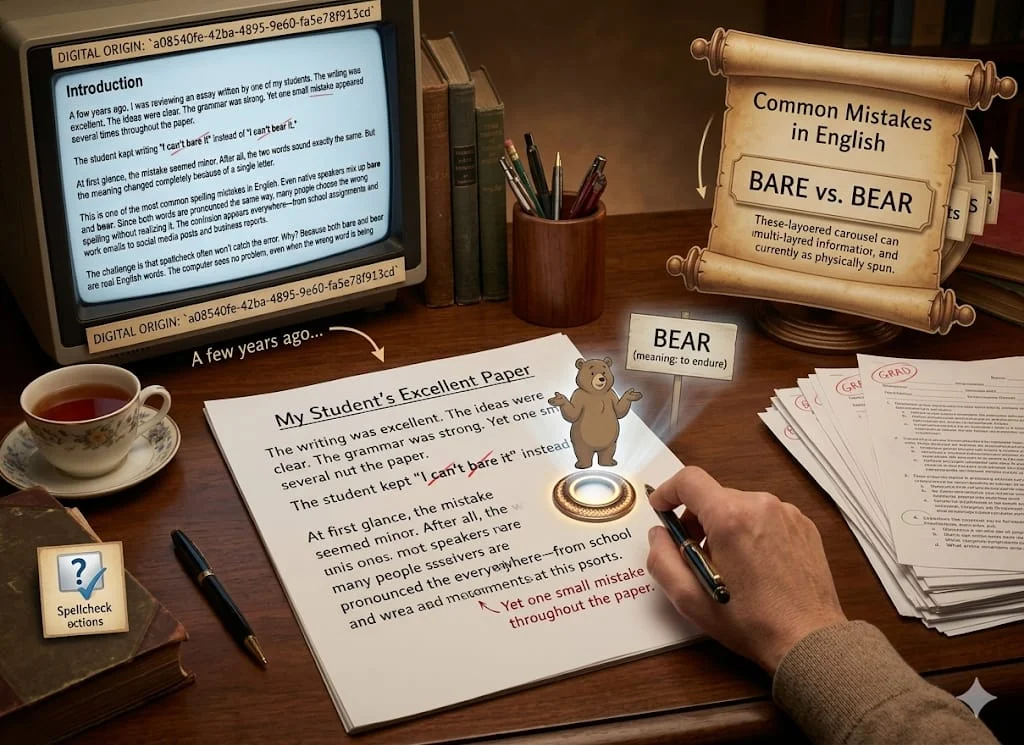
A few years ago, I was reviewing an essay written by one of my students. The writing was excellent. The ideas were clear. The grammar was strong. Yet one small mistake appeared several times throughout the paper.
The student kept writing “I can’t bare it” instead of “I can’t bear it.”
At first glance, the mistake seemed minor. After all, the two words sound exactly the same. But the meaning changed completely because of a single letter.
This is one of the most common spelling mistakes in English. Even native speakers mix up bare and bear. Since both words are pronounced the same way, many people choose the wrong spelling without realizing it. The confusion appears everywhere—from school assignments and work emails to social media posts and business reports.
The challenge is that spellcheck often won’t catch the error. Why? Because both bare and bear are real English words. The computer sees no problem, even when the wrong word is being used.
The good news is that learning the difference is much easier than most people think.
In this complete guide, you’ll discover the meaning of bare and bear, their origins, key differences, real-world examples, common mistakes, practical usage tips, and memory tricks that will help you choose the correct word every time.
By the end, you’ll never have to second-guess bare or bear again.
Bare or Bear Quick Answer
The easiest way to remember the difference is to focus on the meaning.
Bare
Bare means:
- Uncovered
- Exposed
- Naked
- Plain
- Without something
Examples:
- She walked across the room with bare feet.
- The walls were completely bare.
- The tree stood with bare branches during winter.
Bear
Bear can mean:
- To carry
- To support
- To endure
- To tolerate
- A large wild animal
Examples:
- I cannot bear the pain.
- The bridge can bear heavy traffic.
- A brown bear was spotted near the forest.
A simple rule is:
If something is exposed, use bare. If something is carried, endured, or furry, use bear.
The Origin / Background of Bare or Bear
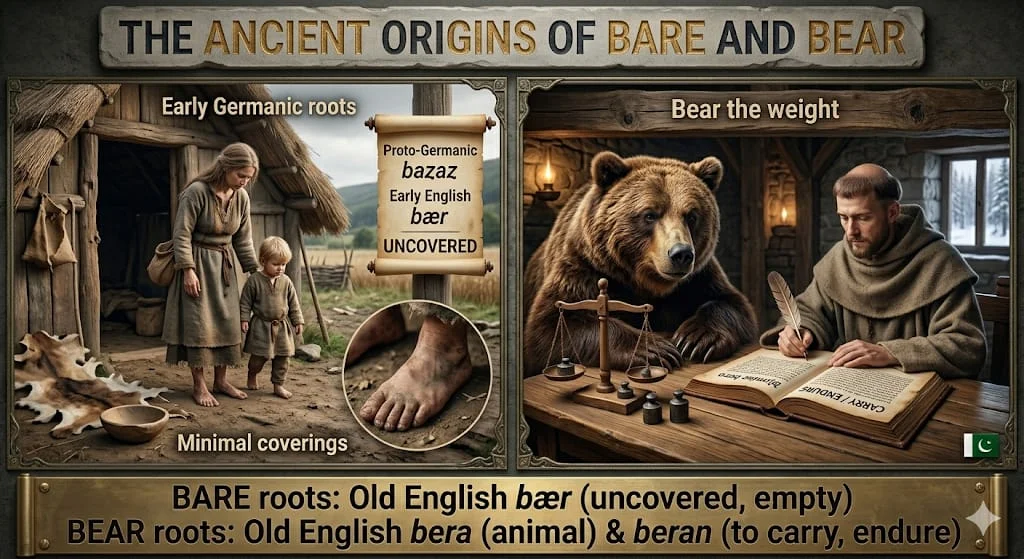
Many English learners wonder why these words sound identical but have completely different meanings.
The answer lies in their history.
The History of Bare
The word bare comes from the Old English word bær.
It originally meant:
- Naked
- Open
- Uncovered
- Empty
Over hundreds of years, the meaning changed very little.
Today, we still use bare in almost the same way.
Examples include:
- Bare hands
- Bare skin
- Bare walls
- Bare ground
The central idea remains the same: something lacks a covering.
The History of Bear
The verb bear comes from the Old English word beran.
Its original meanings included:
- Carry
- Bring
- Support
- Endure
These meanings also survived into modern English.
Examples:
- Bear responsibility
- Bear a burden
- Bear a cost
- Bear pain
Interestingly, the animal bear comes from a different historical source. Over time, both words ended up with the same spelling.
This unusual development is one reason English learners often find the word confusing.
Why the Confusion Exists
People confuse bare and bear because:
- They sound exactly alike.
- Both are common words.
- Spellcheck often misses the error.
- Context is required to know which one is correct.
That’s why understanding the meaning matters much more than memorizing spelling alone.
Bare or Bear Explained Key Differences
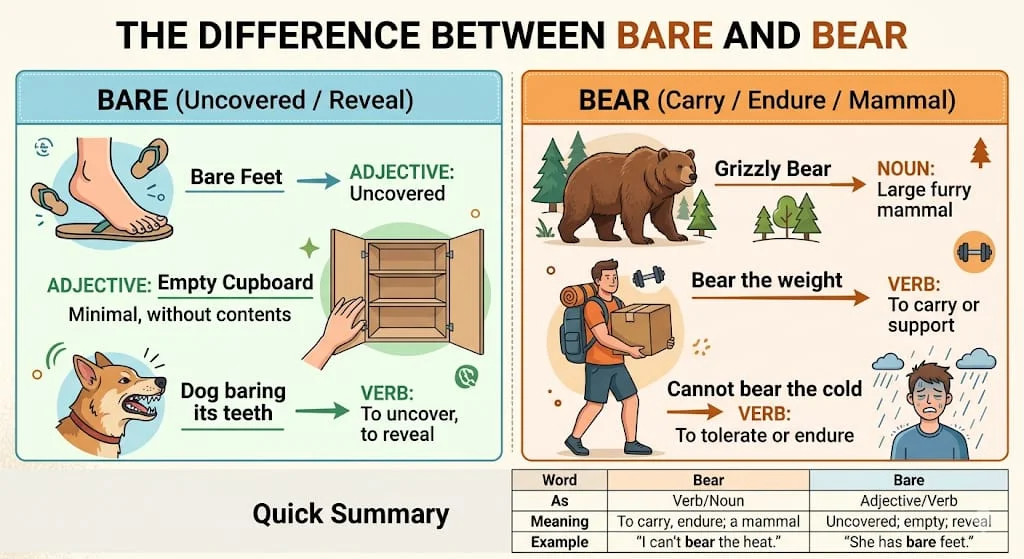
Although they sound identical, their meanings are completely different.
| Term | Meaning | When to Use | Context |
| Bare | Uncovered or exposed | Describing appearance | General English |
| Bare | Minimal amount | Talking about quantity | Everyday English |
| Bear | Carry or support | Responsibilities or weight | Formal and informal |
| Bear | Endure or tolerate | Difficult situations | Everyday English |
| Bear | Large animal | Wildlife discussions | Nature |
Understanding Bare
Think of bare whenever something is visible because it lacks a covering.
Examples:
- bare feet
- bare skin
- bare branches
- bare walls
- bare floor
Sentence examples:
- He walked across the beach with bare feet.
- The apartment had bare walls.
- Winter left the trees bare.
Understanding Bear
Think of bear whenever carrying, supporting, tolerating, or enduring is involved.
Examples:
- bear responsibility
- bear the cost
- bear the burden
- bear the pain
Sentence examples:
- She must bear the consequences.
- The company will bear the expenses.
- I can’t bear this noise any longer.
Understanding Bear as an Animal
The noun bear refers to the large mammal.
Examples:
- polar bear
- black bear
- brown bear
- grizzly bear
Sentence examples:
- The bear wandered through the forest.
- A polar bear can survive harsh Arctic conditions.
Which Version Should You Use?
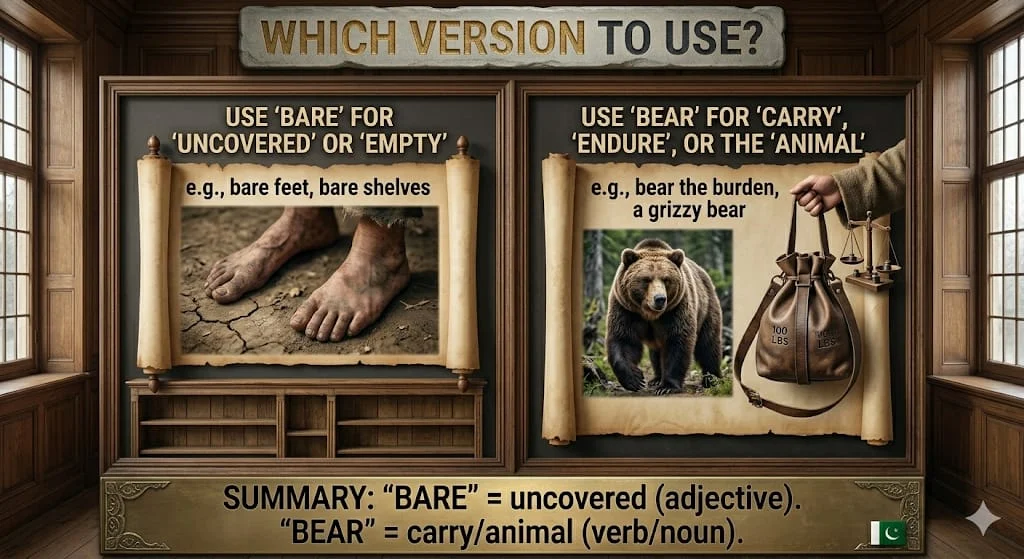
Choosing between bare and bear becomes easy when you ask one question:
What exactly am I trying to say?
Use Bare When Something Is Uncovered
Examples:
- bare shoulders
- bare arms
- bare floor
- bare walls
Correct sentences:
- She wore a dress with bare shoulders.
- The room looked empty with its bare walls.
Use Bear When Talking About Endurance
Examples:
- bear stress
- bear pain
- bear pressure
Correct sentences:
- I can’t bear the waiting.
- He couldn’t bear the disappointment.
Use Bear When Talking About Responsibility
Examples:
- bear costs
- bear losses
- bear responsibility
Correct sentences:
- The company will bear the repair costs.
- Parents often bear significant expenses.
Use Bear for the Animal
Examples:
- bear habitat
- bear population
- bear attack
Correct sentences:
- The bear searched for food.
- Visitors spotted a bear near the trail.
Use Bare for Minimum Amounts
The word bare can also mean the smallest possible amount.
Examples:
- bare minimum
- bare essentials
- bare necessities
Correct sentences:
- He did the bare minimum required.
- We packed only the bare essentials.
Common Mistakes with Bare or Bear
Let’s look at mistakes people make every day.
| Incorrect | Correct |
| I can’t bare the noise. | I can’t bear the noise. |
| She walked with bear feet. | She walked with bare feet. |
| The bear walls looked empty. | The bare walls looked empty. |
| He couldn’t bare the stress. | He couldn’t bear the stress. |
| A bare attacked the camper. | A bear attacked the camper. |
Mistake #1: “I Can’t Bare It”
This is probably the most common error.
Incorrect:
- I can’t bare it.
Correct:
- I can’t bear it.
Why?
Because bear means endure or tolerate.
Mistake #2: “Bear Feet”
Many people accidentally write:
- bear feet
What they really mean is:
- bare feet
Unless you’re literally discussing a bear’s feet, bare feet is correct.
Mistake #3: Confusing Physical Exposure with Endurance
Incorrect:
- The workers had bear hands.
Correct:
- The workers had bare hands.
Hands are uncovered, not carrying something.
Mistake #4: Forgetting Context
Writers often choose the word based on sound rather than meaning.
Always pause and ask:
“Am I talking about exposure or endurance?”
That question usually reveals the answer instantly.
Bare or Bear in Real-World Examples
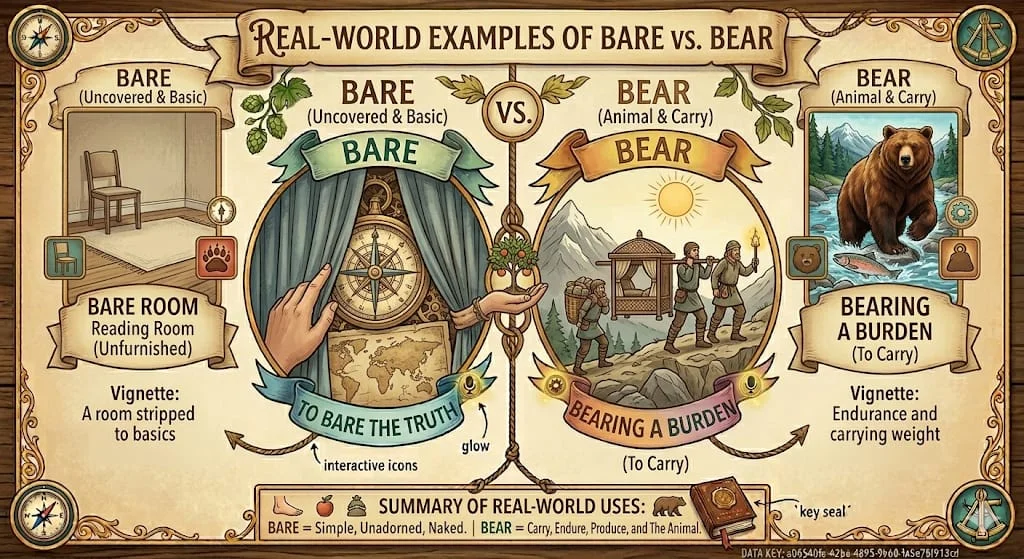
Let’s see how these words appear in everyday communication.
Professional Email
Our company will bear all shipping costs associated with the replacement order.
Job Application
I can bear high-pressure work environments and strict deadlines.
Business Report
The organization will bear the financial responsibility for repairs.
News Headline
Polar bear populations continue to face environmental challenges.
Social Media Post
Nothing feels better than walking on the beach with bare feet.
Travel Blog
The mountain trees stood bare after a harsh winter.
Academic Writing
Participants were asked to complete the task using their bare hands.
Everyday Conversation
I simply cannot bear another hour of waiting.
Marketing Content
This package includes only the bare essentials for beginners.
Wildlife Documentary
The mother bear protected her cubs from danger.
These examples show how frequently both words appear in different types of writing.
📊 Bare or Bear: Data, Trends & Usage
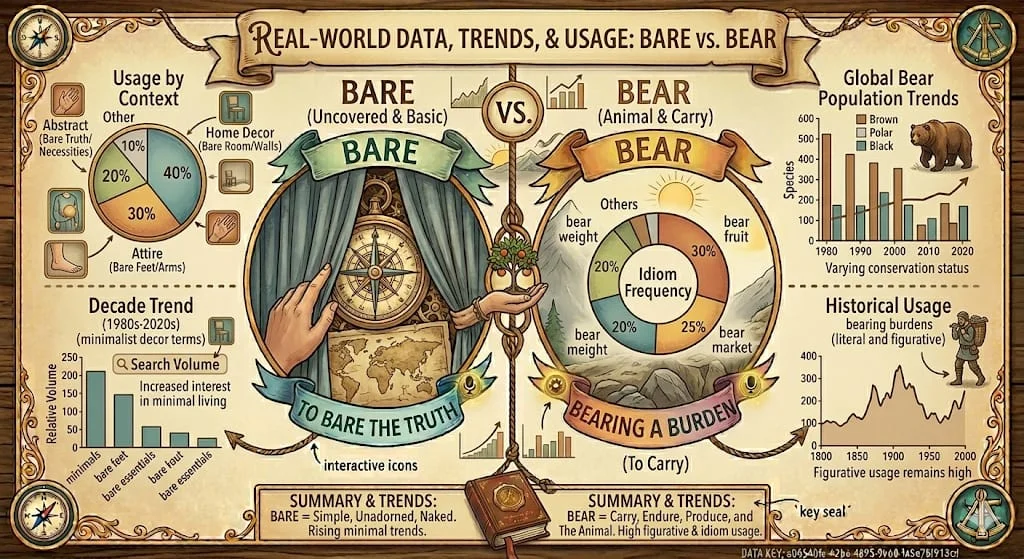
Bare and bear are among the most commonly confused words in English because they sound exactly the same but have very different meanings.
- Bare = uncovered, naked, plain, or exposed.
- Bear = a large mammal 🐻, or a verb meaning to carry, endure, support, or tolerate.
Although both words are widely used, bear appears more frequently in everyday English because it functions as both a noun and a verb.
📈 Usage Trend Analysis
English language corpora and historical text databases show that bear is used significantly more often than bare.
Why Is “Bear” More Common?
The word bear appears in many common expressions:
- Bear with me
- Bear responsibility
- Bear the cost
- Bear the burden
- Grin and bear it
- Polar bear
- Black bear
Meanwhile, bare is primarily used as an adjective:
- Bare feet
- Bare hands
- Bare minimum
- Bare walls
- Bare essentials
As a result, bear enjoys broader usage across conversation, literature, news, and academic writing.
📊 Relative Popularity
| Word | Part of Speech | Typical Meaning | Relative Usage |
|---|---|---|---|
| 🐻 Bear | Noun & Verb | Animal, carry, endure | Higher |
| 👣 Bare | Adjective & Verb | Uncovered, exposed | Lower |
Approximate Usage Pattern
Bear  ████████████████████████████ 70%
Bare  ████████████                 30%
These figures are illustrative and represent general usage patterns rather than exact measurements.
📅 Historical Trends
🐻 Bear
The word bear has existed in English for centuries and remains consistently popular due to:
- Animal references
- Business and finance terms (bear market)
- Common idioms
- Everyday verbs
Examples:
- Bear the pain.
- Bear responsibility.
- The bear wandered through the forest.
👣 Bare
The word bare has also been used for centuries but appears less frequently because its meaning is more specialized.
Examples:
- Bare feet.
- Bare skin.
- The room had bare walls.
🌐 Search Trends
People searching “bare or bear” usually want to know:
- Which spelling is correct.
- The difference between the two words.
- Whether to use bear with me or bare with me.
- Common grammar mistakes involving these homophones.
- Easy ways to remember the distinction.
📱 Online Usage Patterns
Common Uses of “Bear”
- Bear with me
- Bear responsibility
- Bear witness
- Bear fruit
- Bear the burden
- Teddy bear
- Polar bear
Common Uses of “Bare”
- Bare feet
- Bare hands
- Bare minimum
- Bare skin
- Bare essentials
- Bare room
🎯 Memory Trick
👣 Bare = Exposed
Think:
Bare = Barefoot
If something is uncovered, use bare.
🐻 Bear = Carry or Endure
Think:
A bear is strong enough to carry heavy things.
If the meaning involves carrying, tolerating, enduring, or the animal itself, use bear.
📌 Key Takeaway
While bare and bear sound identical, they serve different purposes. Usage data and language trends show that bear is generally more common because it functions as both a noun and a verb. The most frequent mistake is writing “bare with me” instead of “bear with me.”
✅ Bare = uncovered, exposed, plain
✅ Bear = animal, carry, endure, tolerate
Remember: You walk with bare feet, but you bear responsibility. 🐻👣
Comparison Table: Bare vs Bear
| Term/Variant | Meaning | Region/Context | Best Used When |
| Bare | Uncovered | Global English | Talking about exposed things |
| Bare | Minimal amount | Everyday English | Referring to necessities or minimum requirements |
| Bare Feet | Feet without shoes | Everyday use | Describing uncovered feet |
| Bear | Carry or support | Global English | Talking about responsibility or weight |
| Bear | Endure or tolerate | Everyday and professional writing | Discussing pain, stress, or hardship |
| Bear | Wild animal | Nature and wildlife | Referring to the mammal |
| Bear Responsibility | Accept responsibility | Business and formal writing | Discussing obligations |
Frequently Asked Questions
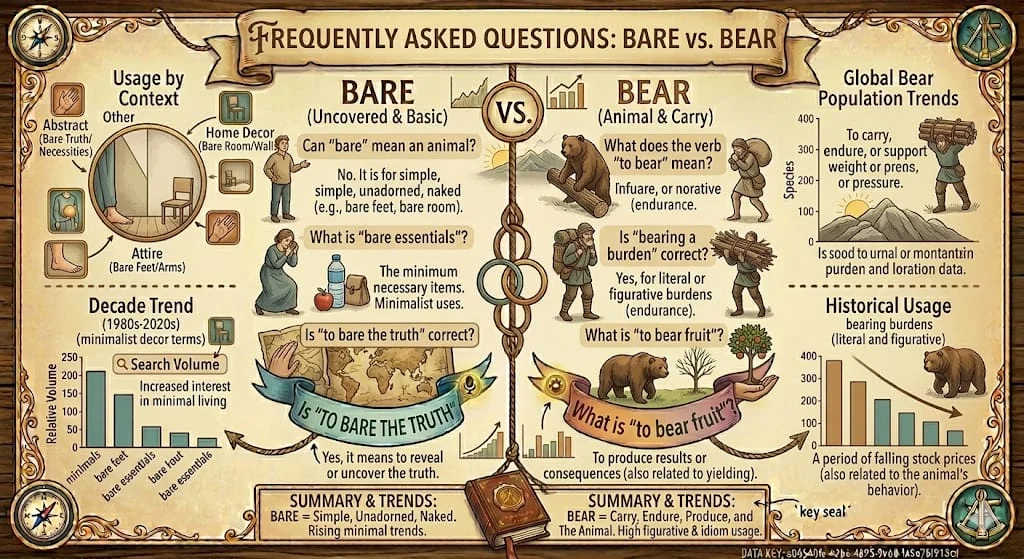
Q: What does bare mean?
A: Bare means uncovered, exposed, plain, or lacking something. It often describes objects, body parts, or places without a covering.
Q: What does bear mean?
A: Bear can mean carry, support, endure, tolerate, or refer to the large wild animal known as a bear.
Q: Bare vs bear — what’s the difference?
A: Bare relates to exposure or lack of covering. Bear relates to carrying, supporting, enduring, or the animal.
Q: Is “I can’t bare it” correct?
A: No. The correct phrase is “I can’t bear it.” Here, bear means tolerate or endure.
Q: Which is correct: bare feet or bear feet?
A: Bare feet is correct because the feet are uncovered. Bear feet would mean the feet of an actual bear.
Q: Why do people confuse bare and bear?
A: They are homophones. This means they sound exactly the same but have different spellings and meanings.
Q: Can bare and bear be used interchangeably?
A: No. They have completely different meanings. Using the wrong word changes the meaning of the sentence.
Conclusion
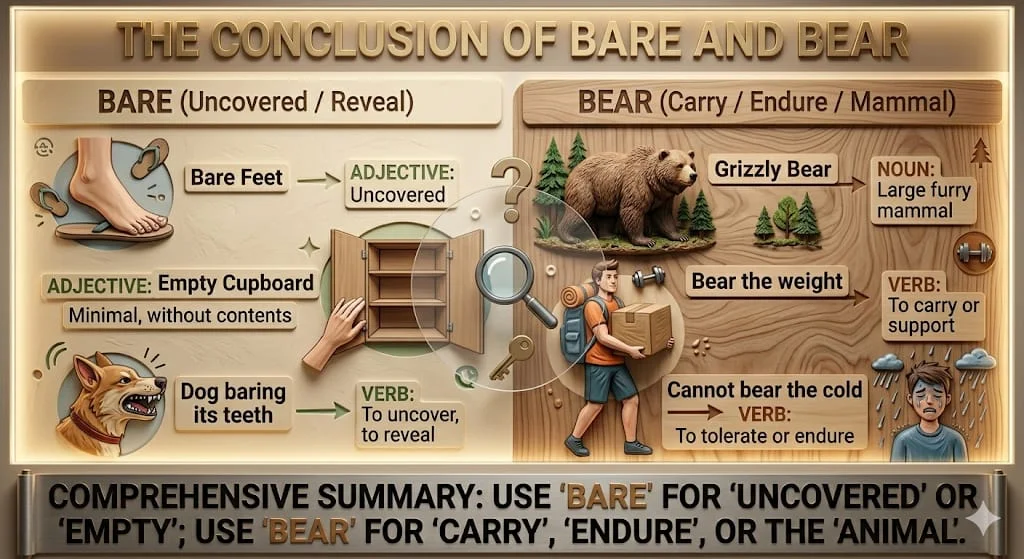
The difference between bare and bear may seem tricky at first, but it becomes simple once you focus on meaning rather than sound.
Remember these key points:
- Bare means uncovered, exposed, or lacking something.
- Bear means carry, endure, support, or refers to the animal.
- Use bare feet, not bear feet.
- Use I can’t bear it, not I can’t bare it.
- Think about the sentence meaning before choosing the spelling.
A useful memory trick is this:
Bare = exposed. Bear = endure or animal.
That simple rule will help you avoid most mistakes instantly.
The next time you write an email, school assignment, social media post, or professional report, you’ll know exactly which word belongs in your sentence.
Bookmark this guide so you never confuse bare and bear again. Better yet, share it with a friend, student, or coworker who still struggles with these commonly mixed-up words.
Read More:
Unkempt or Unkept: The Complete Guide to the Right Word🤔✅

📚✨ I’m an English enthusiast and author dedicated to exploring word differences, spelling variations, and common language questions. By drawing on trusted dictionaries, language resources, and practical usage examples, I create clear, reliable content that helps readers learn with confidence and communicate more effectively. ✍️🌍