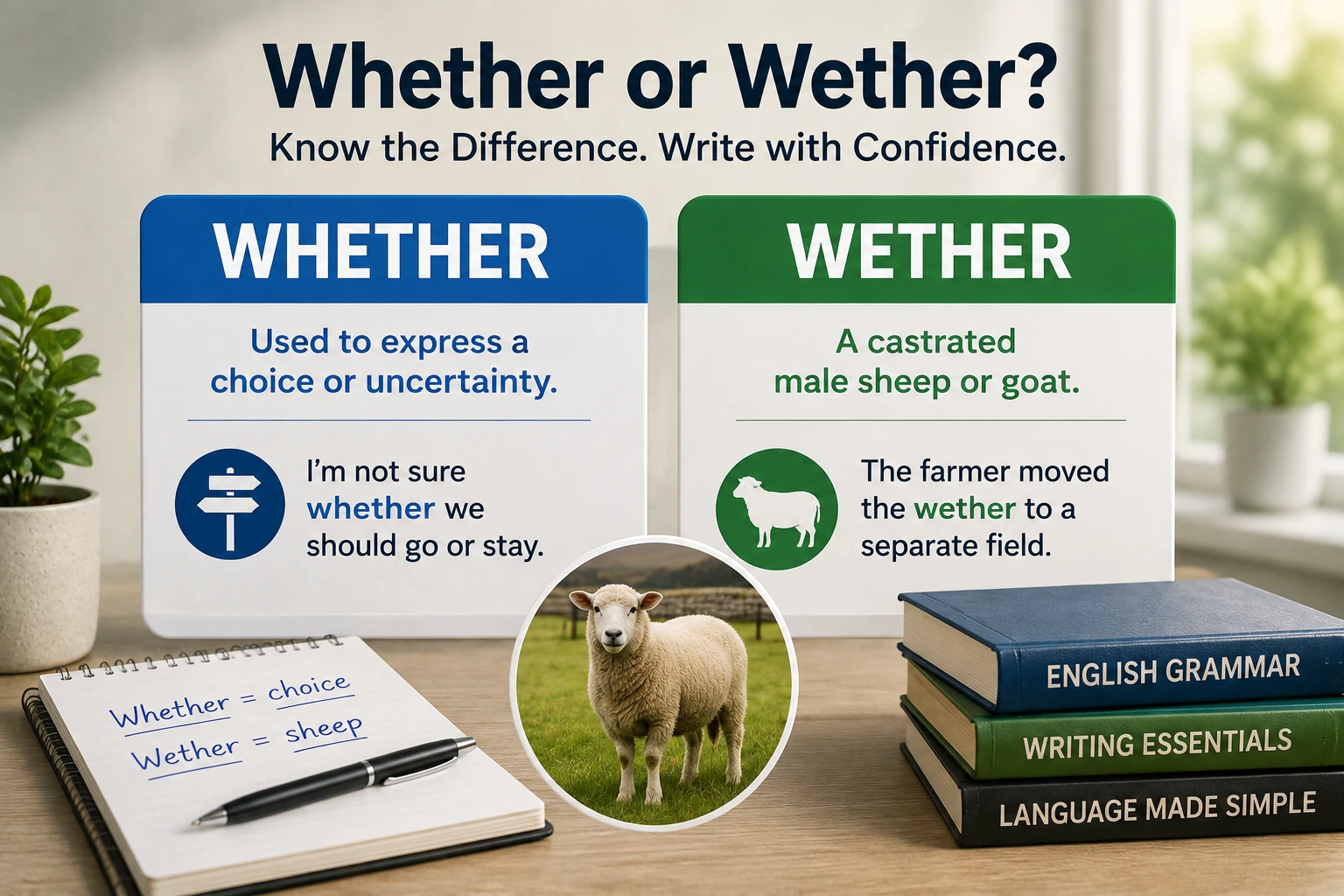
Whether is the correct spelling when talking about a choice, possibility, or condition. Wether is a real English word, but it means a castrated male sheep or goat and is almost never used in everyday writing.
Have you ever typed “wether” when you meant “whether”? I certainly have. While proofreading one of my articles, I noticed I had written, “I’m not sure wether it’s true.” My spell checker caught it instantly, but it reminded me how easy this mistake is to make.
The confusion happens because both words are spelled almost the same and sound nearly identical. Most people only know the word whether, so they naturally assume wether is just a misspelling. In reality, wether is a legitimate English word but it has a completely different meaning.
The good news is that once you understand what each word means, you’ll never confuse them again. In this guide, you’ll learn the correct spelling, the difference between whether and wether, where each word came from, and how to use them confidently in everyday writing.
Whether or Wether: Quick Answer
In almost every situation, you should use whether.
- ✅ Whether = Used to express a choice, possibility, or uncertainty.
- ✅ Wether = A castrated male sheep or goat (an agricultural term).
- ❌ Don’t use wether when you mean whether.
Examples
Correct:
- I don’t know whether she will come.
- Tell me whether you agree.
- We haven’t decided whether to travel this summer.
Correct (agriculture):
- The farmer separated the wether from the flock.
Incorrect:
- I don’t know wether she will come. ❌
- Please tell me wether you agree. ❌
If you’re writing emails, essays, blog posts, or messages, whether is almost always the word you need.
The Origin of Whether or Wether
Although these two words look alike, they have very different histories.
The Origin of Whether
The word whether comes from the Old English word hwæther, which meant which of two or which one. Over time, its meaning expanded to express alternatives, choices, and uncertainty.
Today, it’s one of the most common conjunctions in English.
Examples:
- I don’t know whether to stay or leave.
- She asked whether the meeting had started.
The Origin of Wether
The word wether also comes from Old English, but it developed in farming and animal husbandry.
A wether is:
A castrated male sheep or goat that is not used for breeding.
Outside agriculture and veterinary contexts, most English speakers rarely use this word.
Whether or Wether Explained
The confusion exists because the words differ by only one letter and are pronounced almost the same. However, their meanings are completely unrelated.
| Term | Meaning | When to Use | Context |
| Whether | Expresses a choice, possibility, or uncertainty | Everyday writing | General English |
| Wether | A castrated male sheep or goat | Farming and livestock | Agricultural English |
Whether Meaning
Use whether whenever you’re talking about alternatives or uncertainty.
Examples:
- I can’t decide whether to buy the blue shirt.
- We don’t know whether it will rain tomorrow.
- Please let me know whether you’re attending.
Wether Meaning
Use wether only when referring to a specific type of farm animal.
Examples:
- The wether grazed quietly in the field.
- Farmers often keep a wether with the flock.
- The veterinarian examined the injured wether.
The Easy Trick to Remember
Ask yourself this question:
Are you talking about a decision or choice?
- Yes → Use whether. ✅
Are you talking about a sheep or goat?
- Yes → Use wether. ✅
If the sentence has nothing to do with livestock, whether is almost certainly the correct word.
Which One Should You Use?
For almost every piece of everyday writing, the answer is whether.
Whether you’re writing an email, essay, report, blog post, or text message, whether is the correct word when you’re expressing a choice, uncertainty, or two possible outcomes.
Use wether only if you’re talking about a castrated male sheep or goat. Unless you work in farming, veterinary medicine, or animal science, you’ll probably never need this word.
For Students
Use whether in assignments, exams, and essays.
Example:
- I haven’t decided whether to study abroad.
For Professionals
Use whether in business emails, reports, and workplace communication.
Example:
- Please confirm whether the meeting will begin at 10 a.m.
For Farmers and Livestock Experts
Use wether only when referring to the animal.
Example:
- The wether was moved to a separate pasture.
Quick Recommendation
| Audience | Recommended Word | Why |
| Students | Whether | Standard English for choices and uncertainty |
| Professionals | Whether | Correct in formal and business writing |
| Bloggers & Writers | Whether | Appropriate for almost every article |
| Farmers | Wether | Correct animal term when needed |
| General Readers | Whether | The word you’ll almost always use |
Tip: If your sentence isn’t about a sheep or goat, choose whether.
Common Mistakes with Whether and Wether
Because the words look and sound alike, writers often confuse them. Here are the mistakes to avoid.
Mistake 1: Using Wether Instead of Whether
❌ I don’t know wether I’ll have time.
✅ I don’t know whether I’ll have time.
Why?
You’re expressing uncertainty, not talking about an animal.
Mistake 2: Assuming Wether Is a Misspelling
Many people think wether is simply wrong.
Actually, wether is a real English word—but it has a completely different meaning.
Mistake 3: Using Whether for an Animal
❌ The farmer fed the whether before sunrise.
✅ The farmer fed the wether before sunrise.
Why?
Here you’re referring to a specific type of sheep or goat.
Mistake 4: Confusing Whether with Weather
This is another very common mistake.
- Whether = choice or uncertainty
- Weather = climate or atmospheric conditions
Examples:
- I don’t know whether we’ll travel. ✅
- The weather looks beautiful today. ✅
Mistake 5: Using If Instead of Whether
Sometimes if works, but not always.
Compare:
- Please let me know whether you’re coming. ✅
- Please let me know if you’re coming. ✅ (Informal)
However:
- The question is whether we should continue. ✅
- The question is if we should continue. ❌ (Less natural and often considered incorrect in formal English)
Whether or Wether in Real-World Examples
Professional Email
Please let us know whether you can attend Friday’s meeting.
News Headline
Officials have not decided whether new restrictions will be introduced.
Social Media Post
Still can’t decide whether to watch a movie or start a new book!
Formal Report
The committee will determine whether additional funding is required.
Agricultural Report
The veterinarian examined the injured wether before returning it to the flock.
Everyday Conversation
- I’m not sure whether I’ll join you tonight.
- Tell me whether you finished the assignment.
- The farmer bought another wether for the pasture.
Whether or Wether: Data, Trends & Usage
Searches for whether or wether are extremely common because the two words are pronounced almost the same but have very different meanings.
Here’s what usage patterns show:
- Whether is one of the most frequently used conjunctions in English.
- Wether is a legitimate word but appears mainly in farming, agriculture, and veterinary writing.
- Most searches for this keyword come from students, English learners, writers, and professionals checking their spelling.
- The search intent is primarily informational, with users wanting to know which spelling is correct and when to use each word.
A useful insight is that whether appears millions of times more often in everyday English than wether, making it the correct choice in nearly every writing situation.
Whether vs Wether Comparison Table
| Term/Variant | Meaning | Region/Context | Best Used When |
| Whether | Expresses a choice, possibility, or uncertainty | British & American English | Everyday writing, speech, emails, essays, and reports |
| Wether | A castrated male sheep or goat | Agricultural and veterinary contexts | Only when referring to the animal |
Frequently Asked Questions
What does whether mean?
Whether is a conjunction used to introduce a choice, possibility, or uncertainty. It often means “if” or “which of two options.”
Examples:
- I don’t know whether she’ll arrive today.
- Please tell me whether you agree.
Is whether or wether correct?
For almost all everyday writing, whether is the correct spelling. Wether is a real English word, but it refers to a castrated male sheep or goat.
Is wether a real word?
Yes. Wether is a legitimate dictionary word used in farming and animal husbandry. However, it’s rarely used outside agricultural contexts.
Can I use whether and if interchangeably?
Sometimes, but not always.
For example:
- Let me know whether you’re coming. ✅
- Let me know if you’re coming. ✅
However:
- The question is whether we should continue. ✅
- The question is if we should continue. ❌ (Less appropriate in formal English)
Why do people confuse whether and wether?
The two words differ by just one letter and are pronounced almost the same. Since wether is rarely used, many people accidentally type it instead of whether.
Is whether used in formal writing?
Yes. Whether is commonly used in academic papers, business emails, legal documents, reports, and professional communication.
How can I remember the difference?
Here’s an easy trick:
- Whether → Think of choice or decision.
- Wether → Think of wool and sheep.
If your sentence isn’t about livestock, whether is almost certainly the correct word.
Conclusion
Although whether and wether look almost identical, they have completely different meanings. Whether is the word you’ll use when talking about choices, uncertainty, or alternatives. It’s one of the most common conjunctions in English and appears in everyday conversations, emails, essays, and professional writing.
On the other hand, wether is a specialized farming term for a castrated male sheep or goat. Unless you’re writing about livestock, you probably won’t need it.
The easiest way to remember the difference is simple: if your sentence is about a decision, choose whether. If it’s about sheep or goats, use wether.
Bougie or Boujee:Slang Words & Meanings

As an English language enthusiast, I love diving into the tricky details of word differences and spelling variations. My mission is to explain confusing terms and make them accessible to everyone, helping readers to communicate with clarity and confidence.