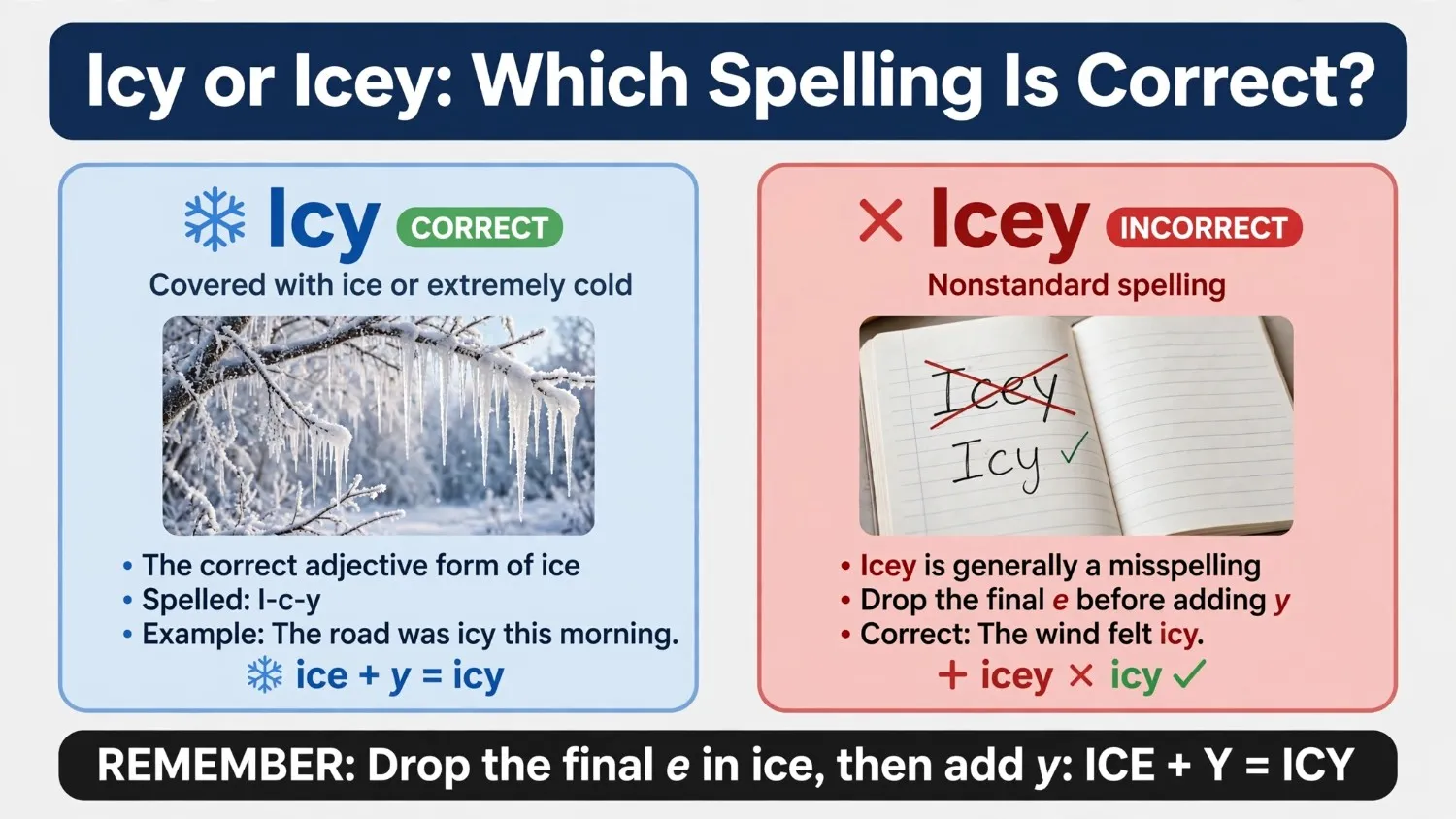
“Icy” is the correct spelling, meaning covered with ice, very cold, or emotionally unfriendly. “Icey” is incorrect in standard English and is mainly used only as a name or brand.
Have you ever typed “The road is icey” and then stopped because the word looked wrong? You are not alone. Many people search for icy or icey because the base word is ice. It may seem natural to keep the letter “e” when adding “y.” Yet English spelling does not always work that way.
The correct spelling is icy. It can describe a road covered with ice, very cold weather, or a person who acts cold and unfriendly. Icey is not the standard spelling of this adjective. It may appear as a name, brand, song title, or game title, but it should not replace icy in normal writing.
This guide gives you a quick answer and a full explanation. You will learn why the final “e” disappears, whether British and American English use different forms, and how to use the word in emails, news reports, social posts, and formal work. You will also see common mistakes, clear examples, and simple tips that make the correct spelling easy to remember.
Icy or Icey – Quick Answer
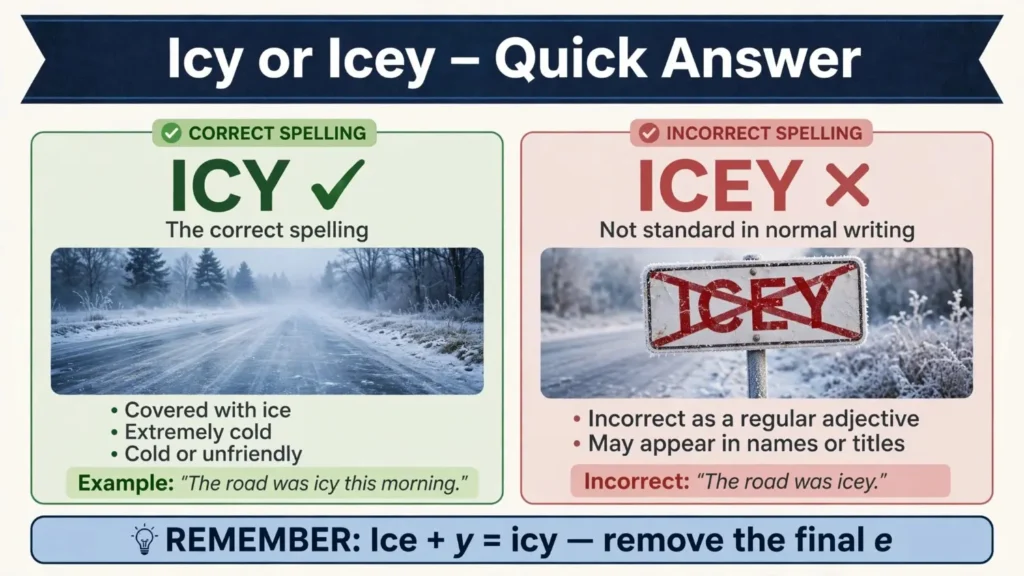
Icy is the correct spelling.
Use icy when something:
- Has ice on it
- Feels very cold
- Looks like ice
- Feels cold or unfriendly
Major British and American dictionaries list icy as the standard adjective. They define it as covered with ice, very cold, or emotionally cold.
Correct examples
- The road was icy this morning.
- An icy wind came through the window.
- She gave me an icy look.
- Be careful on the icy steps.
Incorrect example
- The road was icey this morning.
Corrected version
- The road was icy this morning.
A simple rule to remember is:
Ice + y = icy
The final “e” is removed before the “y” is added.
The Origin of Icy or Icey
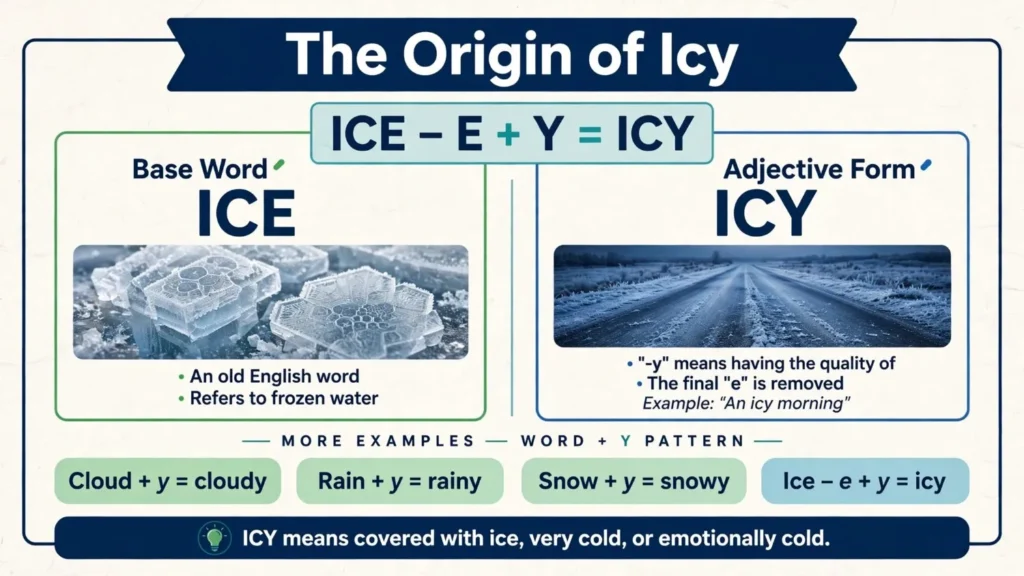
The word icy comes from the noun ice and the adjective ending -y. The suffix -y often means “full of,” “covered with,” or “having the quality of.”
For example:
- Cloud + y = cloudy
- Rain + y = rainy
- Snow + y = snowy
- Ice + y = icy
The word ice has very old roots. It comes from Old English and is related to similar words in German, Dutch, and other Germanic languages. The modern spelling of ice began to appear during the 1400s.
When English speakers formed the adjective, they did not keep the final “e.” They wrote icy, not icey. This shorter spelling became the normal form.
The confusion still exists because people can clearly see the word ice inside the adjective. They may think removing the “e” changes the word too much. However, the pronunciation stays the same:
- Icy: “eye-see”
- Icey: often read the same way, but not standard
The spelling icey may also appear as a personal name, stage name, product name, or title. In those cases, it is a proper noun or creative spelling rather than the normal adjective.
British English vs American English Spelling
British and American English have several spelling differences. For example, British writers often use colour, while American writers use color. British English uses centre, while American English uses center.
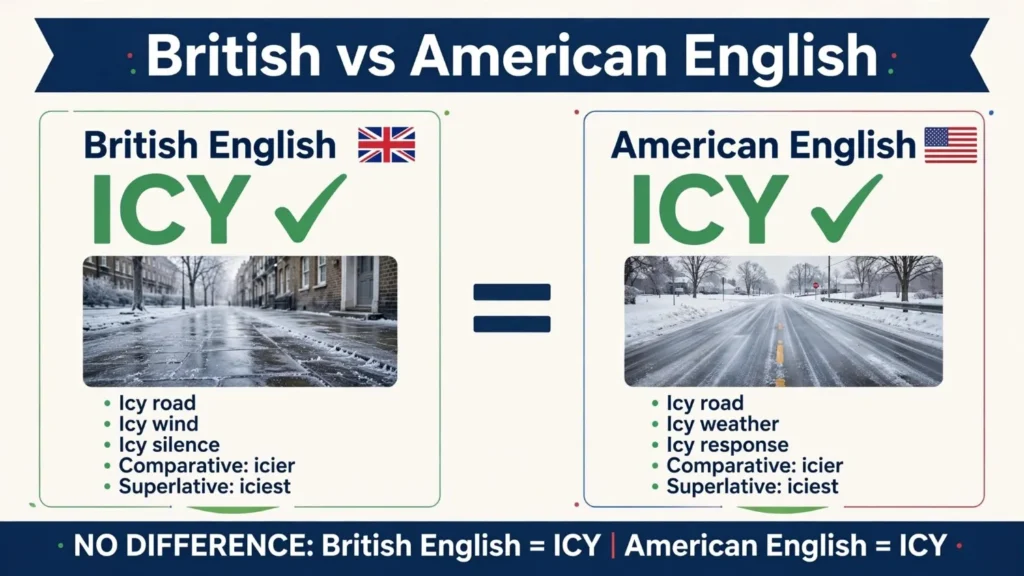
However, there is no British-American difference for icy. Both forms of English use the same spelling. Cambridge Dictionary lists icy in both its British and American sections. Merriam-Webster also uses icy as the standard American form.
| Meaning | British English | American English |
| Covered with ice | Icy | Icy |
| Very cold | Icy | Icy |
| Cold or unfriendly | Icy | Icy |
| Comparative form | Icier | Icier |
| Superlative form | Iciest | Iciest |
| Standard spelling of “icey” | Icy | Icy |
Unlike words such as colour/color or centre/center, icy stays the same in both systems.
This also applies to countries that often follow British English, such as:
- Australia
- New Zealand
- Canada
- India
- Pakistan
- South Africa
Writers in these countries should also use icy in normal English.
Which Spelling Should You Use?
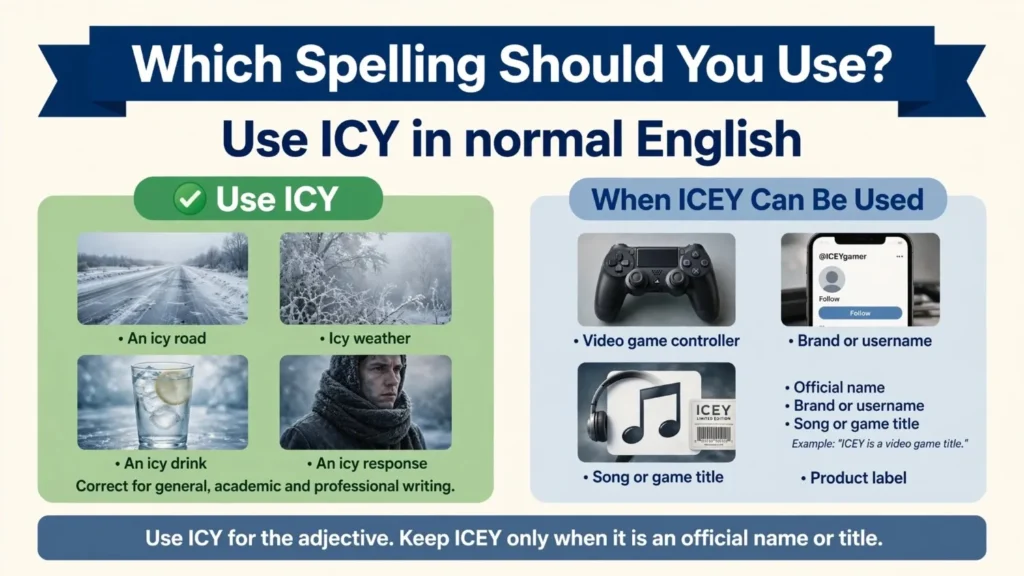
Use icy for all general, academic, professional, and creative writing.
For American readers
Write:
- Icy roads
- Icy weather
- Icy water
- Icy response
Do not use icey as the adjective.
For British and Commonwealth readers
Use the same spelling:
- Icy pavement
- Icy conditions
- Icy wind
- Icy silence
There is no need to change the word for a British audience.
For a global audience
Choose icy. It is clear, correct, and understood across English-speaking regions.
When can “Icey” be correct?
Icey may be correct when it is part of an official name or title. For example, ICEY is the name of a video game. It can also appear in artist names, usernames, songs, and brands.
In these cases, keep the official spelling:
- I started playing ICEY last night.
- Her online name is IceyRose.
- The artist uses Icey as a stage name.
Do not change a person’s name, brand, or official title. In every other case, use icy.
Common Mistakes with Icy or Icey
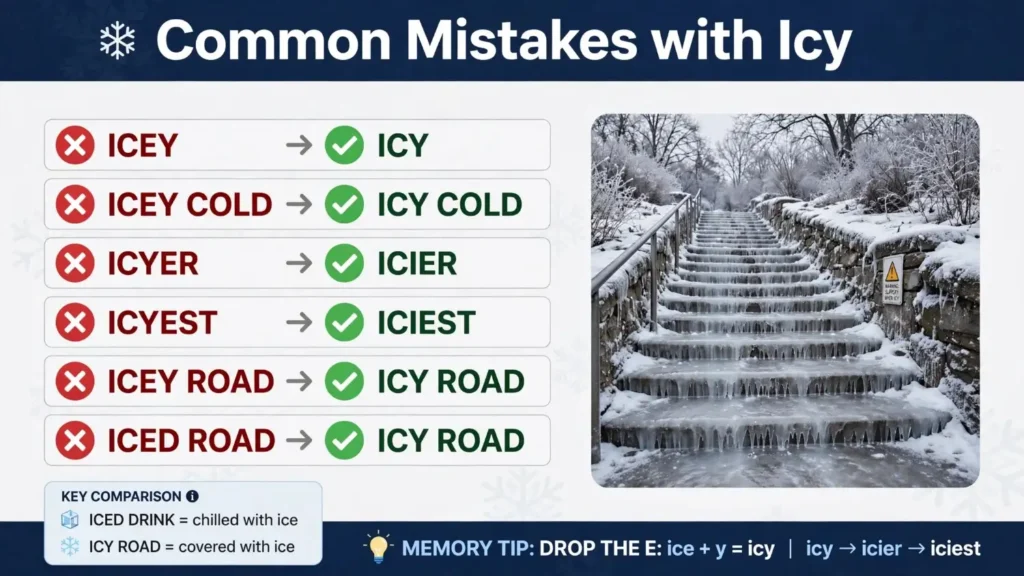
1. Keeping the final “e”
Incorrect:
- The path looks icey.
Correct:
- The path looks icy.
The final “e” in ice is removed before adding “y.”
2. Using “iced” instead of “icy”
Iced and icy are both correct words, but they do not always mean the same thing.
- Iced coffee means coffee served with ice or chilled.
- Icy coffee may mean coffee that has an unpleasant amount of ice in it.
Merriam-Webster defines iced as a liquid containing ice or cooled by ice or refrigeration.
3. Writing “icey cold”
Incorrect:
- It was icey cold outside.
Correct:
- It was icy cold outside.
The phrase icy cold means very cold.
4. Confusing “icier” with “icyer”
Incorrect:
- Today is icyer than yesterday.
Correct:
- Today is icier than yesterday.
The comparative form of icy is icier.
5. Confusing “iciest” with “icyest”
Incorrect:
- This was the icyest morning of the year.
Correct:
- This was the iciest morning of the year.
The superlative form is iciest.
6. Using “icy” only for real ice
Icy can also describe a person’s voice, look, or manner.
- She gave him an icy stare.
- His reply sounded icy.
- The meeting ended in icy silence.
Both Cambridge and Merriam-Webster include this unfriendly or emotionless meaning.
Icy or Icey in Everyday Examples
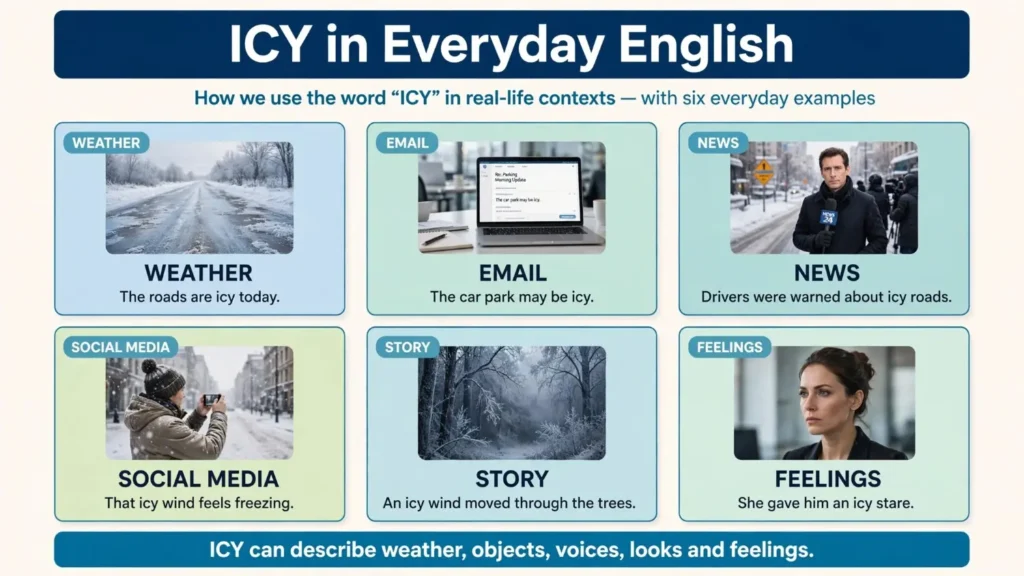
The word icy works in many types of writing. It can describe weather, objects, drinks, voices, and feelings.
In emails
The car park may be icy tomorrow morning, so please arrive with care.
Due to icy road conditions, the office will open at 10 a.m.
Her response to the proposal was polite but icy.
In news reports
Drivers were warned about icy roads after temperatures fell overnight.
Several schools closed because of snow and icy conditions.
The talks ended after an icy meeting between the two groups.
On social media
The roads are so icy today. Drive safely.
That icy wind made the walk feel much longer.
Her icy stare said everything.
In formal writing
Staff should avoid the north entrance during icy weather.
The report noted an icy relationship between the two leaders.
Salt was placed on the icy surface to lower the risk of falls.
In stories
An icy wind moved through the dark trees.
His smile faded when he heard her icy voice.
The lake had a smooth, icy surface.
In product descriptions
Enjoy an icy drink on a hot afternoon.
The cooling system creates an icy blast of air.
The pale blue finish gives the room an icy look.
Icy or Icey – Comparison Table
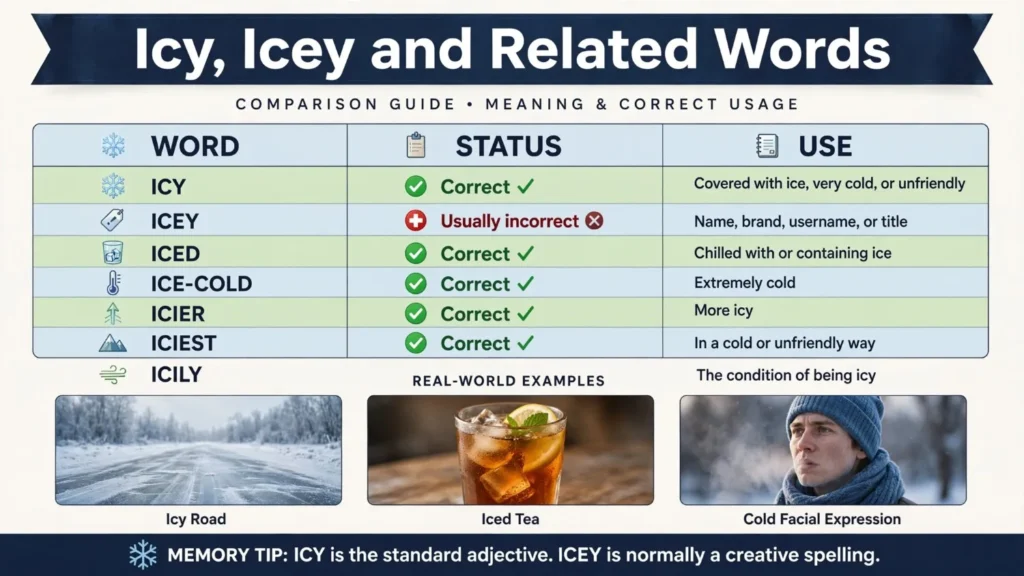
| Form | Is It Correct? | Meaning or Use | Example |
| Icy | Yes | Covered with ice, very cold, or unfriendly | The road is icy. |
| Icey | No, in normal writing | Creative spelling, name, brand, or title | ICEY is a game title. |
| Iced | Yes | Chilled with ice or containing ice | I ordered iced tea. |
| Ice-cold | Yes | Extremely cold | She drank ice-cold water. |
| Icier | Yes | More icy | The road is icier today. |
| Iciest | Yes | Most icy | January was the iciest month. |
| Icily | Yes | In a cold or unfriendly way | He replied icily. |
| Iciness | Yes | The state of being icy | The road’s iciness caused delays. |
Icy or Icey – Google Trends & Usage Data
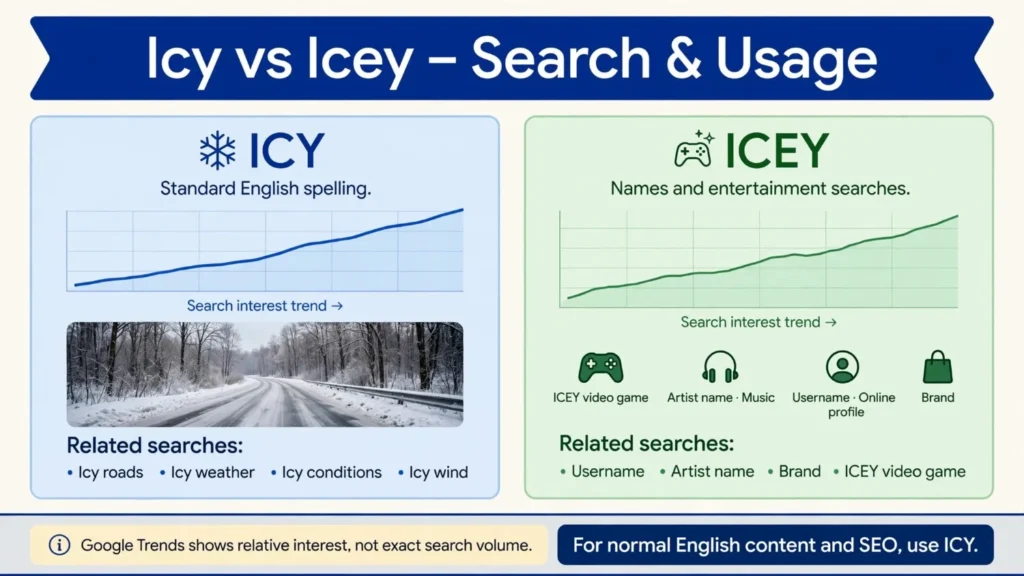
Search data supports the same practical advice: icy is the useful spelling for normal English content.
Google Trends measures relative search interest, not exact search volume. It normalizes results by time and location and places them on a scale from 0 to 100. A low-volume spelling can sometimes show zero, small spikes, or statistical noise.
When checking icy or icey, context matters:
- Icy is searched in relation to weather, roads, cold temperatures, attitudes, songs, and products.
- Icey may be searched as a name, username, music title, or the video game ICEY.
- Winter weather can raise searches for phrases such as “icy roads” and “icy conditions.”
- Entertainment releases can create brief searches for the title ICEY.
This means the comparison is not always a pure spelling test. Some people searching for icey may be looking for a title or name rather than the adjective.
Google also warns that Trends does not automatically combine spelling variations or misspellings. Each term must be compared on its own.
For content aimed at the United States, United Kingdom, Canada, Australia, or other English-speaking markets, icy is the correct keyword and spelling. It matches standard dictionary use in both British and American English.
Read Also: Whether or Wether: Which Spelling Is Correct?
Frequently Asked Questions
Is “icey” a real word?
Icey is not the standard spelling of the adjective. It may be used as a name, brand, username, song title, or game title.
Which is correct: icy or icey?
Icy is correct when you mean covered with ice, very cold, or emotionally cold.
Why is icy not spelled icey?
The word is formed by adding “y” to ice. The final “e” is removed, giving us icy.
Is icy an American spelling?
No. Icy is used in both American and British English.
What is the plural of icy?
Icy is an adjective, so it does not have a plural form. You can write “an icy road” or “two icy roads.”
What is the comparative form of icy?
The comparative form is icier.
Example:
- The road is icier today.
What is the superlative form of icy?
The superlative form is iciest.
Example:
- This is the iciest part of the road.
Can icy describe a person?
Yes. It can describe someone who seems cold, distant, or unfriendly.
Example:
- She gave me an icy response.
Conclusion
The answer to icy or icey is simple: use icy in normal English. It is the accepted spelling in American, British, Canadian, Australian, and other forms of English. It can describe a road covered with ice, very cold air, an unfriendly look, or a cold tone of voice.
The spelling icey feels logical because the base word is ice. However, the final “e” is removed when the adjective is formed. That gives us icy, along with the related forms icier, iciest, icily, and iciness.
Remember that iced is also a correct word, but it has a different use. An iced drink contains ice or has been chilled. An icy drink is extremely cold or has a lot of ice in it.
Only keep the spelling Icey when it is part of an official name, title, username, or brand. For emails, articles, schoolwork, reports, weather updates, and professional content, icy is always the safe choice.

Hi, I’m Shafqat Rehman. I write easy-to-follow guides about spelling differences, grammar, commonly confused words, comparison keywords, and British and American English variations. I enjoy breaking down confusing language topics and explaining them with clear examples. My aim is to help readers understand English differences and use the right words naturally and confidently.