“Analysis” is singular, while “analyses” is plural—use “analysis” for one examination and “analyses” for more than one.
If you have ever written a report, research paper, or business document, you may have wondered whether analyses or analysis is the correct word. The answer is simple: analysis is singular, while analyses is plural.
For example, you can write, “The analysis shows a clear trend” when talking about one detailed study. If you are talking about several separate studies, you should write, “The analyses show similar results.”
The confusion happens because analyses does not look like the usual English plural form. Most English nouns form their plural by adding -s or -es, such as report → reports or box → boxes. However, analysis comes from Greek and keeps an older plural form: analyses.
There is another source of confusion, too. Analyses can also be the third-person singular form of the British English verb analyse. For example, “She analyses the results.” In American English, this is written as “She analyzes the results.”
Understanding this difference helps you write correctly in academic, professional, and everyday English.
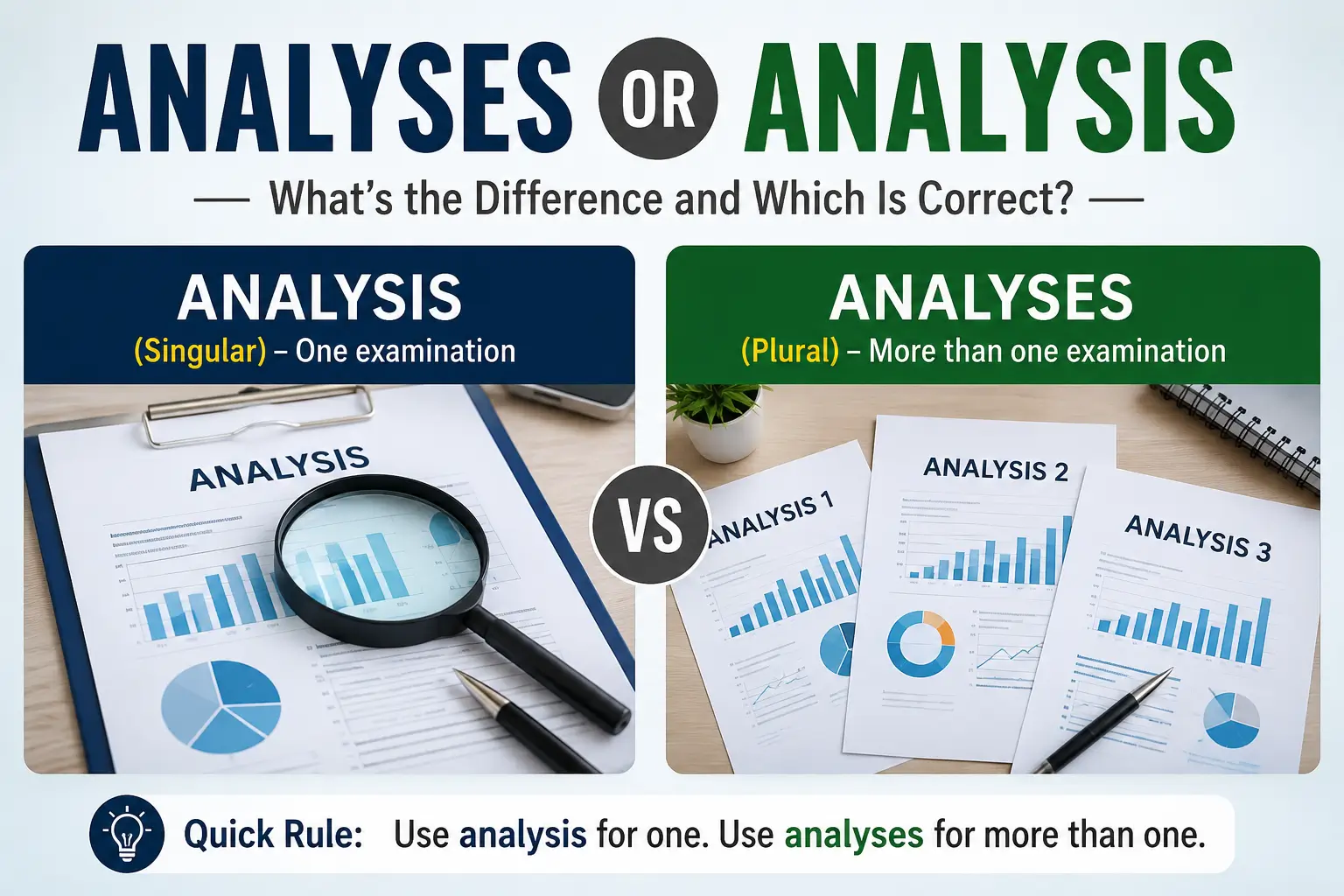
Analyses or Analysis – Quick Answer
Analysis is the singular form.
Analyses is the plural form.
Examples
- One analysis: The analysis of the data was detailed.
- Several analyses: The analyses of the data produced different results.
So:
One = analysis
More than one = analyses
The pronunciation also changes:
- analysis → uh-NAL-uh-sis
- analyses → uh-NAL-uh-seez
Oxford and Merriam-Webster both list analyses as the plural of analysis. (Oxford Learner’s Dictionaries)
Quick Comparison Table
| Word | Meaning | Example |
|---|---|---|
| analysis | One detailed examination | This analysis is useful. |
| analyses | More than one examination | These analyses are useful. |
| analyse | British English verb | They analyse the data. |
| analyze | American English verb | They analyze the data. |
| analyses | British English verb for he/she/it | She analyses the data. |
| analyzes | American English verb for he/she/it | She analyzes the data. |
The Origin of Analyses or Analysis
The word analysis has a long history. It comes from the Greek word analusis, meaning something like “breaking up” or “loosening.” The idea was to break a complex thing into smaller parts so it could be understood.
The word entered English through Medieval Latin and was first recorded in English in the late 16th century. Merriam-Webster gives 1580 as the first known use of analysis in English. (Merriam-Webster)
The Greek plural form became analyses in English.
This is why we do not normally write:
- ❌ analysises
- ❌ analysises
- ❌ analysi
Instead, the correct plural is:
- ✅ analyses
The same type of pattern appears in other words borrowed from Greek:
- analysis → analyses
- crisis → crises
- thesis → theses
- hypothesis → hypotheses
The spelling may look unusual, but analyses is the standard English plural of analysis.
British English vs American English Spelling

The noun analysis and its plural analyses are spelled the same in British and American English.
The main spelling difference appears with the related verb.
British English usually uses:
- analyse
- analyses
- analysed
- analysing
American English usually uses:
- analyze
- analyzes
- analyzed
- analyzing
Oxford lists analyse as the British English spelling and analyze as the North American English spelling.
British vs American English Table
| Form | British English | American English |
|---|---|---|
| Noun, singular | analysis | analysis |
| Noun, plural | analyses | analyses |
| Verb, base form | analyse | analyze |
| He/She/It | analyses | analyzes |
| Past tense | analysed | analyzed |
| -ing form | analysing | analyzing |
Examples
British English:
The researcher analyses the results carefully.
American English:
The researcher analyzes the results carefully.
But when using the noun:
The researcher completed an analysis.
And:
The researchers completed several analyses.
The noun spelling does not change between British and American English.
Which Spelling Should You Use?
Your choice depends on what you mean and which English style you are following.
Use “analysis” for one study
Use analysis when you are talking about one examination, report, or study.
Example:
The analysis of the survey was completed yesterday.
Use “analyses” for multiple studies
Use analyses when you mean two or more separate examinations or studies.
Example:
The analyses of the survey data produced different conclusions.
Travelling or Traveling:https://versuswords.com/analyses-or-analysis/ Which Spelling Should You Use?
For British English
Use analyse and related British forms when following British English.
For American English
Use analyze and related American forms.
Example:
The team analyzes customer feedback every month.
For Global English
If your audience is international, choose one English style and use it consistently. Do not switch between analyse and analyze in the same document unless there is a specific reason.
For academic or professional writing, consistency is more important than choosing one variety over the other.
Common Mistakes with Analyses or Analysis
Here are some common mistakes writers make.
Mistake 1: Using “analysis” for several studies
❌ The three analysis were completed.
✅ The three analyses were completed.
Because there are three studies, the plural analyses is needed.
Mistake 2: Adding “-es” to make the plural
❌ The researchers completed several analysises.
✅ The researchers completed several analyses.
Analysises is not the standard plural.
Mistake 3: Confusing “analyses” with “analyzes”
These words can look similar, but they have different uses.
Analyses can be:
- The plural noun of analysis
- The British English verb form of analyse
Analyzes is the American English verb form.
Compare:
The report contains several analyses.
She analyses the report.
She analyzes the report.
Mistake 4: Writing “an analysis” incorrectly
Because analysis begins with a vowel sound, use an.
✅ an analysis
❌ a analysis
For example:
We need an analysis of the results.
Mistake 5: Using the wrong verb agreement
Singular:
The analysis shows a problem.
Plural:
The analyses show a problem.
Do not write:
❌ The analyses shows a problem.
Use:
✅ The analyses show a problem.
Analyses or Analysis in Everyday Examples
Both words are common in academic, business, scientific, and everyday writing.
In Emails
Singular:
I have attached the analysis of this month’s sales.
Plural:
I have attached the analyses of the three sales regions.
In Academic Writing
Singular:
This analysis examines the effects of social media.
Plural:
These analyses examine the effects of social media.
In Business Writing
Singular:
Our analysis suggests that sales may increase.
Plural:
Our analyses suggest that sales may increase in several markets.
In News Writing
The newspaper published an analysis of the election results.
For several reports:
Experts offered different analyses of the election results.
On Social Media
You might see:
My analysis of the match is simple: the defense needs improvement.
Or:
Several analyses of the match reached the same conclusion.
In Formal Writing
The analysis provides useful information about customer behavior.
Or:
The analyses provide useful information about customer behavior across different regions.
Analyses or Analysis – Google Trends & Usage Data
People search for analysis and analyses for different reasons. The singular analysis is the more common everyday form because it is used when discussing one study, report, or examination.
The plural analyses is especially common in academic, scientific, statistical, and research writing, where several studies or methods may be discussed.
Search interest can also be affected by related terms such as:
- data analysis
- statistical analysis
- business analysis
- literary analysis
- financial analysis
- analysis meaning
- analyses meaning
- analysis plural
- plural of analysis
Google Trends uses a relative index rather than showing the exact number of searches. Therefore, search interest should be treated as an indicator of relative popularity, not as an exact count of searches.
For SEO, this means it is useful to target the main phrase analyses or analysis while naturally covering related searches such as plural of analysis, analysis plural, and analyses meaning.
Analysis vs Analyses: Simple Rule
Remember this easy rule:
Analysis = one
Analyses = two or more
Think of it like this:
One analysis
Two analyses
Three analyses
Many analyses
More Examples
| Singular | Plural |
|---|---|
| one analysis | two analyses |
| one analysis report | several analysis reports |
| one data analysis | multiple data analyses |
| one literary analysis | several literary analyses |
| one financial analysis | several financial analyses |
| one scientific analysis | several scientific analyses |
Notice that analysis changes to analyses, not analysises.
FAQs About Analyses or Analysis
1. Is “analyses” the plural of “analysis”?
Yes. Analyses is the correct plural of analysis.
Example:
One analysis
Several analyses
2. Is “analysises” correct?
No. Analysises is not the standard English plural.
The correct plural is analyses.
3. What is the difference between analysis and analyses?
Analysis means one detailed examination.
Analyses means two or more detailed examinations.
Example:
The analysis was accurate.
The analyses were accurate.
4. Is “analyses” British or American?
The noun analyses is used in both British and American English.
However, analyses can also be the British English verb form of analyse.
5. What is the American spelling of analyses?
For the plural noun, the spelling remains analyses in American English.
However, the American verb is analyze.
Example:
They analyze the data.
6. How do you pronounce analyses?
Analyses is generally pronounced approximately uh-NAL-uh-seez.
The singular analysis is approximately uh-NAL-uh-sis.
7. Which is correct: “the analysis show” or “the analysis shows”?
Use:
The analysis shows.
Because analysis is singular.
For the plural:
The analyses show.
Because analyses is plural.
Conclusion
Choosing between analyses or analysis is easy once you remember the basic rule. Analysis is singular, while analyses is plural. Use analysis when you mean one detailed examination, and use analyses when you mean more than one
For example, “The analysis shows a problem” refers to one examination. “The analyses show different results” refers to several examinations.
The spelling can seem confusing because analyses is not formed by simply adding -s or -es. It comes from the older Greek plural pattern. This is why analysis → analyses is correct, while analysises is incorrect.

I am experienced education expert and language writer dedicated to making English learning simple, clear, and practical. With a passion for grammar, vocabulary, and everyday English, they create easy-to-understand content that helps students and readers improve their language skills with confidence.