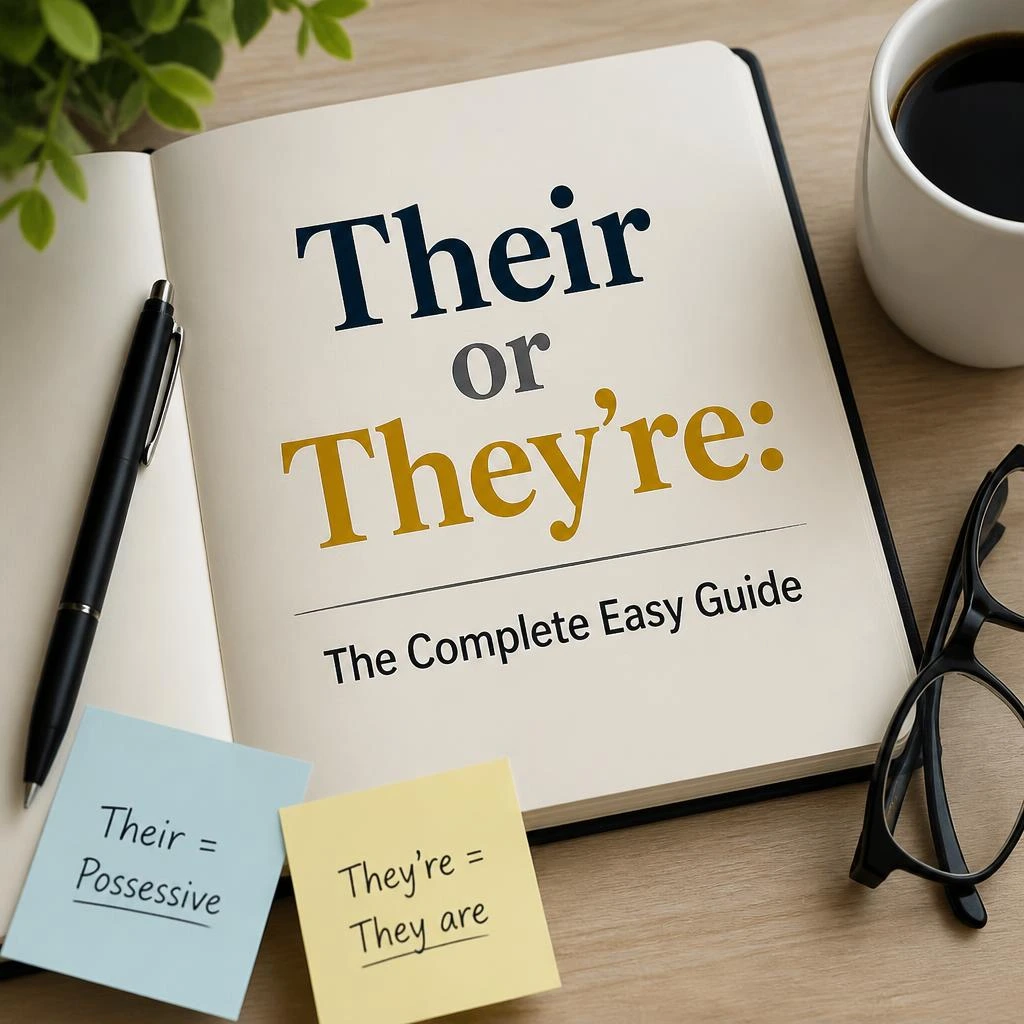
Their shows ownership, while they’re is a short form of they are. “Their car is new” means the car belongs to them, while “They’re happy” means they are happy.
A student once handed me an essay that contained the sentence, “Their going to present there project tomorrow.”
I immediately spotted two grammar mistakes. Yet the student was surprised because the words sounded exactly the same when spoken aloud.
That is why their and they’re confuse so many people. Even native English speakers mix them up. The problem is simple: these words sound alike but have different meanings and uses.
You may have seen corrections on social media, in school assignments, business emails, or online comments. A small mistake can make otherwise excellent writing look careless.
The good news is that learning the difference is much easier than most people think.
Once you understand a simple rule, you will rarely confuse these words again. This guide explains the meaning of each word, where they come from, how to use them correctly, common mistakes to avoid, and plenty of real-world examples.
Let’s clear up the confusion once and for all.
Their or They’re : Quick Answer
The difference is simple.
- Their = belongs to them
- They’re = they are
Examples
✅ Their house is beautiful.
✅ They’re moving next week.
Try this quick test:
Replace they’re with they are.
If the sentence still makes sense, use they’re.
Example:
“They’re excited.”
“They are excited.”
It works, so they’re is correct.
📚The Origin: Background of Their or They’re
Understanding where these words came from can make them easier to remember.
The Origin of Their
Their comes from Old Norse, a language spoken by Vikings many centuries ago.
It developed into a possessive word that shows ownership.
Examples:
- Their books
- Their home
- Their ideas
The Origin of They’re
They’re is a contraction.
A contraction combines two words into one shorter form.
They are → They’re
English uses contractions frequently because they make speech and informal writing smoother.
Examples:
- We are → We’re
- You are → You’re
- They are → They’re
The confusion exists because both words sound exactly the same when spoken.
Their or They’re Explained: Key Differences
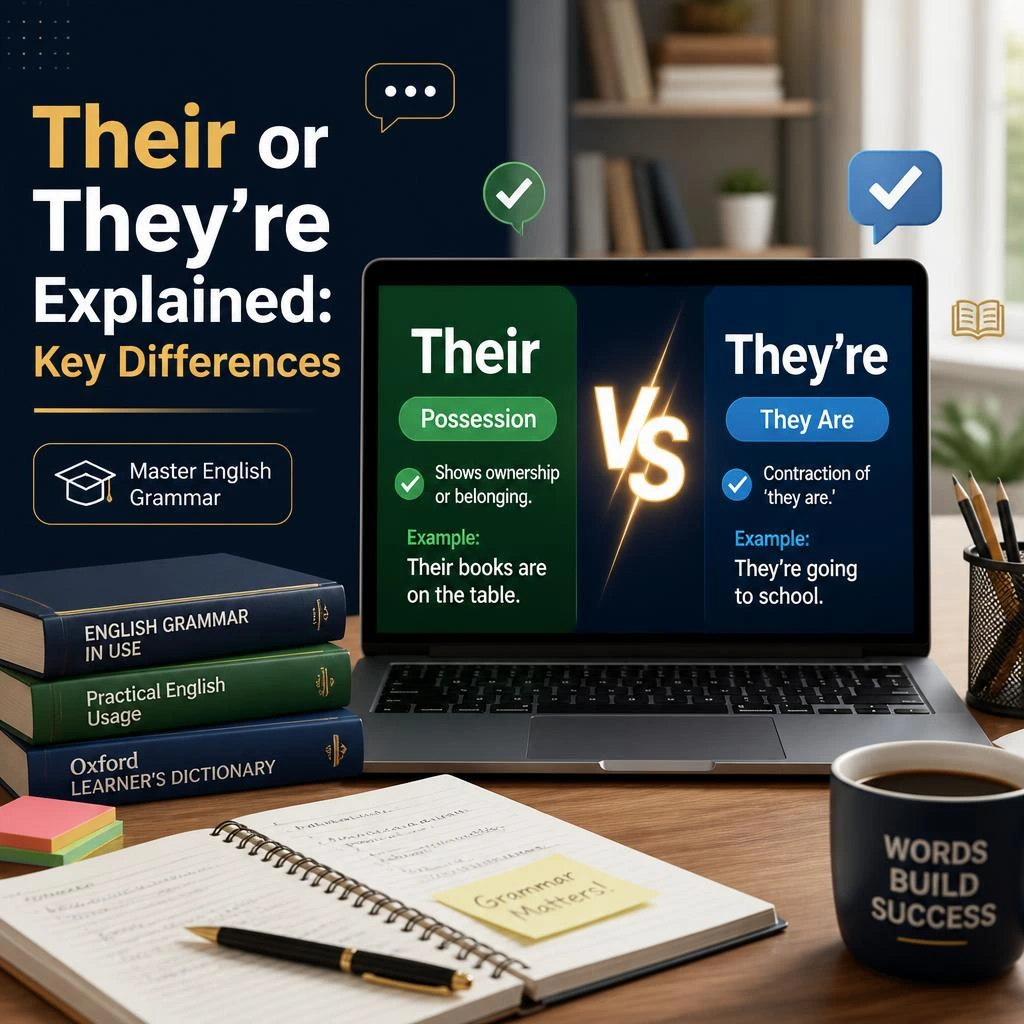
| Term | Meaning | When to Use | Region/Context |
| Their | Belonging to them | Ownership | All English varieties |
| They’re | Short for “they are” | Subject + verb | All English varieties |
Their
Use their when something belongs to a group of people.
Examples:
- Their dog is friendly.
- Their office is downtown.
- Their children attend school nearby.
They’re
Use they’re when you mean they are.
Examples:
- They’re studying for exams.
- They’re planning a vacation.
- They’re ready to begin.
Quick Memory Trick
If you can replace the word with they are, choose they’re.
If not, use their.
Which Version Should You Use?✅
The answer depends on what you want to say.
For Students
Use their when showing ownership.
Use they’re when meaning they are.
For Business Professionals
Correct usage matters in emails and reports.
Grammar mistakes can affect credibility.
For Content Writers
Double-check these words during editing.
Readers often notice mistakes involving common homophones.
For Social Media Users
Informal writing still benefits from correct grammar.
Using the right word helps your message look polished.
For Global English
The rule never changes.
Whether you use British English or American English, their and they’re have the same meanings.
⚠️Common Mistakes with Their or They’re
Mistake 1: Using Their Instead of They’re
❌ Their going to the meeting.
✅ They’re going to the meeting.
Why it happens: People hear the sound and choose the wrong spelling.
Mistake 2: Using They’re Instead of Their
❌ They’re car broke down.
✅ Their car broke down.
Why it happens: Writers forget that ownership requires their.
Mistake 3: Ignoring the “They Are” Test
❌ Their excited about the trip.
✅ They’re excited about the trip.
Why it happens: The sentence actually means “they are excited.”
Mistake 4: Mixing Multiple Homophones
❌ Their bringing there bags because they’re traveling.
✅ They’re bringing their bags because they’re traveling.
Why it happens: Words like their, there, and they’re sound alike.
Mistake 5: Skipping Proofreading
❌ Their happy with they’re results.
✅ They’re happy with their results.
Why it happens: Small grammar errors are easy to miss.
Their or They’re in Real-World Examples

Professional Email
“Please confirm whether their team can attend the meeting tomorrow.”
“They’re expected to arrive before 10 a.m.”
News Headline
“Residents Say Their Neighborhood Needs More Parking”
“Officials Confirm They’re Reviewing New Safety Measures”
Social Media Post
“They’re finally launching the product next week!”
“Love their new logo design.”
Formal Document or Report
“The company updated their policies this year.”
“They’re implementing new procedures across all departments.”
📉Their or They’re: Data, Trends & Usage
The keyword “their or they’re” remains one of the most searched English grammar topics.
Who Searches It?
- Students
- English learners
- Teachers
- Job seekers
- Business professionals
Search Intent
Primary intent:
Informational
People want to learn the correct usage.
Why Is It So Popular?
Several factors contribute:
- The words sound identical.
- They appear in everyday writing.
- Grammar checkers frequently flag mistakes.
- Exams often test this distinction.
Why It Matters Today
Emails, social media posts, reports, and online communication are everywhere.
A simple grammar mistake can affect how professional your writing appears.
Standalone Comparison Table
| Term/Variant | Meaning | Region/Context | Best Used When |
| Their | Belonging to them | Universal English | Showing ownership |
| They’re | They are | Universal English | Expressing action or state |
| There | Refers to a place or location | Universal English | Talking about location |
| Theirs | Possessive pronoun | Universal English | Ownership without a noun |
| They | Pronoun referring to people | Universal English | Referring to a group |
Frequently Asked Questions
Q: What does their mean?
A: Their is a possessive word. It shows that something belongs to a group of people.
Q: What does they’re mean?
A: They’re is a contraction of they are. It combines a pronoun and a verb into one shorter form.
Q: How do you use they’re correctly?
A: Use they’re whenever you can replace it with they are. If the sentence still works, the choice is correct.
Q: Their vs they’re : what’s the difference?
A: Their shows ownership, while they’re means they are. The meanings are completely different even though the words sound the same.
Q: Is they’re acceptable in formal writing?
A: Yes, but many formal documents prefer the full form they are. Business and academic writing sometimes avoid contractions.
Q: Which version is correct ; their or they’re?
A: Both are correct when used properly. The correct choice depends on the meaning of your sentence.
Q: Can their and they’re be used in the same sentence?
A: Yes. Example: “They’re proud of their accomplishments.” Both words are correct because they serve different purposes.
Conclusion
The difference between their and they’re is one of the most common grammar challenges in English. Fortunately, the rule is simple once you know what each word means.
Remember these key points:
- Their shows ownership.
- They’re means they are.
- Use the “they are” test whenever you’re unsure.
- Proofreading helps catch mistakes before you publish or submit your writing.
The more you practice, the easier the distinction becomes. Soon, choosing between these words will feel automatic.
Whenever you write an email, school paper, report, or social media post, take a quick second to check which word fits your meaning.
Now you know exactly how to use their and they’re correctly. Bookmark this guide so you never second-guess these words again, and share it with someone who’s still confused about them.
Read more:Dutches or Duchess: Complete Guide to the Correct Word

I am an English author, language explorer dedicated to analyzing words, phrases, and idioms. Through my writing, I uncover subtle language differences and help readers improve their communication skills. My content helps readers navigate English with clarity and confidence.