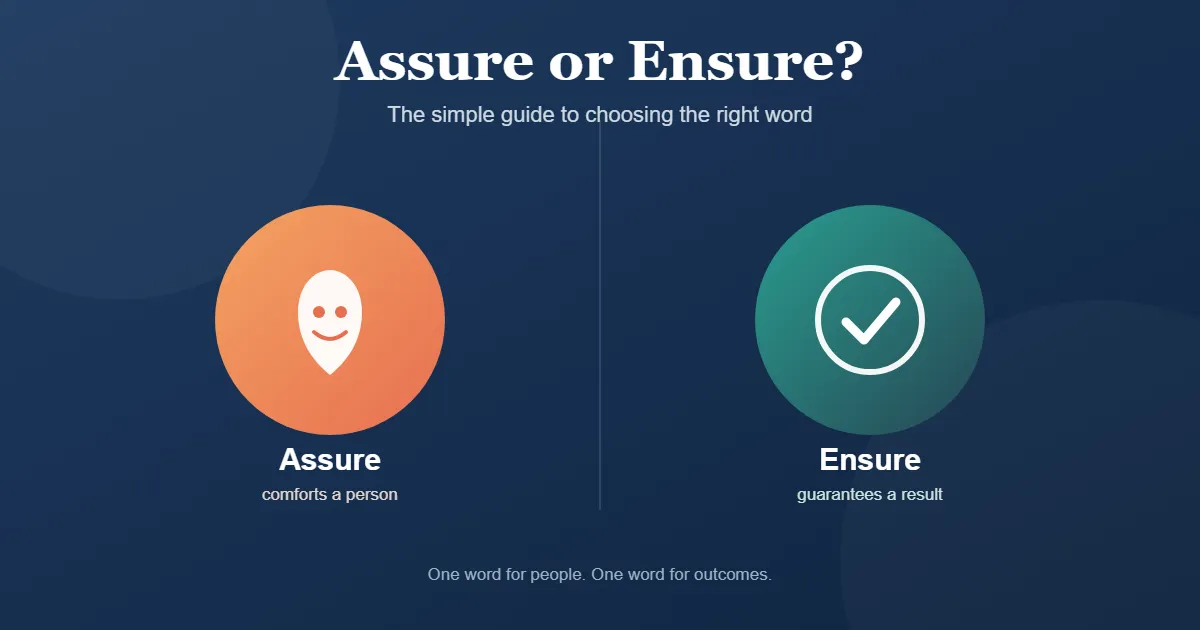
“Assure calms the heart, Ensure locks in the result one word for people, one word for outcomes.“
Have you ever paused mid-sentence, unsure whether to write “assure” or “ensure”? You are not alone. These two words look alike, sound alike, and even come from the same root. But they do not mean the same thing, and mixing them up can make your writing look careless especially in emails, reports, or resumes.
People search for “assure or ensure” because English gives us three close cousins assure, ensure, and insure and school rarely explains the difference clearly. The confusion is not about spelling. It is about meaning. Assure is about people. Ensure is about outcomes. Insure is about money.
This guide gives you a fast answer first, then walks through the history, the British-versus-American habits, the mistakes people make most often, and real examples from emails, news, and social media. By the end, you will pick the right word every time, without needing to check a dictionary.
Assure or Ensure Quick Answer
Here is the short version:
- Assure means to comfort someone or remove their doubt. It is used with a person. Example: I assure you that your order will arrive on time.
- Ensure means to make something certain or guarantee an outcome. Example: Please ensure the door is locked before you leave.
- Insure means to protect something financially with an insurance policy. Example: We insure our car every year.
A simple memory trick: assure a person, ensure a result, insure a possession.
The Origin of Assure and Ensure
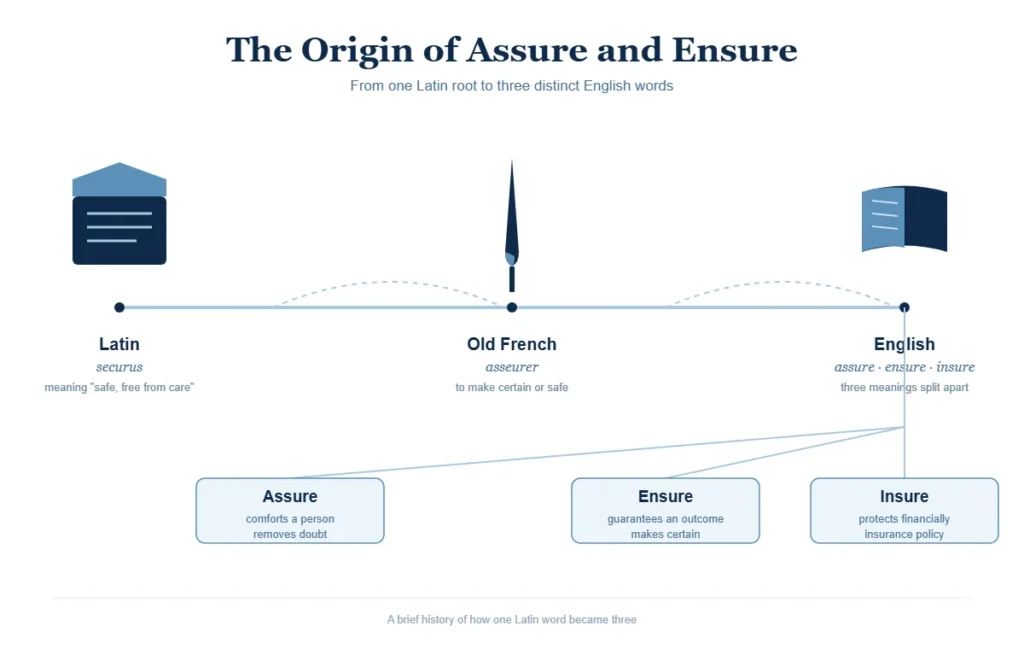
All three words trace back to the Latin word securus, meaning “safe” or “free from care.” From there, they passed into Old French as asseurer, which gave English both “assure” and, later, “ensure.”
For centuries, English writers used “ensure” and “insure” as interchangeable spellings of the same word. There was no fixed rule. It was only when insurance companies began using contracts and formal financial language that “insure” became tied specifically to money and policies, while “ensure” kept the broader meaning of making something certain.
“Assure” branched off earlier and kept a more personal meaning: giving someone confidence or removing their doubt. In British English, “assurance” also became the traditional word for life insurance, because a person’s death is a certainty, not a risk — a subtle historical distinction that still shows up in the names of British insurance companies today.
So the spelling differences are not accidents. They grew out of real efforts to separate financial, factual, and emotional meanings that once shared a single word.
British English vs American English Usage
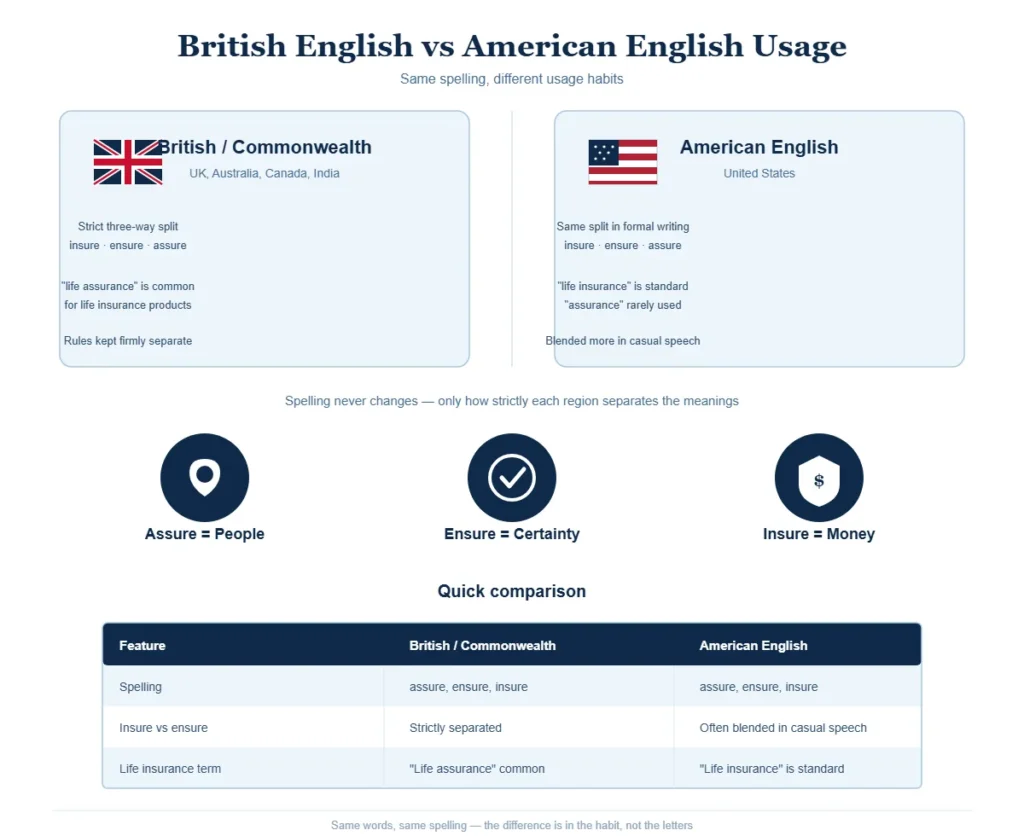
The good news: assure, ensure, and insure are spelled the same way in both British and American English. There is no colour/color-style spelling split here. The real difference is in how strictly each region separates the meanings.
British and Commonwealth English (UK, Australia, Canada, India) tend to keep the three words firmly separated. “Insure” is used strictly for financial and insurance matters, “ensure” for making something certain, and “assure” for reassuring people. British English also keeps the older habit of using “assurance” for life insurance products.
American English usually follows the same three-way split in formal and professional writing. But in everyday speech, some Americans use “insure” and “ensure” more loosely, treating them as near-interchangeable when talking about guaranteeing an outcome.
| Feature | British / Commonwealth English | American English |
|---|---|---|
| Spelling | Same: assure, ensure, insure | Same: assure, ensure, insure |
| Insure vs ensure | Strictly separated | Often separated, but sometimes blended in casual speech |
| “Assurance” for life insurance | Common (e.g., “life assurance”) | Rare (usually “life insurance”) |
| Formal writing rule | Insure = money, ensure = certainty, assure = people | Same rule, more strictly enforced in professional writing |
Which Spelling Should You Use?
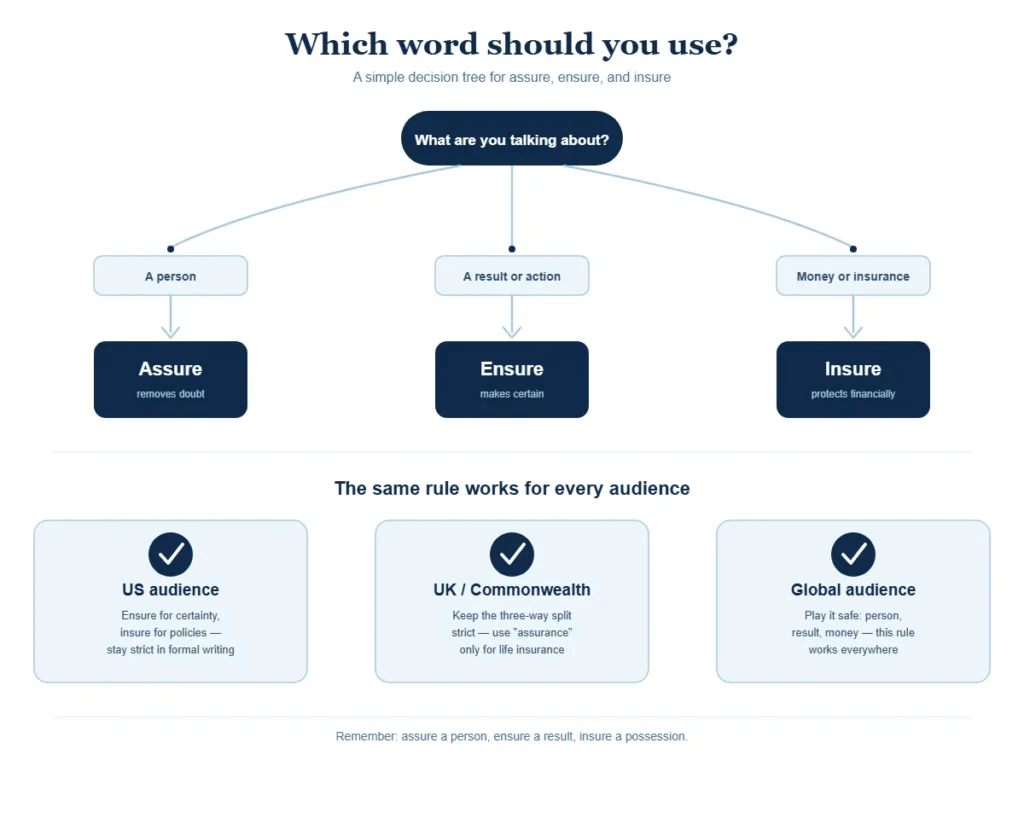
Since the spelling itself never changes, the real question is which word fits your audience and context.
- Writing for a US audience: Use “ensure” for certainty and outcomes, and “insure” for anything involving an insurance policy. In casual American speech, you may see the two blended, but professional writing keeps them separate.
- Writing for a UK, Australian, Canadian, or Indian audience: Keep the three-way distinction strict. Use “assurance” only if you are specifically discussing UK-style life insurance products.
- Writing for a global or mixed audience: Play it safe. Use “ensure” for certainty, “insure” for money, and “assure” for people. This rule works correctly everywhere, in every English-speaking market.
Read more 👉: Analyses or Analysis: What’s the Difference and Which Is Correct?
Common Mistakes with Assure or Ensure
Even confident writers slip up. Here are the most frequent errors:
- ❌ He insured me that the report was finished. ✅ He assured me that the report was finished. (You reassure a person — that’s “assure,” not “insure.”)
- ❌ Please insure the meeting starts on time. ✅ Please ensure the meeting starts on time. (This is about certainty, not money.)
- ❌ We will ensure your car against theft. ✅ We will insure your car against theft. (This is a financial policy, so it needs “insure.”)
- ❌ I want to assure success on this project. ✅ I want to ensure success on this project. (“Assure” only works with a person as the object, never with an abstract outcome like “success.”)
- ❌ Can you ensure me that this is correct? ✅ Can you assure me that this is correct? (You assure a person; you don’t “ensure” a person.)
Assure or Ensure in Everyday Examples
In emails: “I assure you we take this issue seriously and are working on a fix.” / “Please ensure all fields are completed before submitting the form.”
In news writing: “Officials assured residents that the water supply was safe.” / “The new policy aims to ensure equal access to healthcare.”
In formal or business writing: “The company insures all company vehicles against damage and theft.” / “Management will ensure that all safety protocols are followed.”
Assure or Ensure Google Trends & Usage Data
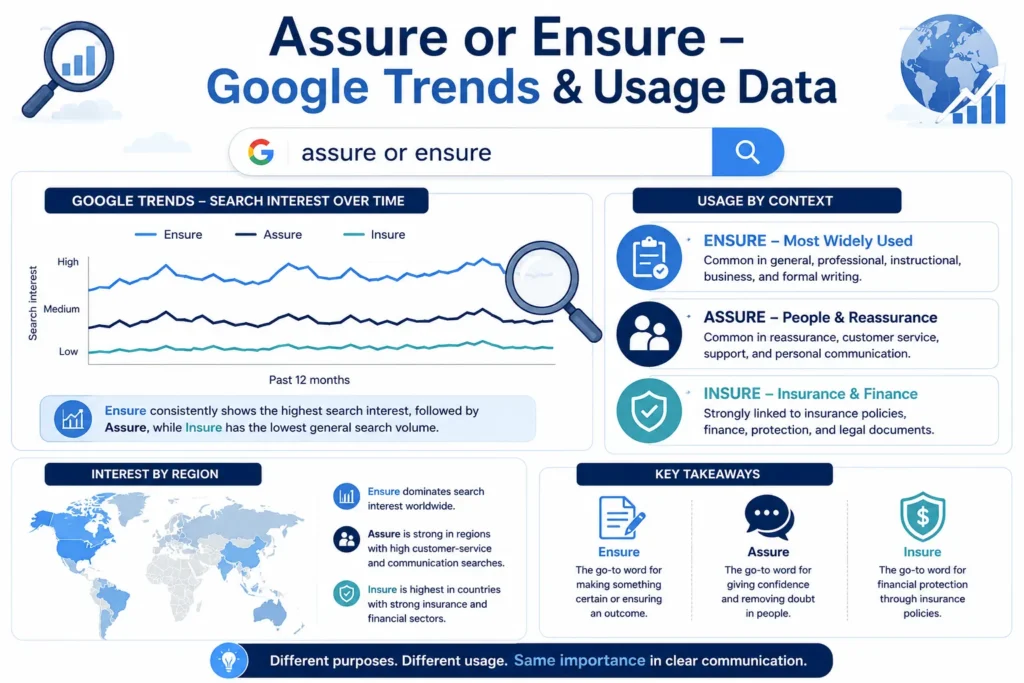
Search interest in this word group is driven mostly by learners and professionals checking their grammar before sending an email or finishing an assignment — the confusion shows up everywhere English is used, not just in one country.
General usage patterns show a few consistent trends:
- “Ensure” is searched and used far more often worldwide than “assure” or “insure,” since it fits general writing, instructions, business documents, and news.
- “Insure” spikes around insurance-related topics such as car insurance, health insurance, home insurance — particularly in the US and Canada, where insurance terminology is a everyday part of consumer life.
- “Assure” is searched less often on its own but appears constantly in customer service, PR, and reassurance-focused writing (“we assure you,” “rest assured”).
- Search interest for “assure vs ensure” and “ensure vs insure” comes heavily from students, non-native English speakers, and proofreading formal documents which explains why the confusion is meaning-based rather than tied to a single country or dialect.
Comparison Table: Assure vs Ensure vs Insure
| Word | Core Meaning | Used With | Example |
|---|---|---|---|
| Assure | Remove doubt, give confidence | A person | I assure you the flight is on time. |
| Ensure | Make certain, guarantee an outcome | An action or result | Ensure the file is saved before closing. |
| Insure | Provide financial protection | A possession or asset | We insure our home against fire damage. |
Frequently Asked Questions
1. What is the difference between assure and ensure?
Assure means to give confidence to someone. Ensure means to make certain that something happens.
2. Is it assure or ensure success?
Use ensure success because success is a result.
3. Can I say “I ensure you”?
In most cases, no. The correct phrase is I assure you.
4. Is there a spelling difference between British and American English?
No. Both countries use the same spellings.
5. Which word is used in business writing?
Both are used. Assure is for reassuring people, while ensure is for making sure tasks or processes are completed.
6. Is ensure more formal than assure?
Not necessarily. They simply have different meanings and are used in different situations.
7. How can I remember the difference?
Remember this rule:
Ensure = An event or result.
Assure = A person.
Conclusion
“Assure or ensure” is one of the most common word mix-ups in English, but the fix is simple once you separate the meanings instead of the spellings. Assure is about people ” you assure someone to calm their doubts”. Ensure is about outcomes ” you ensure that something happens correctly”. Insure is about money “you insure property or belongings with a financial policy”.
The spelling never changes between British and American English, so there is no regional trick to lean on. What changes is how strictly each audience expects the three words to be separated. UK, Commonwealth, and formal American writing keep a strict three-way split, while casual American speech sometimes blends “ensure” and “insure.”
The safest rule for any audience: assure a person, ensure a result, insure a possession. Keep that sentence in mind, and you will never second-guess yourself in an email, report, or conversation again. Small distinctions like this one are what separate polished, professional writing from writing that just gets the job done.