Afternoon is the time after 12 p.m. and before evening.
Evening is the later part of the day, usually before night.
Have you ever wondered whether to say “afternoon” or “evening” when talking about a certain time of day? You are not alone. Many English learners search for “afternoon or evening” because it can be hard to know exactly when afternoon ends and evening begins. The confusion is common in greetings, emails, meetings, appointments, and everyday conversations.
The good news is that both afternoon and evening are correct English words. They describe different parts of the day. Afternoon normally starts at noon and covers the period before evening. Evening comes later, usually after the late afternoon and before night.
There is no single worldwide clock time that separates the two. The meaning can change slightly depending on culture, season, and context. However, common English usage gives us a useful general guide. In this article, you will learn when to use afternoon and evening. You will also learn how British and American English use these words and how to use them correctly in speaking and writing.
Afternoon or Evening: Quick Answer
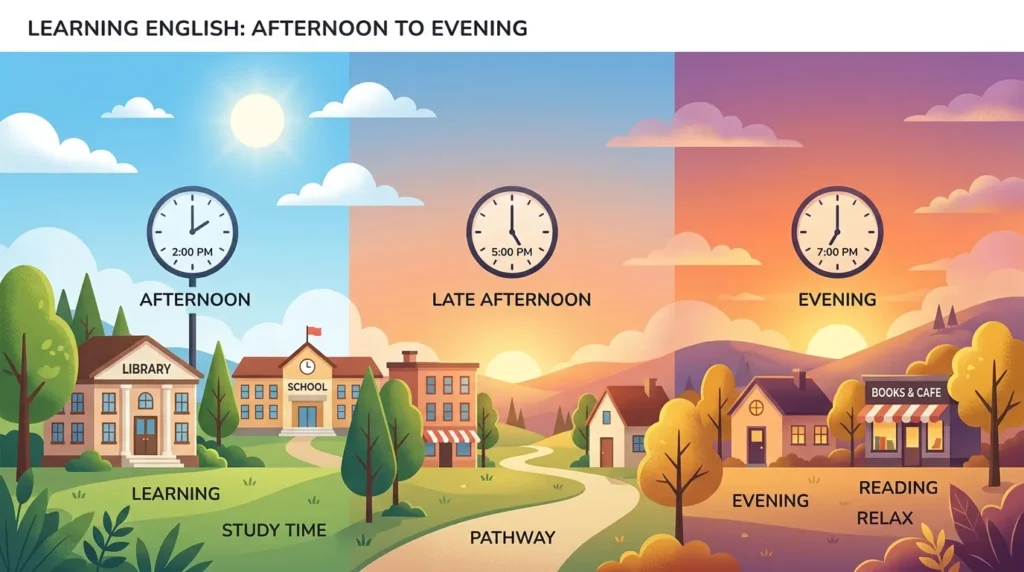
The simple answer is:
- Afternoon = the part of the day after noon and before evening.
- Evening = the later part of the day, usually before night.
For example:
- 2:00 p.m. → afternoon
- 4:00 p.m. → afternoon
- 5:00 p.m. → often late afternoon or evening, depending on context
- 7:00 p.m. → evening
- 9:00 p.m. → evening
Cambridge defines afternoon as the time between the middle of the day and evening. Merriam-Webster similarly defines it as the part of the day between noon and sunset.
There is no exact rule such as “5:00 p.m. is always evening.” Context matters.
For example:
I have an appointment tomorrow afternoon.
This usually suggests a time after noon and before the evening.
We are having dinner tomorrow evening.
This suggests a later time, often after the normal working day.
Quick Comparison
| Word | General Meaning | Common Time |
| Afternoon | After noon and before evening | About 12 p.m.–5/6 p.m. |
| Evening | Later part of the day before night | About 5/6 p.m.–9/10 p.m. |
| Night | Dark or late part of the day | Usually later than evening |
These time ranges are approximate, not strict grammatical rules.
The Origin of Afternoon or Evening
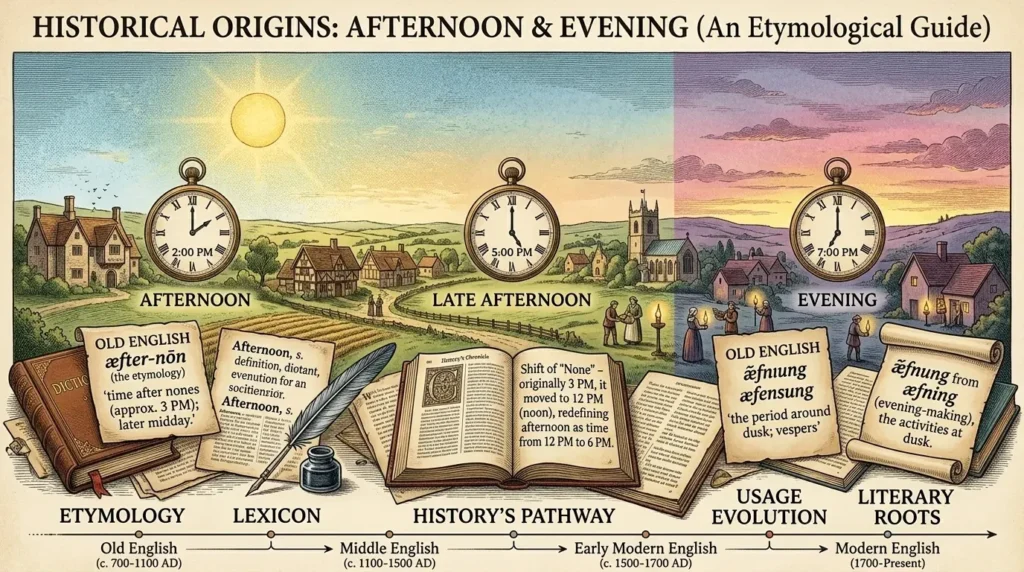
The two words have different histories.
Origin of “Afternoon”
The word afternoon is easy to understand because it literally refers to the time after noon.
It developed from Middle English forms such as afternone and after-non. Merriam-Webster records its first known use in the 13th century.
The word is made from:
after + noon = afternoon
Earlier English also used forms such as aftermete for the part of the day following the noon meal.
Over time, afternoon became the standard modern English form.
Origin of “Evening”
Evening has a much older history. It comes from Old English ǣfnung, related to ǣfen, meaning evening. Merriam-Webster records the noun’s first known use as before the 12th century.
Unlike afternoon, the word evening has a different origin. It comes from an older Germanic word that referred to the later part of the day.
So, the words have different origins:
| Word | Historical Source | Basic Idea |
| Afternoon | Middle English afternone | Time after noon |
| Evening | Old English ǣfen / ǣfnung | Later part of the day |
The spelling differences are therefore historical. They are not British-versus-American spelling differences.
British English vs American English Spelling
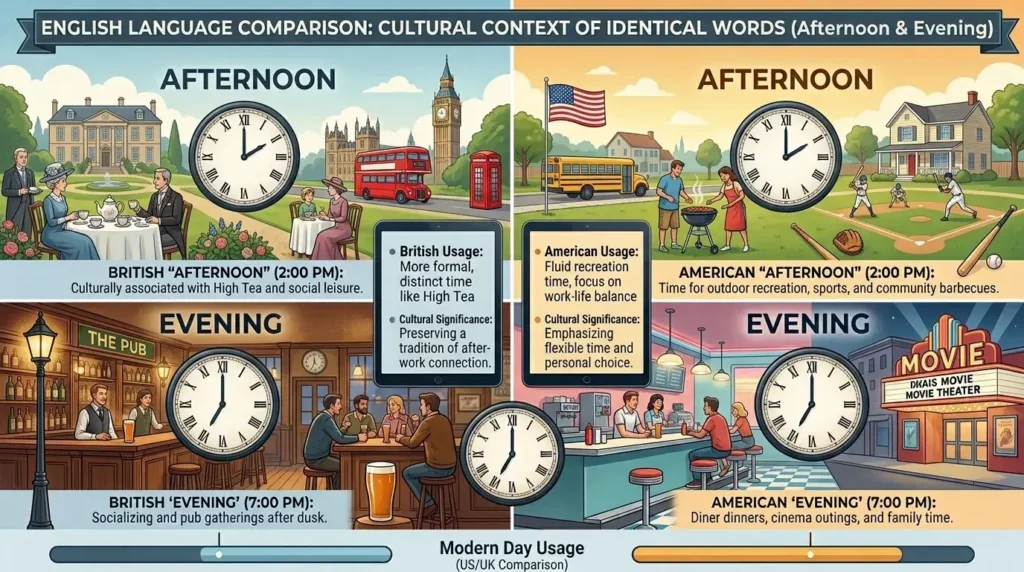
British and American English usually use the same spelling for both words.
British English:
- afternoon
- evening
American English:
- afternoon
- evening
There is no standard American spelling such as afternun or evenin.
Comparison Table
| Feature | British English | American English |
| Afternoon | afternoon | afternoon |
| Evening | evening | evening |
| Afternoon spelling | Same | Same |
| Evening spelling | Same | Same |
| Main difference | Usage and context may vary | Usage and context may vary |
Both varieties use expressions such as:
- Good afternoon.
- Good evening.
- This afternoon
- Tomorrow evening
- Yesterday afternoon
- Friday evening
The main difference is not spelling. It is when people use these words, especially in greetings and social situations.
For example, one person may call 5:00 p.m. “late afternoon,” while another may call it “early evening.”
That does not mean one person is using incorrect English.
Which Spelling Should You Use?
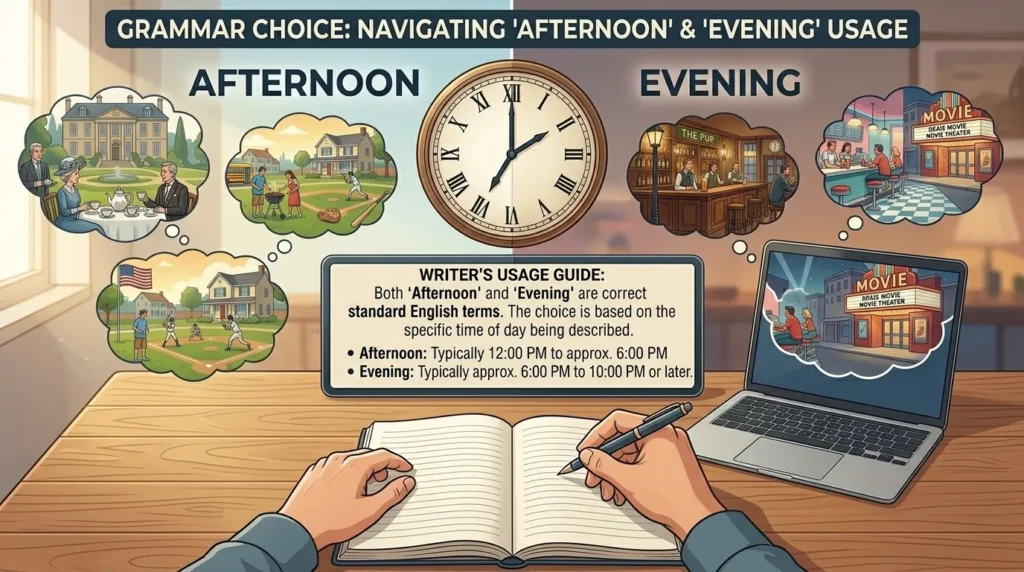
You do not need to choose between different spellings.
Use:
- afternoon when you mean the time after noon and before evening.
- evening when you mean the later part of the day before night.
For American English
Use afternoon for times such as:
The meeting starts this afternoon.
Use evening for later events:
The event starts this evening.
For British English
The same spellings are correct:
I will call you this afternoon.
We are going out this evening.
For Commonwealth English
Countries like Australia, Canada, and other English-speaking countries also use afternoon and evening.
For Global English
If you are writing for an international audience, avoid relying on a very exact boundary.
Instead of:
The meeting will be at 5:00 p.m. in the evening.
You can simply write:
The meeting will be at 5:00 p.m.
Using the exact time removes possible confusion.
Common Mistakes with Afternoon or Evening
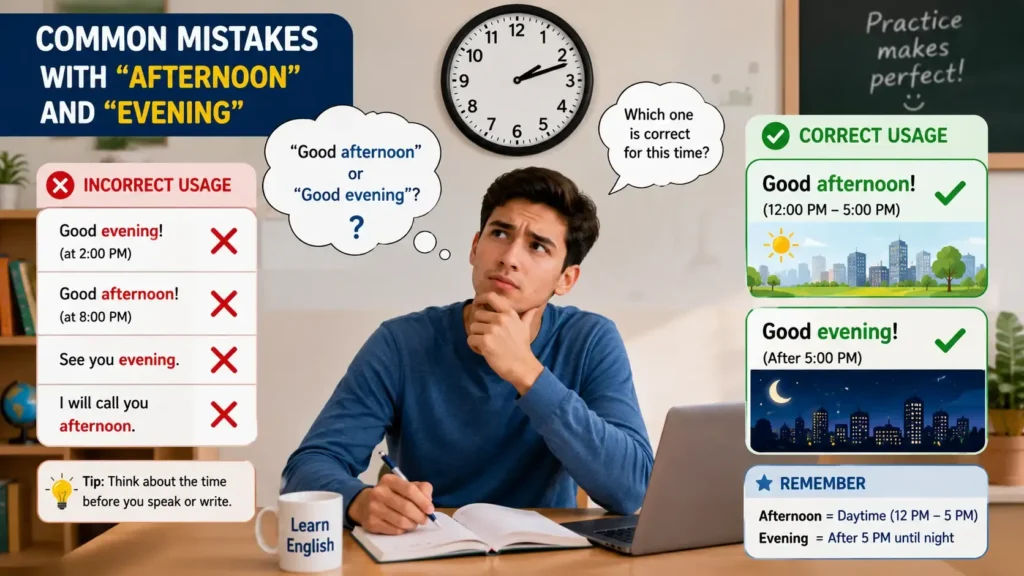
Here are some common mistakes English learners make.
1. Treating afternoon and evening as synonyms
They are related, but they do not normally mean exactly the same thing.
Incorrect idea:
Afternoon and evening always mean the same time.
Better:
Afternoon comes before evening.
2. Thinking there is one exact starting time for evening
There is no universal rule that says evening begins at exactly 5:00 p.m.
The boundary can depend on context, daylight, location, and personal usage.
3. Writing “good evening” in the afternoon
For example:
Good evening! — at 2:00 p.m.
In most situations, Good afternoon would be more natural.
4. Writing “good afternoon” very late at night
For example:
Good afternoon! — at 8:00 p.m.
Good evening would normally be better.
5. Confusing “in the afternoon” and “at afternoon”
The standard expression is:
I will see you in the afternoon.
Not:
I will see you at afternoon.
6. Using “at evening”
The normal expression is:
We went for a walk in the evening.
Not:
We went for a walk at evening.
However, we use at with specific times:
We met at 6 p.m.
Afternoon or Evening in Everyday Examples
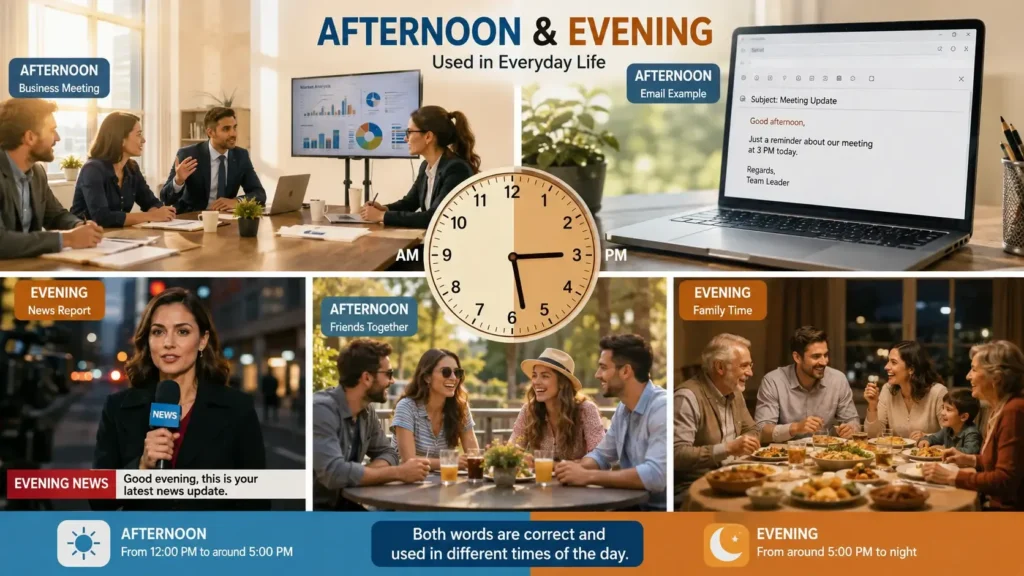
Knowing the difference is useful in many real-life situations.
In Emails
For an afternoon meeting:
Good afternoon, I am writing to confirm our meeting this afternoon.
For an evening event:
Good evening, I am writing to confirm your attendance at the event this evening.
In News Writing
News articles often use these words to describe when something happened:
The storm arrived on Tuesday afternoon.
Officials held a press conference Tuesday evening.
The exact time can be added when precision is important.
On Social Media
People commonly use both words in captions and posts:
Enjoying a quiet afternoon with friends.
Having a great evening with family.
In Formal Writing
Both words are perfectly acceptable in professional and academic writing:
The study was conducted in the afternoon.
The results were presented in the evening.
In Everyday Speech
You might say:
What are you doing this afternoon?
Or:
Are you free this evening?
These are natural and common expressions.
Afternoon or Evening – Google Trends & Usage Data
People search for “afternoon or evening” for several reasons. The search is usually about meaning, time ranges, greetings, and correct usage, rather than spelling.
Search interest can vary by country because daily schedules and cultural habits differ. For example, people in different regions may use evening at slightly different times.
It is also important to understand that Google Trends does not provide one permanent worldwide ranking for a phrase. Search interest changes over time, location, language, season, and user intent.
The strongest practical usage patterns are clear:
- Afternoon is strongly connected with time after noon.
- Evening is connected with the later part of the day.
- Good afternoon is a daytime greeting.
- Good evening is a later-day greeting.
- Exact times such as 3 p.m., 6 p.m., or 8 p.m. remove uncertainty.
That is why professional schedules often give an exact time instead of just saying “afternoon” or “evening.”
When talking to people in other countries, it is better to use the exact time because people may understand these time periods differently.
Afternoon vs Evening: Side-by-Side Comparison
| Point | Afternoon | Evening |
| Starts | After noon | Later in the day |
| Ends | Around late afternoon | Before or around night |
| Typical range | About 12 p.m.–5/6 p.m. | About 5/6 p.m.–9/10 p.m. |
| Greeting | Good afternoon | Good evening |
| Common phrase | In the afternoon | In the evening |
| Example | I work in the afternoon. | I work in the evening. |
| British spelling | Afternoon | Evening |
| American spelling | Afternoon | Evening |
| Spelling difference | None | None |
Remember that these time ranges are only general guides.
FAQs About Afternoon or Evening
1. Is 5 p.m. afternoon or evening?
It can be either. 5 p.m. is often described as late afternoon or early evening. Context and local usage matter.
2. Is 6 p.m. afternoon or evening?
6 p.m. is usually called evening, but this can change with the season and situation.
3. Is 12 p.m. afternoon?
Yes. 12 p.m. is noon, and the period immediately after noon is generally called the afternoon.
4. Should I say “Good afternoon” at 4 p.m.?
Yes. Good afternoon is natural at 4 p.m.
5. Should I say “Good evening” at 5 p.m.?
You can, especially if you consider 5 p.m. to be evening. In some situations, Good afternoon may still sound natural.
6. Are afternoon and evening spelled differently in British and American English?
No. Both varieties normally spell them afternoon and evening.
7. Which is correct: “in the afternoon” or “at afternoon”?
The standard expression is “in the afternoon.”
For example:
I will finish the work in the afternoon.
The same pattern applies to evening:
I will finish the work in the evening.
Conclusion
The difference between afternoon and evening is mainly about the time of day, not spelling. Afternoon refers to the period after noon and before evening. Evening refers to the later part of the day before night. The exact boundary is flexible, so there is no universal clock time when afternoon suddenly becomes evening.
Both afternoon and evening are spelled the same way in British and American English. This means you do not need to worry about choosing a British or American spelling.
For everyday communication, use afternoon for earlier times after noon and evening for later times. Use Good afternoon and Good evening in the same general way. When the exact time matters, especially in professional emails, meetings, travel plans, or international communication, simply include the clock time.
The key rule is simple: afternoon comes after noon; evening comes later. Once you understand this, choosing the right word becomes easy.
See also: Past or Passed: What’s The Difference?

Ali Hassan is an English language writer and educator who specializes in grammar, spelling, and commonly confused words. He creates simple and easy-to-understand content to help students, writers, and English learners improve their English with confidence.