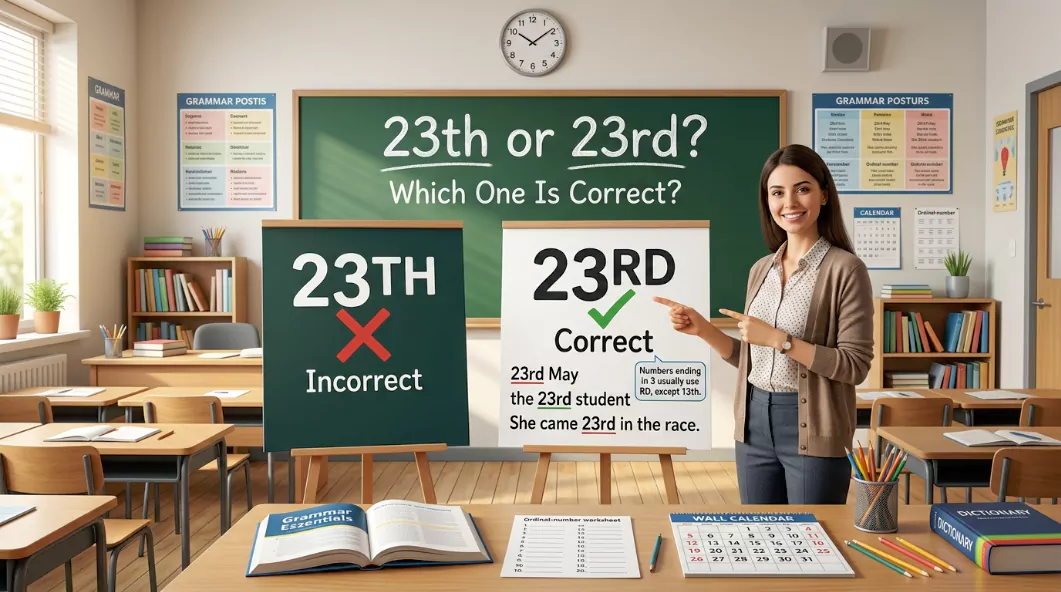
Have you ever wondered whether you should write 23th or 23rd?
Many people search for this because English ordinal numbers can be confusing. While numbers like 20th, 21st, 22nd, and 24th follow different endings, it is easy to guess the wrong one for 23.
This mistake appears in emails, birthday invitations, school assignments, and social media posts. Even native English speakers sometimes type the wrong ending when writing dates quickly. If you want your writing to look professional and correct, knowing the proper ordinal form matters.
This guide explains the difference between 23th and 23rd in simple English. You will learn which spelling is correct, why the mistake happens. How British and American English treat ordinal numbers, and where you should use each form. By the end, you will never confuse these two spellings again.
23th or 23rd Quick Answer
The correct spelling is 23rd.
23th is incorrect and should not be used in standard English.
Correct Examples
- My birthday is on the 23rd of June.
- The meeting starts on the 23rd.
- She finished in 23rd place.
Incorrect Examples
- ❌ My birthday is on the 23th of June.
- ❌ The event is scheduled for the 23th.
Quick Rule
Numbers ending in 3 usually use rd, except 13th
Examples:
| Number | Correct Form |
| 3 | 3rd |
| 13 | 13th |
| 23 | 23rd |
| 33 | 33rd |
| 43 | 43rd |
The Origin of 23th or 23rd
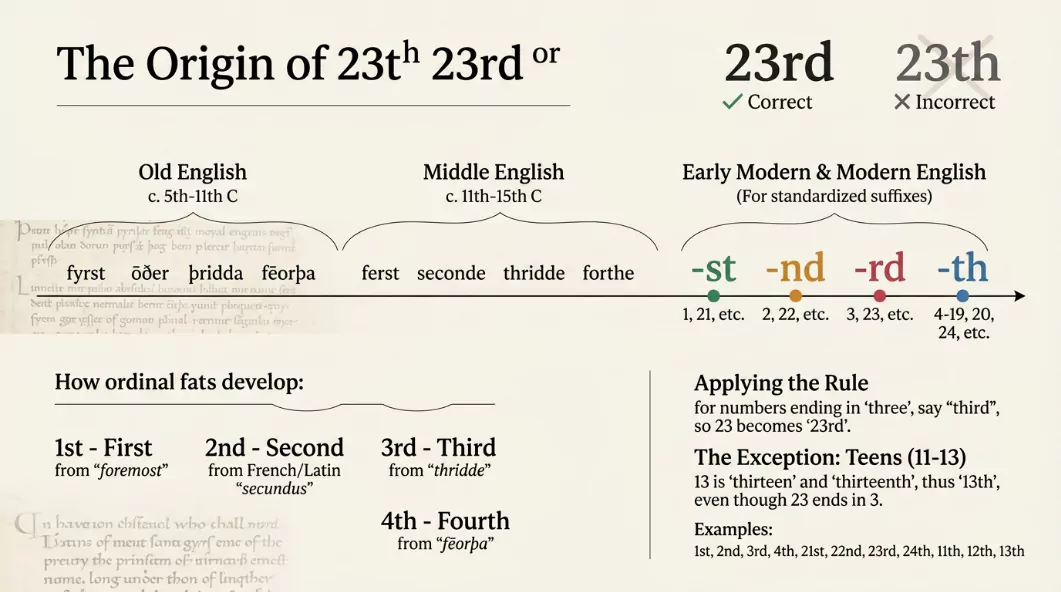
Ordinal numbers show position or order rather than quantity.
Examples include:
- first
- second
- third
- fourth
The endings st, nd, rd, and th come from Old English. Over time, English developed simple rules based on the last digit of most numbers.
The word third became shortened as 3rd. Because 23 ends in 3, it follows the same pattern and becomes 23rd.
People often write 23th because many numbers end with th, such as:
- 4th
- 5th
- 10th
- 20th
- 24th
This causes confusion, but the official English rule remains the same.
British English vs American English Spelling
There is no difference between British English and American English for 23rd.
Both countries use the same ordinal ending.
British English Examples
- The meeting is on 23rd September.
- She arrived on the 23rd.
American English Examples
- The meeting is on September 23rd.
- He graduated on the 23rd.
The date format changes, but the ordinal ending does not.
Comparison Table
| Feature | British English | American English |
| Correct spelling | 23rd | 23rd |
| Incorrect spelling | 23th | 23th |
| Example date | 23rd September | September 23rd |
| Official usage | 23rd | 23rd |
Which Spelling Should You Use?
Always use 23rd.
If Your Audience Is in the United States
Use 23rd.
Example:
- September 23rd, 2026
If Your Audience Is in the United Kingdom
Use 23rd.
Example:
- 23rd September 2026
If Your Audience Is Global
Use 23rd because it is accepted worldwide.
Avoid 23th in every situation.
Common Mistakes with 23th or 23rd
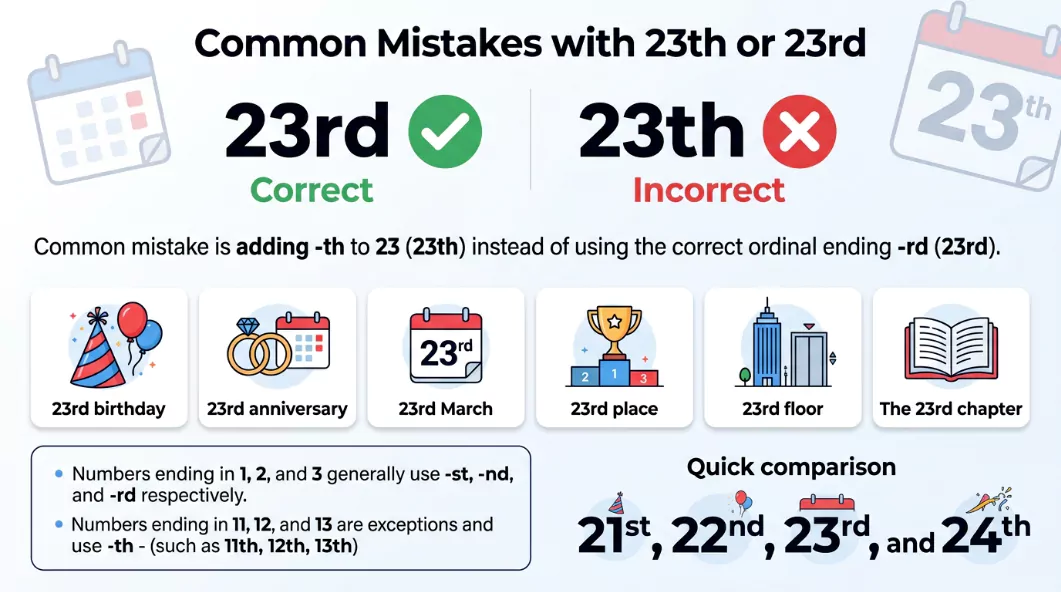
Many writers make these mistakes.
| Incorrect | Correct |
| 23th | 23rd |
| 33th | 33rd |
| 43th | 43rd |
| 53th | 53rd |
Why Does This Happen?
People remember that many numbers use th, so they apply the same ending to every number.
The easiest way to remember the rule is:
- 1 → st
- 2 → nd
- 3 → rd
- Except 11, 12, and 13, which all use th.
Read Also: Rabi or Rabbi: Which Spelling Is Correct?
23th or 23rd in Everyday Examples
Emails
Correct:
Our meeting is scheduled for the 23rd.
News
Correct:
The conference opens on the 23rd of October.
Social Media
Correct:
Can’t wait for my birthday on the 23rd!
Business Writing
Correct:
Payment is due on the 23rd.
Invitations
Correct:
Join us on the 23rd for dinner.
23th or 23rd Google Trends & Usage Data
Search data shows that many users type 23th into Google because they are unsure which form is correct.
Most searches come from people wanting to check grammar before writing:
- emails
- school work
- resumes
- invitations
- reports
Google and grammar tools recommend 23rd as the correct spelling.
Usage by Country
| Country | Common Usage |
| United States | 23rd |
| United Kingdom | 23rd |
| Canada | 23rd |
| Australia | 23rd |
| New Zealand | 23rd |
| India | 23rd |
The incorrect spelling 23th mainly appears in search queries and typing mistakes.
Comparison Table
| Variation | Correct? | Usage |
| 23rd | ✅ Yes | Standard English |
| 23th | ❌ No | Grammar mistake |
| Twenty-third | ✅ Yes | Formal writing |
| Twenty-third (written) | ✅ Yes | Books and official documents |
Frequently Asked Questions
Is 23th correct?
No. The correct form is 23rd.
Why is it 23rd instead of 23th?
Because numbers ending in 3 usually take the rd ending, except 13th.
Is 23rd correct in British English?
Yes. British English uses 23rd.
Is 23rd correct in American English?
Yes. American English also uses 23rd.
Can I write twenty-third instead of 23rd?
Yes. Both are correct. The written word is often used in formal writing.
Why do people search for 23th?
People often assume every ordinal number ends in th, leading to this common mistake.
Is 23th accepted anywhere?
No. It is not accepted in standard English.
Conclusion
The answer is simple: 23rd is always the correct spelling, while 23th is incorrect. The rule comes from English ordinal numbers, where numbers ending in 3 normally use the rd ending. The only exception is 13th, following the special rule for 11-13.
Both British and American English use 23rd, though date formats differ. In the UK, you may see 23rd September, while in the US you are more likely to see September 23rd. The ordinal ending stays the same in both styles.
For clear, professional writing, always use 23rd in formal and social contexts. Use this simple pattern: 1st, 2nd, 3rd, and th for most other numbers. The exceptions are 11th, 12th, and 13th. Following this rule will help you avoid one of the most common English spelling mistakes.

I’m a dedicated English language writer and educator focused on making learning simple, practical, and engaging. With a strong interest in grammar, vocabulary, and everyday communication, I create clear and useful content that helps learners build their English skills and communicate with confidence.