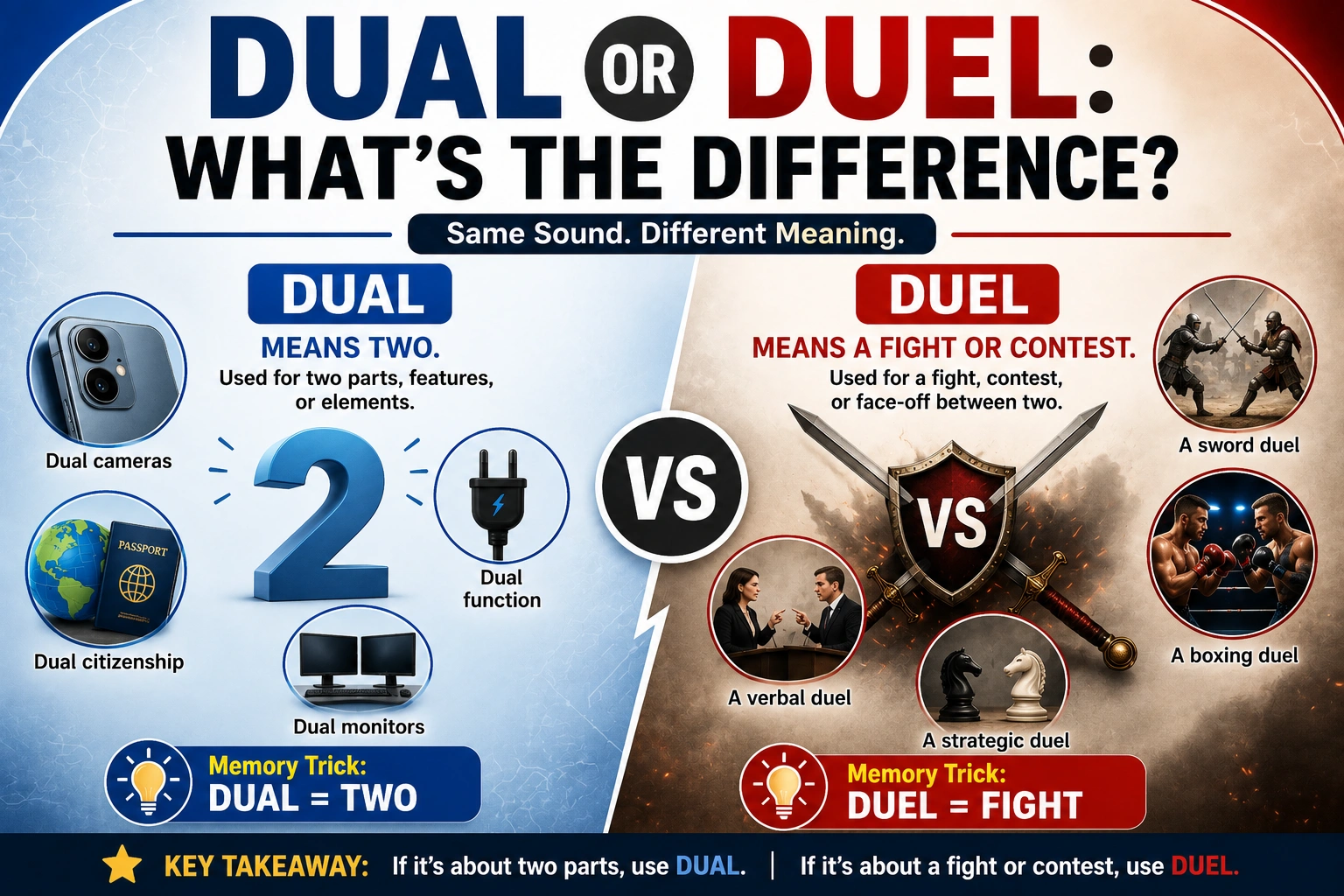
Have you ever typed “dual or duel” and stopped because you were not sure which word was correct? These two words are easy to confuse because they sound alike, but they have completely different meanings. One is about two parts or elements, while the other is about a fight or contest between opponents.
Dual usually means “having two” or “consisting of two parts.” For example, “The phone has dual cameras.” Duel means a fight or contest between two people or sides. For example, “The two warriors fought a duel.”
People often search for “dual or duel” when writing emails, essays, articles, schoolwork, product descriptions, or social media posts. The confusion is especially common because both words are pronounced similarly. They are homophones, which means they sound alike but have different meanings and spellings.
This guide explains the difference between dual and duel in simple English. You will learn their meanings, origins, British and American spelling differences, common mistakes, everyday examples, and easy tricks to remember which word to use.
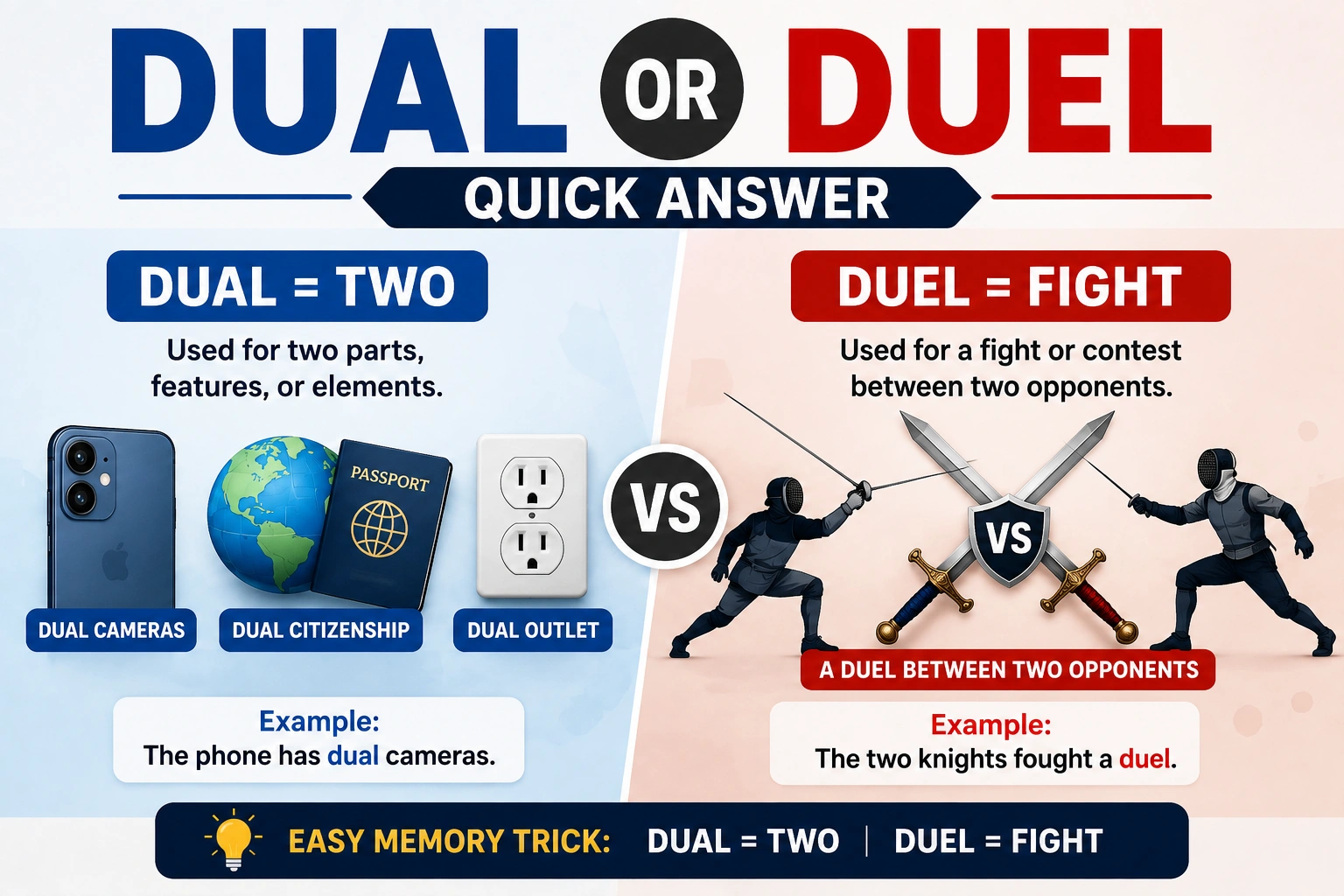
The quick answer is simple:
- Dual = involving two parts, people, features, or elements.
- Duel = a fight or contest between two opponents.
Examples of “Dual”
The car has dual airbags.
She has dual citizenship.
This phone has a dual-camera system.
In each example, dual describes something involving two parts or aspects. Merriam-Webster defines dual as relating to or consisting of two parts or elements.
Examples of “Duel”
The two knights fought a duel.
The two teams had a duel for first place.
The candidates engaged in a verbal duel.
A duel can mean a traditional fight between two people, especially one involving weapons. It can also describe a contest or conflict between two opponents.
Easy Memory Trick
Think:
DUAL = TWO
DUEL = FIGHT
If you can replace the word with double or two-part, use dual.
If you can replace it with fight, showdown, or contest, use duel.
| Word | Meaning | Example |
|---|---|---|
| Dual | Having two parts or elements | The laptop has dual screens. |
| Duel | A fight or contest between two opponents | The two fighters had a duel. |
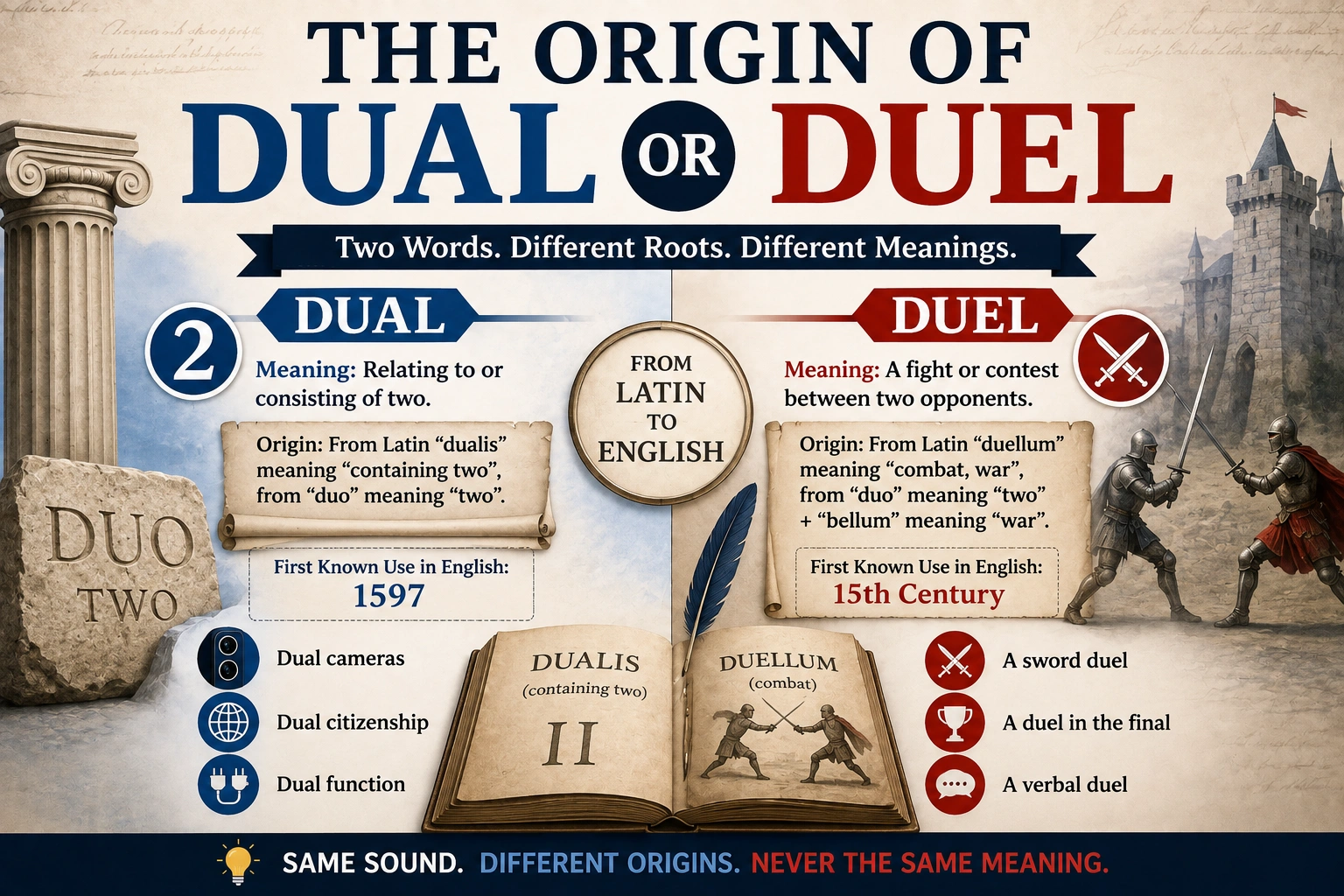
Although dual and duel sound alike, they come from different historical paths.
Origin of “Dual”
Dual comes from Latin dualis, meaning “containing two” or relating to two. It comes from the Latin word duo, meaning “two.” Merriam-Webster gives the first known English use of dual as an adjective as 1597.
The word later developed the broad meaning we use today: something that has two parts, sides, functions, or features.
For example:
- dual citizenship
- dual purpose
- dual role
- dual camera
- dual identity
The basic idea remains two.
Origin of “Duel”
The history of duel is more surprising.
Duel comes from Medieval Latin duellum, meaning combat. Merriam-Webster traces it to an older Latin word connected with war and gives the first known English use as the 15th century.
Over time, duel became associated with a fight between two people. The spelling also looked as if it were connected to Latin duo, meaning “two,” which helped support its association with two-person combat.
So the words look and sound similar, but their meanings developed differently.
Why Are They So Easy to Confuse?
The main reason is pronunciation.
Dual and duel are commonly pronounced alike, making them homophones. Their spelling is different, but when you hear them in conversation, context must tell you which word the speaker means.
British English vs American English Spelling
For the main words dual and duel, British English and American English use the same spelling.
| Word | British English | American English |
|---|---|---|
| Dual | dual | dual |
| Duel | duel | duel |
| Duality | duality | duality |
| Duelist | duellist | duelist |
| Dueling | duelling | dueling |
| Dueled | duelled | dueled |
The main difference appears in some words derived from duel.
British English commonly doubles the l before endings such as -ing and -ed:
- duelling
- duelled
- duellist
American English usually uses one l:
- dueling
- dueled
- duelist
Merriam-Webster lists both forms, including dueling/duelling and duelist/duellist.
Examples
British English:
The two players were duelling for the title.
American English:
The two players were dueling for the title.
Both are correct for their respective varieties of English.
However, dual remains spelled dual in both varieties.
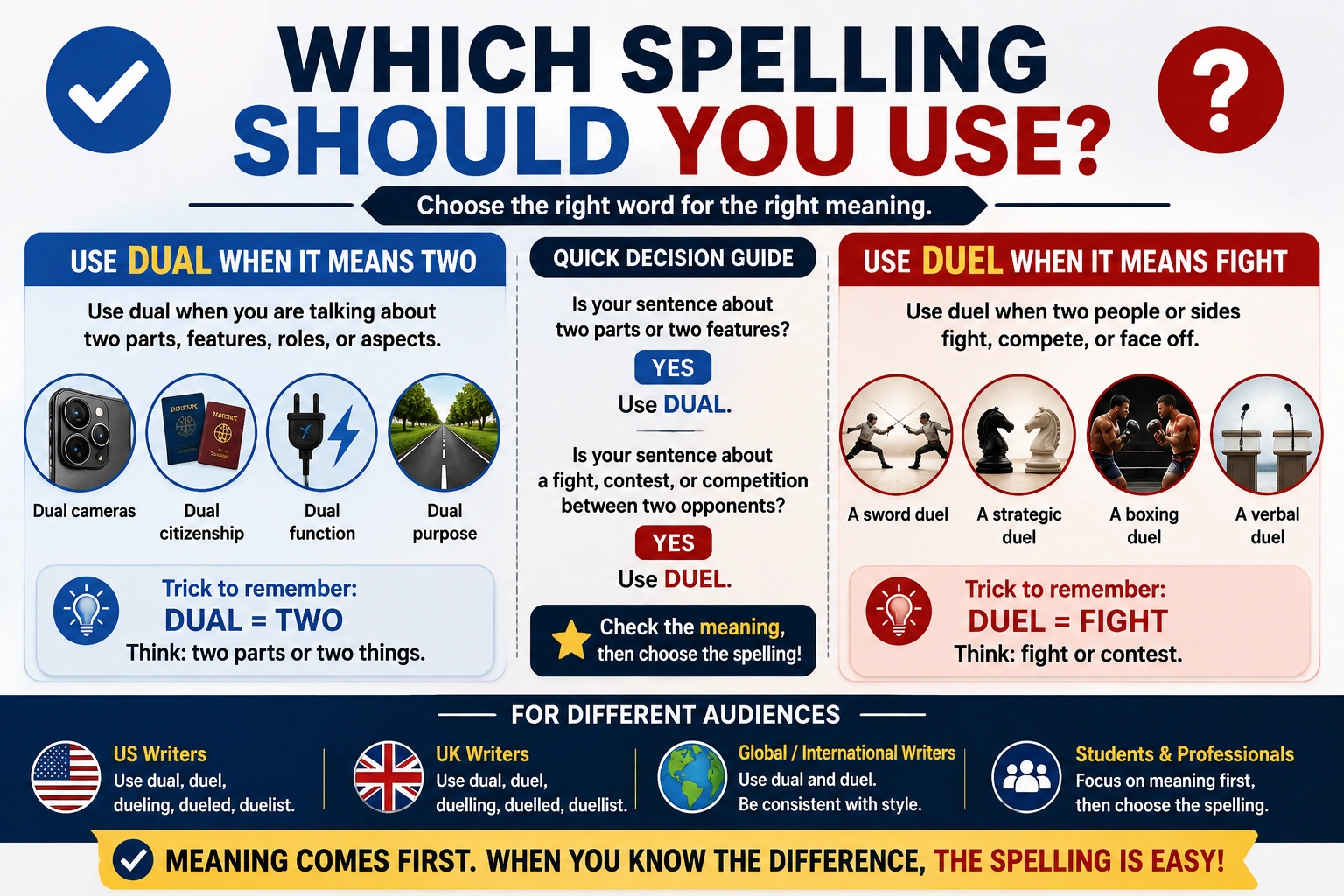
The correct word depends on your meaning, not your country.
Use “Dual” When You Mean Two
Choose dual when something has two parts, functions, roles, or aspects.
Examples:
The phone has dual speakers.
He has a dual role in the company.
The machine has a dual function.
She holds dual citizenship.
Use “Duel” When You Mean a Fight or Contest
Choose duel when two people or sides face each other in combat, conflict, or competition.
Examples:
The two knights fought a duel.
The players entered a fierce duel.
The two candidates had a verbal duel.
Advice for US Writers
Use:
- dual
- duel
- dueling
- dueled
- duelist
Advice for UK and Commonwealth Writers
Use:
- dual
- duel
- duelling
- duelled
- duellist
The important point is to keep your spelling style consistent throughout a document.
Common Mistakes with Dual or Duel
Mistake 1: “He had a dual with his opponent.”
This is incorrect if you mean a fight.
Correct:
He had a duel with his opponent.
Remember: duel = fight.
Mistake 2: “The phone has duel cameras.”
This is incorrect if you mean two cameras.
Correct:
The phone has dual cameras.
Remember: dual = two.
Mistake 3: “They were dualing in the competition.”
If you mean two opponents were competing, the correct word is dueling in American English or duelling in British English.
American:
They were dueling for the championship.
British:
They were duelling for the championship.
Mistake 4: “She has duel citizenship.”
This is incorrect.
Correct:
She has dual citizenship.
Citizenship involving two countries is dual citizenship.
Mistake 5: “The two fighters entered a dual.”
Incorrect.
Correct:
The two fighters entered a duel.
A duel is a fight or contest.
Quick Correction Table
| Incorrect | Correct |
|---|---|
| duel cameras | dual cameras |
| dual with his enemy | duel with his enemy |
| duel citizenship | dual citizenship |
| dual of words | duel of words |
| dualing | dueling / duelling |
| dualist | duelist / duellist |
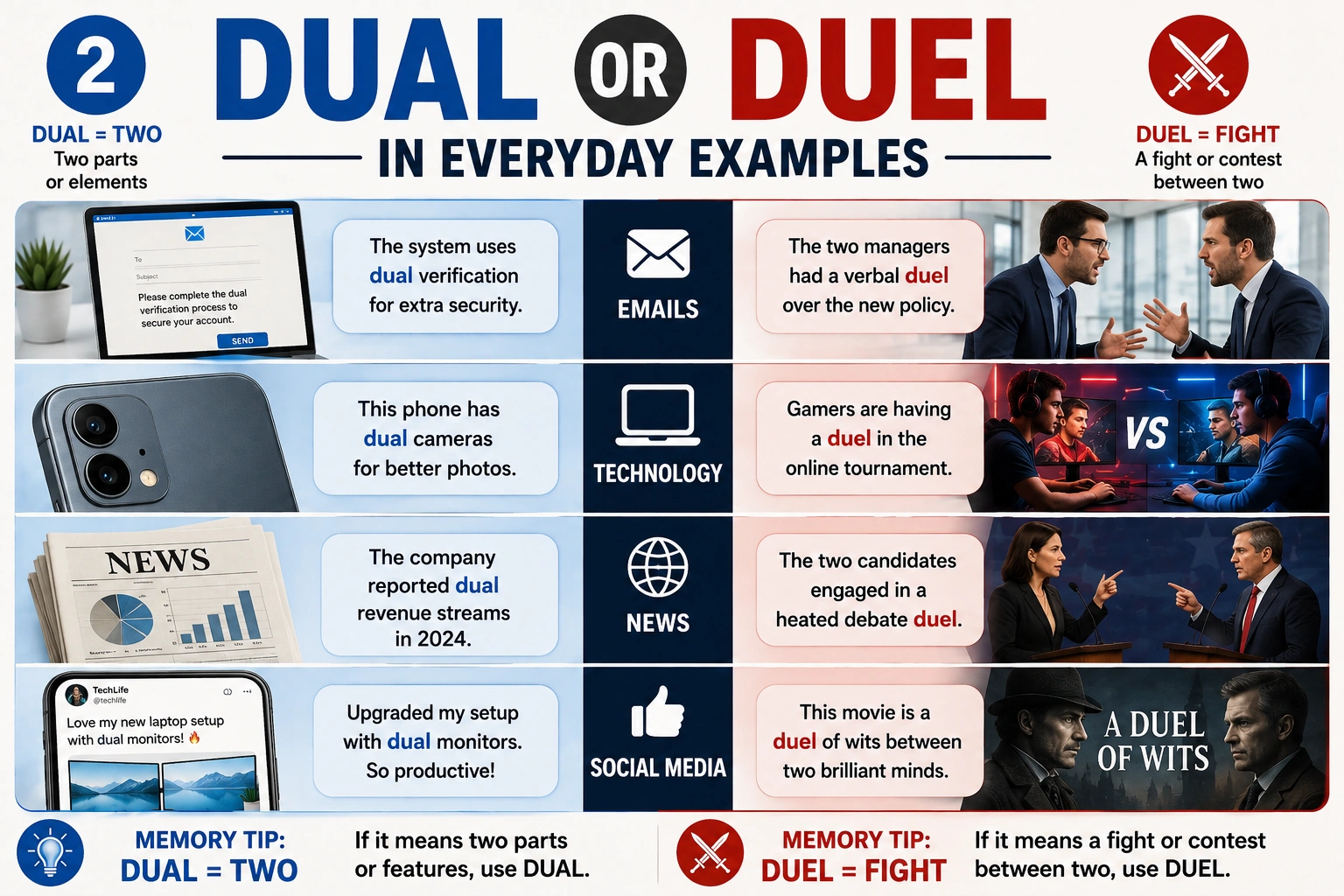
Understanding real examples can make the difference much easier to remember.
In Emails
Dual:
The new system has a dual authentication process.
Here, dual means the system has two related parts or stages.
Duel:
The article describes a famous duel between two historical figures.
Here, duel means a fight.
In News
Dual:
The company introduced a phone with dual cameras.
This describes a product with two cameras.
Duel:
The two candidates faced off in a heated verbal duel.
Here, duel describes a strong verbal contest.
On Social Media
Dual:
My new laptop supports dual monitors.
Duel:
That final match was an incredible duel!
The first refers to two screens. The second describes a contest.
In Formal Writing
Dual:
The program serves a dual purpose.
Duel:
The novel describes a duel between two rivals.
Both sentences are correct because the words have different meanings.
In Technology
The word dual is very common in technology.
Examples include:
- dual SIM
- dual cameras
- dual monitors
- dual-core processor
- dual-band Wi-Fi
- dual storage
These terms all involve two features, systems, or components.
In Sports
Duel can describe a close contest between two competitors.
The two athletes were locked in a fierce duel.
Here, the word does not necessarily mean physical combat. It can describe a competitive struggle.
Dual or Duel – Google Trends & Usage Data
Searches for “dual or duel” are mainly driven by the spelling and meaning confusion between these homophones. Related searches include phrases such as:
- dual vs duel
- dual or duel meaning
- duel vs dual
- dual meaning
- duel meaning
- dual cameras
- dual citizenship
- duel definition
Google Trends allows users to compare search interest by location and time, but the results change depending on the selected country, period, and search type.
The two words also appear in very different contexts.
Dual has broad modern usage in technology, business, education, law, and everyday descriptions. Common phrases include “dual cameras,” “dual citizenship,” and “dual purpose.” Dictionary and corpus examples show dual being used across many modern contexts.
Duel is less common in everyday conversation but remains useful in historical writing, fiction, sports, debates, and descriptions of competition. Modern dictionaries also recognize its broader meaning of a conflict or contest between two opponents.
Therefore, search interest in dual is often connected with its many practical meanings, while searches involving dual or duel often come from people trying to choose the correct spelling.
Dual vs Duel Comparison Table
| Feature | Dual | Duel |
|---|---|---|
| Meaning | Involving two | A fight or contest |
| Main part of speech | Adjective | Noun and verb |
| Basic idea | Two parts or aspects | Two opponents |
| Common contexts | Technology, business, education | History, sports, conflict |
| Example | dual cameras | a sword duel |
| Memory word | Two | Fight |
| British spelling | dual | duel |
| American spelling | dual | duel |
| British derived form | — | duelling |
| American derived form | — | dueling |
One-Sentence Difference
Dual means two; duel means a fight or contest between opponents.
FAQs About Dual or Duel
1. What is the difference between dual and duel?
Dual means involving two parts or elements. Duel means a fight or contest between two opponents.
2. Is dual or duel correct?
Both are correct words. The correct choice depends on the meaning of your sentence.
Use dual for two parts. Use duel for a fight or contest.
3. Is “dual citizenship” correct?
Yes. Dual citizenship is correct because it refers to citizenship in two countries.
4. Is “duel cameras” correct?
No. If you mean two cameras, write dual cameras.
5. Are dual and duel homophones?
Yes. They are commonly treated as homophones because they have the same or very similar pronunciation but different spellings and meanings.
6. Is it “dueling” or “duelling”?
Both are correct, depending on the English variety.
- Dueling is standard American English.
- Duelling is standard British English.
Merriam-Webster recognizes both forms.
7. What is an easy way to remember dual and duel?
Remember:
DUAL = TWO
DUEL = FIGHT
If the sentence is about two parts, choose dual. If it is about a fight or contest, choose duel.
Conclusion
The difference between dual or duel is simple once you connect each word with its meaning. Dual means something involving two parts, features, roles, or aspects. Duel means a fight, confrontation, or contest between two opponents.
For example, you would write “dual cameras” because a phone has two cameras. You would write “a duel between two fighters” because they are facing each other in combat. The words sound alike, but they cannot normally be used in place of each other.
Both dual and duel have the same spelling in British and American English. However, some forms of duel change. American English generally uses dueling and dueled, while British English commonly uses duelling and duelled.
For a quick memory trick, think “dual = two” and “duel = fight.” This simple rule will help you choose the right word in emails, essays, articles, reports, social media posts, and everyday writing. Once you focus on the meaning rather than the sound, dual vs. duel becomes much easier to master.
Learn dual or duel differences with simple examples, origins, spelling rules, common mistakes, usage tips, FAQs, and easy memory tricks.
you can also read about tryed or tried by clicking this link
👇👇

My name is iqbal hussain, and I am an article writer passionate about creating clear, engaging, and informative content. I specialize in SEO-friendly articles and blog posts. I enjoy researching different topics and turning complex information into simple, useful content that informs readers and provides real value.