Ninth is the correct spelling, while nineth is incorrect.
Use ninth when referring to number 9 in order, such as “the ninth day.”
Have you ever written “nineth” and wondered if it should be “ninth”? You are not alone. This is a common spelling question because the word nine seems to suggest that its ordinal form should be nineth. After all, we often make ordinal numbers by adding -th.
But English has some spelling rules that do not always look simple. When nine becomes an ordinal number, the final e is dropped. This gives us ninth, not nineth.
People often search for “nineth or ninth” when writing school work, emails, reports, dates, forms, or social media posts. They want to know which spelling is correct and why.
The answer is simple: ninth is correct, while nineth is incorrect in standard English.
In this guide, you will learn the difference between nineth and ninth, its origin, common mistakes, and simple examples. You will also learn how ninth is used in British and American English.
Nineth or Ninth: Quick Answer
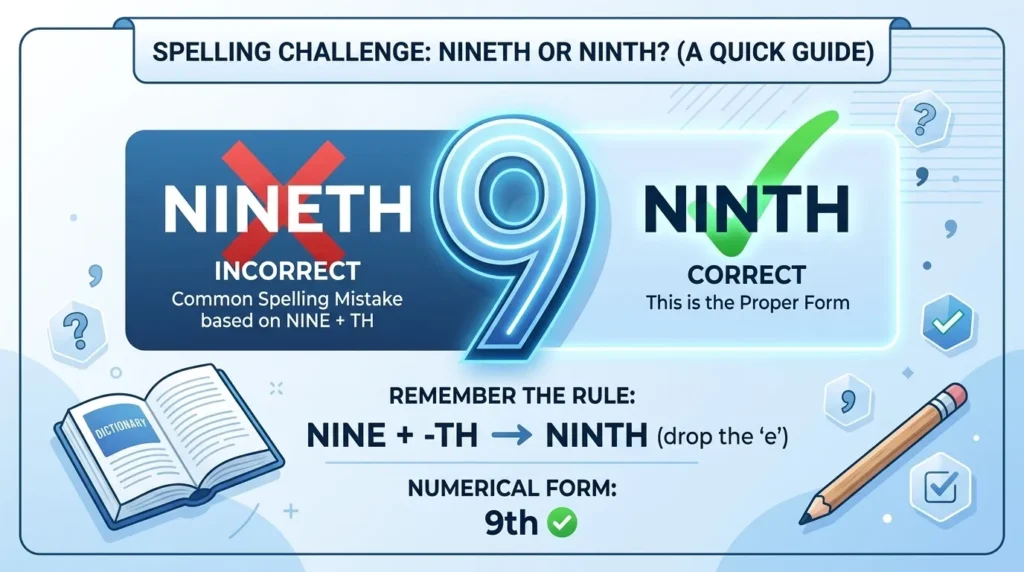
Ninth is the correct spelling.
- ❌ Nineth — incorrect
- ✅ Ninth — correct
- 9th — correct numerical form
The word ninth means coming after the eighth in a series.
Examples
- She finished in ninth place.
- Today is the ninth of June.
- He lives on the ninth floor.
- This is my ninth attempt.
- The meeting is on the ninth of August.
Why is it “ninth”?
The word nine loses its final e before the -th ending:
nine → ninth
So, do not write nineth.
A simple way to remember it is:
Nine + th = ninth, not nineth.
The Origin of Ninth
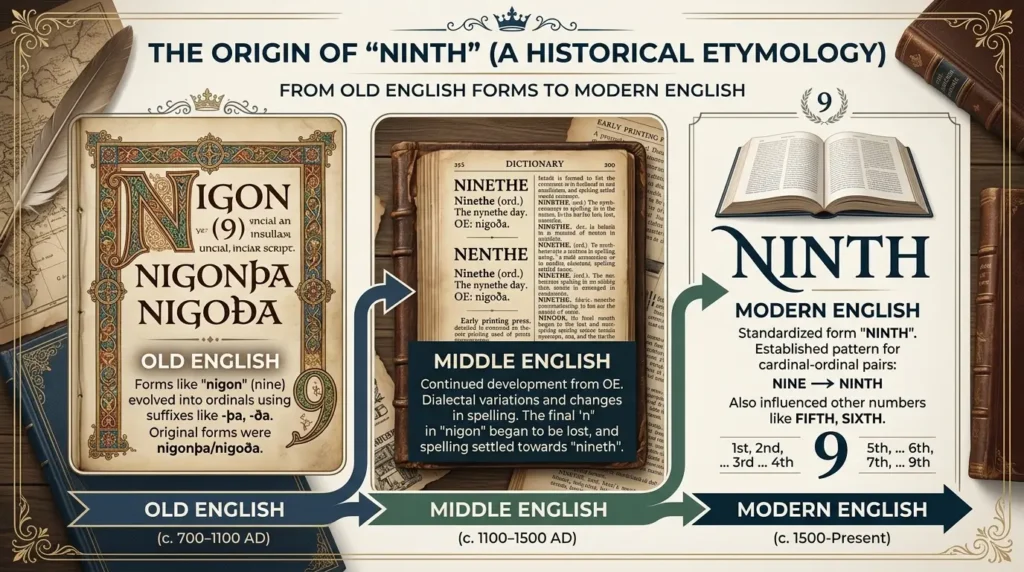
The spelling of ninth has a long history. It did not simply come from taking the modern word nine and adding -th.
The modern word can be traced back to Old English forms such as nigoða and nigende. In Middle English, forms such as ninthe and nynþe were used. Over time, the spelling changed and developed into modern ninth.
The word nine itself also has very old Germanic roots. The related Old English form was nigen, which developed into the modern word nine.
This history explains why ninth is spelled differently from what many learners expect.
English ordinal numbers often use -th, but spelling changes can happen:
| Number | Ordinal |
| six | sixth |
| seven | seventh |
| eight | eighth |
| nine | ninth |
| ten | tenth |
The important point is that ninth is the established standard spelling. Nineth is not an accepted alternative spelling.
British English vs American English Spelling
There is no spelling difference between British and American English for this word.
Both varieties use:
ninth
For example:
- British English: She came ninth in the race.
- American English: She came ninth in the race.
The spelling remains the same in both forms of English. Dictionaries list ninth as the standard word for the ordinal number 9.
Comparison Table
| English variety | Correct spelling | Incorrect spelling |
| British English | ninth | nineth |
| American English | ninth | nineth |
| Canadian English | ninth | nineth |
| Australian English | ninth | nineth |
| International English | ninth | nineth |
Whether you write in British, American, Canadian, or Australian English, always use ninth.
Which Spelling Should You Use?
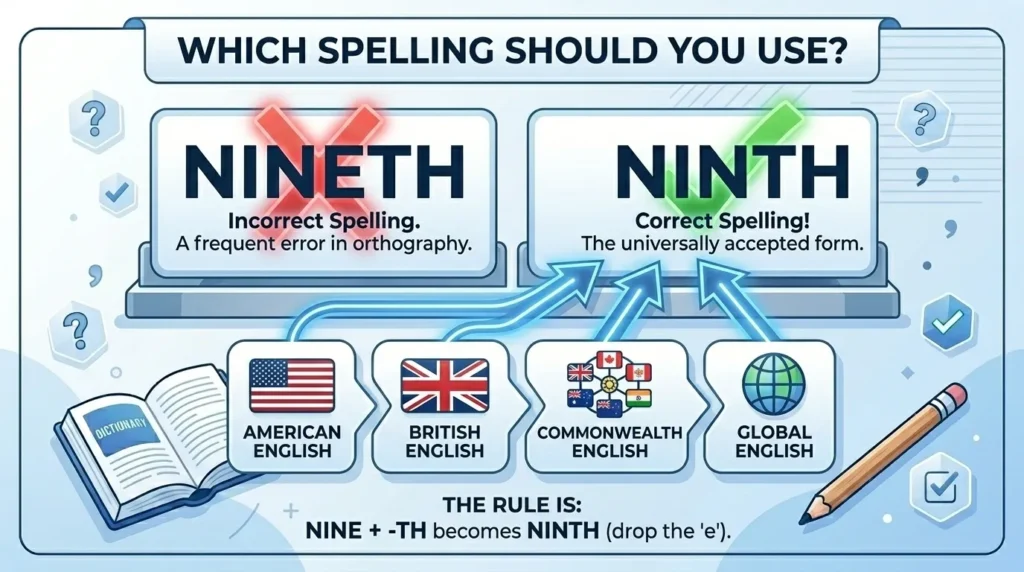
You should always use ninth in standard English.
For American English
Use:
He is in the ninth grade.
Do not write:
He is in the nineth grade.
For British English
Use:
She lives on the ninth floor.
Do not write:
She lives on the nineth floor.
For Commonwealth English
Countries such as Canada, Australia, and other English-speaking countries also use ninth.
For Global English
If you write for an international audience, ninth is the safest and correct choice.
There is no need to choose between nineth and ninth based on country. Ninth is correct everywhere in standard English.
Common Mistakes with Nineth or Ninth
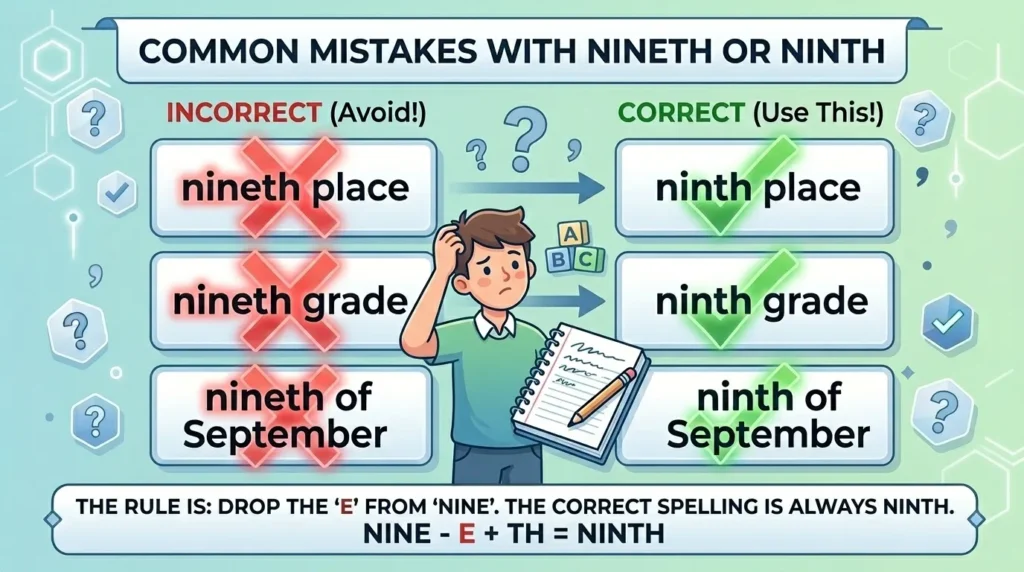
The most common mistake is keeping the e from nine.
Mistake 1: Writing “nineth”
❌ She finished in nineth place.
✅ She finished in ninth place.
Mistake 2: Using “nineth” in dates
❌ The event is on the nineth of September.
✅ The event is on the ninth of September.
Mistake 3: Writing “nineth grade”
❌ My brother is in nineth grade.
✅ My brother is in ninth grade.
Mistake 4: Confusing nine and ninth
Nine is a cardinal number.
I have nine books.
Ninth is an ordinal number.
The ninth book is my favorite.
Mistake 5: Thinking every ordinal keeps the full number
English does not always work by simply adding -th.
For example:
- nine → ninth
- five → fifth
- twelve → twelfth
So, it is better to learn common ordinal forms instead of trying to create them by adding letters.
Nineth or Ninth in Everyday Examples
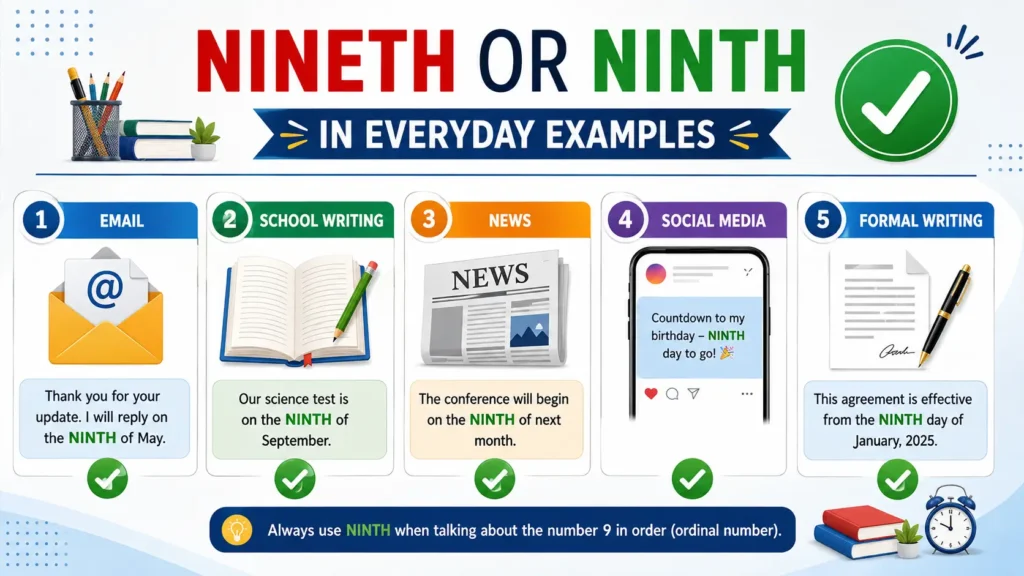
The word ninth appears in many types of writing.
In Emails
Our next meeting will take place on the ninth of August.
In School Writing
Sara finished the race in ninth place.
In News
The team moved into ninth place in the league.
On Social Media
Today is my ninth day of learning English!
In Formal Writing
The applicant completed the ninth section of the form.
In Dates
The deadline is September 9th.
Or:
The deadline is September ninth.
In all these examples, ninth is the correct word.
Nineth or Ninth: Google Trends & Usage Data
Many people search for “nineth or ninth” because they are not sure which spelling is correct. Grammar and spelling guides agree that ninth is correct, while nineth is incorrect.
Search interest can come from many English-learning contexts, including:
- School assignments
- English grammar lessons
- Spelling checks
- Writing and editing
- Emails and formal documents
- Searches by English learners
However, Google Trends is a measure of search behavior, not a dictionary or grammar authority. Search popularity can change by country and over time. A high search volume for nineth would not make it correct.
For accurate spelling, dictionary evidence is more important than search volume. Major dictionary sources define ninth as the ordinal form related to nine.
Read More: Dealt or Delt? The Correct Spelling Explained with Examples
Comparison Table: Nineth vs Ninth
| Feature | Nineth | Ninth |
| Spelling | ❌ Incorrect | ✅ Correct |
| Meaning | Intended as 9th | Coming after eighth |
| Standard English | No | Yes |
| British English | Incorrect | Correct |
| American English | Incorrect | Correct |
| Example | ❌ nineth place | ✅ ninth place |
| Numerical form | Not applicable | 9th |
Quick Rule
Remember:
nine → ninth
Not:
nine → nineth
FAQs About Nineth or Ninth
1. Is “nineth” correct?
No. Nineth is an incorrect spelling in standard English. The correct spelling is ninth.
2. Why is “ninth” spelled without an e?
The spelling developed historically from older forms of the ordinal number. In modern English, the standard spelling is ninth, not nineth.
3. Is “ninth” correct in American English?
Yes. Ninth is the correct spelling in American English.
4. Is “ninth” correct in British English?
Yes. British English also uses ninth.
5. What is the ordinal number of nine?
The ordinal number of nine is ninth.
9 → nine → ninth → 9th
6. Is “ninth grade” correct?
Yes.
My sister is in the ninth grade.
7. How can I remember the spelling of ninth?
Remember this simple rule:
Nine loses the final e before -th: nine → ninth.
Conclusion
The answer to “nineth or ninth” is clear: ninth is the correct spelling. Nineth is a common spelling mistake, but it is not accepted as the standard form in English.
The confusion happens because the word nine contains an e, so it may seem natural to write nineth. However, the correct ordinal form is ninth. The word has a long history and developed from older English forms, which also helps explain why its modern spelling is not simply “nine + th.”
There is also no British-versus-American spelling difference here. Both British and American English use ninth.
Use ninth in school work, emails, reports, news writing, social media, and formal documents. If you need the short numerical form, use 9th.
The easiest rule to remember is simple:
Nine → Ninth
Remember: ninth has no e. This simple rule will help you avoid the common mistake nineth.

Ali Hassan is an English language writer and educator who specializes in grammar, spelling, and commonly confused words. He creates simple and easy-to-understand content to help students, writers, and English learners improve their English with confidence.