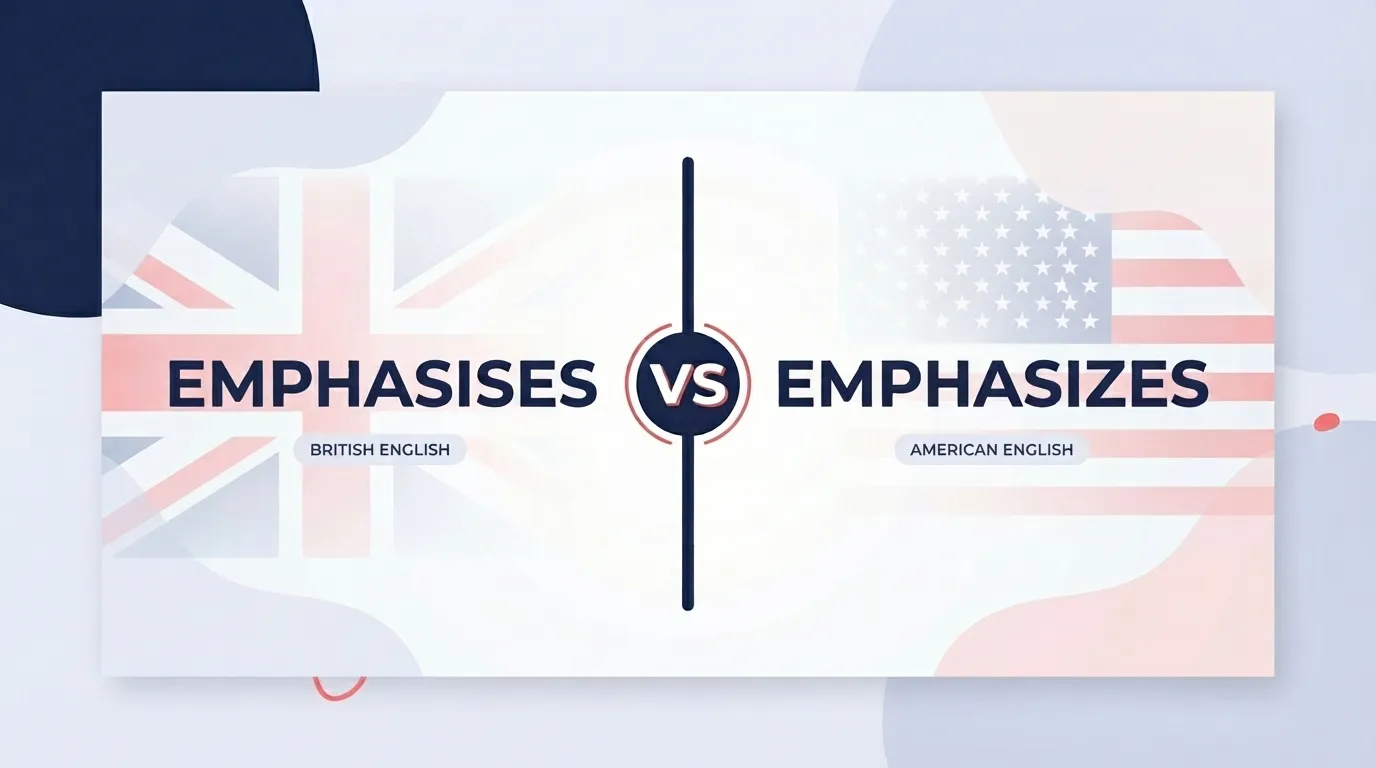
Emphasises and emphasizes are both correct spellings, with emphasises preferred in British English and emphasizes preferred in American English.
You are writing an email. You want to stress a point. You type the word and stop. Is it “emphasises” or “emphasizes”? Both look right. Both feel odd at the same time. This happens to millions of writers every day.
The confusion is simple. English has two main forms: British English and American English. They spell many words in different ways. “Emphasises” and “emphasizes” are one example. Neither spelling is wrong. They are just used in different places.
People search for this term because they want to sound correct. Students want to pass grammar checks. Bloggers want to match their audience. Business writers want to look professional. A wrong spelling can make writing look careless, even when the meaning is clear.
This article gives you a quick answer first. Then it explains the history behind the two spellings. It shows you exactly when to use each one. It also covers common mistakes, real examples, and search data. By the end, you will never second-guess this word again.
Emphasises or Emphasizes: Quick Answer
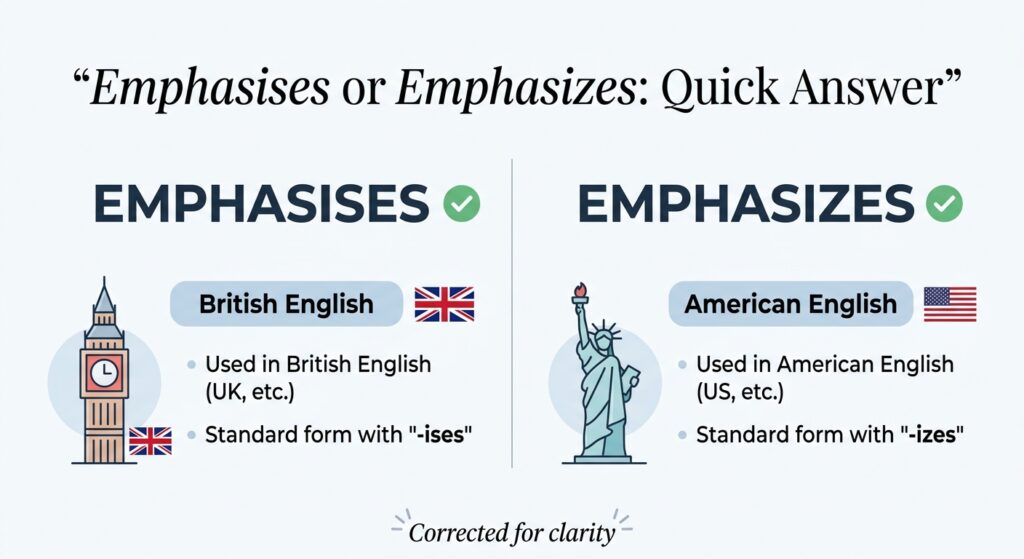
Both spellings are correct.
Emphasizes is the American English spelling. Emphasises is the British English spelling.
They mean the same thing: to give special importance to something.
Examples: The report emphasizes safety rules. (American). The report emphasises safety rules. (British)
Use “emphasizes” if you write for a US audience. Use “emphasises” if you write for a UK, Australian, or Commonwealth audience. Pick one and stay consistent throughout your document.
The Origin of Emphasises or Emphasizes
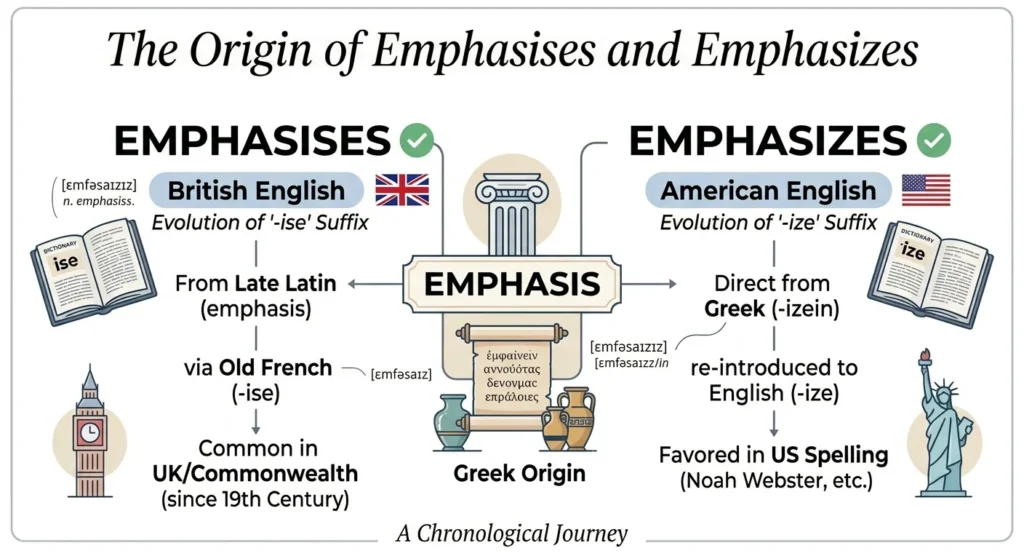
The word comes from the Greek word “emphasis,” which meant a strong or clear expression. Latin later borrowed the term. English took it from there.
The spelling split comes from a bigger pattern in English. Many verbs that end in “-ize” in American English end in “-ise” in British English. Words like “realize/realise,” “organize/organise,” and “recognize/recognise” follow the same rule.
Here is the interesting part. The “-ize” ending is actually older. It comes from the Greek suffix “-izein.” British English used “-ize” for centuries too. Noah Webster, an American lexicographer, pushed for simpler and more consistent spelling in the early 1800s. He favored “-ize” because it matched the word’s Greek root.
Later, British publishers moved toward “-ise” to match French spelling patterns, since French heavily influenced English vocabulary. Over time, American English kept “-ize,” while British English mostly settled on “-ise.” That is why we now have two accepted spellings for the same word.
British English vs American English Spelling
The “-ise” and “-ize” divide is not random. It follows patterns you can learn.
American English almost always uses “-ize” for these verbs. British English allows both “-ise” and “-ize,” but “-ise” is far more common in everyday writing, news, and books.
Here is a simple table to compare the two systems:
| Word Type | American English | British English |
|---|---|---|
| Emphasize/Emphasise | Emphasizes | Emphasises |
| Organize/Organise | Organizes | Organises |
| Realize/Realise | Realizes | Realises |
| Recognize/Recognise | Recognizes | Recognises |
| Apologize/Apologise | Apologizes | Apologises |
| Criticize/Criticise | Criticizes | Criticises |
Note: Some words never change. “Size,” “capsize,” and “seize” always use “z” in both systems. These are not part of the “-ize/-ise” verb pattern.
Which Spelling Should You Use?
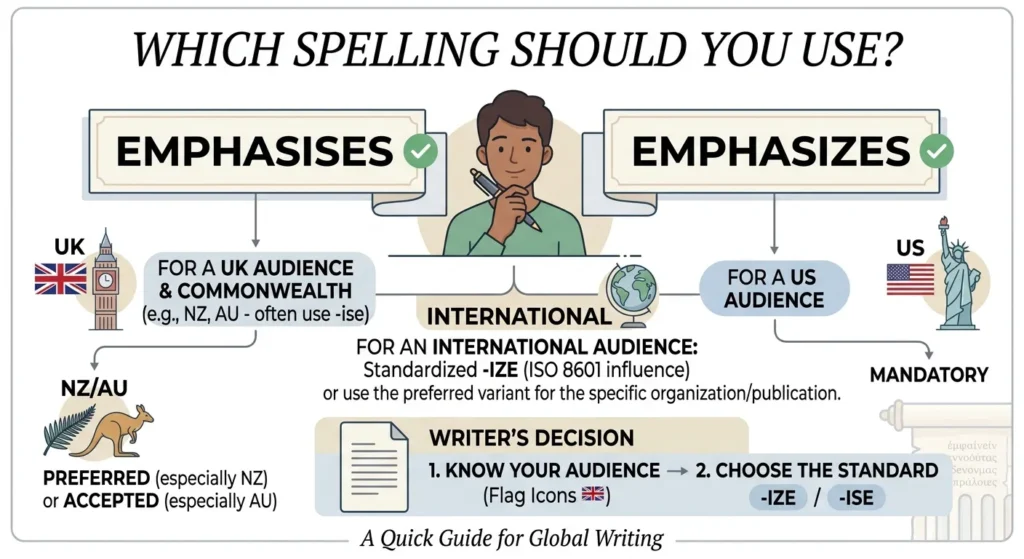
Your choice depends on your audience, not personal preference.
Use “emphasizes” if: You write for a US company, blog, or publication. Your readers are mostly in the United States or Canada. You follow American style guides like AP or Chicago.
Use “emphasises” if: You write for a UK, Australian, Irish, or South African audience. Your readers are in Commonwealth countries. You follow British style guides like Oxford or the Guardian style guide.
If your audience is global: Check your brand’s style guide first. If there is none, pick American English. It has the widest reach online and dominates search engines and global business writing. Stay consistent. Never mix “emphasizes” and “emphasises” in the same document.
Common Mistakes with Emphasises or Emphasizes
Even careful writers slip up. Here are the most frequent errors.
Mistake 1: Mixing spellings in one document. Wrong: “The study emphasises results, but the summary emphasizes methods.” Correct: Pick one spelling and use it throughout.
Mistake 2: Using “emphasise” with an “s” instead of “z” in American content. This confuses spell-checkers set to US English and can flag your writing as incorrect.
Mistake 3: Confusing “emphasis” (noun) with “emphasize/emphasise” (verb). Wrong: “She wants to emphasis the point.” Correct: “She wants to emphasize the point.”
Mistake 4: Wrong verb form. Wrong: “He emphasize the deadline every meeting.” Correct: “He emphasizes the deadline every meeting.”
Mistake 5: Assuming one spelling is more “correct” than the other. Both are grammatically correct. The right choice depends only on audience and style guide.
Read more 👉: Rather vs Whether: What Is the Difference and When to Use Each
Emphasises or Emphasizes in Everyday Examples
In emails (American): “This email emphasizes the need for quick action on the budget request.”
In emails (British): “This email emphasises the need for quick action on the budget request.”
In news headlines (American): “New Report Emphasizes Climate Risks in Coastal Cities”
In news headlines (British): “New Report Emphasises Climate Risks in Coastal Cities”
On social media (American): “Our new ad campaign emphasizes sustainability and local sourcing.”
On social media (British): “Our new ad campaign emphasises sustainability and local sourcing.”
In formal writing (American): “The committee’s findings emphasize the importance of transparent reporting.”
In formal writing (British): “The committee’s findings emphasise the importance of transparent reporting.”
Emphasises or Emphasizes Google Trends & Usage Data
Search interest for “emphasizes” is consistently higher worldwide than “emphasises.” This is mainly because the United States has the largest number of English-language internet users and content creators.
By country, the pattern is clear:
United States and Canada: “Emphasizes” dominates almost completely. United Kingdom, Ireland, Australia, New Zealand, South Africa: “Emphasises” is more common, though “emphasizes” still appears due to American media influence. India and other former British Commonwealth nations: Mixed usage, with a lean toward British spelling in formal writing and American spelling in tech and business content. Global search engines: American spelling tends to rank slightly more often, since more content worldwide uses American English conventions.
This data matters for SEO. If you write content for a global audience, “emphasizes” often captures more search traffic. If your content targets a specific British or Commonwealth market, “emphasises” will connect better with local readers.
Keyword Variations Comparison Table
| Variation | Region | Usage Context |
|---|---|---|
| Emphasizes | US, Canada, Global SEO | Business, tech, general web content |
| Emphasises | UK, Australia, Commonwealth | News, academic, formal British writing |
| Emphasize | US, Canada | Base verb form, informal and formal |
| Emphasise | UK, Australia | Base verb form, informal and formal |
| Emphasized | US, Canada | Past tense |
| Emphasised | UK, Australia | Past tense |
Frequently Asked Questions
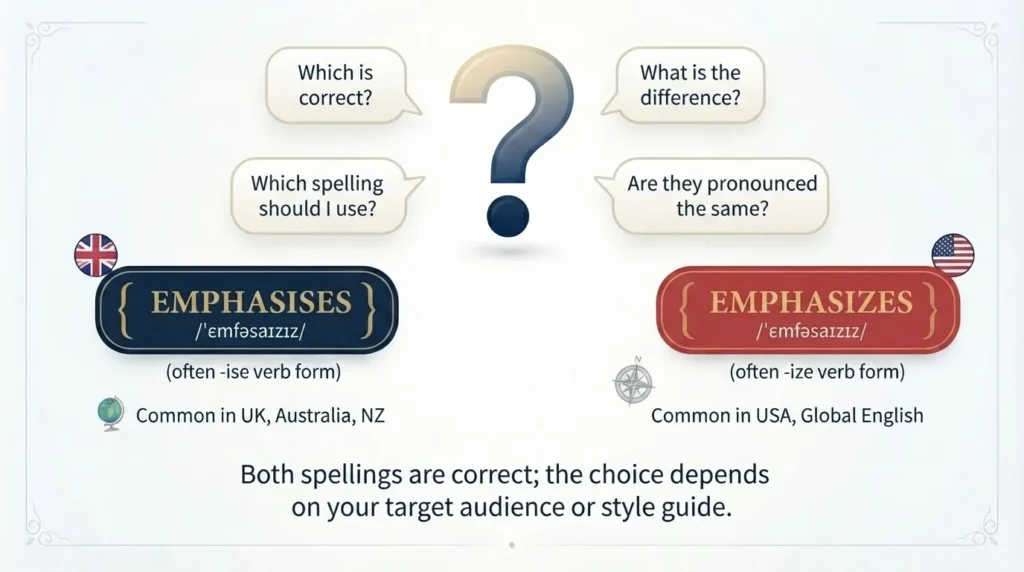
1. Is “emphasises” a real word? Yes. It is the correct British English spelling of “emphasizes.” Both are valid and mean the same thing.
2. Which spelling does Microsoft Word prefer? It depends on your language setting. If your document is set to English (US), Word will flag “emphasises” as a possible error. If it is set to English (UK), it will accept “emphasises” instead.
3. Is “emphasizes” more correct than “emphasises”? No. Neither is more correct. American English uses “emphasizes.” British English uses “emphasises.” Both follow proper grammar rules for their region.
4. Can I use both spellings in the same website? You can, if different pages target different regions. But avoid mixing them within a single page or document. Consistency matters for readability and professionalism.
5. What is the past tense of emphasize or emphasise? The past tense forms are “emphasized” (American) and “emphasised” (British). The same “-ize/-ise” rule applies.
6. Why does American English use “z” instead of “s”? Noah Webster promoted “-ize” spellings in the 1800s to simplify American English and match the word’s original Greek root, which used a “z” sound.
7. Does Canada use “emphasizes” or “emphasises”? Canadian English mostly follows American spelling for this word, so “emphasizes” is more common, though some Canadian style guides allow British spellings too.
8. Which spelling should I use for SEO? For a global or US-focused audience, use “emphasizes.” It generally has higher search volume. For a UK or Commonwealth audience, use “emphasises” to match local search habits.
Conclusion
Both “emphasises” and “emphasizes” are correct spellings of the same word. The only difference is regional. American English uses “emphasizes,” while British English and most Commonwealth countries use “emphasises.” Neither version is wrong, and neither shows poor grammar. The real mistake is mixing both spellings in the same piece of writing.
Your choice should always match your audience. Writing for US readers or a global SEO strategy? Choose “emphasizes.” Writing for UK, Australian, or Commonwealth readers? Choose “emphasises.” Business writers, students, and content creators should check their target region first, then apply that spelling consistently across every document, email, and webpage.
Small details like this build trust with readers. Consistent spelling shows attention to detail and respect for your audience’s language conventions. Now that you understand the origin, the rules, and the regional differences, you can use either spelling with full confidence. Just remember: pick one, stay consistent, and match it to your reader.