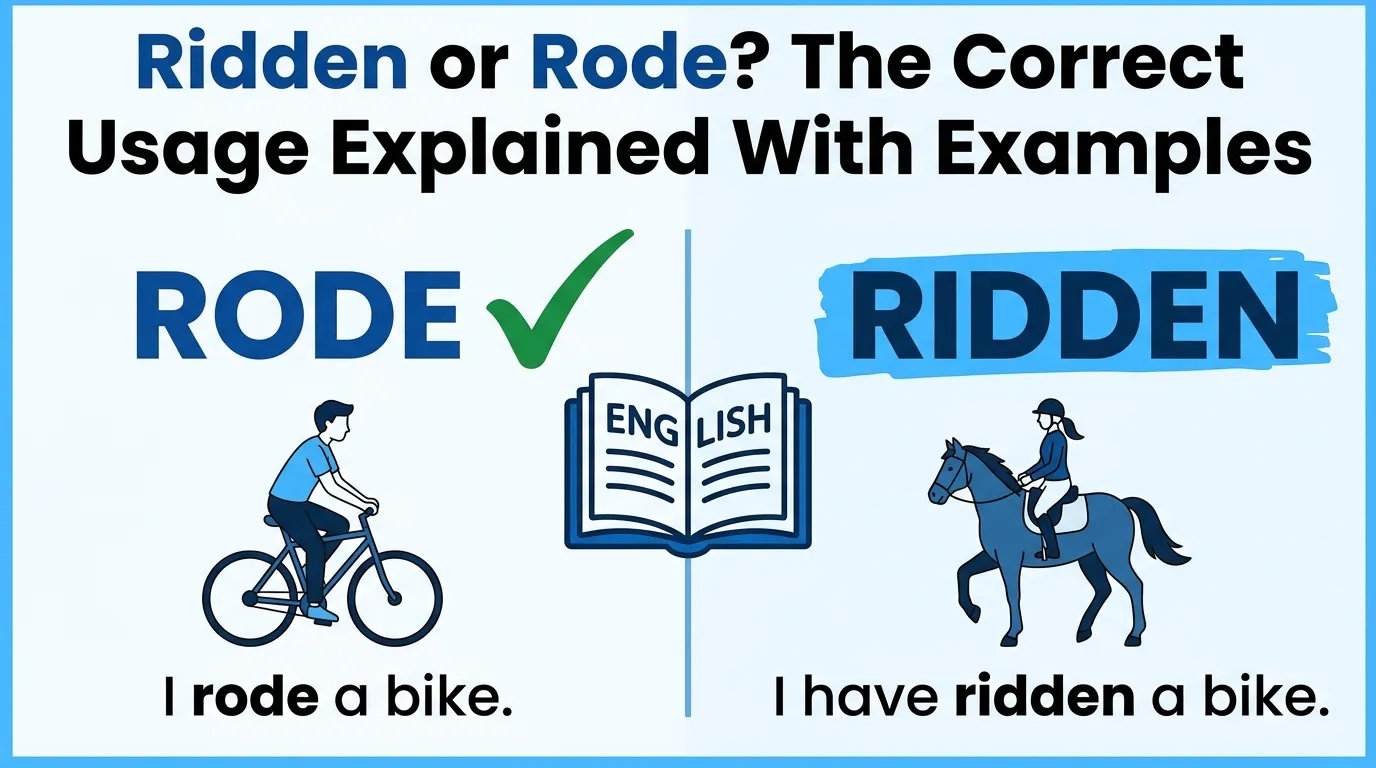
Rode is the past form of ride and is used for a completed past action.
Ridden is the past participle and is used with have, has, or had.
Have you ever wondered whether to use “ridden” or “rode”? You are not alone. Many English learners find these two words confusing because both come from the verb “ride.” The main difference is simple: “rode” is the past tense, while “ridden” is the past participle.
For example, we say, “I rode a horse yesterday.” But we say, “I have ridden a horse many times.”
Knowing when to use ridden or rode can help you write better English. This is important in schoolwork, emails, social media, conversations, and formal writing.Many people find it confusing because English has different forms of irregular verbs.
In this guide, you will learn the difference between rode and ridden, their history, common mistakes, British and American usage, and many easy examples. By the end, you will know exactly when to use each word.
Ridden or Rode: Quick Answer
The quick answer is:
- Rode = simple past tense of ride.
- Ridden = past participle of ride.
Examples with “rode”
- I rode my bike yesterday.
- She rode a horse last weekend.
- We rode the bus to school.
Examples with “ridden”
- I have ridden a horse before.
- She has ridden her bike all morning.
- He had ridden the train before.
A simple rule is:
Use “rode” for a completed past action. Use “ridden” after helping verbs such as “have,” “has,” or “had.”
Comparison Table
| Word | Verb Form | Example |
| Ride | Present | I ride my bike. |
| Rode | Simple past | I rode my bike yesterday. |
| Ridden | Past participle | I have ridden my bike. |
The Origin of Ridden or Rode
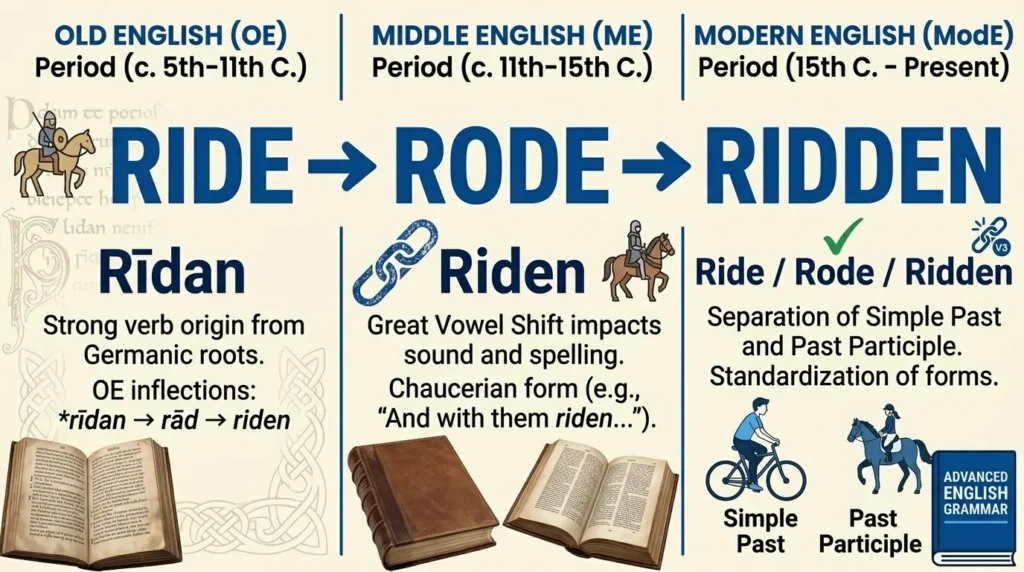
The words ride, rode, and ridden come from the same old English verb.
The modern verb ride has roots in Old English. Its older forms changed over time as English developed. Like many common English verbs, it became an irregular verb.
Instead of adding -ed, the verb changes its form:
ride → rode → ridden
This pattern is similar to other irregular verbs:
- write → wrote → written
- drive → drove → driven
- speak → spoke → spoken
- break → broke → broken
The spelling differences exist because these verbs developed from older Germanic forms of English.
Today, ride is the base form, rode is the simple past form, and ridden is the past participle.
British English vs American English Spelling
There is no major spelling difference between British and American English for ride, rode, or ridden.
Both varieties use:
- ride
- rode
- ridden
The main difference is not spelling. It is sometimes usage and sentence style.
For example:
British English: “I have ridden the train many times.”
American English: “I have ridden the train many times.”
Both sentences are correct.
Comparison Table
| Form | British English | American English |
| Present | ride | ride |
| Past | rode | rode |
| Past participle | ridden | ridden |
| Example | I rode a horse. | I rode a horse. |
| Perfect form | I have ridden a horse. | I have ridden a horse. |
So, whether you write for a British, American, Canadian, Australian, or international audience, the spelling ridden is always the same.
Which Spelling Should You Use?

You do not need to choose between British and American spellings for rode and ridden. Both forms are standard in English.
For American English
Use:
- rode for simple past
- ridden with have, has, or had
Example:
I rode my bike yesterday.
I have ridden my bike many times.
For British and Commonwealth English
The same basic rule applies.
Example:
She rode her horse yesterday.
She has ridden horses since childhood.
For Global English
If you write for an international audience, simply follow the basic grammar rule:
ride → rode → ridden
This form is clear and accepted across major English varieties.
Common Mistakes with Ridden or Rode
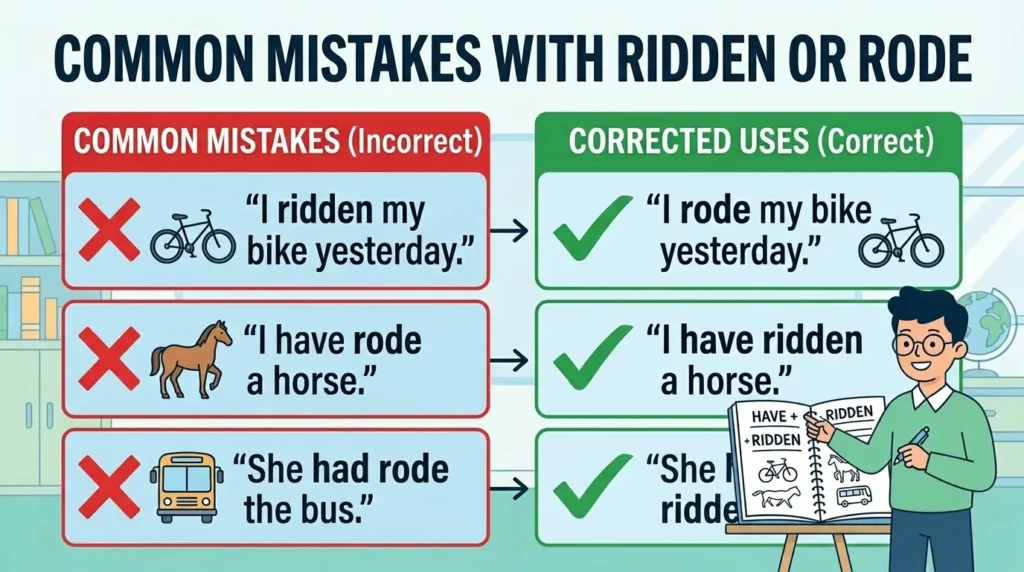
Many mistakes happen because people use rode and ridden in the wrong places.
Mistake 1: Using “ridden” alone as the past tense
❌ I ridden my bike yesterday.
✅ I rode my bike yesterday.
“Ridden” needs a helping verb in standard perfect constructions.
Mistake 2: Using “rode” after “have”
❌ I have rode a horse.
✅ I have ridden a horse.
After have, has, or had, use the past participle ridden.
Mistake 3: Using “rode” after “had”
❌ She had rode the bus before.
✅ She had ridden the bus before.
Mistake 4: Confusing “ride” and “rode”
❌ I ride my bike yesterday.
✅ I rode my bike yesterday.
Use rode when talking about a finished action in the past.
Mistake 5: Using “ridden” instead of “rode”
❌ We ridden the roller coaster last Friday.
✅ We rode the roller coaster last Friday.
Ridden or Rode in Everyday Examples
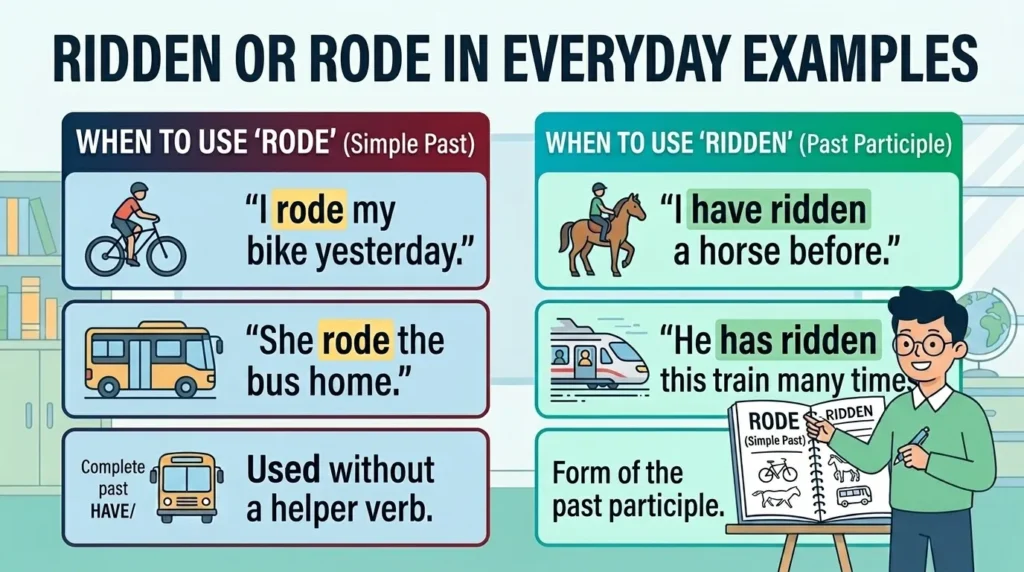
Understanding these words becomes easier when you see them in real situations.
In Emails
Correct:
I rode the train to the meeting yesterday.
Correct:
I have ridden this train several times.
In News Writing
A news report might say:
The cyclist rode through the city yesterday.
For an experience or earlier event, it might say:
The cyclist has ridden across several countries.
On Social Media
Rode:
I rode a horse for the first time today!
Ridden:
I have never ridden a horse before.
In Formal Writing
Rode:
The researcher rode the train to the study site.
Ridden:
The researcher had ridden the train several times before the study began.
In Everyday Speech
- I rode my bike to work.
- Have you ever ridden a horse?
- She rode the bus home.
- He has ridden this bike for years.
Ridden or Rode: Google Trends & Usage Data
People often search for “ridden or rode” because they want to check their grammar. Students, English learners, and writers commonly look up this question online.
The two words appear in different contexts because they have different grammatical jobs.
Rode is common when people describe a specific past event:
- I rode a bike yesterday.
- She rode a horse last week.
- They rode the bus home.
Ridden often appears with perfect tenses:
- I have ridden a bike.
- She has ridden a horse.
- They had ridden the bus before.
People around the world search for this grammar question, especially in the US, UK, Canada, Australia, India, and Pakistan.
The important point is that popularity can change by country and search platform. The grammar rule itself does not change: rode is the past tense, while ridden is the past participle.
Ridden vs Rode: Quick Comparison
| Feature | Rode | Ridden |
| Base verb | Ride | Ride |
| Verb form | Simple past | Past participle |
| Used alone for past action? | Yes | No |
| Common helpers | Usually none | Have, has, had |
| Example | I rode a bike. | I have ridden a bike. |
| Meaning | A past riding action | A completed or experienced riding action |
| Correct? | Yes | Yes |
Easy Memory Trick
Remember this pattern:
Ride → Rode → Ridden
Think of it like:
Today: I ride.
Yesterday: I rode.
Before now / experience: I have ridden.
FAQs About Ridden or Rode
1. Is “rode” the past tense of “ride”?
Yes. Rode is the simple past tense of ride.
Example:
I rode my bike yesterday.
2. Is “ridden” the past tense of “ride”?
No. Ridden is the past participle.
Example:
I have ridden my bike many times.
3. Is “I have rode” correct?
No. In standard English, say:
I have ridden.
Not:
I have rode.
4. Is “I rode a horse” correct?
Yes. Rode is correct when talking about a completed past action.
Example:
I rode a horse last summer.
5. Is “I have ridden a horse” correct?
Yes. Ridden is correct after have.
Example:
I have ridden a horse before.
6. What is the difference between rode and ridden?
Rode is the simple past form.
Ridden is the past participle.
Example:
- I rode yesterday.
- I have ridden before.
7. Are rode and ridden spelled the same in British and American English?
Yes. Both British and American English use rode and ridden.
See Also: Sempai or Senpai? Which Spelling Is Correct?
Conclusion
The difference between ridden or rode is simple once you understand their grammar roles. Both words come from the verb ride, but they are used in different ways.
Use rode as the simple past tense when talking about a finished action in the past:
I rode my bike yesterday.
Use ridden as the past participle, usually with helping verbs such as have, has, or had:
I have ridden my bike many times.
The spelling is the same in British and American English, so you do not need to worry about regional spelling differences. The key is to remember the three forms:
ride → rode → ridden
If you keep this pattern in mind, you can avoid common mistakes such as “I have rode” or “I ridden yesterday.” Whether you are writing an email, school assignment, social media post, or formal document, choosing the correct form will make your English clearer and more accurate.

Ali Hassan is an English language writer and educator who specializes in grammar, spelling, and commonly confused words. He creates simple and easy-to-understand content to help students, writers, and English learners improve their English with confidence.