Both “acknowledgements” and “acknowledgments” are correct spellings, with “acknowledgements” preferred in British English and “acknowledgments” in American English.
You just finished your thesis, book, or big project. Now you need to thank the people who helped you. You type the word. Then you stop. Is it “acknowledgements” or “acknowledgments”? Spell check doesn’t complain either way. Your screen just sits there, waiting.
This mix-up trips up more people than you’d think. Students writing dissertations. Authors finishing their first book. Employees writing a company report. All of them hit the same wall.
Here’s the short answer: both spellings are correct. The confusion comes from a simple fact. British English and American English don’t always agree on spelling. This word is one of the clearest examples.
In this article, you’ll get a quick answer first. Then you’ll learn where the word comes from, how the two spellings split apart, and which one fits your writing. You’ll also see real examples, common mistakes, and answers to the questions people ask most. By the end, you’ll never second-guess this word again.
Acknowledgements or Acknowledgments: Quick Answer
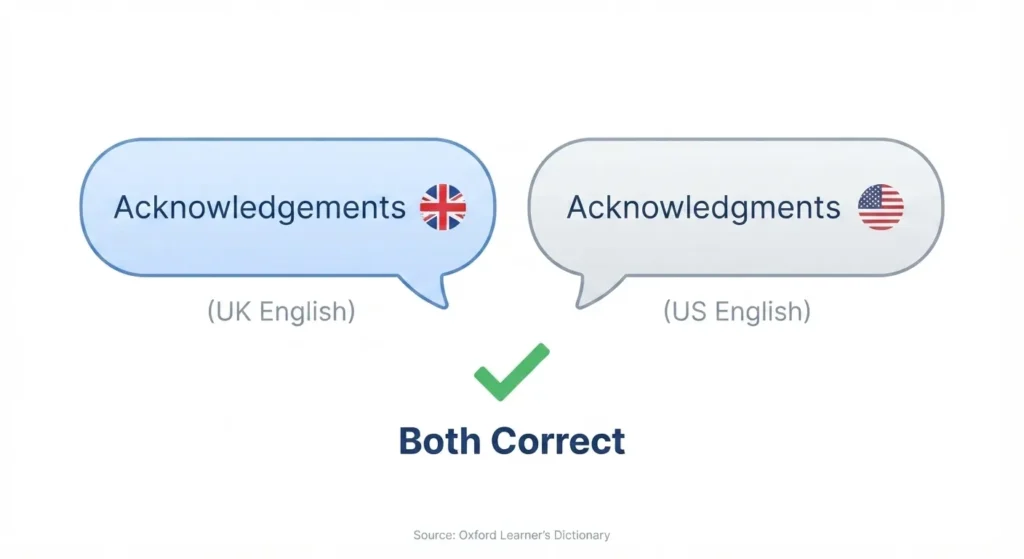
Both spellings are correct. The choice depends on which style of English you use.
- Acknowledgements (with the extra “e”) is the standard spelling in British English, Australian English, and most Commonwealth countries.
- Acknowledgments (without the “e”) is the standard spelling in American English.
Example:
- UK: “The author added a long acknowledgements section at the end of her book.”
- US: “The author added a long acknowledgments section at the end of her book.”
Neither version is wrong. Pick one and use it consistently in the same document.
The Origin of Acknowledgements or Acknowledgments
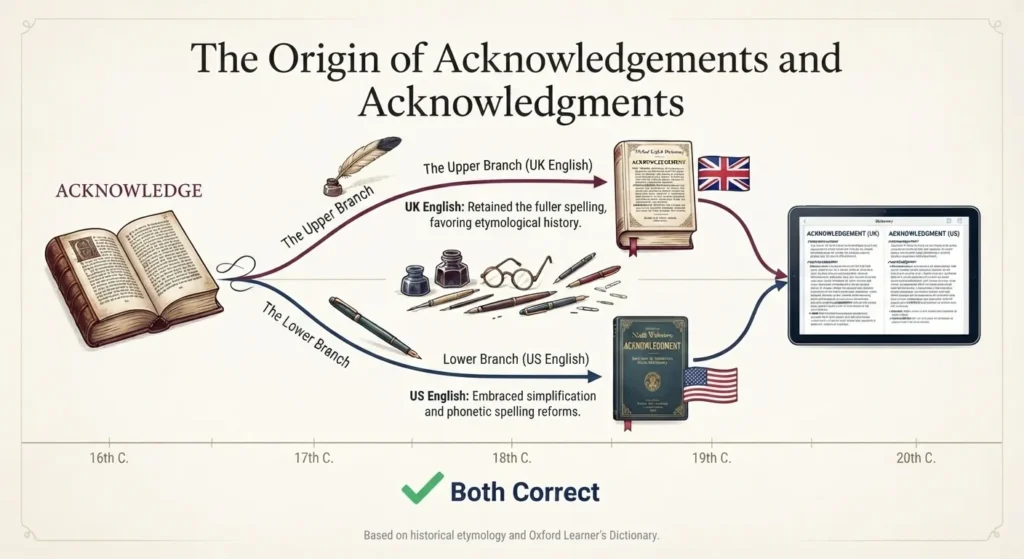
The word comes from “acknowledge,” which traces back to Middle English. It combines the old word “knowlechen” (to admit or confess) with the prefix “a-.” Over time, “acknowledge” came to mean recognizing or confirming something, often to give credit or thanks.
The noun form adds the suffix “-ment,” turning the verb into a thing: an “acknowledgment” is the act of acknowledging something.
So where does the extra “e” come from? English spelling was never fully standardized until dictionaries came along. Samuel Johnson’s 1755 dictionary, used widely in Britain, kept many silent “e” spellings in words like “judgement,” “acknowledgement,” and “abridgement.” Noah Webster, writing his American dictionary decades later, wanted simpler, more logical spelling. He dropped many of these silent letters. That single choice created a lasting split between British and American English.
This isn’t the only word affected. “Judgement” vs. “judgment” and “abridgement” vs. “abridgment” follow the exact same pattern.
British English vs American English Spelling
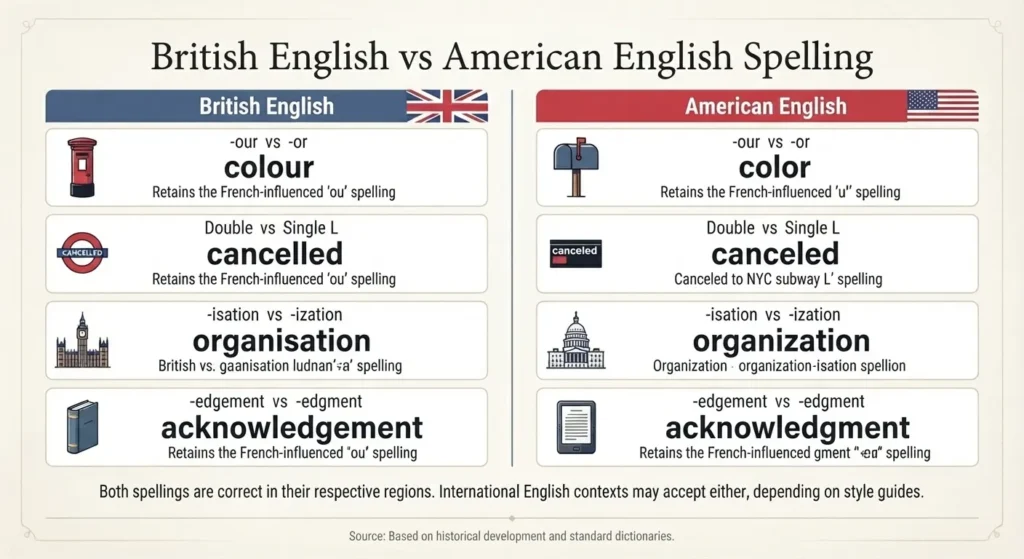
The core rule is simple: British English tends to keep the “e” before “-ment” when the base word ends in a soft “g” sound. American English tends to drop it.
This affects a small family of words, and “acknowledgement” is one of the most common.
| Word Type | British English | American English |
|---|---|---|
| Acknowledgement | acknowledgement | acknowledgment |
| Judgement | judgement | judgment |
| Abridgement | abridgement | abridgment |
| Plural form | acknowledgements | acknowledgments |
| Verb form (same in both) | acknowledge | acknowledge |
Note that “judgment” is actually common in both British and American legal writing, even in the UK. This is one exception worth remembering. “Acknowledgement,” however, keeps a cleaner split: British writers almost always use the “e,” and American writers almost always drop it.
Which Spelling Should You Use?
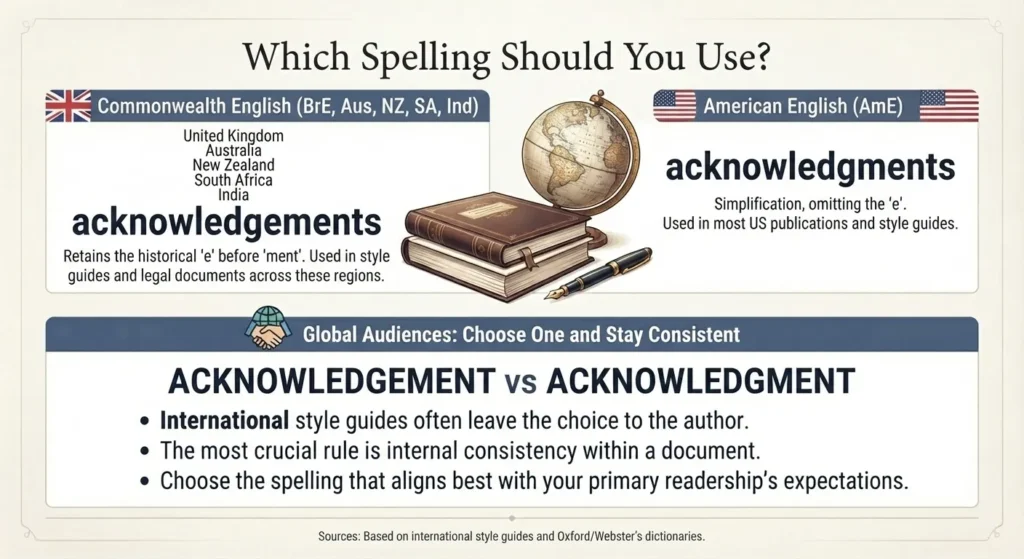
Your choice depends on your audience, your location, and your style guide.
If you write for a US audience: Use “acknowledgments.” This matches American publishing standards, US news outlets, and most American academic style guides, including APA and Chicago (US edition).
If you write for a UK, Irish, Australian, or Commonwealth audience: Use “acknowledgements.” This matches British publishers, UK universities, and Commonwealth government writing.
If you write for a global or mixed audience: Check if your company, publisher, or university has a style guide. If not, pick one spelling and stay consistent through the whole document. Mixing both spellings in one piece of writing looks like a typo, even though each spelling is technically correct.
If you’re a student: Follow your institution’s required style. US universities almost always expect “acknowledgments.” UK and Commonwealth universities almost always expect “acknowledgements.”
Read more 👉: Emphasises or Emphasizes: Which Spelling Is Correct?
Common Mistakes with Acknowledgements or Acknowledgments
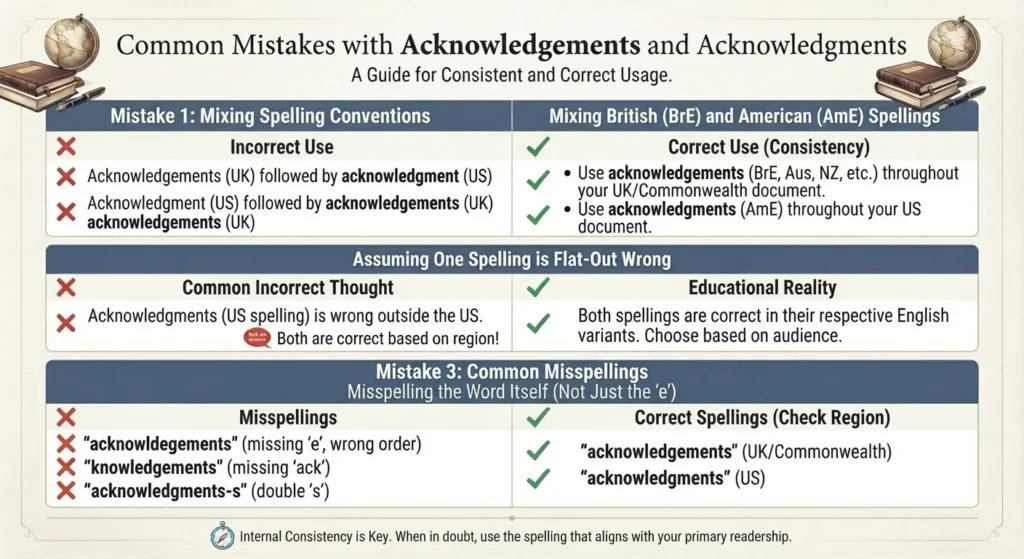
Mistake 1: Mixing both spellings in the same document. Wrong: “In the acknowledgements, I want to acknowledgments everyone who helped.” Fix: Pick one spelling and use it every time the word appears.
Mistake 2: Misspelling the middle of the word. Wrong: “Acknowledgement” written as “acknowledgement” with a missing “d” or extra letter, like “acknowlegement.” Fix: The correct root is “acknowledge,” so every form keeps that full spelling: acknowledge + ment.
Mistake 3: Confusing the noun with the verb. Wrong: “I want to acknowledgement your help.” Fix: The verb is always “acknowledge.” Only the noun takes the “-ment” ending: “I want to acknowledge your help” or “This is my acknowledgment of your help.”
Mistake 4: Using the wrong plural form. Wrong: “acknowledgments’s” or “acknowledgements’s” Fix: The plural is simply “acknowledgments” or “acknowledgements.” No apostrophe needed unless you’re showing possession.
Mistake 5: Assuming one spelling is “more correct” than the other. Fix: Neither spelling is more correct. They are regional variants, like “colour” and “color.”
Acknowledgements or Acknowledgments in Everyday Examples
In a book or thesis: “In the acknowledgements, she thanked her advisor, her family, and her research team.” (UK style) “In the acknowledgments, she thanked her advisor, her family, and her research team.” (US style)
In a work email: “I’d like to send my acknowledgments for the quick turnaround on this project.” (US) “I’d like to send my acknowledgements for the quick turnaround on this project.” (UK)
In news writing: US outlets like the New York Times or CNN use “acknowledgments.” UK outlets like the BBC or The Guardian use “acknowledgements.”
In social media posts: “Huge acknowledgments to my team for pulling this off 🙌” (US) “Huge acknowledgements to my team for pulling this off 🙌” (UK)
In formal reports and grants: Government and academic reports usually follow the country’s national spelling standard. US federal reports use “acknowledgments.” UK government reports use “acknowledgements.”
Acknowledgements or Acknowledgments – Google Trends & Usage Data
Search interest for both spellings stays fairly steady year-round, with small spikes around graduation season and book publishing cycles, when students and authors are finishing dissertations, theses, and manuscripts.
Generally, “acknowledgements” sees more search volume in the UK, Ireland, Australia, New Zealand, India, and other Commonwealth countries. “Acknowledgments” sees more search volume in the United States and Canada (though Canada often leans toward the British spelling in formal writing, creating some overlap).
Globally, “acknowledgements” tends to show slightly higher overall search volume, largely because more English-speaking countries default to British spelling conventions than to American ones. Still, in raw US traffic, “acknowledgments” dominates.
Keyword Variation Comparison
| Variation | Region | Common Use |
|---|---|---|
| Acknowledgements | UK, Australia, Commonwealth | Books, theses, formal writing |
| Acknowledgments | US, Canada (mixed) | Books, theses, formal writing |
| Acknowledgement (singular, UK) | UK, Australia | Referring to one act of thanks |
| Acknowledgment (singular, US) | US | Referring to one act of thanks |
| Acknowledging | Global | Present participle, used in both styles |
FAQs
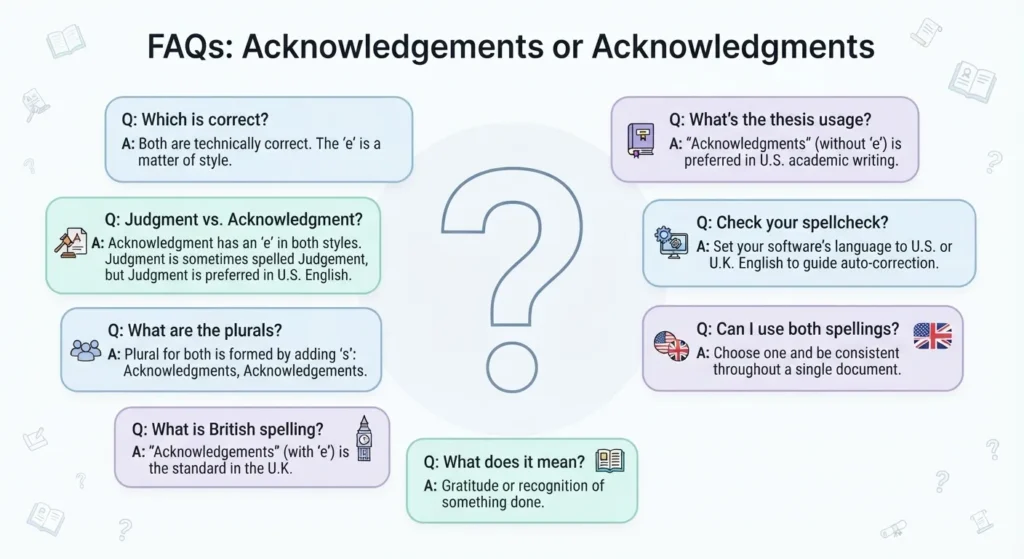
1. Is “acknowledgements” or “acknowledgments” more correct? Neither is more correct. “Acknowledgements” is British English. “Acknowledgments” is American English. Both are accepted in formal writing within their respective regions.
2. Which spelling should I use in a thesis or dissertation? Use the spelling required by your university’s style guide. US institutions typically want “acknowledgments.” UK and Commonwealth institutions typically want “acknowledgements.”
3. Does Microsoft Word or Google Docs prefer one spelling? Spell check follows whatever language setting you choose. If your document is set to English (US), it will flag “acknowledgements” as a possible error. If set to English (UK), it will flag “acknowledgments” instead.
4. Can I switch between both spellings in one document? No. Pick one spelling and use it consistently throughout the entire document, even if both are individually correct.
5. Is “acknowledgement” the same as “acknowledgment” in meaning? Yes. Both mean the same thing: the act of recognizing, admitting, or thanking someone or something. Only the spelling differs.
6. Why does British English keep the extra “e”? British English preserved older spelling conventions from historical dictionaries. American English simplified many of these spellings in the 1800s, largely due to Noah Webster’s influence.
7. What’s the plural form of this word? The plural is “acknowledgments” (US) or “acknowledgements” (UK). No apostrophe is needed unless showing possession, such as “the acknowledgments’ placement in the book.”
8. Is “judgment” spelled the same way as “acknowledgment”? Mostly, yes. American English drops the “e” in both. British English usually keeps the “e” in “acknowledgement,” but often drops it in “judgment,” especially in legal writing. This is a notable exception.
Conclusion
Both “acknowledgements” and “acknowledgments” are correct spellings of the same word. The only difference is regional. British English, Australian English, and most Commonwealth countries use “acknowledgements,” with the extra “e.” American English drops that “e” and uses “acknowledgments.”
This split traces back to different dictionary traditions. British dictionaries kept older spelling patterns. American dictionaries, shaped by Noah Webster, simplified them. The same pattern shows up in related words like “judgement” and “abridgement.”
When deciding which spelling to use, think about your audience. Writing for a US reader, publisher, or university? Use “acknowledgments.” Writing for a UK, Irish, Australian, or Commonwealth reader? Use “acknowledgements.” Writing for a global audience with no clear style guide? Choose one spelling and stay consistent across your entire document.
Getting this right shows attention to detail, whether you’re finishing a thesis, publishing a book, or writing a professional report. Now that you know the difference, you can write with confidence and never second-guess this word again.