
Leery is the correct and standard spelling when you mean cautious, suspicious, or hesitant about something. Leary is a less common variant, so use leery in formal, professional, and everyday writing.
Have you ever typed leery or leary and stopped because both spellings looked right? You are not alone. The two words sound almost the same. They also appear in real writing. This can make the choice confusing.
The quick answer is simple. Leery is the standard spelling in modern English. It means cautious, suspicious, or slow to trust someone or something. Leary does exist, but Merriam-Webster lists it as a less common spelling of leery. For clear and professional writing, leery is the better choice.
People often search for leery or leary when writing emails, school work, articles, reports, or social posts. Some also wonder if one spelling is British and the other is American. That is not the case. Cambridge gives leery as an English word with both UK and US pronunciation forms.
This guide explains the spelling, meaning, history, regional use, common mistakes, and everyday examples so you can use the word with confidence.
Leery or Leary – Quick Answer
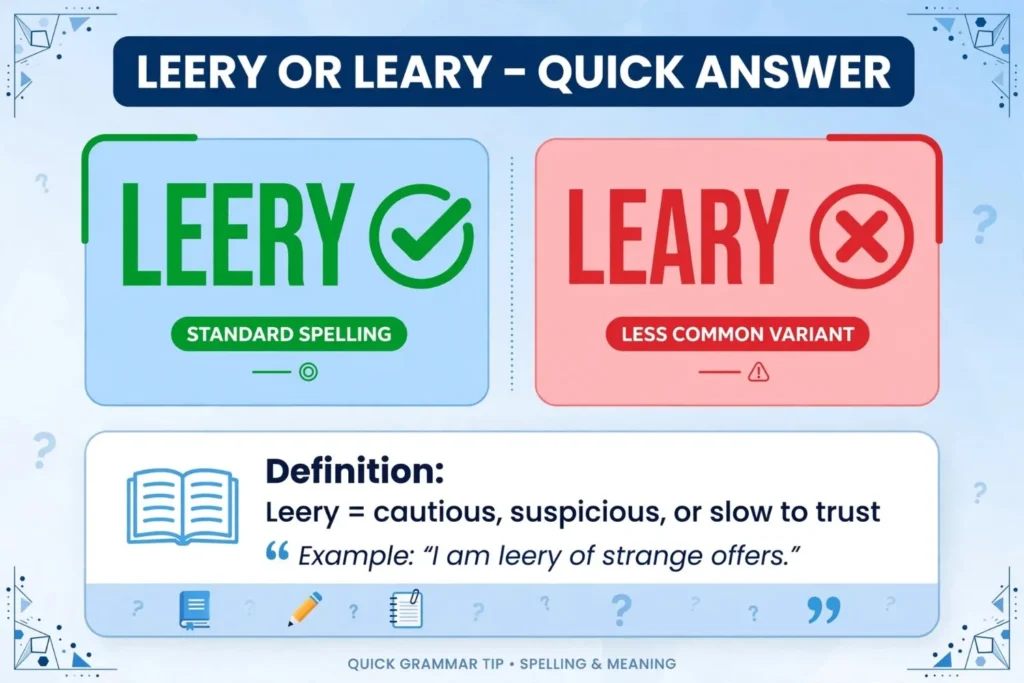
Leery is the safest and standard spelling.
It is an adjective. It means that someone feels suspicious, careful, or unsure because they do not fully trust a person, thing, or situation. Cambridge defines leery as not trusting someone or something and often wanting to avoid it. Merriam-Webster gives similar meanings such as suspicious and wary.
Examples:
- I am leery of giving my card details to unknown websites.
- She was leery of the strange offer.
- We are leery about making such a large change.
- He felt leery of trusting someone he had just met.
Leary can appear as a less common variant. However, it is not the best choice for normal professional writing. Merriam-Webster recognizes it but points readers back to leery.
So, when you are unsure about leery or leary, choose leery.
The Origin of Leery or Leary
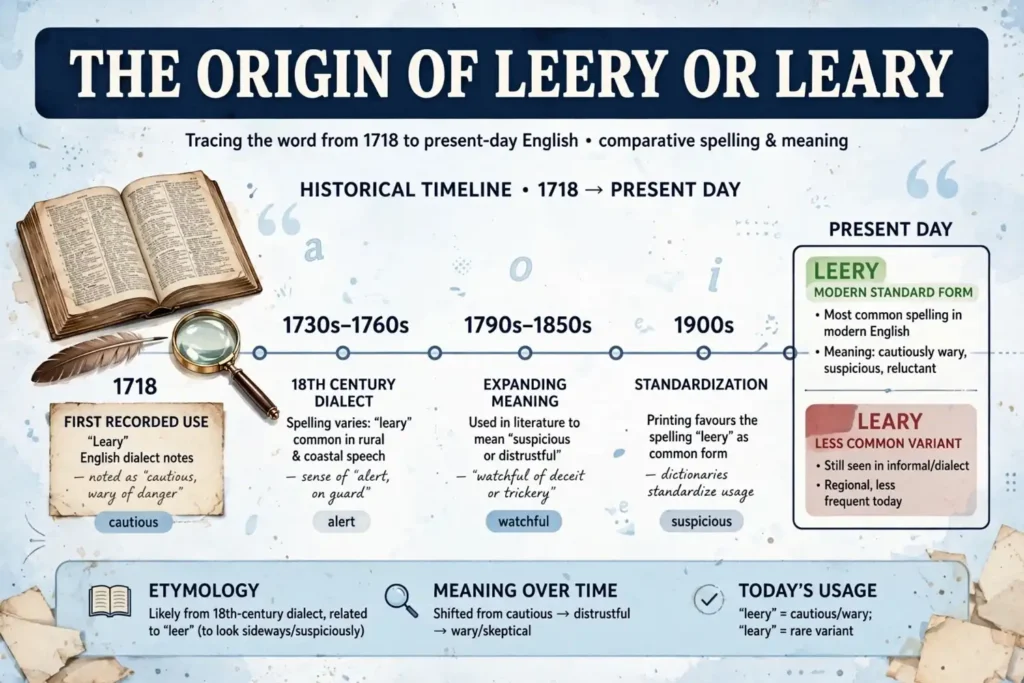
The history of leery or leary helps explain why both forms can sometimes appear.
The word leery has been used since the early 1700s. The Oxford English Dictionary records its earliest known use in 1718. Etymology sources also date the word to 1718 and say it first had meanings linked with being alert, suspicious, knowing, or watchful.
Its exact origin is not fully certain.
One idea links it to an older word connected with learning or knowledge. Another possible link is the verb leer. Older uses of that word could describe a secret or sideways look. These ideas fit the modern sense of watching something with doubt or suspicion. However, language experts do not agree on one certain source.
The spelling leary developed as an alternative form. It may look natural because many English words ending in the “ee-ree” sound use different vowel patterns. Today, however, leery is far more suitable for standard writing, while Merriam-Webster labels leary as less common.
A simple memory trick is:
Leery has two E’s because you keep your eyes open when you are suspicious.
British English vs American English Spelling

Many spelling questions happen because British and American English use different forms.
For example:
| British English | American English |
|---|---|
| colour | color |
| centre | center |
| favourite | favorite |
| travelling | traveling |
But leery or leary does not follow this type of regional spelling rule.
Cambridge lists leery with both UK and US pronunciations, while Merriam-Webster uses leery as the main American dictionary form. This shows that leery works well in both major varieties of English.
Leery vs Leary Comparison
| Feature | Leery | Leary |
| Standard modern spelling | Yes | Less common variant |
| Meaning | Suspicious, cautious, wary | Same when used as a variant |
| Common in American English | Yes | Much less common |
| Suitable for British English | Yes | Best avoided in formal writing |
| Good for professional writing | Yes | Usually no |
| Common pattern | Leery of | Leary of is less standard |
| Can be a surname | Rare as surname | Yes, Leary can be a surname |
Merriam-Webster specifically describes leary as a “less common spelling of leery.”
So there is no need to change the spelling based on whether your audience is in Britain or America.
Which Spelling Should You Use?

For most readers, the answer is easy:
Use leery.
For American Readers
Use leery in emails, articles, essays, reports, and business writing.
Example:
Correct: Customers may be leery of sharing private data.
Using leary may look like a spelling mistake, even though some dictionaries recognize it as a rare variant. Merriam-Webster clearly presents leery as the main form.
For British Readers
Use leery as well.
Cambridge includes the word in British English and provides a UK pronunciation for it. There is no standard British rule that requires leary.
For Canada, Australia, and Other Commonwealth Readers
Leery is also the safest choice.
Using one standard spelling makes your writing easier to understand across different countries.
For Global and SEO Content
Choose leery when writing for an international audience.
It matches the main dictionary spelling and reduces the risk of readers thinking you made an error.
You can still mention leery or leary in an article about spelling because people search for both forms.
Read More: Tryed or Tried? The Correct Spelling
Common Mistakes with Leery or Leary
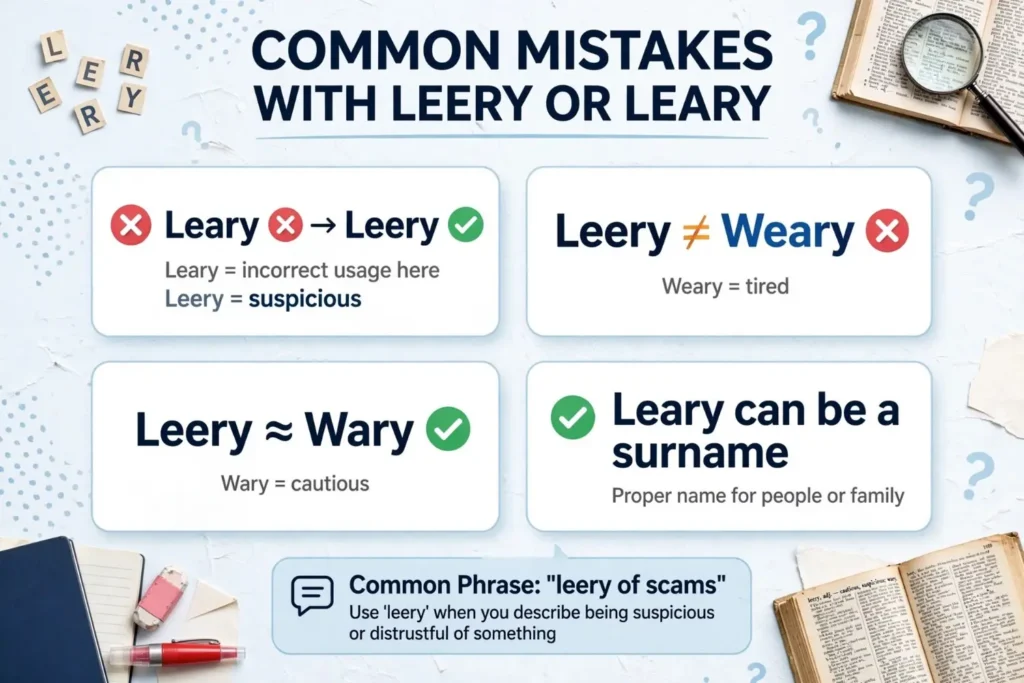
The confusion around leery or leary often comes from sound, spelling, and similar words.
1. Writing “Leary” Instead of “Leery”
Less clear:
I am leary of this website.
Better:
I am leery of this website.
Although Merriam-Webster recognizes leary as a less common spelling, leery remains the main form.
2. Confusing Leery with Weary
These words have different meanings.
Leery means suspicious or cautious.
Weary means tired.
Example:
- I am leery of that deal.
Meaning: I do not trust it. - I am weary after working all day.
Meaning: I am tired.
3. Confusing Leery with Wary
Leery and wary are close in meaning.
Merriam-Webster lists wary among the synonyms of leery.
You could say:
- I am leery of online scams.
- I am wary of online scams.
Both sentences show caution or distrust.
4. Using “Leary” When It Is a Name
Leary can also be a proper name or surname. In that case, the spelling should not be changed.
For example:
Mr. Leary joined the meeting.
Here, Leary is a name. It does not mean suspicious.
5. Forgetting the Word “Of”
Leery is often followed by of.
Examples:
- leery of strangers
- leery of scams
- leery of investing
- leery of the plan
Both Cambridge and Merriam-Webster show leery commonly used with of.
Leery or Leary in Everyday Examples
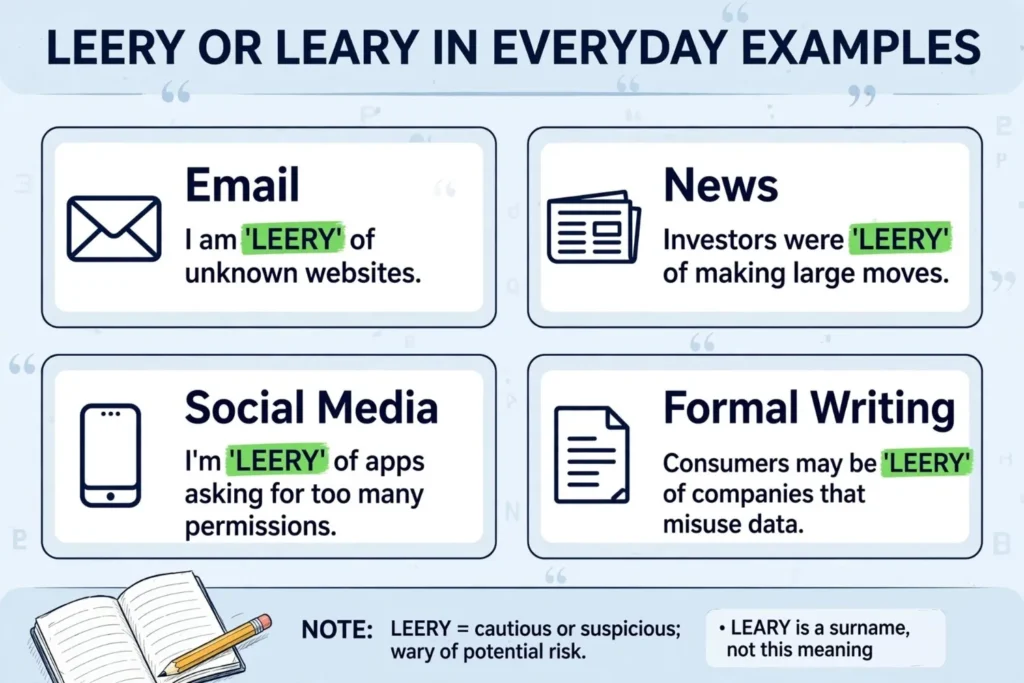
Knowing the rule is useful. Seeing the word in real situations makes it easier to remember.
In Emails
Professional email:
I am leery of approving the payment until we confirm the account details.
This sounds careful and professional.
In News Writing
Investors were leery of making large moves before the new report came out.
Here, leery shows doubt or caution.
On Social Media
I am leery of apps that ask for too many permissions.
This is natural and easy to understand.
In Formal Writing
Consumers may become leery of companies that fail to protect personal information.
The word works well when explaining caution or lack of trust.
In Everyday Conversation
I’m a little leery of buying a phone from someone I don’t know.
This is also natural because leery is often used in informal speech. Cambridge and Collins both describe the word as informal in at least some uses.
More Simple Examples
- She was leery of the salesman.
- He is leery of giving personal details online.
- Parents may be leery of unknown apps.
- I was leery about accepting the offer.
- They seemed leery of the new rule.
- We are leery of deals that look too good to be true.
Leery or Leary – Google Trends & Usage Data
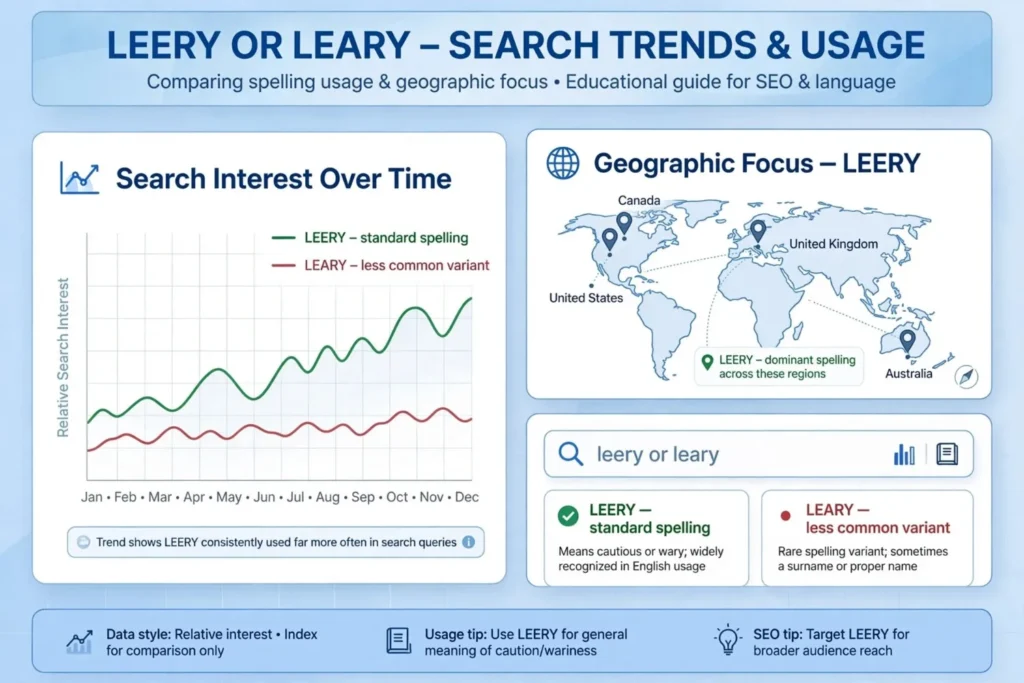
Search data can help explain why people continue to look up leery or leary.
Google Trends measures relative search interest, not exact search volume. Its scores run from 0 to 100 based on the share of searches for a term within a selected time and place. A score of 100 means the term reached its highest relative interest in that comparison.
Google also treats spelling variations as separate search terms. This matters when comparing leery and leary. Google explains that Trends does not automatically combine misspellings or spelling variants when users enter individual search terms.
For spelling research, it makes sense to compare the two forms separately.
United States
The main dictionary form is leery, so writers targeting US readers should use that spelling. Merriam-Webster treats leary only as a less common form.
United Kingdom
Leery is also accepted in British English. Cambridge provides a UK pronunciation and standard definition for the word.
Canada and Australia
There is no major British-versus-American spelling rule that changes leery into leary. For international English content, leery remains the safest form.
Search interest for a spelling question can change by country, date, and search settings. Google also warns that very low-volume search terms may not produce enough data to create a Trends graph.
For SEO writers, this means the phrase leery or leary can be useful for answering spelling intent, while leery should remain the spelling used in normal sentences.
Leery vs Leary – Full Comparison Table
| Point | Leery | Leary |
| Meaning | Cautious, suspicious, wary | Same as leery when used as a variant |
| Standard spelling | Yes | Less common |
| Dictionary status | Main form | Variant in some dictionaries |
| US English | Preferred | Rare |
| UK English | Standard and accepted | Not needed as a British alternative |
| Formal writing | Recommended | Usually avoid |
| Business emails | Recommended | Usually avoid |
| Academic writing | Recommended | Usually avoid |
| SEO spelling article | Use as main form | Mention as search variation |
| Example | I am leery of the offer. | Less standard: I am leary of the offer. |
| Easy memory tip | Two E’s | Do not use unless needed as a name or variant |
Merriam-Webster supports leery as the main form while listing leary as less common, and Cambridge uses leery for both UK and US English.
FAQs About Leery or Leary
1. Is it leery or leary?
Leery is the standard spelling. Leary exists as a less common variant, but leery is better for normal and professional writing.
2. What does leery mean?
Leery means suspicious, cautious, or unwilling to trust someone or something.
3. Is leary a real word?
Yes. Merriam-Webster lists leary as a less common spelling of leery. Still, using leery will look more natural to most readers.
4. Is leary the British spelling of leery?
No. Leery is used in British English too. Cambridge lists both UK and US pronunciation forms for leery.
5. Should I write leery of or leary of?
Write leery of in standard English.
Example:
I am leery of sharing my password.
The phrase leery of is also shown in major dictionary examples.
6. What is the difference between leery and weary?
Leery means suspicious or cautious. Weary means tired.
Example:
I am leery of the deal, but I am weary from reading the contract.
7. Are leery and wary the same?
They are very close in meaning. Both can describe a person who feels careful or suspicious. Merriam-Webster lists wary as a synonym of leery.
Conclusion
The confusion over leery or leary is easy to solve once you know the main rule. Leery is the standard spelling to use when you mean cautious, suspicious, or unsure about trusting someone or something. Major dictionaries use leery as the main form, while Merriam-Webster describes leary as a less common spelling.
There is also no special British-versus-American rule to remember. Leery works in both varieties of English. Cambridge includes UK and US pronunciation forms for the word, so writers do not need to switch to leary for a British audience.
For emails, articles, school work, reports, social posts, and global SEO content, choose leery. Use phrases such as leery of scams, leery of strangers, or leery of an offer.
One simple rule is enough: when choosing between leery or leary, write leery unless Leary is a person’s name or you are discussing the rare spelling itself.

Hi, I’m Shafqat Rehman. I write easy-to-follow guides about spelling differences, grammar, commonly confused words, comparison keywords, and British and American English variations. I enjoy breaking down confusing language topics and explaining them with clear examples. My aim is to help readers understand English differences and use the right words naturally and confidently.