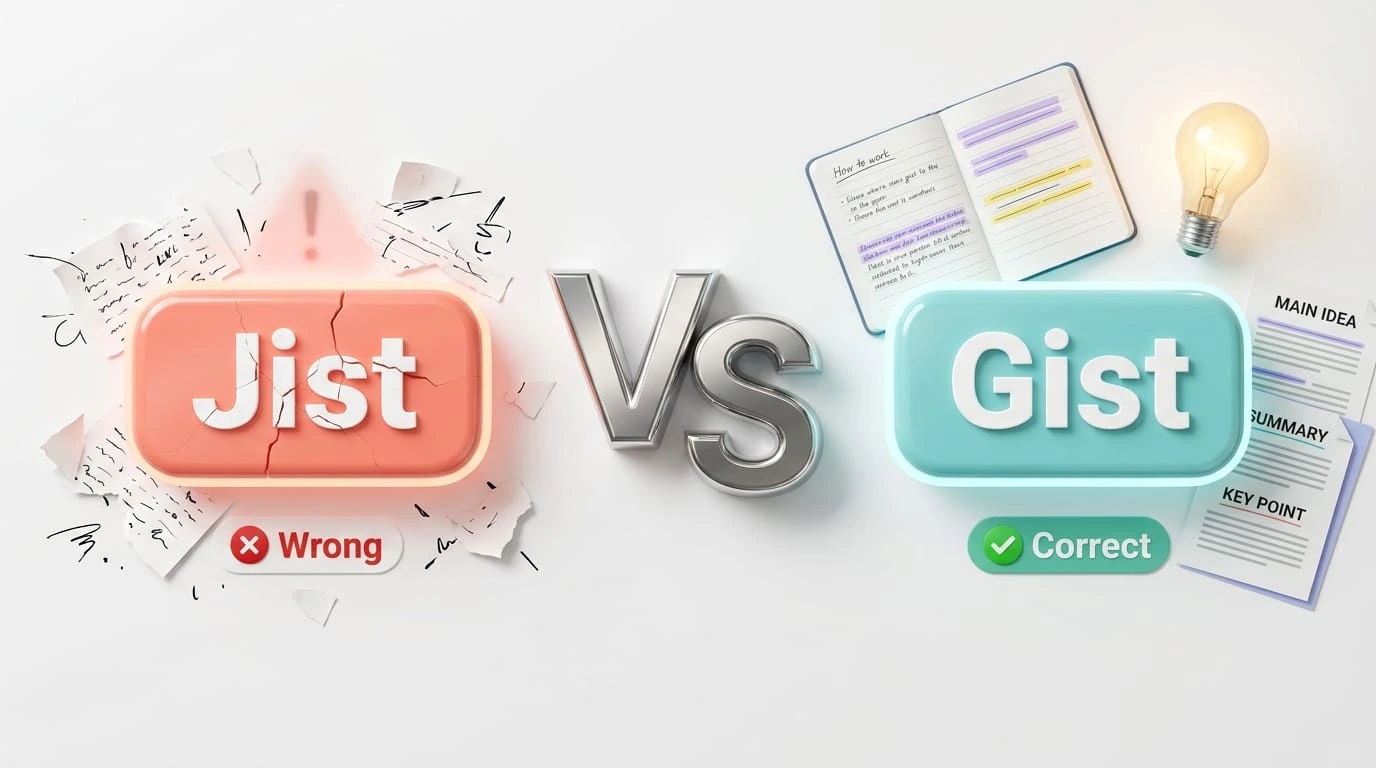
“Gist” is the correct English word. It means the main point, central idea, or essential meaning of something. “Jist” is a common misspelling of gist and should be avoided in formal and informal writing.
The first time I saw someone write “jist of the story,” I barely noticed anything wrong. After all, “gist” is pronounced with a soft “j” sound, so “jist” seems like it should be correct. But when I checked a dictionary, I discovered that “jist” isn’t a standard English word at all it’s simply a spelling mistake that many people make.
If you’ve searched for “jist or gist,” you’re probably wondering whether both spellings are acceptable or if one is more correct. This confusion is common because English pronunciation doesn’t always match spelling. Words like giant, giraffe, and gist all begin with the letter G but sound like J.
The good news is that the answer is simple. Once you understand why gist is spelled with a G, you’ll never second-guess it again. In this guide, you’ll learn the meaning of gist, why jist appears so often, real-life examples, common mistakes, pronunciation tips, and the correct word to use in every situation.
Gist Pronunciation
Pronunciation: /dʒɪst/ (jist)
Although gist starts with the letter G, it is pronounced exactly like “jist.” This pronunciation is one of the main reasons many people accidentally spell the word with a J instead of a G.
Jist or Gist: Quick Answer
The correct spelling is gist.
Gist means the main idea, essential point, or overall meaning of something. Jist is not a standard English word. It is simply a misspelling caused by pronunciation.
Examples
✅ I understood the gist of the presentation.
✅ Can you give me the gist of the meeting?
❌ I understood the jist of the presentation.
Quick Comparison
| Word | Correct? | Meaning | Best Use |
| Gist | ✅ Yes | Main idea or essential meaning | All writing |
| Jist | ❌ No | Misspelling of gist | Avoid |
The Origin of Jist or Gist
The word gist has an interesting history. It comes from an old legal term that entered English through Anglo-French. The original word referred to the essential point or grounds of a legal case.
Over time, its meaning expanded beyond law. Today, gist simply means the central idea or most important part of any conversation, article, story, or explanation.
So why do people write jist?
The answer is pronunciation. Since gist is spoken with a J sound, many writers naturally assume it should begin with the letter J. English spelling, however, doesn’t always follow pronunciation.
That’s why:
- Giant
- Ginger
- Giraffe
- Gist
all begin with G but are pronounced with a soft J sound.
Jist or Gist Explained: Key Differences
Although the two spellings look similar, only one is correct in standard English.
| Term | Meaning | When to Use | Context |
| Gist | The main point or essential meaning | Always | Everyday and formal English |
| Jist | Misspelling of gist | Never | Typographical error |
Example Sentences
Gist
I didn’t read the whole report, but I understood the gist.
Can you tell me the gist of the conversation?
Jist
❌ Please explain the jist of the article.
Which Version Should You Use?
The answer is straightforward.
For Students
Always write gist in essays, assignments, and exams.
For Professionals
Use gist in emails, reports, presentations, and business communication.
For Content Writers
Choose gist because it is the only correct spelling recognized by dictionaries and style guides.
For International Readers
No matter where your audience lives, gist is the accepted spelling.
Professional Recommendation
| Audience | Recommended Word |
| Students | Gist |
| Business Professionals | Gist |
| Teachers | Gist |
| Writers | Gist |
| Global Audience | Gist |
Bottom line: Never replace gist with jist.
Common Mistakes with Jist or Gist
Many writers confuse pronunciation with spelling. Here are the mistakes to avoid.
| Mistake | Correct Version | Why? |
| The jist of the story | The gist of the story | Gist is the correct spelling. |
| I got the jist. | I got the gist. | Jist is not a standard English word. |
| Assuming jist is American English | Gist is correct everywhere | There is no regional difference. |
| Using both spellings in one article | Use gist consistently | Consistency improves clarity. |
Quick Tip
Remember: If you mean “the main idea,” always write gist with a G, even though it sounds like J.
Gist in Common Phrases
These are the most common phrases where the word is used in everyday and professional English.
| Phrase | Correct Usage |
| Get the gist | ✅ Correct |
| The gist of the story | ✅ Correct |
| The gist of the conversation | ✅ Correct |
| Understand the gist | ✅ Correct |
| Explain the gist | ✅ Correct |
Gist in Real-World Examples
Seeing gist in everyday situations makes it easier to remember the correct spelling.
In a Professional Email
Could you send me the gist of yesterday’s meeting? I wasn’t able to attend.
In a News Headline
Experts explain the gist of the government’s new education policy.
On Social Media
I didn’t watch the whole video, but I got the gist from the comments.
In a Formal Report
The executive summary provides the gist of the research findings and recommendations.
Gist: Data, Trends & Usage
The word gist is searched thousands of times each month because many people hear it before they see it written. Since it’s pronounced like “jist,” it’s common for learners to type the wrong spelling into search engines.
Usage Insights
- Gist is the only standard spelling recognized by major dictionaries.
- Jist mainly appears as a spelling error in online searches and informal writing.
- Students, English learners, writers, and professionals frequently search for this word.
- Search intent is informational, as users want to know the correct spelling and meaning.
Popular Usage by Region
| Region | Preferred Spelling |
| United States | Gist |
| United Kingdom | Gist |
| Canada | Gist |
| Australia | Gist |
| New Zealand | Gist |
Why It Matters
As online communication grows, spelling correctly builds credibility. Using gist instead of jist helps your writing appear more professional and trustworthy.
Jist vs Gist Comparison Table
| Term | Meaning | Region/Context | Best Used When |
| Gist | The main idea or essential meaning | Worldwide | Always |
| Jist | Misspelling of gist | None | Never |
Frequently Asked Questions
1. What does gist mean?
Gist means the main point, central idea, or essential meaning of something without including every detail.
2. Is “jist” a real word?
No. Jist is not a standard English word. It is simply a common misspelling of gist.
3. Why do people spell gist as “jist”?
Because gist is pronounced with a soft J sound, many people naturally assume it should start with the letter J.
4. Can I use “jist” in formal writing?
No. In essays, emails, reports, and professional documents, always use gist.
5. Which is correct: jist or gist?
Gist is the only correct spelling. Jist should be avoided in all types of writing.
6. Is gist used in British and American English?
Yes. Gist is the standard spelling in both British and American English.
7. How can I remember the correct spelling of gist?
Think of words like giant, giraffe, and ginger. They all begin with G but have a J sound. Gist follows the same pattern.
Conclusion
The confusion between jist or gist is easy to understand because the word gist sounds like it begins with the letter J. However, standard English uses only one correct spelling: gist. It means the main idea, central point, or essential meaning of something, whether you’re talking about a conversation, book, report, or presentation.
Remember these key takeaways:
- Gist is the correct spelling.
- Jist is a common misspelling.
- Gist is used in both British and American English.
- You can confidently use gist in academic, professional, and everyday writing.
Ninth or Nineth: Which One Is Correct?

As an English language enthusiast, I love diving into the tricky details of word differences and spelling variations. My mission is to explain confusing terms and make them accessible to everyone, helping readers to communicate with clarity and confidence.