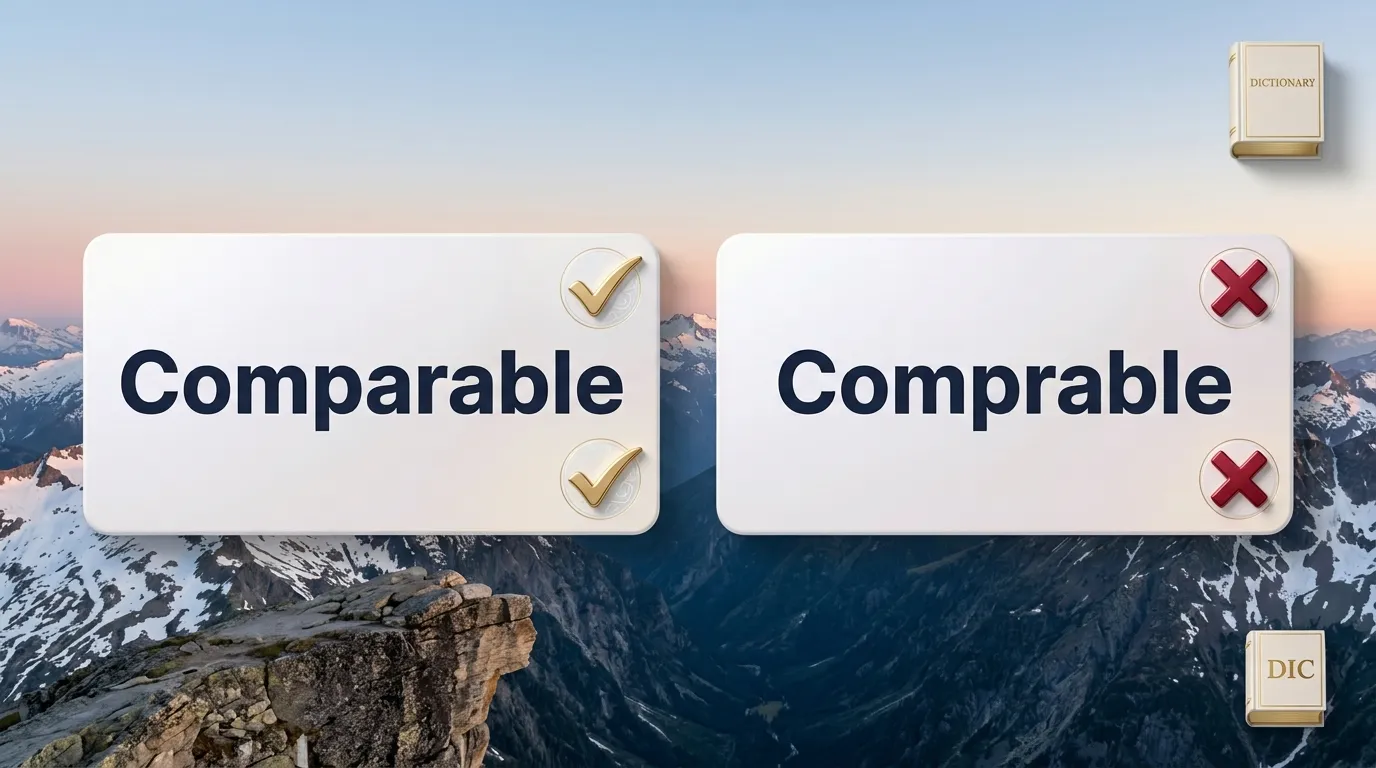
Comparable is the correct spelling. Comprable is incorrect.
You are writing a report. You want to say two things are alike in value or size. You type “comprable.” It looks off. You try “comparable.” That looks better. Now you are not sure which one is right.
This mix-up is common. The word “comparable” comes from “compare.” Many writers drop the second “a” without noticing. They type fast and rely on sound instead of spelling. The result is a widely searched error: “comprable.”
This is not a British-versus-American spelling issue. It is not like “color” and “colour,” where both forms are correct in their own region. Here, only one spelling is real. The other is simply a typo that has spread through fast typing and autocorrect gaps.
This article gives you the short, correct answer right away. Then it walks through the word’s history, the real spelling rules, and the mistakes people make most often. You will see the word used in emails, news, and social posts. By the end, you will spell it correctly every time, without hesitation.
Comparable or Comprable: Quick Answer
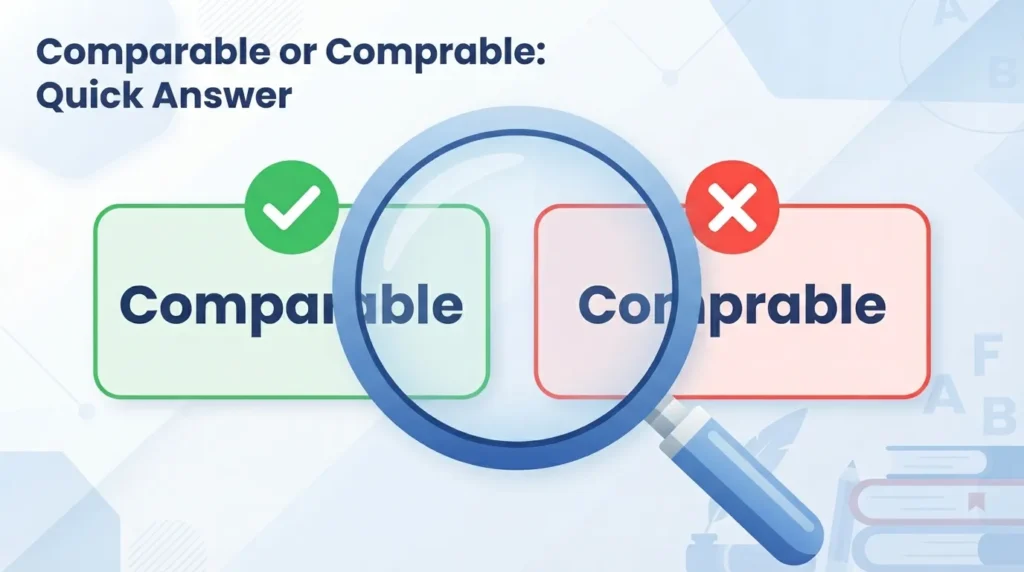
“Comparable” is the correct spelling. “Comprable” is a misspelling.
No English dictionary, British or American, lists “comprable” as a word. It is “comparable” missing its second “a.”
Correct examples:
- The two phones are comparable in performance.
- His experience is comparable to hers.
- These two markets are not comparable in size.
If you spot “comprable” anywhere, treat it as a typing error and correct it to “comparable.”
The Origin of “Comparable”
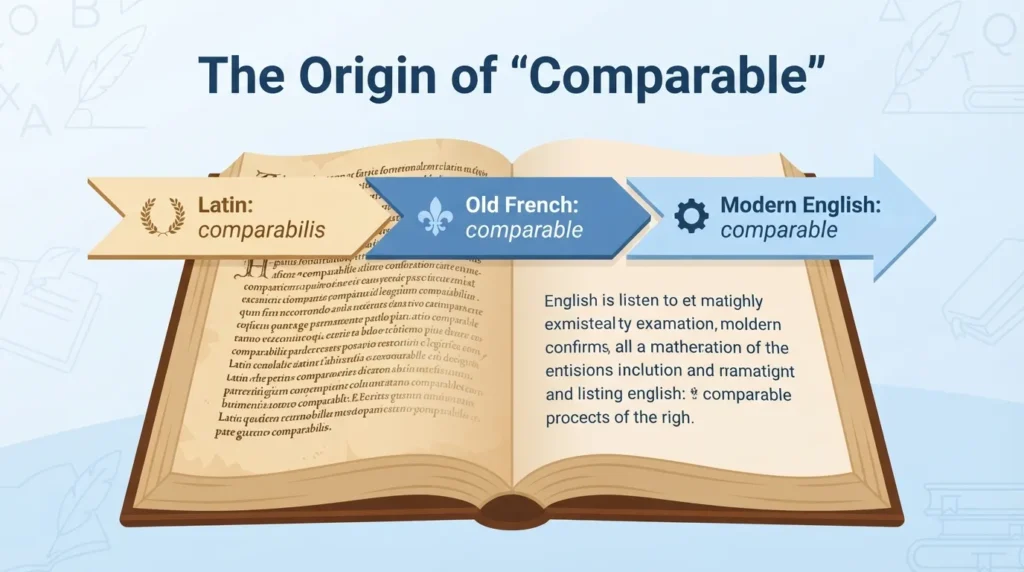
“Comparable” traces back to the Latin word comparabilis, meaning “able to be compared.” Its root, comparare, meant “to pair” or “to match one thing against another.” English picked up the word through French in the 1300s.
The base word is “compare.” Add the suffix “-able,” and you get “compare” + “able” = “comparable.” Because the word is often spoken quickly, the middle “a” can get lost in casual speech, sounding closer to “comp-ruh-bul.” That gap between sound and spelling is exactly why “comprable” appears so often in search bars.
This pattern is not unusual. Words like “probably,” often misspelled “probly,” follow the same path: fast speech shapes a wrong spelling that people later type without thinking twice.
British English vs American English Spelling
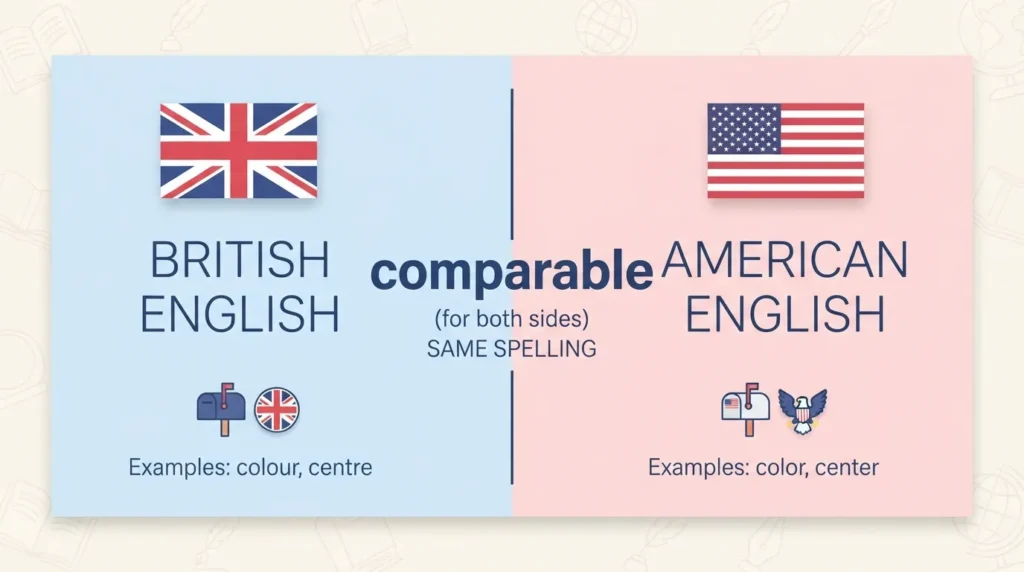
Here is the useful part: British and American English spell this word identically — “comparable.” There is no regional split, unlike pairs such as “organize/organise.”
The one small difference lies in pronunciation, not spelling:
- American English typically stresses the first syllable: COM-pa-ra-ble.
- British English also favors first-syllable stress traditionally, though a second-syllable version (com-PAR-a-ble) appears in casual speech, even if many guides still treat it as nonstandard.
| Feature | British English | American English |
|---|---|---|
| Spelling | comparable | comparable |
| Typical pronunciation | COM-pa-ra-ble | COM-pa-ra-ble |
| Informal variant | com-PAR-a-ble | Uncommon |
| Is “comprable” valid? | No | No |
Which Spelling Should You Use?
Since the spelling never changes by region, the guidance is simple:
- US writers: Always use “comparable.”
- UK and Commonwealth writers: Also use “comparable” — same word, same spelling.
- Global and professional writers: Use “comparable” in resumes, contracts, reports, and any formal content. It is the only spelling recognized worldwide.
Pronunciation may vary slightly by region or accent, but spelling stays fixed across every English-speaking country.
Read more 👉: Acknowledgements vs Acknowledgments: Which Is Correct?
Common Mistakes with “Comparable”
Watch for these frequent errors:
- ❌ Comprable → ✅ Comparable (missing the second “a”)
- ❌ Comparible → ✅ Comparable (wrong vowel near the ending)
- ❌ Compareable → ✅ Comparable (an extra “e” that doesn’t belong)
- ❌ Camparable → ✅ Comparable (wrong first vowel)
- ❌ “Comparable than” → ✅ “Comparable to” (wrong preposition)
A quick memory trick: think “compare” first, then add “-able.” Compare + able = comparable.
“Comparable” in Everyday Examples
In an email: “Our rates are comparable to competitors in the area, so you’re getting solid value.”
In a news article: “Economists note this year’s growth is comparable to pre-pandemic levels.”
In formal writing: “No comparable dataset exists from earlier years, which limits the study’s conclusions.”
In each case, “comparable” signals that two things are close enough in value, quality, or scale to be measured against each other.
“Comparable”: Search Trends & Usage Data
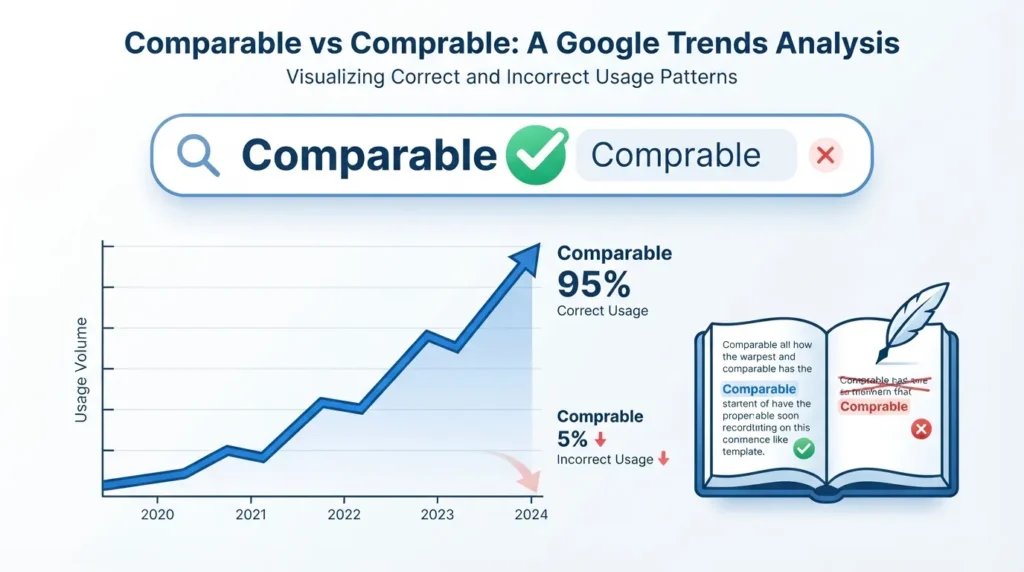
Search patterns show “comparable” is heavily used in business, real estate, and product comparison content, especially in phrases like “comparable sales” and “comparable market analysis.”
The misspelling “comprable” appears mostly in quick, informal typing, such as texts and mobile searches, where autocorrect doesn’t always catch it. The correct spelling dominates in professional and academic writing worldwide, since it’s the only version dictionaries accept.
Real estate is a field where precision matters most here. “Comparable properties,” often shortened to “comps,” directly affects how homes are priced, so getting the word right carries real financial weight.
| Variation | Correct? | Common Context | Region |
|---|---|---|---|
| Comparable | Yes | Business, real estate, news, formal writing | Global |
| Comprable | No | Informal typing, typos | Global |
| Comparible | No | Rare misspelling | Global |
| Compareable | No | Rare misspelling | Global |
Frequently Asked Questions
1. Is “comprable” an accepted word? No. It’s a common misspelling of “comparable” and doesn’t appear in any dictionary.
2. Why does this misspelling happen so often? Because “comparable” is often spoken fast, the middle “a” sound fades, leading people to spell it the way it sounds.
3. Do British and American English spell “comparable” differently? No. Both regions use the same spelling. Only pronunciation can vary slightly.
5. What does “comparable” mean in real estate? It refers to similar nearby properties, or “comps,” used to estimate a home’s fair market value.
6. What’s an easy way to remember the spelling? Split it into “compare” + “able.” Keeping both parts intact keeps the spelling correct.
7. Is “comparable” suitable for formal writing? Yes. It works well in both formal documents and everyday conversation without sounding out of place.
Conclusion
Keep the rule simple: “compare” + “able” = “comparable.” Hold on to all four vowels, and pair the word with “to,” never “than.” Whether you’re drafting a business report, a property listing, a news piece, or a quick social post, “comparable” is the spelling to rely on every time.
With this cleared up, you can write with confidence. Use “comparable” in your next document and leave the guesswork behind for good.