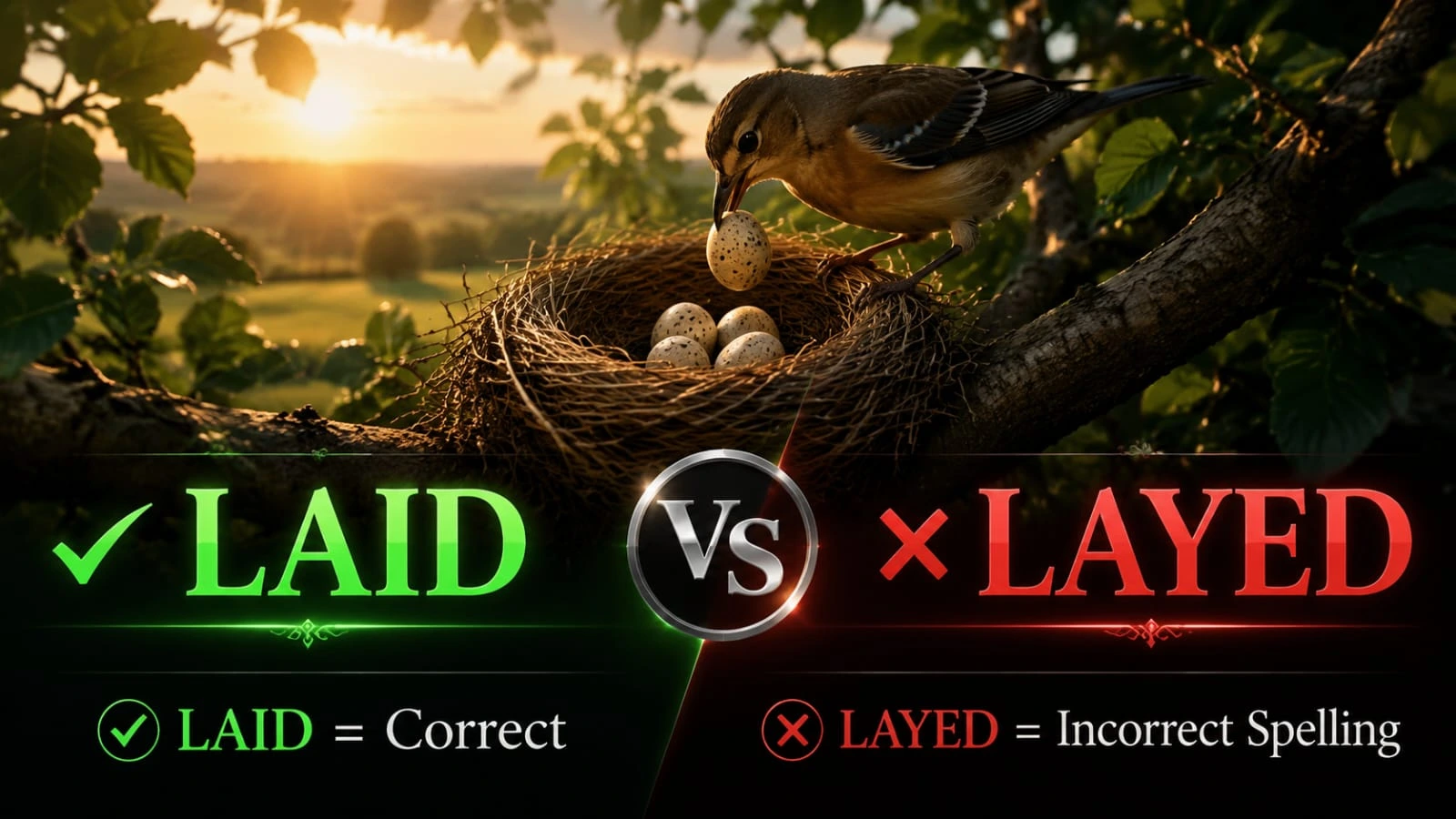
"Laid" is the correct past tense of "lay." "Layed" is a common misspelling and isn't a real word in standard English.
I once submitted a project update that read, “The foundation was layed last Tuesday.” My supervisor circled the word in red and wrote “laid” above it. I stared at it, confused, since “lay” seemed like it should just add “-ed” the normal way.
If you’ve ever hesitated over this word, you’re far from alone. This is one of the most commonly misspelled past-tense verbs in English, and the confusion makes total sense once you see why it happens.
This guide clears up exactly why “laid” is correct, where the mix-up comes from, and how to spell it confidently every time, whether you’re writing a report, a text, or a formal document.
Layed or Laid: Quick Answer
“Laid” is always correct. “Layed” is a spelling error, not an accepted variant.
- ✅ She laid the blanket on the grass.
- ❌ She layed the blanket on the grass.
The confusion happens because most regular verbs simply add “-ed” for the past tense, like “played” or “stayed.” But “lay” is an irregular verb, and its past tense doesn’t follow that standard pattern.
The Origin of Laid
“Lay” comes from Old English lecgan, meaning to place or put something down. Unlike regular verbs, “lay” belongs to a small group of English verbs that form irregular past tenses by changing internal spelling rather than simply adding “-ed.”
This irregular pattern shows up in a handful of related verbs:
- lay → laid
- pay → paid
- say → said
Notice the shared pattern: each of these verbs changes the y to i before adding d, instead of tacking on the regular “-ed” ending. Because so many other English verbs follow the standard “-ed” rule, writers naturally assume “lay” should too, which is exactly why “layed” shows up so often.
Laid Explained: Key Differences and Variations
| Word | Correct Past Tense | Verb Type | Example |
| Lay | Laid | Irregular | He laid the book on the table. |
| Play | Played | Regular | She played the piano yesterday. |
| Stay | Stayed | Regular | We stayed at the hotel overnight. |
| Pay | Paid | Irregular | He paid the bill in cash. |
Notice that “lay” behaves nothing like “play” or “stay,” even though all three end the same way in their base form. Irregular verbs simply don’t follow the predictable “-ed” pattern.
Which Spelling Should You Use?
For everyday writing
Always use laid. There’s no context where “layed” is correct.
For students and ESL learners
Group “lay” with “pay” and “say” as irregular verbs that change y to i before adding d, rather than following the standard “-ed” rule.
For professional or formal documents
Double-check reports, emails, and contracts carefully, since “layed” often slips through in fast typing.
For global or neutral use
Laid is standard across American, British, Australian, and all other English dialects. There’s no regional variation here.
Common Mistakes with Laid
Mistake 1: Writing “layed” instead of “laid”
✅ The hens laid several eggs this morning.
❌ The hens layed several eggs this morning.
Why it happens: Writers apply the standard “-ed” rule without realizing “lay” is an irregular verb.
Mistake 2: Confusing “laid” with “lied”
✅ He laid the keys on the counter. She lied about her age.
❌ He lied the keys on the counter. (mixing up “lay” and “lie”)
Why it happens: “Lay” and “lie” are two separate verbs with overlapping past tenses, which creates frequent confusion.
Mistake 3: Misusing “laid” for the verb “lie” (to recline)
✅ Yesterday, she lay down for a nap.
❌ Yesterday, she laid down for a nap.
Why it happens: “Lay” is also the past tense of “lie” (to recline), which adds another layer of confusion between these closely related verbs.
Mistake 4: Writing “layed” in professional or legal documents
✅ The groundwork was laid before the project began.
❌ The groundwork was layed before the project began.
Why it happens: Formal writing sometimes gets less careful proofreading than expected, letting the error slip through.
Mistake 5: Assuming spellcheck will always catch it
✅ Always proofread manually, since some tools miss this error.
❌ Relying only on autocorrect to flag “layed” as incorrect.
Why it happens: Certain spellcheck settings and casual writing apps don’t consistently catch this specific mistake.
Laid in Real-World Examples
Professional email:
“The groundwork for the new marketing strategy was laid during last week’s planning session.”
News headline:
“City Officials Laid Out New Infrastructure Plan at Town Hall Meeting”
Social media post:
“Finally laid down some new flooring in the kitchen this weekend. 🛠️”
Formal document:
“The terms of the agreement were laid out clearly in section three.”
In every case, laid is the only correct spelling, regardless of tone or formality.
Laid: Data, Trends & Usage
Search interest in “layed vs laid” stays fairly steady, with noticeable spikes around school writing assignments, professional reports, and construction or project updates, where the word appears often. This falls into the informational search category, with students, professionals, and writers checking spelling before submitting or publishing content.
This mistake shows up frequently among writers who confuse “lay” with regular verbs like “play” and “stay.” Because “layed” looks like it should follow the same predictable pattern, it remains one of the more persistent irregular-verb errors in everyday English writing.
Ninth or Nineth: Which One Is Correct?
Layed vs Laid: Comparison Table
| Term/Variant | Meaning | Region/Context | Best Used When |
| Laid | Correct past tense of “lay” | Universal, all English dialects | Always, in any writing context |
| Layed | Misspelling, not a real word | None, incorrect everywhere | Never, avoid entirely |
| Lay | Base verb form (to place something down) | Universal | Present tense or infinitive use |
Frequently Asked Questions
Q: What does “laid” mean?
A: “Laid” is the past tense of “lay,” meaning something was placed or put down, such as “She laid the papers on the desk.”
Q: How do you use “laid” correctly in a sentence?
A: Use “laid” any time you’re describing the past-tense action of placing something down, such as “He laid the tools beside the toolbox.”
Q: Laid vs layed, what’s the difference?
A: There’s no real difference in meaning, since “layed” isn’t a correct word at all. “Laid” is the only accepted past tense of “lay.”
Q: Is “laid” acceptable in formal writing?
A: Yes, completely. “Laid” is the standard spelling in academic writing, legal documents, professional reports, and everyday communication.
Q: Which version is correct, laid or layed?
A: “Laid” is correct. “Layed” is a spelling error that doesn’t appear in any English dictionary.
Q: Where does the word “laid” come from?
A: It comes from Old English lecgan, meaning to place or put down. Like “paid” and “said,” it forms its past tense irregularly instead of simply adding “-ed.”
Q: Can “laid” be used in casual conversation and texting?
A: Yes. The spelling never changes based on tone, it’s “laid” whether you’re texting a friend or writing a formal report.
Final Takeaway
Here’s the short version. “Laid” is always correct. “Layed” is always wrong.
Key points to remember:
- The rule: “Lay” is an irregular verb, joining “pay” and “say” in changing y to i before adding d
- Watch for “lie” too: Don’t confuse “laid” (past tense of “lay”) with “lay” (past tense of “lie”)
- No shortcuts: Regular “-ed” rules don’t apply to this verb
- No exceptions: “Laid” is standard in every English dialect, formal or casual
Once you remember that “lay” breaks the regular “-ed” pattern, you’ll never write “layed” again.
Embedded or Imbedded: The Complete Guide to the Correct Usage

As an English language enthusiast, I love diving into the tricky details of word differences and spelling variations. My mission is to explain confusing terms and make them accessible to everyone, helping readers to communicate with clarity and confidence.