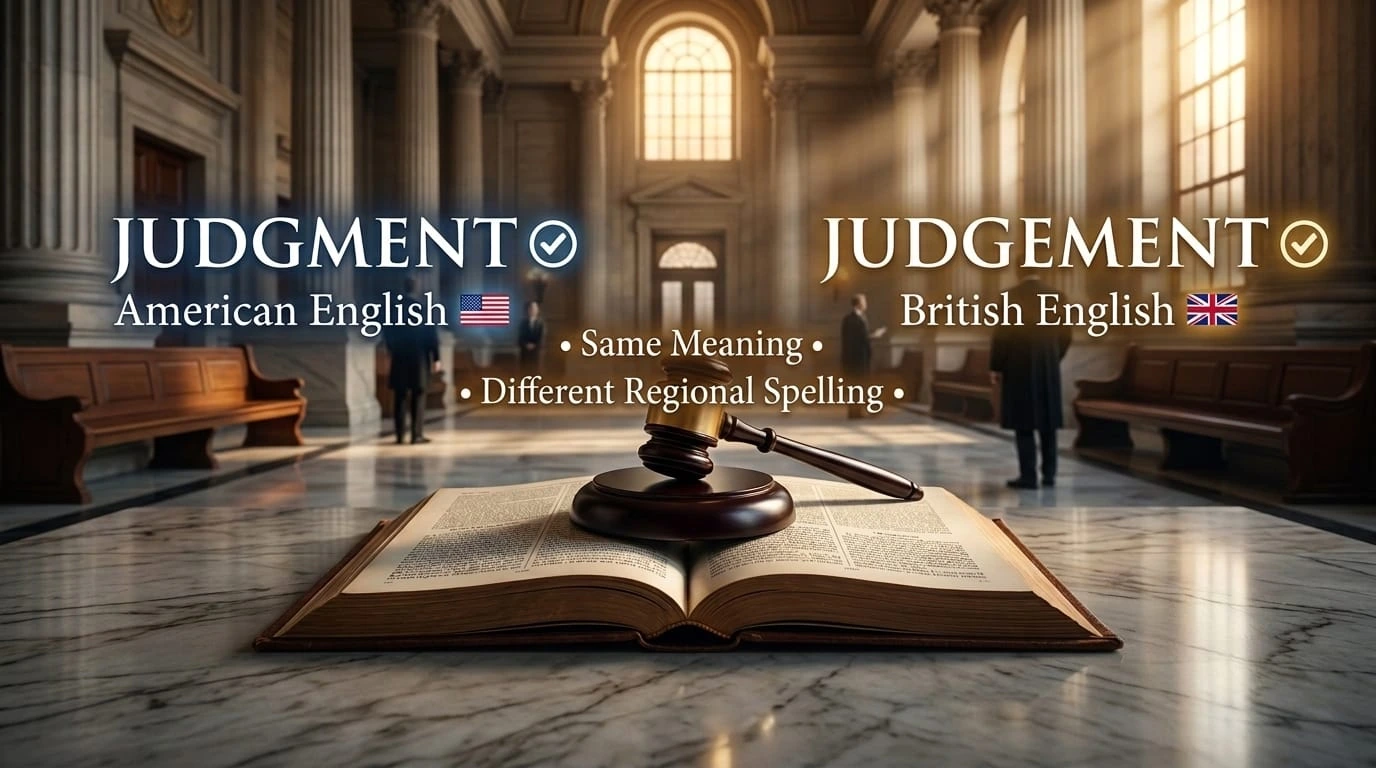
Both “judgment” and “judgement” are correct. “Judgment” is standard in American English, while “judgement” is standard in British English, though British legal writing often uses “judgment” too.
I once proofread a document for a British client and changed every instance of “judgement” to “judgment,” assuming I was correcting a typo. My client politely pointed out that I’d actually introduced the error, not fixed one.
Turns out, both spellings are correct, and the right choice depends entirely on which side of the Atlantic you’re writing for. This is one of those word pairs where dictionaries accept both forms, yet almost nobody explains the actual rule behind the split.
If you’ve ever paused before typing this word, wondering whether to include that extra e, this guide clears it up completely. You’ll learn exactly when to use “judgment,” when “judgement” fits better, and the one surprising exception that trips up even careful writers.
Judgment or Judgement: Quick Answer
Both spellings are correct. The difference comes down to region, not grammar.
- ✅ American English: “The judge issued her judgment on Friday.”
- ✅ British English: “The judge issued her judgement on Friday.”
The rule to remember: American English drops the extra e, while British English typically keeps it, except in one specific legal context.
The Origin of Judgment/Judgement
“Judgment” comes from Old French jugement, rooted in Latin judicare, meaning “to judge.” As the word settled into English, it followed the standard spelling rule for adding suffixes to words ending in a silent e: drop the e before adding “-ment.”
That would suggest “judgment” should be the only correct form. But English spelling doesn’t always follow its own rules consistently. Over the centuries, British English kept the extra e, treating “judgement” as the standard spelling, while American English dropped it, following the stricter suffix rule more closely.
Here’s the twist that catches even experienced writers off guard: in British legal writing, “judgment” (without the e) is actually the preferred spelling, even though “judgement” is standard everywhere else in British English. This exception dates back to legal tradition and remains common in court documents and law reports.
Judgment vs Judgement Explained: Key Differences and Variations
| Term | Meaning | When to Use | Region/Context |
| Judgment | Decision, opinion, or legal ruling | American English (general); British English (legal) | US writing; UK courts and law |
| Judgement | Decision or opinion | British English (general use) | UK, Australia, Canada, everyday writing |
| Judgmental | Describing someone overly critical | Both dialects | Universal, no regional split |
Notice that “judgmental” always drops the e, even in British English, regardless of which base spelling a writer prefers.
Which Spelling Should You Use?
For American audiences
Use judgment, without the e. This is standard across all American writing, including legal contexts.
For British or Commonwealth audiences
Use judgement, with the e, for general writing. Switch to judgment specifically for UK legal documents or court rulings.
For global or mixed audiences
Either spelling works, but stay consistent throughout the same document.
For legal or professional writing
Check your specific jurisdiction’s style guide. UK law consistently uses “judgment,” even though everyday British writing uses “judgement.”
Common Mistakes with Judgment/Judgement
Mistake 1: Mixing spellings within the same document
✅ She showed good judgment throughout the negotiation, and her judgment proved correct.
❌ She showed good judgement throughout the negotiation, and her judgment proved correct.
Why it happens: Writers switch unconsciously, especially when copy-pasting from different sources.
Mistake 2: Assuming British legal writing uses “judgement”
✅ The court’s judgment was published this morning. (UK legal context)
❌ The court’s judgement was published this morning. (incorrect in UK legal writing)
Why it happens: Writers assume British English always keeps the e, without knowing about the legal exception.
Mistake 3: Adding an e to “judgmental”
✅ He seemed judgmental about her choices.
❌ He seemed judgemental about her choices.
Why it happens: Writers assume the base word’s regional spelling carries over to every related form.
Mistake 4: Assuming one spelling is simply “wrong”
✅ Both “judgment” and “judgement” are correct, depending on dialect.
❌ “Judgement” is a typo for “judgment.”
Why it happens: People assume American English spelling rules apply universally.
Mistake 5: Ignoring house style guides in professional writing
✅ Check your organization’s style guide, then stay consistent.
❌ Randomly switching between “judgment” and “judgement” in the same report.
Why it happens: Writers aren’t always aware their organization has a preferred spelling.
Minute or Minuet: The Easy Guide to Using the Right Word🕒💃
Judgment/Judgement in Real-World Examples
Professional email:
“We trust your judgment on this decision and will move forward with your recommendation.”
News headline (UK legal context):
“Supreme Court Delivers Judgment on Landmark Constitutional Case”
Social media post:
“Trying not to be too judgemental about other people’s coffee orders. ☕”
Formal document (US context):
“The committee’s judgment was based on a thorough review of all submitted evidence.”
Notice how the UK legal headline uses “judgment,” even though the same publication would likely use “judgement” in a non-legal article.
Judgment/Judgement: Data, Trends & Usage
Search interest in “judgment vs judgement” is steady and mostly informational, driven by writers, editors, and students confirming which spelling fits their audience. American users overwhelmingly search “judgment,” while UK, Australian, and Canadian users search “judgement” more often, except when researching legal topics.
Legal professionals and law students drive a notable share of searches specifically about the UK legal exception, since this rule surprises even native British writers who assume “judgement” applies everywhere. Publishing and editorial teams also search this term frequently when standardizing house style across international content.
Judgment vs Judgement: Comparison Table
| Term/Variant | Meaning | Region/Context | Best Used When |
| Judgment | Decision, opinion, or ruling | American English; UK legal writing | Writing for US audiences, or any legal document |
| Judgement | Decision or opinion | British, Australian, Canadian English | General UK, Commonwealth, non-legal writing |
| Judgmental | Overly critical | Universal, both dialects | Describing a person’s critical attitude |
FAQs
Q: What does “judgment” or “judgement” mean?
A: Both words refer to the ability to make considered decisions, or to a formal decision or ruling, such as a court judgment. The meaning is identical, only the spelling changes by region.
Q: How do you use “judgment” correctly in a sentence?
A: Use “judgment” the same way you’d use “judgement,” for example, “Use your best judgment” works exactly like “Use your best judgement.”
Q: Judgment vs judgement, what’s the difference?
A: The difference is regional, not grammatical. American English drops the e, while British English typically keeps it, except in legal writing.
Q: Is “judgement” acceptable in formal writing?
A: Yes, in British, Australian, or Commonwealth general writing. UK legal documents, however, typically use “judgment” instead.
Q: Which version is correct, judgment or judgement?
A: Both are correct. Choose based on your audience’s region, and remember the legal exception in UK writing.
Q: Where does the word “judgment” come from?
A: It comes from Old French jugement, rooted in Latin judicare, meaning “to judge.” The spelling split developed over centuries between American and British English.
Q: Why does British legal writing use “judgment” instead of “judgement”?
A: This exception comes from long-standing legal tradition and remains standard in UK court documents and law reports, even though “judgement” is used everywhere else in British English.
Final Takeaway
Here’s the short version. Both “judgment” and “judgement” are correct, the choice depends on your audience and context, not on right versus wrong.
Key points to remember:
- The rule: American English drops the e; British English typically keeps it
- The exception: UK legal writing uses “judgment,” even in British English
- Watch related words: “Judgmental” always drops the e, in both dialects
- Consistency matters: Pick one style per document and stick with it
Once you know your audience and context, choosing between “judgment” and “judgement” becomes automatic.
Toward or Towards: The Correct Usage✅

As an English language enthusiast, I love diving into the tricky details of word differences and spelling variations. My mission is to explain confusing terms and make them accessible to everyone, helping readers to communicate with clarity and confidence.