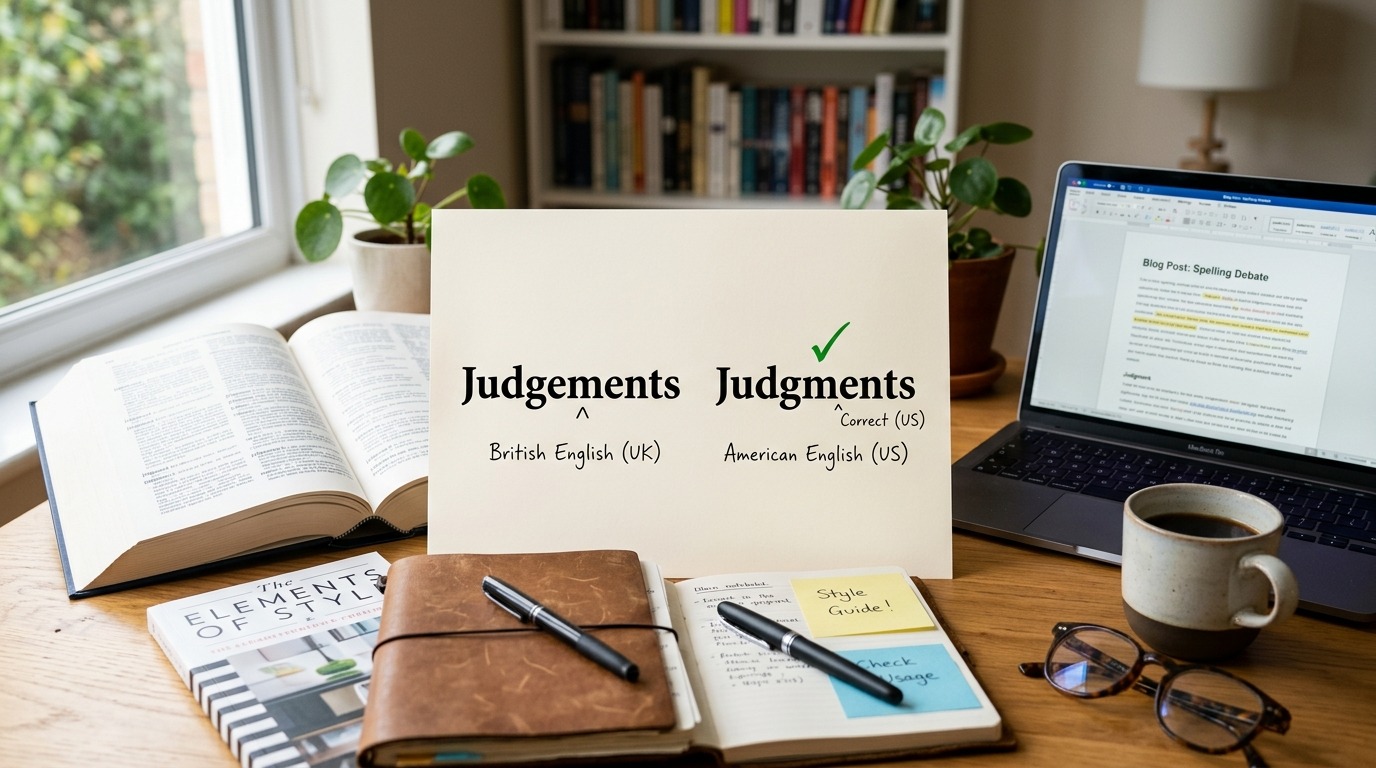
Both spellings are correct. “Judgment” (no middle e) is the standard American spelling. “Judgement” (with the middle e) is standard in British, Australian, and most Commonwealth English.
The Spelling That Splits a Whole Language
I once edited a legal brief for a client who’d written “judgement” in every paragraph correct in London, but the brief was headed for a New York court. I had to change it twelve times before lunch.
That’s the strange thing about judgments and judgements. Neither one is a typo. Neither one is “wrong.” They’re both fully accepted words it just depends on which side of the Atlantic you’re writing for.
This mix-up trips up students, lawyers, and business writers constantly, especially when spell-checkers disagree with each other or with a style guide. This guide settles the confusion for good. You’ll learn exactly when to use each spelling, why the difference exists, and how to avoid looking inconsistent in your own writing.
Judgements or Judgments : Quick Answer
Here’s the short version before we dig in.
- Judgment the preferred spelling in American English. “The court issued its judgment on Tuesday.”
- Judgement the preferred spelling in British, Australian, and Canadian English. “The court issued its judgement on Tuesday.”
Same meaning. Same pronunciation. The only difference is one letter, and which country’s style guide you’re following.
The Origin Behind the Two Spellings
The word comes from the Old French jugement, which entered English in the 1300s already missing the middle e. For centuries, English writers used both spellings somewhat interchangeably.
Things changed in the 1800s. American English, shaped heavily by Noah Webster’s push toward simpler, more phonetic spelling, dropped the silent e in many words judgment, acknowledgment, and abridgment among them. British English kept the fuller, older spelling pattern in most cases, preserving judgement.
There’s one notable exception worth knowing: even in British legal writing, “judgment” (without the e) is often used when referring specifically to a court ruling. So a British newspaper might write “judgement” for general use, while a British court document says “judgment.” That small inconsistency is one of the biggest sources of confusion.
Judgement vs Judgment : Key Differences
| Term | Meaning | When to Use | Region/Context |
|---|---|---|---|
| Judgment | The act of forming an opinion, or a formal court decision | General and legal writing in the US; legal writing in the UK | United States; UK courts specifically |
| Judgement | Same meaning as above | General writing in the UK, Australia, Canada, and most Commonwealth countries | UK, Australia, Canada, Ireland (outside legal contexts) |
Both words mean the same three things: the ability to make sensible decisions, an opinion you’ve formed, or a formal ruling from a court. The spelling never changes the meaning only the audience you’re writing for.
Which Version Should You Use?
Your choice depends on your audience and the style guide you’re following, not on personal preference.
- For American readers or US-based publications → Use judgment. This is the standard in AP Style, Chicago Manual of Style, and nearly all US dictionaries.
- For British, Australian, or Canadian readers → Use judgement. This matches Oxford spelling and most Commonwealth style guides.
- For legal writing anywhere, including the UK → Use judgment when referring specifically to a court’s official ruling. British courts themselves favor this shorter spelling for legal documents.
- For global or neutral content → Pick one spelling and stay consistent throughout the entire piece. Mixing both looks like a proofreading error.
If you’re not sure who your audience is, check your spell-checker’s language setting it usually reveals which dialect your document defaults to.
Common Mistakes with Judgement and Judgment
1. Mixing both spellings in one document
- ❌ “The judgement was clear, but the judgment surprised everyone.”
- ✅ Pick one spelling and use it consistently throughout.
- Why it happens: writers switch between sources or copy text from different style guides without noticing.
2. Assuming one spelling is simply “wrong”
- ❌ Correcting “judgement” to “judgment” in a British document.
- ✅ Leave regional spelling as-is unless you’re specifically targeting an American audience.
- Why it happens: American spell-checkers often flag “judgement” as an error, even though it’s standard elsewhere.
3. Using “judgement” in US legal documents
- ❌ “The defendant appealed the judgement.”
- ✅ “The defendant appealed the judgment.”
- Why it happens: writers default to the more familiar everyday spelling without checking legal convention.
4. Using “judgment” in casual UK writing
- ❌ “Use your own judgment, mate” (in a UK blog post)
- ✅ “Use your own judgement, mate.”
- Why it happens: American media influence makes the shorter spelling feel more common, even outside the US.
5. Forgetting British legal exception
- ❌ Assuming all UK writing uses “judgement,” including court rulings.
- ✅ Remember UK courts typically write “judgment” for official rulings.
- Why it happens: most people don’t realize legal English has its own separate convention from everyday British English.
Judgement and Judgment in Real World Examples
Professional Email (US):
“Please use your best judgment when finalizing the budget figures.”
News Headline (UK):
“Supreme Court Delivers Landmark Judgment on Workers’ Rights”
Social Media Post (Australia):
“Honestly, that was a bad judgement call on my part. 😅”
Formal Document (US legal):
“The court’s final judgment is binding on all named parties.”
Notice how legal contexts lean toward “judgment” almost everywhere, while everyday writing follows regional spelling norms.
Judgement vs Judgment : Data, Trends & Usage
Search interest in “judgements or judgments” comes mostly from students, writers, and legal professionals trying to confirm correct usage before submitting work. This is an informational search people want clarity, not a product.
Searches spike around legal proceedings, academic essay deadlines, and whenever a major court ruling makes headlines, since news outlets in different countries often spell the word differently in the same news cycle.
This matters more now because global content reaches readers everywhere. A US company writing for a UK audience or vice versa needs to choose deliberately rather than let autocorrect decide.
Judgement vs Judgment : At a Glance
| Term/Variant | Meaning | Region/Context | Best Used When |
|---|---|---|---|
| Judgment | Decision, opinion, or court ruling | United States; UK legal writing | Writing for American audiences or any legal document |
| Judgement | Decision, opinion, or court ruling | UK, Australia, Canada (non-legal) | Writing for British, Australian, or Canadian general audiences |
Frequently Asked Questions
Q: What does “judgment” mean? A: Judgment refers to the ability to make sensible decisions, an opinion someone has formed, or a formal ruling issued by a court. The meaning is identical regardless of spelling.
Q: What does “judgement” mean? A: Judgement carries the exact same meaning as “judgment” it’s simply the British, Australian, and Canadian spelling preference.
Q: Judgement vs judgment what’s the real difference? A: There’s no difference in meaning or pronunciation. The only distinction is regional spelling convention: “judgment” in American English, “judgement” in British and Commonwealth English.
Q: Is “judgement” acceptable in formal writing? A: Yes, as long as you’re writing for a British, Australian, or Canadian audience and stay consistent. For American formal writing, “judgment” is the expected standard.
Q: Which version is correct judgement or judgment? A: Both are correct. Use “judgment” for American audiences and legal writing, and “judgement” for British and Commonwealth general writing.
Q: Where does the spelling difference come from? A: It traces back to 19th-century American spelling reforms led by Noah Webster, who dropped silent letters from many words, including “judgment,” while British English kept the older spelling pattern.
Q: Can “judgement” be used in legal contexts in the UK? A: Typically no. Even though British English generally uses “judgement,” UK courts conventionally write “judgment” for official rulings, matching legal tradition rather than everyday spelling.
Final Takeaway
Here’s what to remember: both judgment and judgement are correct your choice depends entirely on your audience. Use judgment for American readers and legal writing anywhere. Use judgement for British, Australian, or Canadian general writing.
Pick one spelling, stay consistent throughout your document, and you’ll never look unsure again. Bookmark this guide for the next contract, essay, or article that makes you pause and share it with anyone who’s ever argued about which spelling is “right.”
Judgements or Judgments: Which Spelling Is Correct?

I am an English language enthusiast who enjoys exploring word differences and spelling variations.
My work focuses on making confusing English terms easier to understand for everyday readers.
I believe clear language helps people communicate with confidence.